
Marble and Wood: How to Combine Them in an Elegant Interior
Marble and wood is the pairing nobody has to be talked into. One is cool, dense and still. The other is warm, soft to the touch and visibly alive. Put them next to each other and each one makes the other look better. But “works in most houses” is not the same as “works by itself”, and the difference between a calm room and a confused one is almost always in the details: undertone, finish and grain.
This guide goes further than the usual advice to put a walnut table next to a white wall. It explains why the combination works, how to match a stone to a timber, what to do about grain and veining when both are strong, how to use the pairing room by room, and the mistakes we see most often. If you want the wider picture first, our guide to pairing marble with other materials covers wood, metal, glass and other stones in one place.
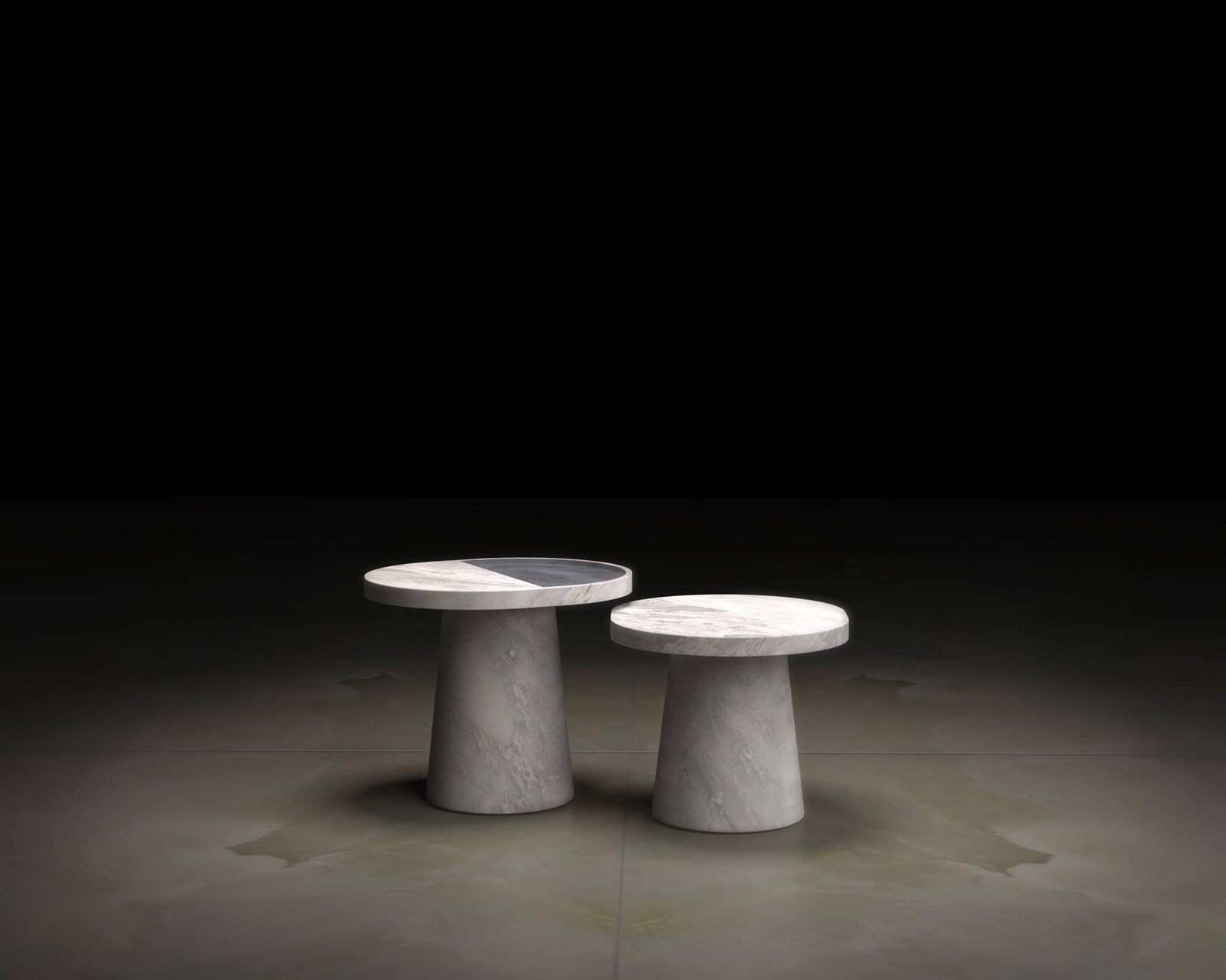
Why marble and wood work together
Marble is a metamorphic rock. It is cold to the hand, heavy and, once polished, reflective. Wood is organic. It is warm, slightly soft, absorbs light instead of returning it and changes over the years. In a room where everything is stone, the space feels hard. In a room where everything is timber, it can feel closed and a little ordinary. Mix them and each corrects the other.
There is also a visual reason. Both materials have a pattern, but a different kind. Marble has veining, which is irregular and runs through the whole stone. Wood has grain, which is directional and follows the growth of the tree. Because they are different, they can sit together without repeating each other, as long as you manage how much of each pattern the eye has to take in. For a plain-language definition of the rock itself, Wikipedia’s page on marble is a clear primer.
Step one: match the undertone
The single most useful habit is to look at the undertone of the stone before choosing a timber. Marble is rarely a pure colour. A white can lean cool and blue-grey, or warm and cream. A black can be neutral or slightly brown. A grey can carry green or pink. Timber has the same range: oak runs from pale and yellow to honey, walnut from chocolate to nearly black with a purple note.
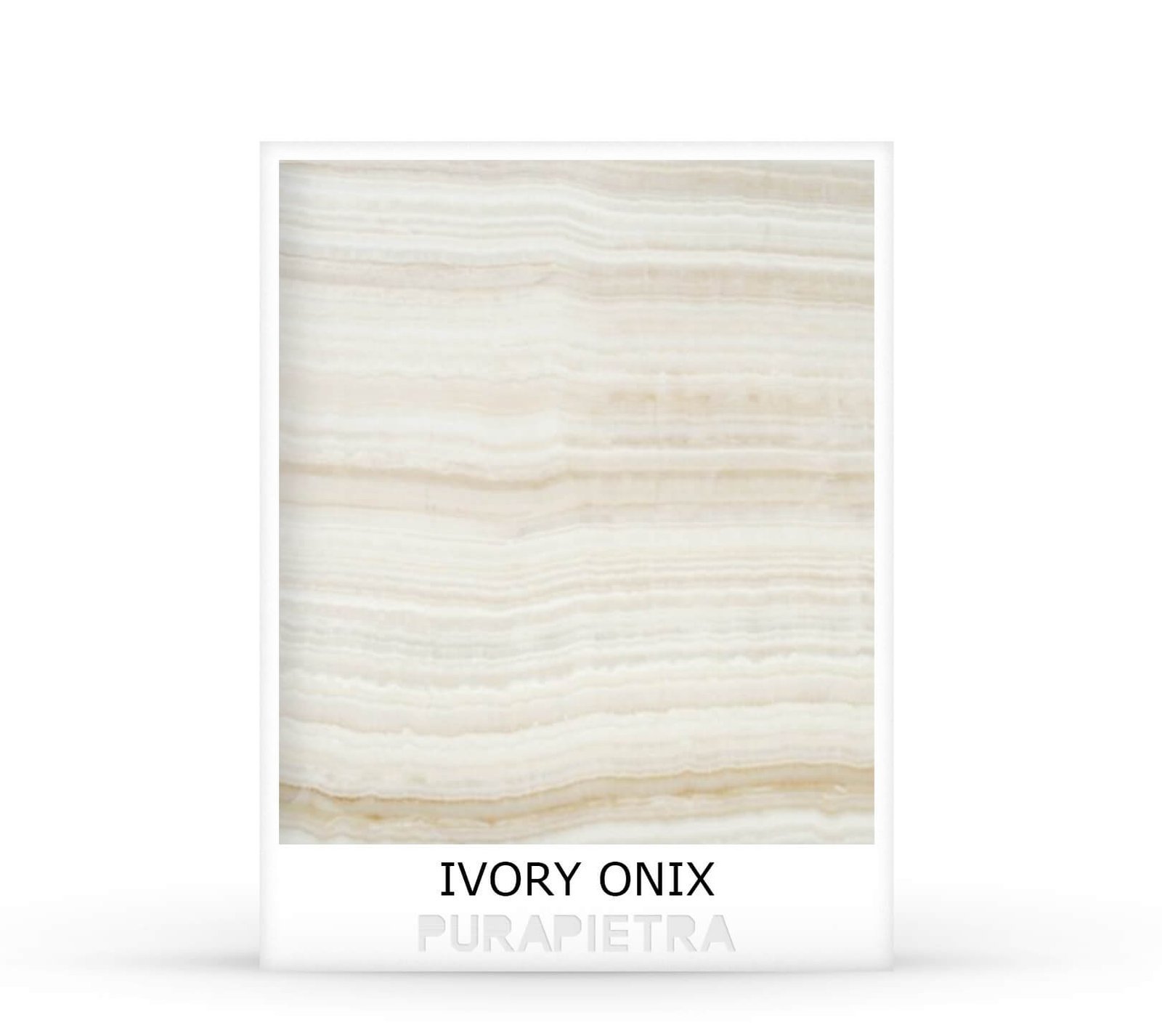
The rule we use is to let the warm and cool balance fall on one side. A warm cream stone, such as Ivory Onix, sits naturally beside honey oak and ash. A cooler white with grey veining, the kind covered in our guide to Carrara and Statuario, suits a mid-brown walnut that supplies the warmth the stone lacks. A dark stone takes a rich, dark timber. Put a cool grey marble against a yellow pine and the pair will look wrong, even if you cannot say why.
Take both samples to the same window, in the same light, and look at them together at the time of day the room is used most. A sample in a showroom under spotlights tells you very little.
Step two: choose the wood by character
Oak and ash
Pale, open-grained and easy. Oak, particularly when oiled, suits white and cream stones and keeps a room light. Ash is paler and straighter in grain, and it is a good choice when you want the timber to recede. Both are forgiving, and both will take a honed marble well.
Walnut
Richer and darker, with a visible grain that gives a room depth. Walnut is the timber we reach for most often with pale marble that has strong grey veining, because it supplies contrast and warmth in one move. With dark stone it creates a deep, enveloping scheme. Our guide to black marble interiors describes mid and dark woods as the most forgiving pairing for black stone, and that holds across the range.
Pale and lightly stained timbers
Pale timbers suit a Scandinavian or Japanese feel and let the stone take the lead. The risk is a room that goes flat, with nothing to anchor it. Add one dark element, a black frame or a dark stone table, to give the eye somewhere to rest.
Woods to approach with care
Strongly coloured timbers, such as cherry or a heavily red-stained wood, rarely sit comfortably with cool marble. High-gloss, lacquered timber beside polished stone can look like the lobby of a hotel. If you love a bold timber, give it a plain, honed stone and leave the veining quiet.
Step three: pair the finishes
Finish matters as much as colour. As a rule, match the sheen. A honed or matt marble sits best with an oiled or waxed timber, because neither shines and the room feels calm. A polished marble can take a satin timber, but a lacquered one will compete with it for reflections. If you want both to be glossy, keep the area small, such as a tray or a table top, rather than covering a whole room in shine.
Texture can help. A honed stone next to a brushed or lightly textured timber gives the hand something to notice. A rough, wire-brushed oak beside a polished stone gives you contrast that feels deliberate rather than accidental.
Grain against veining: how to manage two patterns
This is the problem most guides skip. If you put a strongly veined marble next to a strongly grained timber, the eye has too much to read. Choose one to lead. If the stone is dramatic, like Calacatta Viola with its strong colour and veining, pick a timber with a quiet, even grain and a plain finish. If the timber is the star, a walnut with a prominent figure, pick a calm stone with soft veining.
Some stones already look like timber. Kenya Black, for example, has layered bands that flow like wood grain, so it pairs best with a plain timber rather than a heavily figured one. The same logic applies to travertine, whose horizontal banding has its own rhythm, and which we cover in our guide to travertine.
Marble and wood room by room
Kitchens
The classic is a marble island with oak floors, or a stone splashback with timber cabinets. Wood keeps a large marble surface from feeling clinical, and marble gives timber cabinets a cleaner edge. Keep the number of finishes down: two surfaces plus metal is plenty. Our guide to marble in the kitchen covers the stone side, including the realistic care a worktop needs.
Bathrooms
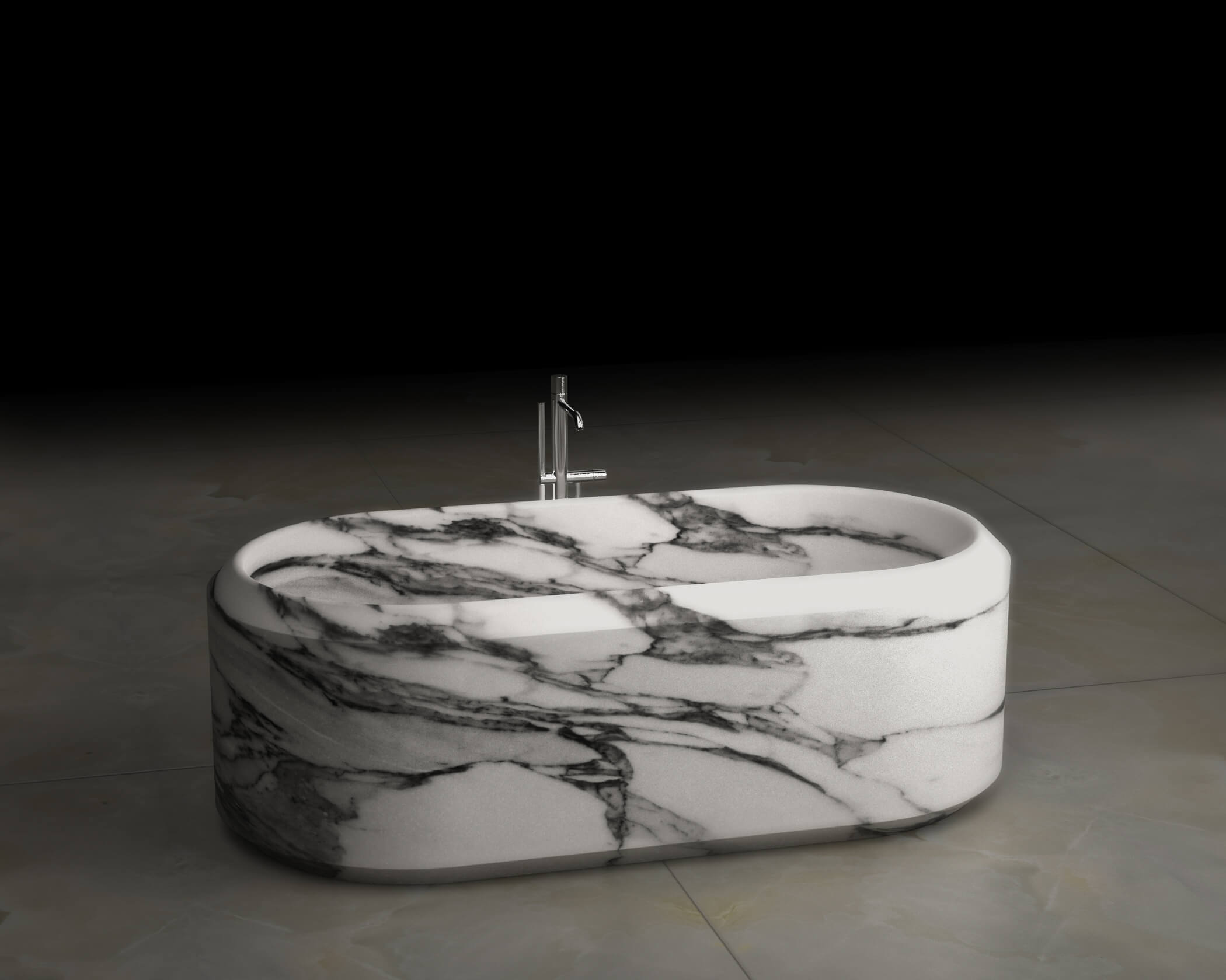
A timber vanity under a stone wall is a combination that rarely dates. The stone handles the water, the wood adds warmth to a room that otherwise feels hard. The catch is moisture. Timber in a bathroom needs to be specified for damp conditions and properly sealed, and it should not be placed where water sits. Let the marble have the wet areas, and use the timber for the dry ones: a shelf, a stool, a vanity drawer front. A carved piece such as the Unit Bath or the Linear basin looks very good beside a plain timber wall.
Living and dining rooms
This is where the pairing is easiest. A stone table with timber chairs, a stone coffee table on a timber floor, a marble fireplace with an oak mantel shelf. A table such as Groove or the Tato tables sit well on timber because the floor supplies the warmth and the stone supplies the weight. Keep the timber of the floor and the furniture in the same family, and let one piece of stone act as the anchor.
Floors and walls
If you are combining stone and timber on the floor, for example a marble entrance meeting an oak living room, think about the junction. A clean metal or stone threshold works better than a thin gap. Heights should match, and the two materials expand and move differently, so this is a job for an installer who has done it before. Our guide to marble flooring explains what to ask. On walls, a stone feature surface framed by timber panelling can be beautiful, and marble wall cladding is the place to read about fixing and joints.
Proportions: how much of each
A simple balance is to let one material lead and the other support. If marble is the lead, it takes the large surfaces, such as a wall, an island or a floor, and the timber appears as furniture, shelving and detail. If timber leads, with a wood floor and cabinets, the marble comes in as one statement piece. Equal amounts of both usually look indecisive. And whatever you choose, a third element, whether metal, glass or textile, helps to tie the two together.
Mistakes to avoid
Matching exactly. A timber that is the same colour as the stone looks like a mistake. The point is to complement, not to copy.
Choosing from small samples in the wrong light. Both stone and timber change under different light. Look at both together, in the room, at the right time of day.
Too many finishes. Polished stone, lacquered timber, shiny metal and glass all competing. Pick the sheen of the room and stay close to it.
Putting untreated timber in wet places. Marble copes with water far better than most timbers. Specify the right wood and finish, or keep it away from the splash zone.
Forgetting the junction. The line where stone meets timber is the part that gets looked at closely. Plan it on the drawing, not on site.
Caring for marble and wood side by side
The two materials need different care, which is worth remembering when you plan the room. Marble is sealed on installation and cleaned with a pH-neutral stone product, never with acids or abrasives. Timber is cleaned with products suited to its finish, and it should not be soaked. Never use a general-purpose spray across both surfaces. Our guide to how long marble lasts explains the stone side in more detail.
Working with Purapietra on a stone and wood scheme
We make stone, and we are happy to work around the timber you already have. Send us a photo of the room, the sample of the wood or the drawing from your joiner, and we will suggest which stone and finish sits well with it. If the piece has to be made to measure, a table, a vanity top or a wall, our page on bespoke marble explains how that works. You can compare the stones themselves in the materials catalogue, and if you want to start from the broader picture, our guide to marble interiors is a good place to begin.
Frequently asked questions about marble and wood
Does marble go with wood?
Yes. Marble is cool and dense, wood is warm and soft, and each balances the other. The pairing works best when the undertones are matched and one of the two leads.
Which wood goes best with white marble?
Oak and ash suit warm and cream whites and keep a room light. Walnut suits a cooler white with grey veining, because it supplies warmth and contrast.
Which wood goes best with black marble?
Mid and dark woods, such as walnut and oiled oak, are the most forgiving. They share the warmth of the stone without competing with it.
Should I match polished marble with polished wood?
Usually not. Match the sheen instead: honed marble with an oiled or matt timber, polished marble with a satin one. A lacquered timber next to polished stone tends to look overdone.
Can I use wood and marble in a bathroom?
Yes, with care. Let the marble take the wet areas and use timber for dry ones, specified for damp conditions and properly sealed.
What if both the marble and the wood have strong patterns?
Let one lead. Pair a dramatic, heavily veined stone with a timber that has a quiet, even grain, and the other way round.
Do marble and wood need different care?
Yes. Seal marble and clean it with a pH-neutral stone product. Clean timber with a product suited to its finish and avoid soaking it. Do not use one cleaner for both.
Kenya Black Marble: Banded Black Stone, Finishes, Uses and Care
Most black marbles try to disappear. Kenya Black does the opposite. Look at a polished slab and you do not see a flat dark surface, you see layers: bands of charcoal and graphite that fold and flow like the grain in a cut log, picked out by thin white lines. It is a black stone with a direction, and that changes how you use it.
Kenya Black is one of the black stones in the Purapietra catalogue, and one of the few where the pattern leads as much as the colour. This guide covers what it looks like, how to read a slab, which finish suits which job, where it works best, what to pair it with, how to look after it and what drives its cost.
What Kenya Black looks like
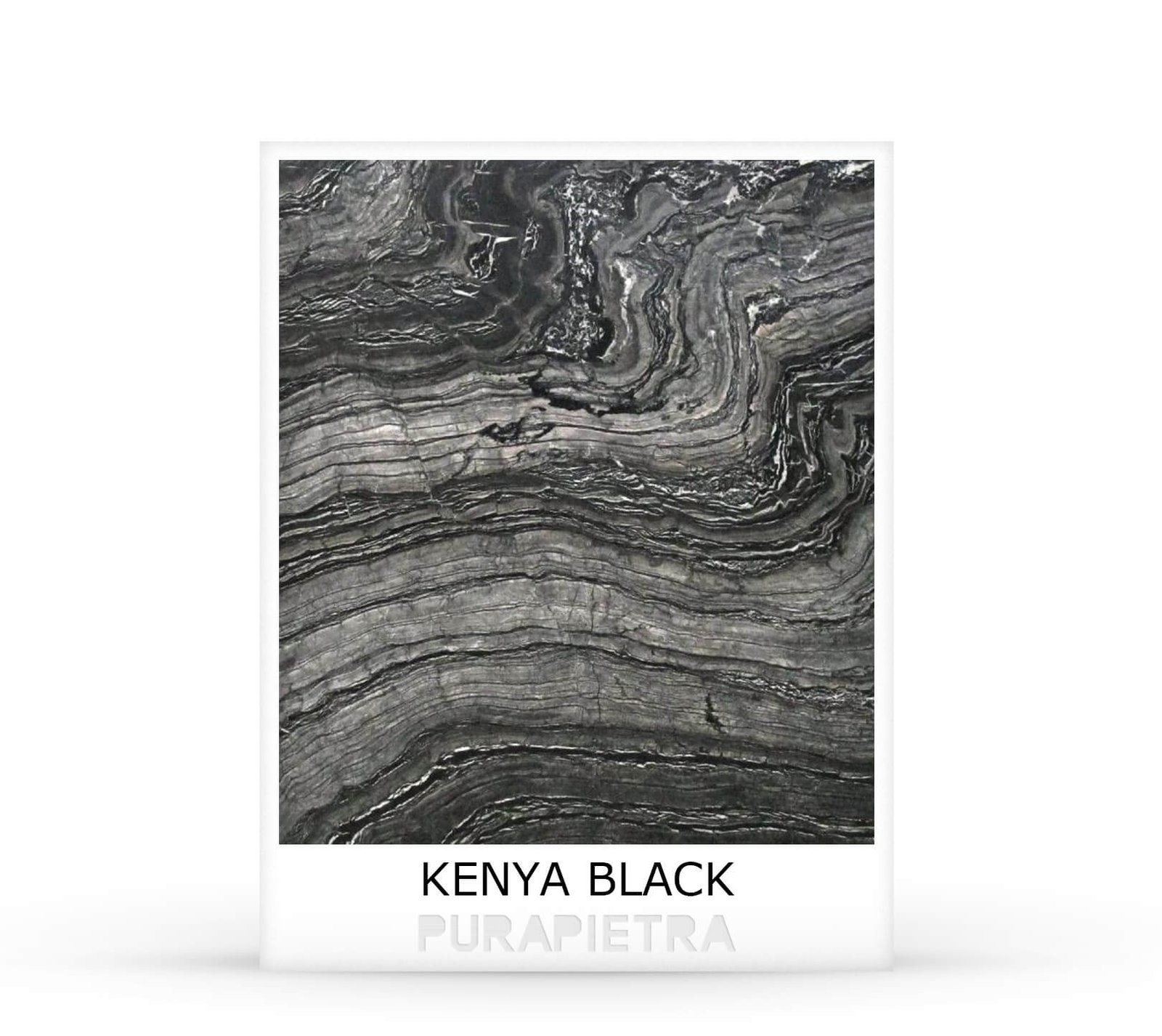
The first thing to know is that Kenya Black is not a uniform black. The swatch above shows it clearly. The ground is a deep charcoal, but the stone is built of long, wavy bands that range from almost black to a lighter, smoky grey. In places the bands run straight and parallel. In others they buckle into folds and ripples, and where they do, thin white veins and small bright flecks gather along the edges.
That layered, directional pattern is why many people describe it as a wood-grain stone. It is a useful comparison, because it tells you how the slab will behave in a room: the pattern has a flow, and the flow can be used. Run it horizontally across a wall and it calms the space. Turn it vertically and it adds height. Cut a long piece along the grain and the stone looks like one continuous surface.
If you are comparing it with the other blacks, the difference is clear. Our guide to black marble in interiors sets the main options side by side, and Kenya Black sits at the more expressive end: it has far more movement than a plain, even black, and it is quieter than the sharp white veining that stone from the Basque Country is known for. For the wider background on where black marble gets its colour and how the family behaves, the pillar guide to black marble goes deeper. For a plain-language definition of the rock itself, Wikipedia’s page on marble is a clear primer.
How to read a slab
Because the pattern is the point, two slabs of Kenya Black can feel quite different. Before you choose, look at four things.
The balance of dark and light bands. Some slabs are mostly deep charcoal with fine pale lines. Others have broad smoky-grey bands and read as noticeably lighter. Both are Kenya Black. Decide whether you want a room that feels dark and dense or one that has visible movement, and choose the slab to match.
The amount of white. White veins and flecks bring contrast. A few of them add sparkle. A lot of them make the slab busier, and a busy slab will compete with everything else in the room. Look at the slab from a few metres away, because that is the distance from which the wall or table will be seen.
Where the folds fall. The wavy areas are the most dramatic part of the stone. On a feature wall you want them where the eye lands. On a worktop you do not want a fold in the exact spot where a tap or a sink has to be cut out. Bring the drawing with you.
Fissures. Like any natural stone, a slab can carry hairline cracks or filled areas. Against a dark ground they are easy to miss in a photo and obvious in the finished piece, so ask to see the real slab. Our guide on how to identify quality stone sets out the checks we apply before a block is approved for cutting.
Finishes for Kenya Black
Polished
Polished brings out the full depth of the stone. The dark bands turn glassy, the white veining sharpens and the folds seem to sit below the surface. It is the right finish for a feature wall, a bar front or a statement table, where you want the stone to be looked at. The cost is practical: a dark polished surface shows dust, water spots and fingerprints more than a pale one.
Honed
Honed turns the same stone from glossy to velvet. The pattern is still there, but softer, and the surface stops reflecting the room. We recommend it wherever the stone will be touched every day, such as a vanity top, a table or a bath surround, because marks and small scratches are much less visible on a honed surface. If you are unsure, honed is the safer choice for anything that people lean on or put things down on.
Brushed
Brushing adds a fine texture and mutes the contrast between the bands. It can look beautiful on a wall, and it is worth asking for a sample, but for a stone whose main attraction is the flow of its pattern it is rarely the first choice.

Best uses for Kenya Black in interior design
Feature walls
This is where the pattern gets room to work. A wall of Kenya Black, with slabs bookmatched so the bands mirror each other, becomes a large graphic surface without a single added decoration. Behind a bed, a fireplace, a reception desk or a dining table, one wall is usually enough. It also benefits from good lighting: a soft wash of light along the surface picks out the folds and the white veining. Our guide to marble wall cladding covers panels, joints and fixing in more detail.
Bathrooms
In a bathroom, Kenya Black works best where the stone has a clear job. A vanity wall, a bath surround or a basin carved from a single piece looks dramatic and stays calm. Pair it with a carved piece such as our Unit Sink or the Linear basin, or surround a freestanding Unit Bath, and the stone does the work. We would keep it honed in wet zones, and we do not suggest dark polished floors in a small bathroom, where every drop of water will show.
Tables and furniture
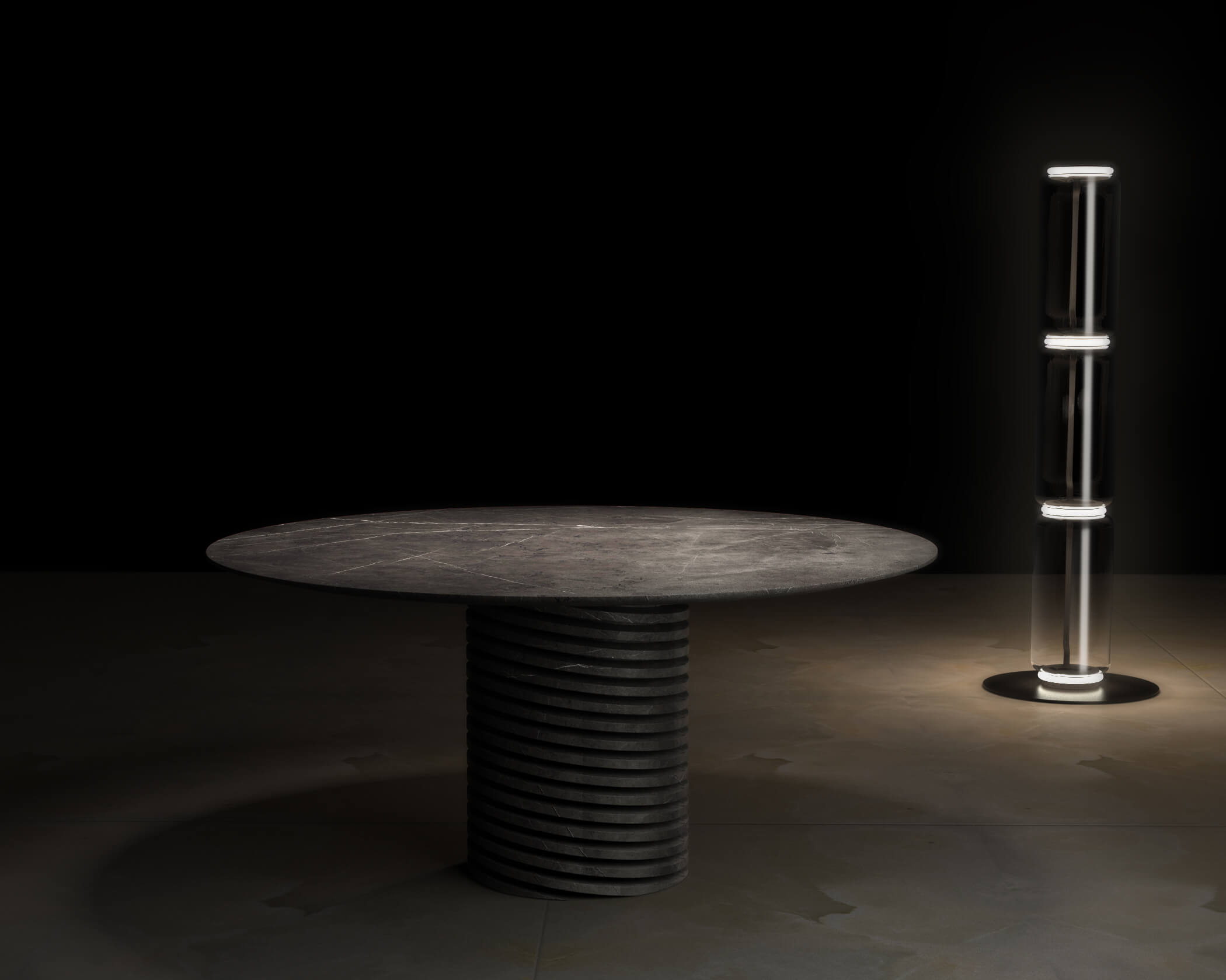
A table top is a good way to use a stone this expressive without committing a whole room. You can choose the exact slab, place the folds where they will be seen and keep the rest of the room quiet. It is also the easiest way to find out whether you like living with a dark, patterned surface. Pieces such as Groove and Tato show how a single dense stone can anchor a room.
Kitchens
A kitchen is possible but it asks for decisions. Kenya Black is a marble, so it etches when acid sits on it, and a dull patch is more visible on a dark surface than on a pale one. A honed island or a wall behind the hob can be excellent. A working worktop that sees lemon, vinegar and wine every day needs a careful finish, a sealer and a household that wipes spills quickly. Our guide to marble in the kitchen goes through the trade-offs honestly.
Floors
Floors are the most demanding use. A dark floor shows dust and scratches, and a polished one adds a risk of slipping. If you want Kenya Black underfoot, a honed finish is the sensible starting point, and our guide to marble flooring covers what to ask your installer. For a first project we would normally suggest a wall or a table instead, and keep the floor for a more forgiving stone.
What to pair with Kenya Black
Kenya Black has a lot to say on its own, so the rest of the room should be quieter. Three habits help.
Keep other patterns calm. If the stone has strong bands, use plain surfaces around it: smooth plaster, a flat paint, a plain textile. Two patterns of the same strength fight each other.
Use warm materials to soften it. Mid and dark woods, oiled timber and brass warm a dark stone without competing with its pattern. Because Kenya Black already looks a little like wood grain, a plain timber is better than a heavily grained one. Our guide to pairing marble with other materials explains how to match undertones and finishes.
Add one light stone, not three. A pale stone next to Kenya Black gives instant contrast. For a quiet, translucent partner, Ivory Onix is a cream stone that works well against dark surfaces. For a calmer white with soft veining, see Calacatta Viola.
Caring for Kenya Black
The care is the same as for any calcite marble, with a few notes for a dark surface. Seal it at installation and again from time to time, and clean it only with a pH-neutral stone product. Avoid vinegar, lemon, bleach and abrasive creams, and wipe spills quickly, particularly anything acidic. Use coasters and a cloth rather than a scourer. On a polished surface, wipe water spots dry so they do not leave rings, and use a soft cloth for dust. Our guide to how long marble lasts explains what to expect over the years and what you can do to keep the surface looking its best.
What sets the price of Kenya Black
There is no fixed price per square metre, and we would rather say so than quote a number that means nothing without the slab. Four things set the cost: the quality of the block and how attractive and balanced its banding is, the thickness you specify, the yield, which is how much of the raw block ends up as usable finished material, and the hours of hand finishing. For a patterned stone like this one, the pattern itself is part of the value: a slab with a striking fold in the right place is worth more than a plain one. Bookmatching also uses more material, because adjacent slabs have to be cut and kept in order.
How to choose a slab
If you can, go to the yard. Photos flatten dark stone and hide the depth of the bands. Look at the slab from a distance first, then close up. Ask for the slab numbers so you know which ones are consecutive, because a bookmatched pair of Kenya Black panels is spectacular when the bands line up. Bring the drawing with you: the position of a joint, a tap or a cut-out changes which slab is right.
Why choose Kenya Black with Purapietra
We treat stone as a building material, not a skin. Every piece is roughed on CNC for accuracy and finished by hand, which is where an edge stops looking machined. With a patterned stone, we ask clients to choose the slab, and we plan where the bands fall, where the joints go and how the lighting will sit before the first cut. If you need something that is made to your own drawing, our page on bespoke marble explains how we work.
You can see Kenya Black next to our other stones in the materials catalogue, and if you are still deciding between dark and light, our guide to marble interiors covers the options. Send us a plan, a sketch or a photo of the room, and we will tell you what the stone can do there and roughly what it will cost.
Frequently asked questions about Kenya Black
What is Kenya Black?
Kenya Black is a black marble with a layered, flowing pattern. The ground is deep charcoal, with wavy bands of near-black and smoky grey and fine white veining, which is why it is often compared to wood grain.
Is Kenya Black a plain black?
No. It is a patterned black, with visible bands and folds. If you want a flat, even black with almost no pattern, there are quieter options in our black marble range, and our black marble interiors guide compares them.
How much does Kenya Black cost?
There is no fixed price per square metre. Cost depends on the quality of the block, the pattern of the banding, the thickness, the usable yield and the hours of finishing. We quote each project once the slab and finish are chosen.
Is Kenya Black good for a bathroom?
Yes, on walls, around a bath or as a vanity top, ideally honed in wet zones. We do not suggest dark polished floors in a small bathroom, where water marks will show.
Can I use Kenya Black for a kitchen worktop?
It is possible, but it is a marble and it etches under acids, which shows more on a dark surface. A honed finish, a good sealer and quick wiping help. An island or a wall behind the hob is an easier use than a busy worktop.
Should I choose polished or honed Kenya Black?
Polished gives the deepest colour and the sharpest veining, and suits walls and statement pieces. Honed is softer, shows fewer marks and is the safer choice for anything touched every day.
How do I care for Kenya Black?
Seal it at installation, clean with a pH-neutral stone product, avoid acids and abrasives, wipe spills quickly and dry water spots on polished surfaces.
How to Pair Marble with Wood, Metal and Glass in a Contemporary Interior
Marble is rarely used alone for long. Within a week of installing it, you start to ask what should sit next to it: what the floor should be, what the taps should be made of, whether the wood should be darker. The stone does not decide these things for you. It only makes the wrong choices easier to see.
Pairing marble with other materials is less about taste than about a handful of habits: matching temperature, contrasting texture, limiting the number of finishes in a room and letting one surface lead. This guide sets out those principles and then walks through the four pairings we are asked about most: wood, metal, glass and other stones. It ends with proportions and the mistakes we see most often.
The principles of pairing marble
Choose a lead. Every room needs one surface that carries the eye. If the marble is the lead, everything else supports it. If the marble is a supporting player, as in a pale floor, then the lead is somewhere else. A room with two leads feels tense, and it usually means one of them should be quieter than it is.
Match the temperature, then contrast the texture. Marble comes in warm stones (creams, beiges, golds) and cool stones (greys, blue-whites, blacks). Materials that share its temperature feel calm and cohesive. Materials with a different texture, such as rough oak against polished stone, give the room interest without clashing. Colour agrees, surface disagrees: that is the shortcut for most rooms.
Read the undertone of the vein. A white marble is never just white. The veins lean warm (gold, brown, burgundy) or cool (grey, blue, black), and that decides which metals and woods will look right next to it. Our guide to Calacatta Viola and the comparison of Carrara vs Statuario both show how much the vein changes the room around it.
Limit the list. Three or four materials in a room is comfortable. Six starts to look like a showroom. If you want more, repeat what you have, so the same wood or the same metal appears more than once.
Judge the pairing in the room. Showroom lights flatter everything. Put the samples together, in the light they will live in, at different times of day, and look at them from a distance, not just up close.
Marble and wood
It is the pairing that works in most houses, and for a good reason. Wood is warm, soft to the touch and visibly alive, while marble is cool, dense and still. Each fixes what the other lacks. A kitchen with a marble island and an oak floor, a bathroom with a walnut vanity under a stone wall or a dining room with a stone table and timber chairs all follow the same logic.
The rule we use is simple. Warm stones take warmer, lighter woods such as oak and ash, and cool or dark stones take darker, richer woods such as walnut. A pale marble with strong grey veining on a walnut cabinet looks deliberate. A cream marble with a cherry-red timber looks like a mistake. Finish matters as well: oiled and matt timber suits honed marble, and a lacquered timber with polished marble tends to look like furniture from a hotel lobby. In our black marble interiors guide, mid and dark woods are described as the most forgiving pairing there is.
Marble and metal
Metal is the accent. Marble is quiet, and a thin line of metal draws attention to its shape, in a tap, a handle, the rim of a tray or the edge of a shelf. The choice of metal follows the vein.
Brass and bronze. Warm metals suit cream and golden stones and anything with a warm vein. Unlacquered brass is a good choice because it dulls and warms as it ages, and a surface that changes over time sits comfortably next to a stone that does the same.
Steel, nickel and chrome. Cool metals follow the grey in a cool white or a black stone, and they look sharper and more contemporary. Brushed finishes are calmer than mirror polish, which can compete with a polished stone.
Blackened metal. A thin frame in dark steel against a pale marble gives the strongest graphic effect, and works well with large panels, such as those in a marble wall cladding scheme.
Keep the metals to small things and keep them consistent. One metal repeated four times looks like a decision. Three different metals look like an accident. And remember that metal finishes need their own cleaning products, which should never be used on the stone, since many cleaners that suit metal etch marble.
Marble and glass
Glass is the quiet partner. It adds light and gives marble more presence by being nearly invisible next to it. A glass shelf against a marble wall, a glass tabletop on a stone base or a glass lamp beside a stone table makes the stone look heavier and the glass lighter, and each emphasises the other.
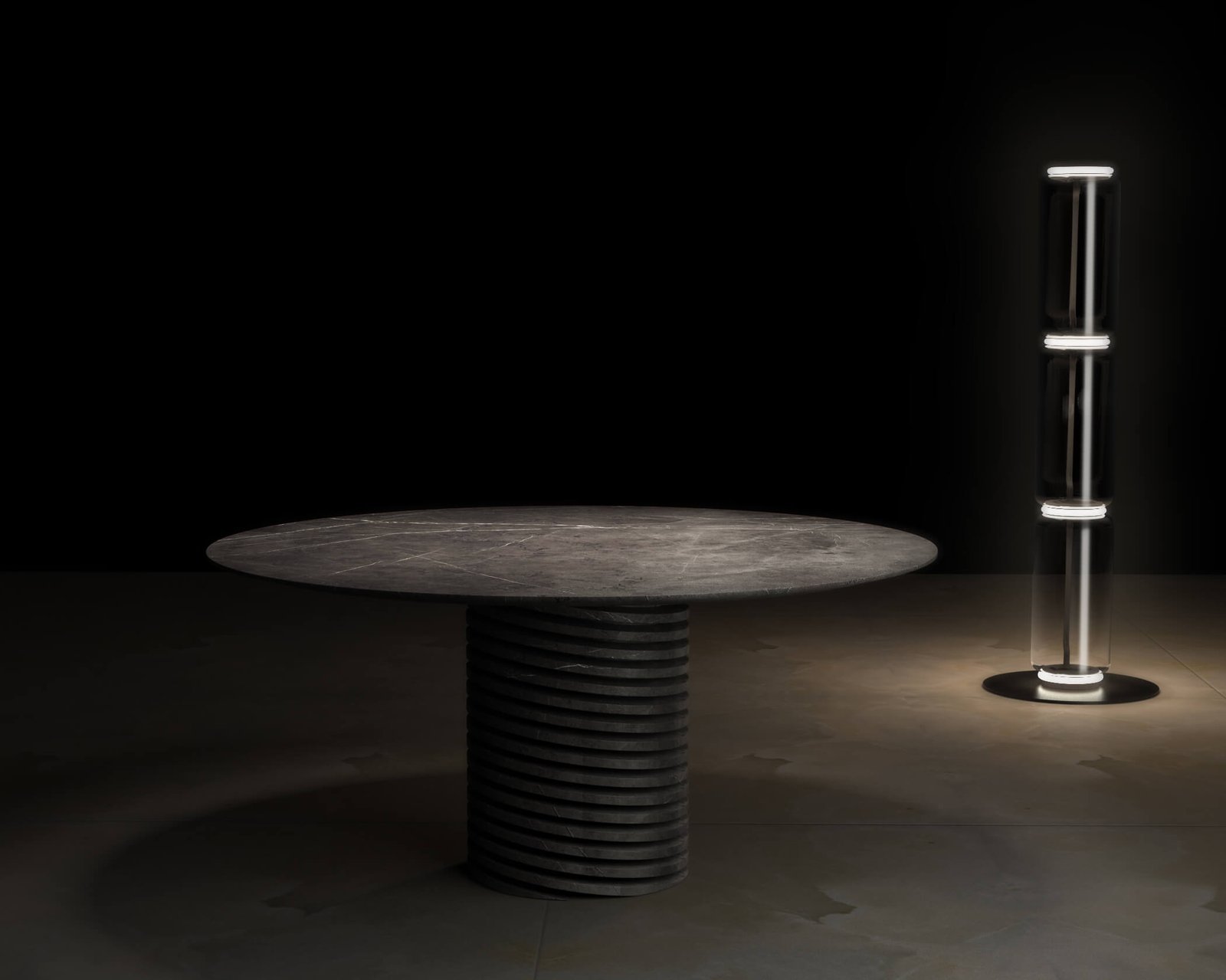
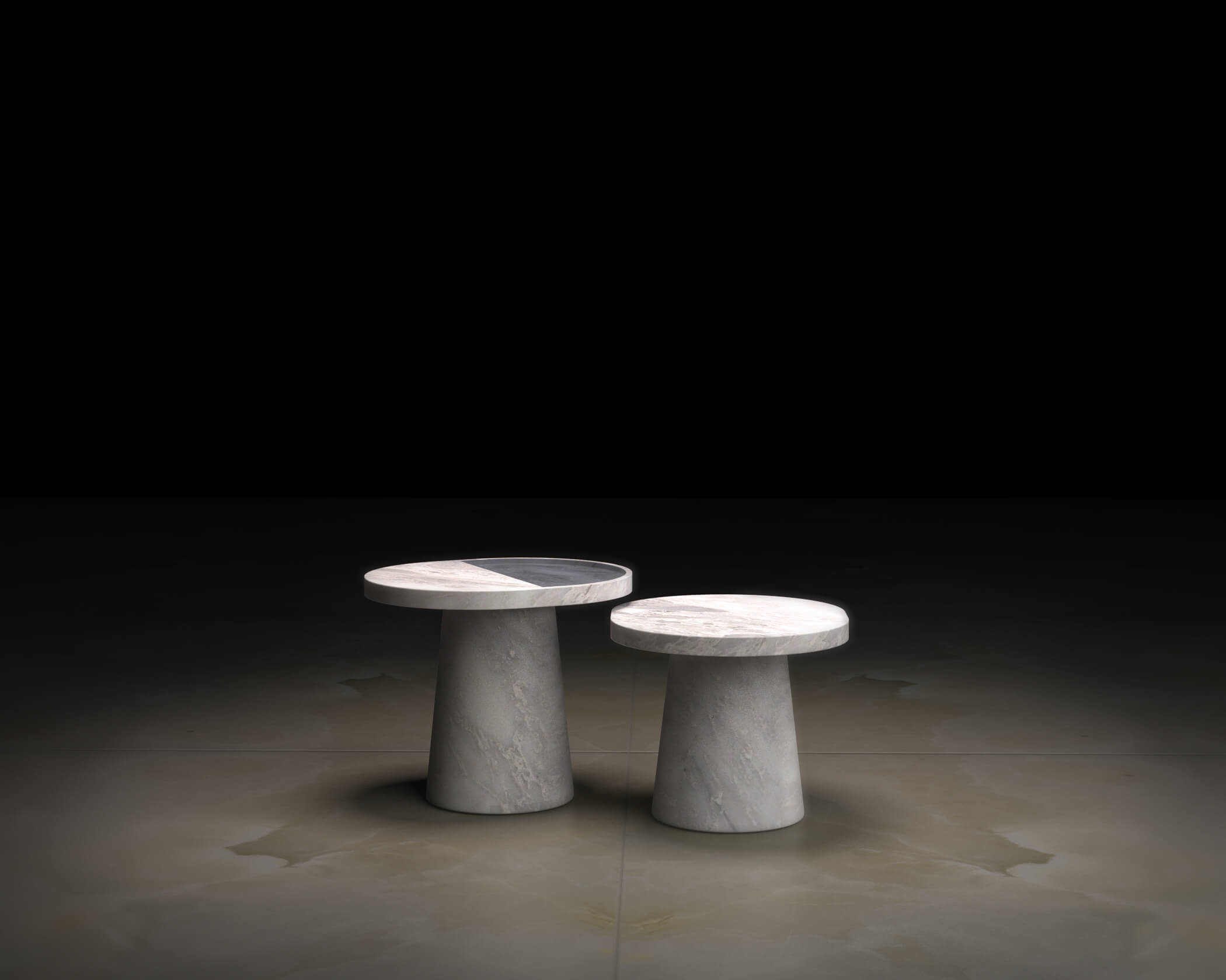
Our Tato coffee table in the New Era collection is built on exactly this idea: the solidity of stone set against the lightness of glass, in a cluster of different heights. The photo of the Groove table above shows the same relationship at room scale, with a glass lamp doing the work.
Marble and other stones
Not every pairing is with a different material. Many of the best interiors use marble with a second stone. A white marble wall with a dark stone floor, or a travertine floor with a marble basin, creates contrast without leaving the family of natural materials.
Two things keep it working. First, keep the same finish on both stones, or at least a deliberate difference: honed with honed, or honed on the floor and polished on the walls. Second, vary the scale of the pattern. A strongly veined stone next to another strongly veined stone fights. A veined stone next to a plain or finely patterned one, such as travertine, or a quiet white like Bianco delle Alpi, works. If you want to go further with colour, our guide to coloured marble shows how to use a strong stone in a small area.
Palette and proportions
A pairing that works on a sample board can fail in a room if the proportions are wrong. These are the ratios we start with:
Roughly sixty, thirty, ten. A calm base for most of the space (walls, floors, large furniture), a second material for about a third, and an accent of strong colour, metal or stone for the rest. Marble can be any of the three. As an accent, a tabletop or a basin gives the pattern room to breathe. As the base, it should be a calm stone.
Keep the pattern in one place. If the stone has a bold vein, keep the surfaces around it plain: warm plaster, off-white paint, quiet timber. Our overview of marble interiors goes through how to spread pattern and calm from room to room.
Vary the finish. Polished marble on a wall, honed on a worktop, brushed on a floor. Matching every finish makes a room flat. Our guide to marble flooring explains why the floor is almost always the place for the quieter finish.
Mistakes to avoid
Too many veined surfaces. The stone is the pattern. Let it be the only one in the room.
Ignoring the undertone. Cool stone with warm wood works only if one of them is clearly the lead. When the two are equally strong and disagree, the room feels off without anyone being able to say why.
Gloss on gloss. A polished stone with a lacquered cabinet and a mirror-finish tap reads as shiny rather than luxurious. Pick one gloss and let the rest be matt.
Choosing from a photo. Photographs flatten colour and make every surface look more even than it is. Always check the real slab with the real wood and metal in the real light.
Forgetting the care. Every pairing has maintenance consequences. Metals need their own products, timber needs oil or wax, and none of those products should touch the stone. Our guide on marble durability covers what the stone itself needs.
Working with Purapietra on your palette
We often start from a drawing, a photo of the room and a few samples of the materials already chosen. From there we can show which stones sit well with them and which do not, and we make bespoke pieces that carry the pairing into the details: a basin, a table, a tray. You can see the options in the materials catalogue and read more about our approach to custom work in bespoke marble. Send us a plan or a photo, and we will tell you what we would pair with it.
Frequently asked questions about pairing marble with other materials
What goes well with marble?
Wood, metal, glass and other natural stones all pair well with marble. Match the temperature of the stone with the material, contrast the texture and keep the number of materials in a room to three or four.
What wood goes best with marble?
Warm, light woods such as oak and ash suit warm stones. Darker woods such as walnut suit cool or dark stones. Oiled or matt timber pairs especially well with honed marble.
Which metal should I choose with marble?
Follow the vein. Brass and bronze suit warm stones, and unlacquered brass ages well beside marble. Steel, nickel and chrome suit cool white and black stones. Brushed finishes are calmer than mirror-polished ones.
Can I use two different stones in the same room?
Yes. Keep the finish consistent or make the difference deliberate, and vary the scale of the pattern: a strongly veined marble pairs well with a plain or finely patterned stone such as travertine.
How many materials should a room have?
Three or four is comfortable. If you want more, repeat what you already have so the same wood or the same metal appears more than once.
Does glass work with marble?
Yes. Glass adds light and makes stone look more solid by contrast. A stone base with a glass top, or a glass lamp beside a stone table, are simple ways to use it.
Ivory Onix: Translucent Cream Onyx, Backlighting and Where It Works Best
Most stones are opaque. Ivory Onix is not. Cut thin and lit from behind, this cream onyx lets the light travel through it and comes out the other side warm and honey-coloured, as though the wall itself had a pulse. In ordinary daylight it is a quiet pale stone. At night, with the right lighting, it is the most atmospheric surface in the house.
Ivory Onix is one of the onyx stones in the Purapietra catalogue, and probably the easiest way into the family. This guide covers what Ivory Onix really is, how to read a slab, which finish suits which job, where it works and where it should be kept away, what to pair it with, how to look after it, and what drives its cost.
What Ivory Onix is, and how it forms
A naming point first. The stone the design trade calls onyx is not marble, even though it is often sold next to it. Marble is limestone that has recrystallised under heat and pressure. Onyx is a banded form of calcite that grows slowly, layer by layer, from water rich in dissolved minerals, typically in caves and around mineral springs. Each layer is a little different from the one before, which is why a slab looks striped: you are reading thousands of years of deposits.
Those layers are also what makes onyx translucent. Calcite that grows slowly and in order lets far more light through than the tightly interlocked grains of a typical marble. The colour comes from trace minerals in the water. In Ivory Onix they are few and gentle, which is why the stone stays within cream, ivory and soft honey, with no strong colour anywhere.
If you want the wider context on how natural stone is classified, Wikipedia’s page on onyx is a clear primer. For the Italian marbles Ivory Onix often sits next to in a scheme, see our guide to Italian white marble.
Appearance: colour, banding and translucency
The ground is a warm cream. Running through it are horizontal bands in white, ivory and pale honey, sometimes thick and cloudy, sometimes fine as pencil lines. Unlike the irregular veining of a Calacatta, the pattern in onyx follows a direction, which gives a slab a calm, almost landscape-like rhythm.
Three things are worth checking before you commit to a slab:
The strength of the banding. Some Ivory Onix slabs are nearly uniform and read as a luminous pale stone. Others carry strong honey bands that turn into a feature. Both are Ivory Onix and they make different rooms. Decide which you want before you look at samples.
Translucency, as opposed to opacity. Cloudy, whiter areas pass less light than clear, honey-coloured ones. On a backlit wall, that difference becomes a glowing area next to a dull one. Hold a sample against a light source and look at it from behind, not only from the front.
Fissures and fills. Onyx is more prone to natural cracks and filled areas than marble, and a hairline that looks harmless on the front can become a bright line when lit from behind. Ask to see the slab with a light behind it. Our guide on how to identify quality stone covers the checks we apply to a block before it is approved for cutting.
Finishes for Ivory Onix
Polished
Polished is the finish onyx is made for. It deepens the banding, brightens the cream and gives the stone its fullest sense of depth, and it lets the most light through. For feature walls, backlit panels, furniture and decorative pieces, polished is the default and the right answer in almost every case.
Honed
A honed surface is matte to satin. It softens the stone, hides small marks better and keeps the pale, calm character, but it also dims the translucency and makes the banding less crisp. We use it where the surface will be touched and handled, such as a vanity top, and where the glow is not the point.
Brushed
Brushing adds a fine texture and noticeably mutes the pattern. For a stone whose whole appeal is clarity and light, it is rarely the first choice. When we suggest it, it is for a tactile detail rather than for a surface that has to glow.
Best uses for Ivory Onix in interior design
Backlit feature walls
This is where Ivory Onix is at its best, and where it earns its reputation. A thin onyx panel with a light source behind it turns a wall into a soft, glowing surface: the bands light up in sequence, from pale ivory to deep honey. Behind a bed, a bath, a reception desk or a bar, one panel is usually enough. Because a wall does not face spills or footsteps, it can be fully polished.
Lighting design matters as much as the stone. An even, diffused source gives a glow. Bright points of light close to the surface give hotspots that look like mistakes. Keep the light source at a sensible distance from the back of the stone, choose a lamp that runs cool, and plan access for replacing it, because the stone is not coming off the wall every time a bulb fails.
Bathrooms
A bathroom is small enough for a single glowing surface to set the mood. Ivory Onix on a vanity wall, behind a freestanding bath or at the back of a shower niche looks calm in daylight and luminous at night. Pair it with a carved piece such as our Unit Sink or the Linear basin and the stone does the work. Keep it out of the wettest zones unless it is sealed and properly specified, and read the care section below before choosing floors, which we do not recommend.
Vanity tops, tables and furniture
A single tabletop or vanity top is a good way to use Ivory Onix without committing a whole room. The surface is small enough to choose the exact slab and place the banding where it will be seen. It is also the best way to discover whether you like living with onyx before you use it at larger scale.
Kitchens
We would be cautious. Onyx is a calcite stone like marble and reacts to acids in the same way, but it is also more sensitive to knocks and to heat, and the banding can hide weak planes. An island front, a bar face or a splashback behind a hob-free area can work well. A busy worktop beside the cooker is not what this stone is for. If you want a stone worktop that looks like light, speak to us first, and we will tell you honestly what will last.
Floors
Not recommended. Onyx is not the stone for walking on. It is softer in daily use than most flooring materials, it scratches and marks, and it is expensive to lay on a scale that makes sense for a floor. For a pale stone floor, a harder white marble is the better choice. Our guide to marble flooring covers the alternatives.
Design objects
Trays, vases and bowls cut from onyx let you have the glow at a domestic scale. A small piece on a console near a lamp is often all it takes. Our marble trays and vases show how we use stone at this size.
Ivory Onix next to its relatives
Ivory Onix has two close relatives in our catalogue: Sky Onix, with cooler blue and grey tones, and Pink Onix, which leans warm and rosy. Ivory is the most neutral of the three, and the one that goes with the widest range of schemes. All three are on our materials page. Against a white marble such as Bianco Statuario, Ivory Onix is warmer, softer and far more luminous, and less hard-wearing. They work well together in the same room, as long as the marble takes the surfaces that are used and the onyx takes the ones that are looked at.
What to pair with Ivory Onix
Warm wood. Oak and walnut bring out the honey in the banding and keep a cream stone from feeling cold. This is the pairing we reach for first.
Brass and bronze, sparingly. Warm metals follow the colour of the bands. Use them on small things, such as taps, handles and a frame around the panel. Check them against the real stone before you order.
Dark, matte surfaces. A deep charcoal or a nero marble beside Ivory Onix makes the glow look brighter. A black marble floor or cabinet in the same room gives the onyx somewhere to be seen against. Our guide to black marble interiors has ideas for that contrast.
Quiet walls. Because the stone already does a lot, keep the walls around it plain: warm plaster, soft off-white, a muted grey. One statement is enough.
For wider room planning, our overview of marble interiors covers how to balance a statement stone with calmer surfaces elsewhere.
Maintenance and care
Seal it at installation. Use a penetrating sealer made for natural stone and ask your installer which one suits onyx. Like marble, onyx absorbs liquids, and a pale stone shows stains.
Clean with pH-neutral products only. Warm water and a neutral stone soap handle most things. Bleach, vinegar, citrus cleaners and limescale products etch the surface, and the effect is much more visible on a polished pale stone than on a veined one.
Treat it gently. Do not drop hard objects on it, do not stand hot items on it and do not clean it with anything abrasive. Onyx is less forgiving than marble, and repairs to cracks are possible but visible.
Check the lighting. Cool-running lamps, even spacing and a way to replace them without taking the panel down will protect the stone as much as any sealer. For a wider view of how stone ages, see our piece on marble durability.
What drives the price of Ivory Onix
We do not publish a square-metre price for Ivory Onix, and we would be wary of anyone who quotes one without seeing the slab. Four things set the cost: the grade of the block and the quality of its banding and translucency, the thickness you specify, the yield, which is how much of the raw block ends up as usable finished material, and the hours of hand finishing. Onyx is a stone where yield matters a great deal, because fissures and weak planes mean not every part of a block can be used. Backlit work also adds the reinforcement of thin panels and the lighting itself, so the budget for an onyx wall is more than the stone alone.
How to choose a slab
If you can, go to the yard, and ask to see the slab lit from behind. Photos flatten colour and hide translucency completely. Stand back a few metres, because that is the distance from which a wall will actually be seen, then look closely for cracks and filled areas. Ask for the slab numbers so you know which ones are consecutive, because a bookmatched pair of onyx panels is spectacular when the bands line up.
Bring the drawing with you. The position of a light, a joint or a cut-out changes which slab is right, and a honey band that looks perfect in the yard can fall exactly where you need a fixing.
Why choose Ivory Onix with Purapietra
We treat stone as a building material, not a skin. Every piece is roughed on CNC for accuracy and finished by hand, which is where an edge stops looking machined. With a stone as delicate as onyx, we ask clients to choose the block, and we plan where the banding falls, where the joints go and how the lighting will sit before the first cut.
You can see Ivory Onix alongside our other white, coloured and rare stones in the materials catalogue. If onyx turns out to be more fragile than your project needs, our guides to white marble and Calacatta Viola cover the stronger and more dramatic options. Send us a plan, a sketch or just a photo of the room, and we will tell you what the stone can do there and roughly what it will cost.
Frequently asked questions about Ivory Onix
What is Ivory Onix?
Ivory Onix is a cream-coloured onyx with soft white and honey-coloured banding. Onyx is a banded form of calcite, not a marble, and it is known for its translucency: a thin slab with a light behind it glows.
Is Ivory Onix a marble?
Not strictly. Marble is recrystallised limestone. Onyx is a banded calcite deposited in layers from mineral-rich water. The two are sold together and share some care rules, but onyx is more translucent and more delicate.
How much does Ivory Onix cost?
There is no fixed price per square metre. Cost depends on the grade of the block, the strength of the banding and translucency, the thickness, the usable yield and the hours of finishing. A backlit wall also needs reinforcement and lighting. We quote each project once the slab and finish are chosen.
Can Ivory Onix be backlit?
Yes, and that is the best use of it. It needs an even, diffused, cool-running light source at a sensible distance from the back of the stone, and thin panels are normally reinforced on the back. Plan the lighting and access before you order the stone.
Is Ivory Onix good for a bathroom?
Yes, on walls, around a bath or on a vanity top, where it can be sealed and kept away from heavy wear. We do not recommend it for bathroom floors.
Can I use Ivory Onix for a kitchen worktop?
We advise caution. Onyx etches in the same way as marble and is also more sensitive to knocks and heat. It suits an island front, a bar or a splashback better than a working worktop next to the cooker.
How do I care for Ivory Onix?
Seal it at installation, clean only with pH-neutral products, avoid acids, abrasives and hot items, and blot spills quickly. Use cool-running lamps behind backlit panels.
Marble Kitchen: Worktops, Islands and Splashbacks Done Right
A marble kitchen is the most beautiful way to make your life slightly more complicated. Nothing else gives a worktop that depth and variation. Nothing else will also show you, with a faint dull ring, exactly where a glass of wine once stood. The question is not whether marble is a good idea in a kitchen. It is whether you are the right person for it, and which parts of the kitchen deserve it.
Marble has been used for work surfaces for as long as people have cooked on stone. Pastry chefs still prefer it for the cool, flat surface it offers for dough. Used in a home, it comes with trade-offs that are worth understanding before you sign an order. This guide goes through where marble works in a kitchen (worktops, islands, splashbacks), the finish that makes it livable, how staining and etching really behave, how to seal and care for it, which stones to choose, what drives the cost, and when another material is the better answer.
Is marble a good choice for a kitchen?
It depends on how you cook and how you feel about wear. Marble is a calcium carbonate stone. That makes it softer than granite or quartzite and chemically reactive: acids dissolve a thin layer of the surface and leave a dull mark, which is called an etch. Oil and wine can also soak into unsealed stone and stain it. Marble is a metamorphic rock, and these traits come with the territory.
What you get in return is real. The veining runs through the full thickness of the stone, so an edge or a cut-out shows the same pattern as the face. The surface stays cool, which is why bakers like it. It can be re-honed: scratches and etches are not permanent damage but a surface that can be refreshed. And no printed or engineered material gives the same movement and depth.
The honest summary: marble suits people who accept that a kitchen worktop is a working surface and will carry a patina. It does not suit people who want it to look identical in ten years.
Where to use marble in a kitchen
Splashbacks and wall panels
If you are unsure, start here. A splashback does not face the same risks as a worktop: cutting boards and hot pans do not land on it, and acids rarely reach it. You can specify a polished finish, run the veining up the wall in one book-matched piece, and enjoy the stone with very little maintenance. The same logic applies to our guide on marble wall cladding, where we go into layout and fixing in more detail.
Islands
An island is where marble earns its place in a kitchen. It is the surface people see first, lean on and gather around, and a single slab with a waterfall edge makes the whole room. It is also the surface that sees the most use, so the finish and the sealing matter. For an island that will be cooked on, choose a honed finish and think about a second, sacrificial surface (a wooden board, a smaller stainless area) for the messiest work.
Worktops
A marble worktop along a wall is the more demanding case: it sits next to the hob, the sink and the kettle. It can work very well. The best results come when the stone is chosen for how it ages, the finish is honed, and the sink and hob cut-outs are planned with the slab in front of you, not after the fact. If you want the look of marble but the worktop will be heavily used, consider marble on the island and a harder stone beside the hob.
Sinks and integrated elements
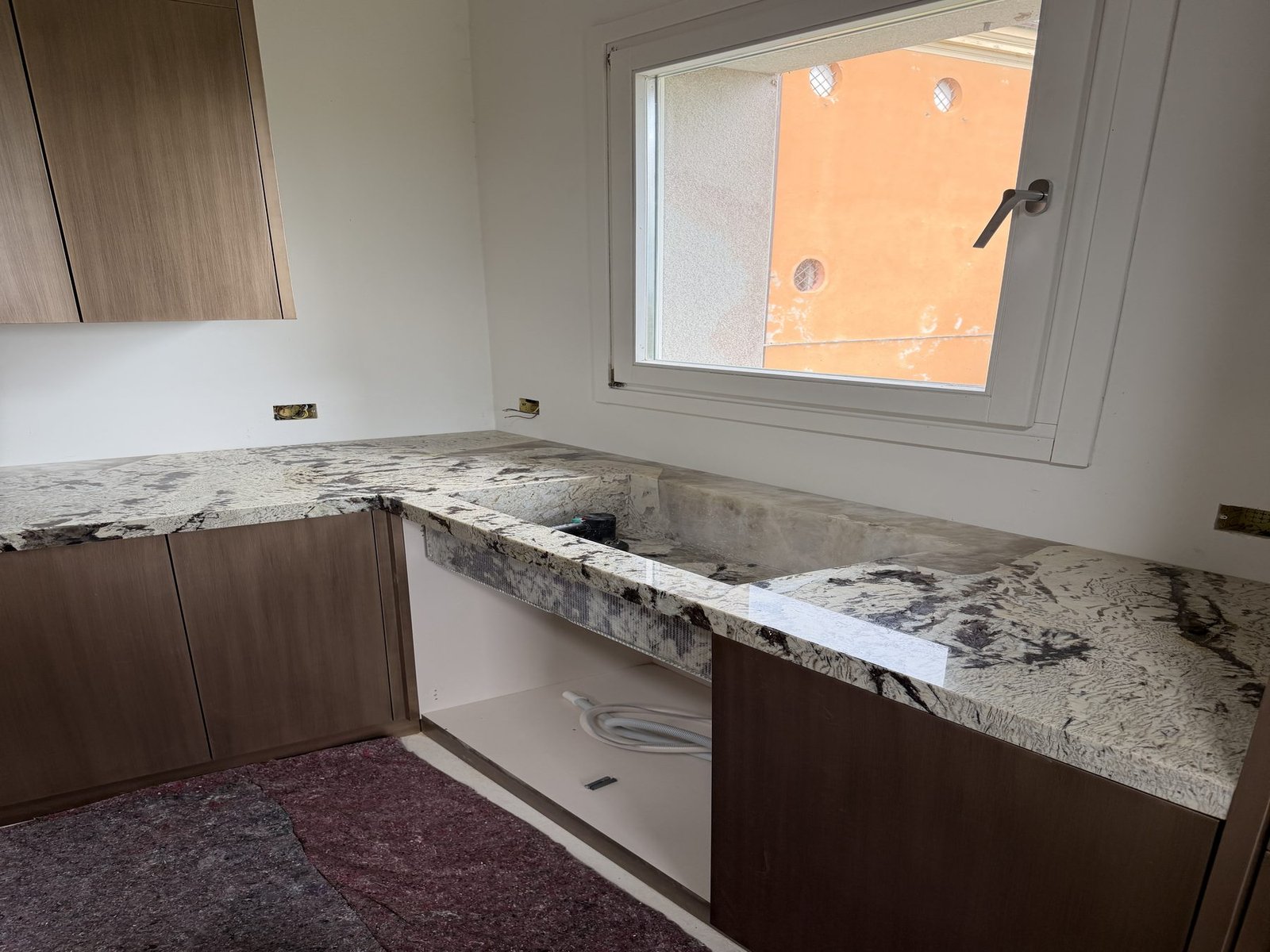
One of the nicer things stone allows is a sink worked directly into the worktop. In the Bologna kitchen shown above, the sink is carved from the same stone as the surface, which removes the usual rim and joint and leaves one continuous piece. It is more work than dropping in a stainless steel sink, and it is the kind of detail that makes a kitchen look built rather than assembled. We cover the wider idea in our piece on bespoke marble.
Choosing the finish for a marble kitchen
Honed. This is the finish we recommend for most kitchen worktops and islands. A honed surface is matte to satin, so the dull marks left by acids blend in far better than they do on gloss. It also looks more relaxed and shows fewer fingerprints. Honed stone is slightly more porous than polished stone, so sealing is more important.
Polished. Polished marble has the deepest colour and the strongest veining, and it is the best choice for splashbacks and wall panels. On a worktop it is unforgiving. Every etch is a dull patch on a mirror finish, and the more acidic your cooking, the sooner you will see them.
Brushed or leathered. A textured finish masks marks well and feels good under the hand. It also holds crumbs and can be harder to wipe clean. We use it where texture is part of the design, not by default.
Stains, etches and scratches: what to expect
It helps to know the three kinds of damage, because they look similar and are fixed differently.
Stains come from liquids the stone absorbs: oil, wine, coffee, tea, some cosmetics. They sit under the surface. Sealing slows absorption but does not stop it forever, which is why spills should be blotted promptly. An absorbed stain can often be drawn out with a poultice.
Etches come from acids: lemon, tomato, vinegar, wine, many cleaning products. They dull the surface and do not go away with wiping, because the polish itself has been dissolved. On a honed finish they are far less visible. When they bother you, a stone specialist can re-hone the area.
Scratches come from hard objects dragged across the surface. Marble is softer than most of the things in a kitchen, so fine scratches will happen. They are usually superficial, and on a honed surface they tend to blend into the pattern.
For a longer view of how marble behaves over the years, see our piece on marble durability.
Sealing and caring for a marble kitchen
Seal it at installation. Use a penetrating, impregnating sealer, not a film-forming coating that wears unevenly. Re-seal worktops and islands every twelve to eighteen months, as we explain in our marble durability guide; walls and splashbacks rarely need it. A simple test: if a few drops of water bead on the surface after a few minutes, the sealer is still working.
Use pH-neutral cleaners. Warm water and a neutral stone soap are enough for daily cleaning. Avoid bleach, vinegar, citrus-based sprays and most bathroom and oven cleaners. In our experience the damage we are asked to repair comes more often from the wrong cleaning product than from cooking.
Blot, do not wipe. Wiping spreads a spill over a larger area. Blotting lifts it before it has time to soak in.
Use boards and trivets. Marble tolerates heat better than many engineered surfaces, but a very hot pan can still leave a mark, and cutting directly on the stone will scratch it and dull your knives. A wooden board and a trivet cost little and save the surface.
Which marble for a kitchen?
The stone matters as much as the finish. Whites with active veining, such as Calacatta Borghini and Bianco Statuario, hide marks better than a plain, even white, because the pattern distracts the eye. Greys and darker stones tend to disguise wear more than very pale ones. A calmer Carrara-type stone is the practical, forgiving option. Our guide to Italian white marble compares the options.
It is also worth saying that not every natural stone in a kitchen needs to be marble. Some of the harder stones are more resistant to acids and can be a better fit for a heavily used worktop. We will tell you if we think another stone suits your use better than marble does. You can see the range in our materials catalogue, and our guide on how to identify quality marble explains what we check on a block before it is cut.
What affects the cost of a marble kitchen
We do not publish a price per square metre, and we would be wary of anyone who quotes one without seeing the project. The main drivers are the stone itself, the thickness you specify, how much material the layout uses (an island with waterfall edges needs more stone than a straight run), the complexity of the edges, cut-outs and any carved elements such as a sink, and the hours of hand finishing. Book-matching slabs also raises the cost, because it needs consecutive slabs from the same block and more material.
The best way to control the budget is to decide where marble matters most. A single island or a splashback in a fine stone, with practical surfaces elsewhere, often gives more effect than marble everywhere. If you are planning a whole ground floor, our guides to marble flooring and marble interiors show how to make the stone work from room to room.
When another material is the better answer
If the worktop will be used hard, every day, with little tolerance for marks, an engineered or harder material may be the more honest recommendation. Marble is not a good fit for someone who wants a surface that never changes. It is a good fit for someone who accepts that it will age, and who likes that it does.
A common middle route is to mix: marble on the island or in a splashback, and a harder surface where the heavy cooking happens. You get the visual weight of the stone without asking it to do all the work.
Working with Purapietra on a marble kitchen
We treat marble as a building material, not a skin. Pieces are roughed on CNC for accuracy and finished by hand by Italian artisans, which is where an edge stops looking machined. For a kitchen we begin with the block and the layout, so we can decide where the veins run, where the joints fall and where the sink and hob sit before anything is cut. Our projects include residential interiors where stone carries the whole room, and the same approach applies to a kitchen of any size.
If you are planning one, send us a plan, a sketch or a photo of the room, and we will tell you which parts of it deserve marble, which finish makes sense and roughly what it will cost. For smaller touches, our marble trays and vases bring the stone into a kitchen without a worktop commitment.
Frequently asked questions about a marble kitchen
Is marble a good choice for kitchen worktops?
It can be, if you accept that it is a soft, reactive stone that will pick up a patina. Choose a honed finish, seal it at installation and use pH-neutral cleaners. If you want a surface that never changes, a harder material is a better fit.
Does marble stain in the kitchen?
Unsealed or poorly sealed marble can stain from oil, wine, coffee and other liquids it absorbs. A penetrating sealer slows this, and blotting spills quickly prevents most stains. An absorbed stain can often be drawn out with a poultice.
What is etching, and can it be repaired?
Etching is a dull mark left when an acid such as lemon, vinegar or wine dissolves the polish on marble. It is not a stain. On a honed surface it is far less visible, and a stone specialist can re-hone the area to remove it.
Should a marble worktop be polished or honed?
Honed is the better choice for most kitchen worktops and islands, because it hides etches and fingerprints. Polished suits splashbacks and wall panels, where acids and wear are rare.
Can I use marble only for the splashback or the island?
Yes, and it is often the best approach. A marble splashback faces few risks and shows the stone at its best. An island gives you a feature surface, with a more resistant material beside the hob if you cook heavily.
How do I clean a marble kitchen?
Use warm water and a pH-neutral stone soap. Avoid bleach, vinegar, citrus cleaners and oven or bathroom products, which can etch the surface. Blot spills rather than wiping, and use boards and trivets.
How much does a marble kitchen cost?
There is no fixed price. Cost depends on the stone, thickness, the amount of material the layout needs, edges, cut-outs, any carved elements such as a sink, and hand finishing. We quote each project once the layout and stone are chosen.
Calacatta Viola Marble: 3 Finishes and Where Violet Veining Works Best
Most white marbles are quiet about their colour. Calacatta Viola is not. Across a warm white ground it carries veins in violet, burgundy and grey, and in the right light the whole slab shifts between plum, rose and ash. It is one of the few natural stones that makes people stop mid-sentence. It is also a stone that can overwhelm a room if you treat it like any other white.
Calacatta Viola belongs to the Calacatta family of Italian marbles, the white stones of the Apuan Alps known for bold, irregular veining. What sets it apart is the colour of the veins, which lean violet and burgundy instead of the usual grey or gold. This guide covers what Calacatta Viola actually looks like, how to read a slab before you buy it, which finish suits which job, where it earns its place in a home, what to pair it with, how to look after it, and what sets the price.
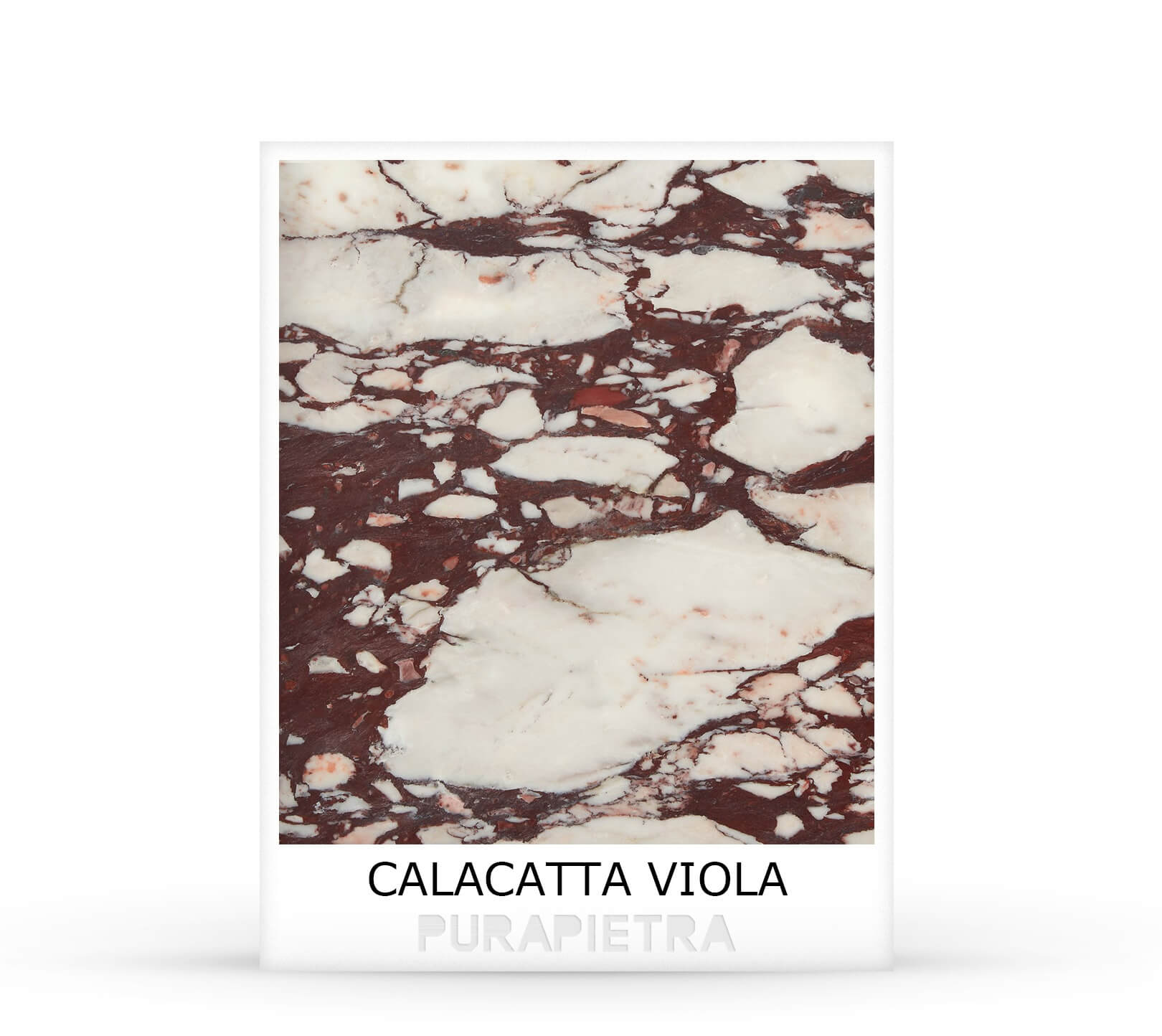
What Calacatta Viola is, and where it comes from
Like the other Calacatta marbles, Calacatta Viola is a white Italian marble from the Apuan Alps, the mountain range behind Carrara that has supplied white marble since Roman times. All of these stones began as limestone and recrystallised under heat and pressure into a dense mass of interlocking calcite crystals, which is what gives marble its slight translucency. Wikipedia’s page on Carrara marble is a good primer on the district if you want the long version.
The violet is the interesting part. Colour in marble comes from trace minerals caught in the calcite as the stone formed, and in Calacatta Viola those traces show up as purple, plum and burgundy veins instead of the usual grey. That is why the colour is not the same from one block to the next, and why no two slabs match.
A word of caution on the name. “Calacatta Viola” is a trade name, not a protected appellation. Two suppliers can sell quite different material under it, and a slab that is mostly grey with a hint of lilac is not the same purchase as one with deep burgundy veins. The name gets you into the right family. The slab in front of you is what you are actually buying.
Calacatta Viola next to its relatives
Clients usually compare it with the other Calacattas we work with. Against Calacatta Borghini, which tends towards a creamy ground and gold veining, Viola is cooler and far more colourful. Against Calacatta Impero, with its wide, scenic grey veins, Viola is less about sweeping lines and more about colour. Against Bianco Statuario, the contrast is bigger still: Statuario is graphic and restrained, Viola is expressive. If you are still deciding between the calm and the dramatic end of white marble, our comparison of Carrara vs Statuario is a useful starting point.
Appearance: colour, veining and character of Calacatta Viola
The ground is a warm white, sometimes with a faint cream or grey cast depending on the block. The veins are what you remember. They run from pale lilac to deep burgundy, often with grey alongside, and they tend to be irregular: patches, clouds and broken lines rather than one clean sweep. Under warm light the stone reads rosy. Under cool daylight it goes greyer and more violet.
Before you commit to Calacatta Viola, three things are worth checking:
How much colour is on the slab. Some slabs are mostly white with a few violet accents. Others are densely veined and read as a purple stone with white in it. Both are Calacatta Viola, and they make very different rooms. Decide which one you want before you look at samples.
The undertone of the violet. Burgundy leans warm and sits well with wood and brass. Lilac and grey-violet lean cool and suit steel and glass. Look at the slab in the light of the room it is going into, not only under the showroom lamps.
Consistency across slabs. With a pattern this irregular, a mismatch at a joint shows. For book-matched walls and large surfaces, ask for consecutive slabs from the same block and lay them out side by side. Our guide on how to identify quality marble covers the other checks we run on a block (fissures, filled cracks, resin backing) before it is approved for cutting.
Finishes for Calacatta Viola
Polished
Polishing gives Calacatta Viola its fullest colour. The violet deepens, the white brightens and the surface takes on the glassy depth that photographs love. We recommend polished for walls, furniture, fireplace surrounds and feature pieces: places where nothing acidic will sit on the surface and nobody walks across it every day.
Honed
A honed finish is matte to satin. It softens the colour slightly and, more importantly, it hides the dull marks that acid leaves on marble. For a worktop, a vanity top or a floor, honed Calacatta Viola is almost always the sensible choice. The violet comes across as softer and more chalky, which many clients find easier to live with than full gloss.
Brushed
Brushing leaves a fine, tactile texture and noticeably mutes the pattern. It suits shower floors and steps, where grip matters. Because the appeal of Calacatta Viola is almost entirely visual, we rarely brush it for feature work. When we do, it is because the stone has to do a practical job in a room where most of the rest is polished.
Best uses for Calacatta Viola in interior design
Feature walls and bookmatched panels
This is where Calacatta Viola is at its best. A vertical surface never meets lemon juice or red wine, so you can polish it, and a bookmatched pair of panels turns the pattern into a symmetrical composition that holds a room. Behind a bed, a bath or a dining table, one wall is usually all you need. We map the veins on the block face before cutting so the joints fall where they should.
Bathrooms
A bathroom is small enough for one bold stone to set the whole mood. Calacatta Viola on a vanity wall or around a shower, with quieter surfaces everywhere else, looks deliberate and calm at the same time. Paired with a carved piece like our Unit Sink or the Linear basin, the stone becomes the room’s main idea. On bathroom floors, go honed or brushed.
Tabletops, vanities and furniture
A single tabletop or vanity top is the classic way to use a stone like this. The surface is small enough to choose the exact slab and place the veins where they will be seen. It is also forgiving: you get the full effect of the colour without committing a whole room to it.
Kitchen islands and worktops
It can be done, and the caveat is the same one we give for every calcite marble: acid etches it. Lemon, wine, vinegar and many descaling products leave dull marks on a polished surface, sometimes within minutes. Choose a honed finish, seal it at installation and accept that the surface will pick up a patina. A coloured stone also shows its marks less than a plain white one, which helps. If the worktop has to stay exactly as it was on day one, a quartzite is a better choice than any marble, and we will say so.
Design objects
Trays, vases and bowls cut from Calacatta Viola let you have the stone at a domestic scale. Our marble trays and vases are made from material left over from larger commissions, so the pieces carry the same veining as the architectural work.
What to pair with Calacatta Viola
Warm oak and walnut. Timber takes the edge off the cool end of the violet and brings out the burgundy. A walnut vanity under a Calacatta Viola wall is a combination we come back to often.
Brass and bronze, used sparingly. Warm metals sit well with burgundy veining. Check them against the real stone before ordering taps, because the violet can look different next to gold than it does on its own.
Blackened steel and brushed nickel. Cool metals pick up the grey in the veining and make the colour look more contemporary.
Quiet walls and floors. Because the stone does so much on its own, keep the surrounding colours soft: warm plaster, off-white, stone-grey. Let one surface be the statement.
A calmer stone in the next room. Using Calacatta Viola in one room and a quieter white such as Bianco delle Alpi or Acqua di Carrara elsewhere keeps a house from feeling like every surface is shouting. Our overview of marble interiors covers this kind of room-to-room planning.
Maintenance and sealing
Seal it when it is installed. Use a penetrating, impregnating sealer, not a film-forming coating that will peel unevenly over time. Re-seal worktops every twelve to eighteen months and walls much less often. A quick test: if a drop of water still beads on the surface after a few minutes, the sealer is working.
Clean with pH-neutral products. Warm water and a neutral stone soap handle almost everything. Bleach, vinegar, citrus cleaners and most bathroom descalers etch the surface directly. In our experience most of the damage we are asked to repair comes from a cleaning product, not from daily life.
Blot, do not wipe. Oil and wine stain because the stone absorbs them. Acid etches because it dissolves the surface. Blotting a spill quickly prevents most stains, and a poultice can pull out an absorbed one later. An etch mark is different: it has to be honed out. For a longer view of how marble ages, see our piece on marble durability.
What drives the price of Calacatta Viola
We do not publish a square-metre price for Calacatta Viola, and we would be wary of anyone who quotes one without seeing the slab. Four things set the cost: the grade and rarity of the block, the thickness you specify, the yield (how much of the raw block ends up as usable finished material), and the hours of hand finishing. For a stone valued for its colour, rarity and selection are the big ones. A block with strong, well-placed violet veining is worth considerably more than one sold under the same name that is mostly grey.
As we say in our guide to the most prized Italian marbles, Calacatta Viola is among the most valuable of them, because violet veining occurs in very few places. What you pay for is the look and the selection work behind it. It is not harder or tougher than a cheaper white, and it behaves in daily use the way any calcite marble does.
How to choose a slab
If you can, go to the yard. Photos flatten colour and make every slab look more even than it is. Stand back a few metres, because that is the distance from which a wall or a tabletop will actually be seen, then walk up close and look at the surface in raking light for fills and hairline cracks. Ask for the slab numbers so you know which ones are consecutive, and photograph them together with a tape measure for scale.
Bring the drawing with you. Knowing where the sink cut-out, a tap hole or a door will fall changes which slab is right. A violet vein that looks perfect in the yard can end up running straight through a cut-out. We mark the pieces out on the slab in chalk, or on a photo, before anything is cut. It takes an extra hour and saves a lot of regret.
Why choose Calacatta Viola with Purapietra
We treat marble as a building material, not a skin. Every piece is roughed on CNC for accuracy and finished by hand, which is where an edge stops looking machined. For Calacatta Viola we ask clients to choose the block, and we draw the vein layout on the block face before the first cut, so the colour, the direction of the veins and the match at every joint are decided in advance.
You can see Calacatta Viola alongside our other white, coloured and rare stones in the materials catalogue. If Viola turns out to be more colour than a room needs, our guides to Italian white marble and white marble cover the calmer options we usually suggest instead. Send us a plan, a sketch or just a photo of the room, and we will tell you what the stone can do there and roughly what it will cost.
Frequently asked questions about Calacatta Viola
What is Calacatta Viola marble?
Calacatta Viola is a white Italian marble from the Calacatta family, from the Apuan Alps near Carrara. It is known for violet, burgundy and grey veining across a warm white ground, a colour combination that occurs in very few places.
How much does Calacatta Viola cost?
There is no fixed price per square metre. Cost depends on block grade, how strong and well placed the violet veining is, slab thickness, usable yield and hours of hand finishing. Calacatta Viola is among the most valuable Italian marbles. We quote each project once the slab and finish are chosen.
Is Calacatta Viola good for a bathroom?
Yes. Walls, vanity surrounds and shower enclosures are some of the best places for it, because a bathroom is small enough for one bold stone to set the mood. Use a polished finish on walls and a honed or brushed finish on floors for better grip.
Can I use Calacatta Viola for a kitchen worktop?
You can, but like every calcite marble it etches on contact with acids such as lemon, wine and vinegar. Choose a honed finish, seal it at installation and expect a patina over time. If the worktop must stay unchanged, a quartzite is the better material.
What is the difference between Calacatta Viola and Calacatta Borghini?
Both are premium Calacatta marbles from the Apuan Alps. Calacatta Borghini tends to have a creamier ground and gold veining. Calacatta Viola is defined by violet and burgundy veins and is usually cooler and more colourful. Slabs vary a lot under both names, so always compare real slabs side by side.
How do I care for Calacatta Viola?
Seal it with a penetrating sealer at installation and re-seal worktops every twelve to eighteen months. Clean only with pH-neutral products, avoid bleach, vinegar and citrus cleaners, and blot spills quickly instead of wiping them. Etch marks can be removed by re-honing.
Where does Calacatta Viola look best?
On a single deliberate surface: a bookmatched feature wall, a bathroom vanity wall, a tabletop or a vanity top. Used sparingly with calm materials around it, the colour reads as a statement. Spread across a whole house it loses its effect.
Marble Flooring: Honest Pros, Cons and 5 Ways to Get It Right
A marble floor is the one surface in a house you touch every single day, usually barefoot. It is also the one people worry about most: will it stain, will it be slippery, will it crack, will it be cold? Some of those worries are fair. Most of them come down to choosing the right stone, the right finish and the right installer, and very little to do with marble itself.
Marble flooring has been used in European interiors for over two thousand years, and plenty of those floors are still walked on. That track record is the best argument for it. The honest counterpoint is that marble is softer and more reactive than porcelain or granite, and a floor that is badly specified will show it within months. This guide goes through the real pros and cons of marble flooring, the finishes that keep it safe underfoot, formats and layouts, which stones suit floors, installation with underfloor heating, day-to-day care, and what drives the cost.

Why choose marble flooring
The first reason is the look, and there is no point pretending otherwise. No printed tile reproduces the depth of real veining, because in marble the pattern runs through the full thickness of the stone and light enters the surface slightly before bouncing back. On a floor, where you see large areas at a low angle, that difference is obvious.
The second reason is longevity. A well laid marble floor does not wear out the way timber or vinyl does. It wears in. Scratches and etches can be honed away, and the whole surface can be restored to near new decades after installation. That is why marble floors in old palazzi and churches are still in use, often after several rounds of restoration.
The third is how it behaves in a warm climate or with underfloor heating. Stone is a good thermal conductor, so it feels cool in summer and passes heat efficiently from a heated screed in winter. A large share of our projects are in the Gulf, and marble flooring is a standard choice there for exactly this reason.
Marble flooring pros and cons
The pros
It lasts. With normal care a marble floor outlives almost every other finish in the house, and it can be restored instead of replaced.
Every floor is unique. No two blocks are the same, so no two floors are either. For a lot of our clients this is the whole point.
It works with heating. Marble flooring over underfloor heating is efficient and comfortable, provided the installation allows for movement (more on that below).
It adds value. Real stone floors are one of the finishes buyers notice. It is hard to put a number on, but it shows in how a room is perceived.
The cons
It etches. Marble is mostly calcium carbonate, and acids dissolve it. Spilled wine, lemon juice or the wrong floor cleaner will leave dull marks on a polished floor. On a honed floor they are far less visible.
It can stain. Unsealed marble absorbs oils and coloured liquids. A good impregnating sealer reduces this a lot but does not make the stone bulletproof.
Polished marble is slippery when wet. This is the most important point for safety, and the one most often ignored. Bathrooms, entrances and anywhere near a pool need a textured finish.
It is heavy and costs more to lay. Stone needs a flat, rigid subfloor and a skilled layer. Installation is a bigger share of the budget than with most other floors.
None of these cons is a reason to avoid marble flooring. They are reasons to specify it properly. If you want a floor you never have to think about, porcelain is the honest recommendation. If you want a floor that gets better with age and are willing to treat it a bit like good leather, marble is hard to beat.
Finishes and slip resistance
The finish you choose matters more on a floor than on any other surface, because it controls both how the floor looks and how safe it is.
Polished
Mirror gloss, full colour, maximum contrast. It is beautiful in a dry living room, a dining room or a hotel lobby with good mats at the door. It is the wrong choice in a bathroom, a kitchen or an entrance that sees rain. It also shows every etch mark.
Honed
A smooth, matte to satin surface. Honed is our default for residential marble flooring: calmer in colour, far more forgiving with etching, and better underfoot. It is still smooth, so it is not the right answer on its own for wet areas.
Brushed, sandblasted and bush-hammered
Textured finishes give real grip. Brushed marble has a soft, leathery feel and suits bathrooms and shower floors. Sandblasted and bush-hammered finishes are rougher and belong on terraces, pool surrounds and outdoor steps. Texture mutes the veining, so these finishes suit stones where colour matters more than pattern.
If you need a number, ask the supplier for slip test results for the specific stone and finish. In Europe the common references are the pendulum test and the German DIN 51130 ramp test, which rates surfaces from R9 (low grip) to R13 (high grip). The newer European standard for pedestrian surfaces, EN 16165, groups several of these methods together. A good supplier will have figures or will test a sample for you.
Marble flooring in modern interiors
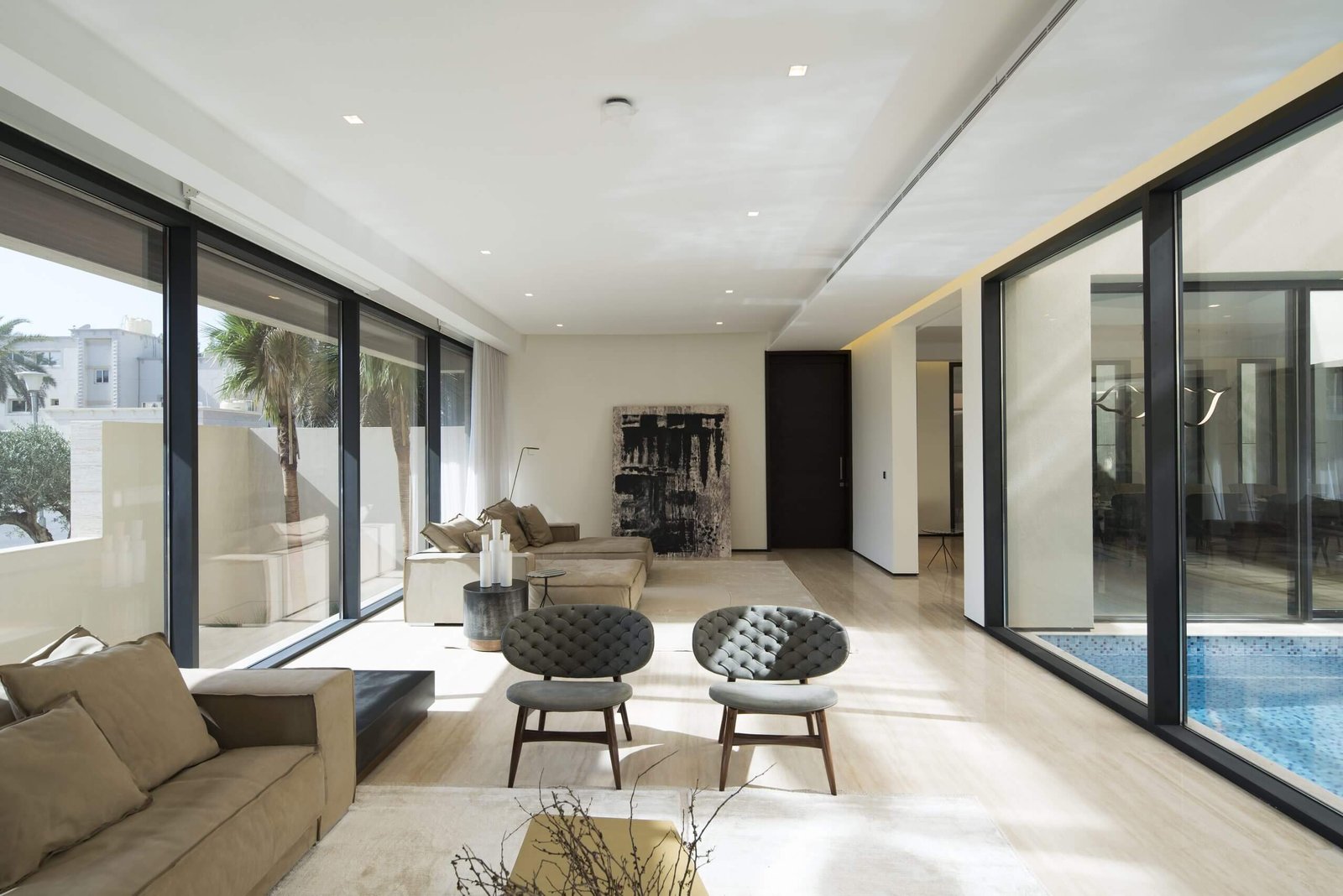
A lot of people picture marble flooring as black and white checkerboard in a grand hallway. That still has its place, but most of the floors we cut today look very different. In contemporary rooms marble flooring tends to be calmer: large honed formats, tight joints, one stone running through several rooms with no thresholds, so the floor reads as a single continuous plane.
Colour does a lot of the work. Pale greys and warm whites sit well with oak, plaster walls and linen, and they let furniture and art take the attention. A bolder stone can still work in a modern scheme if it is used in one place with intent: an entrance, a powder room, a strip of contrasting stone that marks the change from living to dining.
Texture is the other modern move. Brushed and honed marble flooring feels soft underfoot and photographs without glare, which is why it has largely replaced high gloss in private homes. And because stone handles underfloor heating so well, marble flooring pairs naturally with the open, glass-heavy plans of new builds, where a warm floor makes a big difference in winter.
Formats and layouts for marble flooring
Tiles
Standard marble floor tiles are usually 10 to 12 mm thick, in sizes such as 30 x 60 cm or 60 x 60 cm. They are the most economical way to get real marble flooring, quick to lay and easy to replace. The trade-off is more joints, and less chance to show large, continuous veining.
Large formats and slabs
Large formats (80 x 80 cm, 60 x 120 cm and up) or cut-to-size slabs, typically 20 mm thick, give fewer joints and let a vein cross the room. They need a very flat subfloor and more skilled laying, and they cost more, but they are what makes a marble floor look like architecture instead of tiling.
Patterns
Layout changes the feel of a room more than most people expect. A straight grid with tight joints is quiet and modern. A running bond (offset) pattern is more relaxed. Herringbone and chevron in marble strips bring movement and work well in corridors. Borders, inlays and geometric medallions in contrasting stones are a classical move, and one we still make regularly for entrance halls and villas in the Gulf.
One practical tip: decide which way the veins should run before ordering. Along the length of a corridor, veining makes a space feel longer. Across it, the room feels wider. On a bold stone, a floor laid with veins going in random directions can look restless.
Which marbles work best on floors
Almost any sound marble can be used for marble flooring, but some are easier to live with than others.
Mid-tone and patterned stones hide the most. Greys, beiges and busy veining disguise dust, small scratches and etch marks. Grey marble such as Grigio di Vagli and warm stones like those in our beige marble guide are the most forgiving choices for family homes.
White marble flooring is stunning but honest about dirt. A white marble floor lifts a room like nothing else, but it shows every footprint on a polished finish. Honed white floors are much easier to live with.
Dark marble flooring shows dust and etching. Black marble floors are dramatic, but on a polished finish every etch mark and every speck of dust is visible. We tend to use black as a border or inlay rather than across an entire room.
Travertine is a classic alternative. Strictly speaking it is not a marble, but travertine is one of the most popular stone floors in Italy, especially honed and filled.
Whatever the stone, check it for soundness. Heavily fissured or resin-filled material can be fine on a wall and a problem on a floor, where it is under load. Our guide on how to identify quality marble explains what to look for.
Installation and underfloor heating
Most failures in marble flooring are installation failures, not stone failures. Three things make the difference.
A flat, rigid base. Marble does not flex. The subfloor has to be stable, level and properly cured, or tiles will crack and edges will lip. On timber floors, a decoupling membrane or a rigid backer board is essential.
The right adhesive. Many light-coloured marbles can stain or warp with the wrong adhesive, especially green and some white varieties that are sensitive to water. Use a white, fast-setting or rapid-drying adhesive formulated for natural stone, and follow the stone supplier’s advice.
Movement joints with underfloor heating. Marble flooring over underfloor heating works very well, but the screed must be fully cured and the heating brought up to temperature slowly before and after laying. Perimeter and field movement joints let the floor expand and contract without cracking.
After installation the floor is cleaned, sealed with a penetrating sealer, and left to rest before heavy furniture goes back in. Final honing or polishing in place, once the whole floor is down, is how you get a completely even surface with no lipping at the joints.
Caring for marble flooring
Dust often. Grit is what scratches marble floors. A soft dust mop or a vacuum without a beater bar does more to keep a floor looking good than any product.
Mop with pH-neutral cleaner. Warm water and a neutral stone soap are enough. Avoid vinegar, bleach, ammonia and all-purpose “citrus” cleaners. They etch the surface.
Use mats and felt pads. A good mat at each entrance catches most of the grit. Felt pads under chairs and furniture stop scratches.
Reseal on schedule. Busy marble flooring usually needs resealing every one to three years. If water stops beading on the surface, it is time.
Restore instead of replace. When a floor looks tired, a professional can hone and repolish it in place. It is one of the big advantages of marble over materials that just wear out. Our article on marble durability goes deeper into how stone ages and how to restore it.
What does marble flooring cost?
We do not publish a single price per square metre, because the range is huge. Four things drive it: the stone itself (a common beige and a rare Calacatta are in different worlds), the format (tiles cost less than cut-to-size slabs), the finish and the amount of hand work, and the installation, which on a large-format floor can cost as much as the material. Patterns, borders and inlays add cutting time.
A realistic way to budget is to choose two or three candidate stones and ask for a quote on the same room in each. The difference between them often surprises people, and sometimes the cheaper stone in a better format gives the better floor.
Planning floors and walls together
The best marble flooring projects are designed together with the walls, not after them. Carrying the same stone from floor to wall in a bathroom makes a small room feel bigger. Using a quieter floor under a dramatic feature wall lets the wall do the talking. Our guide to marble interiors covers how to plan stone across a whole house, and our Private Villa Milan and Desert Chalet projects show how we handled it on real sites.
At Purapietra we select the blocks, cut and finish the stone in Italy, and follow the installation through. Browse the stones that work on floors in our materials catalogue, then send us a floor plan or a few photos. We will tell you which marble fits the way you actually live, and which finish will keep it safe underfoot.
Frequently asked questions about marble flooring
Is marble flooring a good idea?
Yes, if it is specified properly. Marble flooring lasts for decades, can be restored instead of replaced and works well with underfloor heating. It needs a suitable finish, a good sealer and pH-neutral cleaning. If you want a floor you never have to think about, porcelain is easier.
Is a marble floor slippery?
Polished marble is slippery when wet. Honed marble is better, and brushed, sandblasted or bush-hammered finishes give real grip for bathrooms, entrances and outdoor areas. Ask your supplier for slip test results such as a DIN 51130 R-rating or a pendulum test value.
Can you put marble flooring in a kitchen?
You can, but choose a honed finish and a forgiving, mid-tone or patterned stone. Seal it properly and wipe up acidic spills such as wine, citrus and vinegar quickly, because they etch the surface.
Does marble flooring work with underfloor heating?
Yes. Stone conducts heat well, which makes it one of the most efficient floors over underfloor heating. The screed must be fully cured, the heating brought up to temperature slowly, and movement joints included so the floor can expand and contract.
How thick should marble floor tiles be?
Standard marble floor tiles are usually 10 to 12 mm thick. Large-format tiles and cut-to-size slabs are typically 20 mm. Thicker stone is stiffer and less likely to crack over an imperfect subfloor, but it still needs a flat, rigid base.
How do you clean a marble floor?
Dust or vacuum often to remove grit, then mop with warm water and a pH-neutral stone cleaner. Avoid vinegar, bleach, ammonia and citrus cleaners. Use entrance mats and felt pads, and reseal the floor every one to three years in busy areas.
How long does a marble floor last?
A well installed marble floor can last for generations. Scratches and etch marks can be honed out, and the surface can be restored to near new condition, which is why historic marble floors are still in use today.
Calacatta Impero Marble: 3 Finishes and the Best Ways to Use It
Some marbles ask you to lean in and look for the detail. Calacatta Impero does the opposite: you see it from the doorway. The veins run wide and long across a bright field, and a single slab can hold one continuous gesture from edge to edge. That is exactly why it works so well on the right wall, and why it can go wrong on the wrong one.
Calacatta Impero is a white Italian marble from the Calacatta family, quarried in the Apuan Alps above Carrara and known for broad, scenic veining in shades of grey that sweep across the slab rather than scattering over it. Designers pick it when they want one surface to carry a room. This guide covers where Calacatta Impero comes from, how to read a slab before you buy it, which finish suits which job, where it earns its place indoors, what it pairs with, how to look after it, and what actually moves the price.
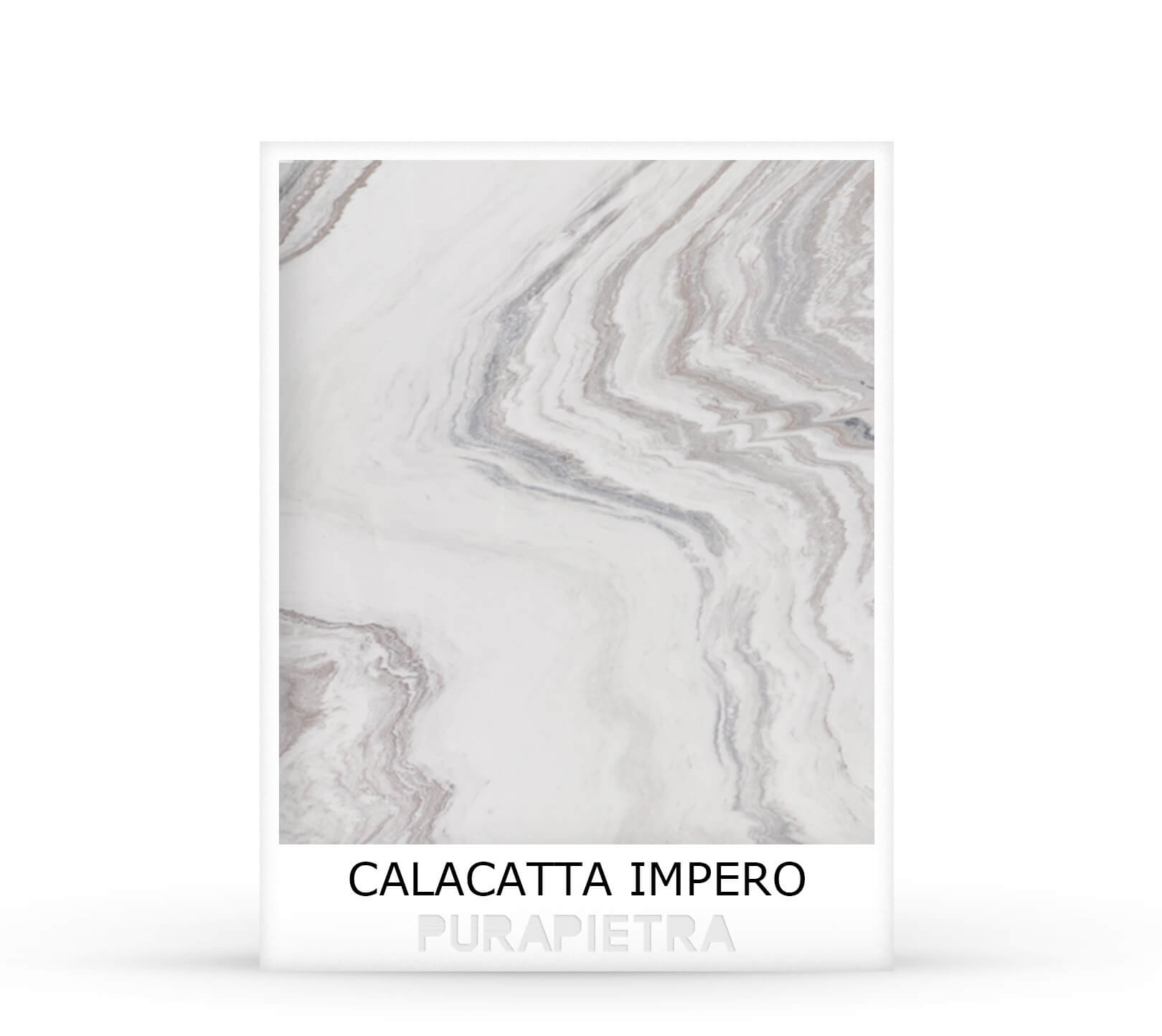
Where Calacatta Impero comes from
Like the other Calacatta names, Calacatta Impero comes out of the Apuan Alps, the mountain range behind Carrara that has supplied white marble since Roman times. Geologically, all of these whites began as limestone and recrystallised over millions of years under heat and pressure into a dense mass of interlocking calcite crystals. That structure is what gives marble its slight translucency and the soft way it holds light. Wikipedia’s page on Carrara marble is a decent primer on the district if you want the long version.
What the geology does not explain is the naming. “Impero”, “Borghini”, “Oro”, “Vagli”: these are trade names, tied loosely to particular quarry fronts and to the look of the material they produce. None of them is a protected appellation. Two suppliers can sell quite different slabs under the same name, and the same quarry can yield blocks that look like two different stones depending on which bench they come from. So the name gets you into the right family. The slab in front of you is what you are actually buying.
Calacatta Impero next to its closest relatives
Clients usually compare Calacatta Impero with three other whites we work with. Against Bianco Statuario, Impero has wider and more continuous veining, where Statuario tends to be sharper and more graphic, with a colder ground. Against Calacatta Borghini, Impero usually reads a touch cooler and less gold, with veins that move in longer sweeps. Against a classic Carrara, there is no real contest in drama: Carrara is soft and even, Calacatta Impero is a statement. If you want colour instead of grey, Calacatta Viola takes the Calacatta family in a very different direction. Our comparison of Carrara vs Statuario is a useful companion if you are still deciding which end of that spectrum a project needs.
Appearance: colour, veining and character of Calacatta Impero
The ground of Calacatta Impero is a clean, bright white, sometimes with a faint warm cast depending on the block. The veins are the point. They run grey, from pale dove to a deep charcoal, often wide enough to be read as bands, and they tend to travel across the slab in long diagonal or sweeping lines instead of breaking into a fine net. On good material you can follow one vein for a metre or more.
Before you commit to Calacatta Impero, three things are worth checking:
Vein density. Some slabs carry two or three dominant veins with open white between them. Others are much busier. Neither is wrong, but they produce very different rooms, and a sample tile will not tell you which one you are getting.
Vein direction. Wide veins have a direction, and that direction decides the layout. On a wall, a vein that climbs diagonally feels dynamic; on a floor it can make a room feel like it is tilting. Decide how the veins should travel before anyone cuts the block.
Consistency across slabs. With a stone this bold, a mismatch at a joint shows immediately. For book-matched walls and large islands, ask for consecutive slabs from the same block and look at them laid out side by side. Our guide on how to identify quality marble goes through the other checks we run on a block (fissures, filled cracks, resin backing) before it is approved for cutting.
Finishes for Calacatta Impero
Polished
Polishing pushes the contrast to its maximum. The white goes brighter, the grey goes deeper, and the surface catches light the way it does in the photographs that usually start the conversation. We specify polished Calacatta Impero for walls, fireplace surrounds, furniture and feature pieces: places where nothing acidic will sit on the surface and the gloss is not going to be walked on every day.
Honed
A honed finish is matte to satin. It softens the contrast a little and, more importantly, it hides the dull marks that acid leaves behind. For a kitchen worktop or a floor, honed Calacatta Impero is almost always the sensible choice. It also calms the veining slightly, which some clients prefer on large surfaces where full gloss can feel like a lot.
Brushed
Brushing leaves a fine, tactile texture and noticeably mutes the pattern. It suits shower floors, benches and steps, where grip matters more than showing the veins off. Because so much of the appeal of Calacatta Impero is visual, we rarely brush it for feature work. When we do, it is because the stone has to do a practical job in a room where the rest of it is polished.
Best uses for Calacatta Impero in interior design
Feature walls and cladding
This is where Calacatta Impero is at its best. A vertical surface never meets lemon juice or red wine, so you can polish it without worrying, and a wall is big enough to let the veins run without interruption. Book-matched panels behind a bed, a bath or in an entrance hall turn the pattern into a composition you would hang on a wall anyway. The work is all in the layout: we map the veins on the block face before cutting so the joints fall where they should.
Bathrooms
A bathroom is small enough for one bold material to set the whole mood. Calacatta Impero on a vanity wall or around a shower, with quieter surfaces everywhere else, looks deliberate. Paired with a carved piece like our Unit Sink or the Linear basin, the stone becomes the room’s main idea instead of one finish among many. On bathroom floors, go honed or brushed.
Kitchen islands and worktops
A Calacatta Impero island is a classic request, and the honest caveat is the same one we give for every calcite marble: acid etches it. Lemon, wine, vinegar and many descaling products will leave dull marks on a polished surface, sometimes within minutes. Choose a honed finish, seal it at installation and accept that the worktop will pick up a patina over the years. If the surface has to stay exactly as it was on day one, a quartzite is a better choice than this marble, and we will say so.
Vanity tops and smaller pieces
Wide veining behaves differently on a small surface. On a one-metre vanity top, a single vein of Calacatta Impero can look magnificent or it can cut the piece awkwardly in half, depending on where the saw falls. This is where choosing the actual slab, and deciding the cut with the fabricator, matters most.
Design objects
Trays, vases and bowls cut from Calacatta Impero offcuts let you have the stone at a domestic scale without committing a whole room to it. Our marble trays and vases are made this way, from material left over from larger commissions that would otherwise go to waste.
What to pair with Calacatta Impero
Brushed nickel and blackened steel. The grey in the veining sits naturally with cool metals. Blackened steel picks up the darkest veins and gives the white something to push against.
Warm oak and walnut. Timber brings back the warmth that a cool white can lack. A walnut vanity under a Calacatta Impero wall is one of the combinations we come back to most often, because the wood gives the eye somewhere to rest.
Brass, used sparingly. Brass works if the block has any warmth in the ground. On a very cool slab it can look like an afterthought, so check it against the real stone before ordering the taps.
A quieter stone elsewhere. Using Calacatta Impero in one room and a calmer white such as Bianco delle Alpi or Acqua di Carrara in the next keeps a house from feeling like every surface is shouting. Our overview of marble interiors covers this kind of room-to-room planning in more detail.
Maintenance and sealing
Seal it when it is installed. Use a penetrating, impregnating sealer, not a film-forming coating that will peel unevenly over time. Refresh it every two to four years on worktops and less often on walls. A quick test: if a drop of water still beads on the surface after a few minutes, the sealer is working.
Clean with pH-neutral products. Warm water and a neutral stone soap handle almost everything. Bleach, vinegar, citrus cleaners and most bathroom descalers etch the surface directly. In our experience most of the damage we are asked to repair comes from a cleaning product, not from daily life.
Blot, do not wipe. Oil and wine stain because the stone absorbs them. Acid etches because it dissolves the surface. Blotting a spill quickly prevents most stains, and a poultice can pull out an absorbed one later. An etch mark is different: it has to be honed out. For a longer view on how marble ages, see our piece on marble durability.
What drives the price of Calacatta Impero
We do not publish a square-metre price for Calacatta Impero, and we would be wary of anyone who quotes one without seeing the slab. Four things set the cost: the grade of the block, the thickness you specify, the yield (how much of the raw block ends up as usable finished material), and the hours of hand finishing. With a stone valued for its veining, yield is the big one. A block that gives large, well-matched slabs with the veins in the right place is worth considerably more than one sold under the same name with a busier or broken pattern.
As a family, Calacatta marbles sit near the top of the Italian whites, generally above standard Carrara and broadly level with Bianco Statuario, depending on the grade. What you pay for with Calacatta Impero is the look and the selection work behind it. It is not harder or tougher than a cheaper white, and it will not perform differently in daily use.
How to choose a slab
If you can, go to the yard. Photos flatten wide veining and make every slab look more even than it is. Stand back a few metres, because that is the distance from which a wall or an island will actually be seen, then walk up close and look at the surface in raking light for fills and hairline cracks. Ask for the slab numbers so you know which ones are consecutive, and photograph them together with a tape measure for scale.
Bring the drawing with you. Knowing where the sink cut-out, the hob or a door will fall changes which slab is right: a vein that looks perfect in the yard can end up running straight through a tap hole. We usually mark the pieces out on the slab in chalk, or on a photo, before anything is cut. It takes an extra hour and saves a lot of regret.
Why choose Calacatta Impero with Purapietra
We treat marble as a building material, not a skin. Every piece is roughed on CNC for accuracy and finished by hand, which is where an edge stops looking machined. For Calacatta Impero we ask clients to choose the block, and we draw the vein layout on the block face before the first cut, so the direction of each vein and the match at every joint is decided in advance, not left to luck.
You can see Calacatta Impero alongside our other white, coloured and rare stones in the materials catalogue. If Impero turns out to be more drama than a room needs, our guides to Italian white marble and white marble cover the calmer options we usually suggest instead. Send us a plan, a sketch or just a photo of the room, and we will tell you what the stone can do there and roughly what it will cost.
Frequently asked questions about Calacatta Impero
What is Calacatta Impero marble?
Calacatta Impero is a white Italian marble from the Calacatta family, quarried in the Apuan Alps near Carrara. It is known for a bright white ground crossed by wide, scenic grey veins that tend to run in long, continuous sweeps across the slab.
How much does Calacatta Impero cost?
There is no fixed price per square metre. Cost depends on block grade, slab thickness, usable yield and hours of hand finishing. Calacatta Impero sits near the top of the Italian whites, broadly level with Bianco Statuario depending on the grade and how well the veining is matched. We quote each project once the slab and finish are chosen.
Is Calacatta Impero good for a bathroom?
Yes. Walls, vanity surrounds and shower enclosures are some of the best places for it, because a bathroom is small enough for one bold stone to carry the room. Use a polished finish on walls and a honed or brushed finish on floors for better grip.
Can I use Calacatta Impero for a kitchen worktop?
You can, but like every calcite marble it etches on contact with acids such as lemon, wine and vinegar. Choose a honed finish, seal it at installation and expect a patina over time. If the worktop must stay unchanged, a quartzite is the better material.
What is the difference between Calacatta Impero and Calacatta Borghini?
Both are premium Calacatta marbles from the Apuan Alps. Calacatta Impero usually reads cooler, with wide grey veins that travel in long sweeps. Calacatta Borghini tends to have a creamier ground and more gold in the veining. Slabs vary a lot under both names, so always compare real slabs side by side.
How do I care for Calacatta Impero?
Seal it with a penetrating sealer at installation and reapply every two to four years on worktops. Clean only with pH-neutral products, avoid bleach, vinegar and citrus cleaners, and blot spills quickly instead of wiping them. Etch marks can be removed by re-honing.
Where does Calacatta Impero look best?
On large vertical surfaces where the veins can run without interruption: book-matched feature walls, fireplace surrounds, bathroom walls and kitchen islands. On small pieces, choose the slab and the cut carefully so a wide vein does not split the piece awkwardly.
Marble Wall Cladding: A Guide to Choosing the Right Material
The question we get asked most about marble wall cladding is never “which stone”, at least not at first. It is “slab or tile”, and the honest answer changes everything else about the budget, the look and how the room will age. Get that one decision right and the material choice becomes the easy part.
Marble wall cladding is the practice of covering a wall in stone — as full slabs, cut tiles or bookmatched panels — rather than using marble only on floors or worktops. Done well it gives a room a depth that paint and most engineered surfaces cannot reproduce, because marble is a translucent, crystalline material that lets light travel a short distance into the surface before it scatters, a property Wikipedia’s entry on marble explains in more technical terms. This guide covers the real choices behind a good cladding job: slabs against tiles, sizes and thickness, which finishes suit which rooms, how to match the stone to the space, the basics of installation and care, and what a handful of real projects have taught us that a mood board never will.
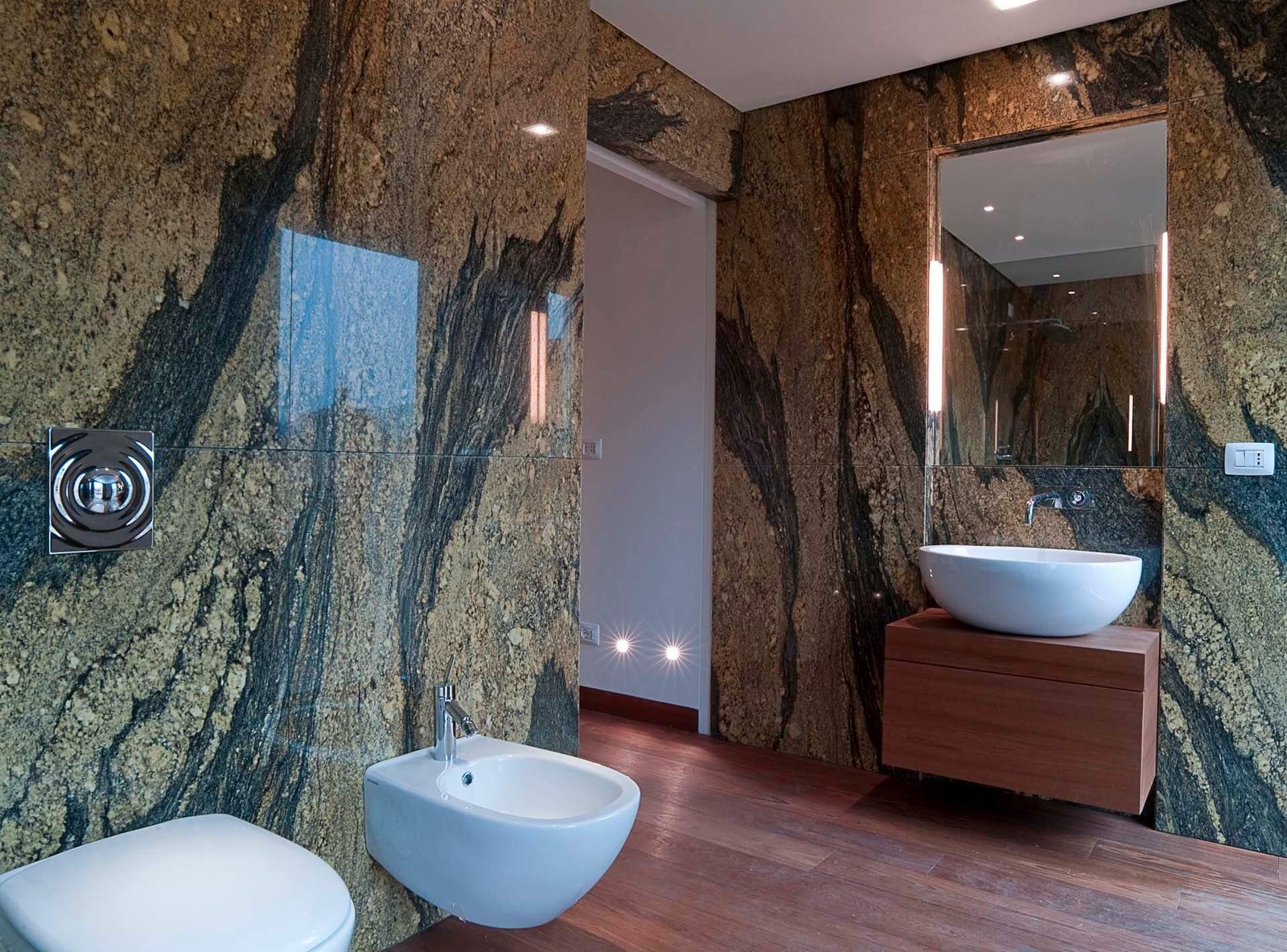
What marble wall cladding actually is
Cladding simply means covering a structural wall with a non-structural stone layer, as opposed to a solid masonry wall built from stone itself. Almost every marble wall you see in a contemporary interior is cladding: thin slabs or tiles fixed to a substrate with adhesive and, on larger or heavier pieces, mechanical anchors as well. The wall does the structural work; the marble does the visual work. That distinction matters because it is what makes ambitious marble walls achievable in ordinary buildings — you are adding a finish, not rebuilding the wall in solid stone.
Slabs, tiles and bookmatched panels
Full slabs
A full slab gives a wall one continuous surface with no grout lines and no repeated joints breaking up the veining. It is the best option whenever the stone’s pattern is the point — a dramatic vein, a bold colour, a stone chosen specifically because of how it looks rather than as a neutral background. Full slabs cost more per square metre and are heavier to handle and install, but for a feature wall they are almost always worth it.
Tiles
Standard tiles, usually 30 to 60 centimetres square or in larger rectangular formats, are more economical and easier to source, replace and transport. The trade-off is visible joints and a pattern that repeats rather than flows. Tiles work well with quieter, more uniform stones such as travertine or a calm grey, and less well with a bold, veined marble where the eye immediately notices the pattern breaking at every joint.
Bookmatched panels
Bookmatching takes two slabs cut sequentially from the same block and mirrors them along the joint, so the veining forms a symmetrical pattern like an open book. It is the most dramatic and most technically demanding option, requiring the slabs to be selected, numbered and installed in the exact sequence they were cut. Done well, a bookmatched wall becomes the single most memorable surface in a house. Done carelessly, with slabs from different blocks, it simply looks like an expensive mistake.
Sizes, thickness and formats to consider
Twenty millimetres is the standard slab thickness for wall cladding in most residential work, giving enough substance for the stone to read as solid without adding unnecessary weight or cost. Thinner cladding, around 10 to 12 millimetres, is available for large-format work where reducing weight matters, typically bonded to a lightweight backing panel for stability. For a genuinely monumental wall — an entrance, a lobby — some clients specify full 30-millimetre slabs to give the surface real presence, though at that thickness the weight and fixing requirements become a serious structural conversation with the installer.
Slab size is limited by what a given block will yield and by what can physically be handled and transported without breaking. Large-format slabs reduce the number of joints across a wall, which is usually the goal, but they also increase handling risk and cost. For most domestic walls, planning around the largest slab size the specific stone reliably produces, rather than an arbitrary maximum, gives the best balance of impact and practicality.
Choosing finishes for marble wall cladding
Polished. The historic default for cladding, and still the right choice for most vertical applications. Polishing deepens colour, sharpens veining and lets the wall catch and reflect light across a room. Because nothing acidic reaches a wall, polish carries none of the maintenance risk it does on a worktop.
Honed. A matt, non-reflective finish that reads calmer and slightly softer than polished. It suits minimal schemes and rooms with a lot of natural light, where a fully polished wall can feel busy or produce unwanted glare.
Brushed and leathered. Textured finishes that mute the veining and add a tactile quality, well suited to a feature wall meant to be touched as much as seen — a stair wall, a bench surround, an entrance that people brush past.
Matching marble cladding to the room
Bathrooms. The room that rewards commitment most. Running one stone floor to ceiling and into the shower enclosure removes every grout line a tiled bathroom accumulates, and gives even a small room genuine depth. A bold, veined stone works particularly well here because the room is small enough for the pattern to read as composition rather than overwhelm the space — see our guide to black marble interiors for how this plays out with darker stones specifically.
Entrance halls and lobbies. High visual return for relatively contained square footage, and the one place in a house where a dramatic, expensive stone reliably earns its keep, since every visitor sees it and nobody stays long enough to test its patience.
Feature walls behind a bed or seating. A single clad wall gives a room one strong material gesture without committing the whole space to stone, and it is the lowest-risk way to introduce a bold or coloured marble — our overview of coloured marble covers which stones suit this kind of statement application.
Kitchen splashbacks. A clad splashback run in one continuous slab, matched to or contrasting with the worktop, is one of the more popular contemporary requests. Unlike a worktop, a splashback rarely takes direct acid contact, which makes it a far less risky application for a stone you might hesitate to specify horizontally.
Installation and care basics
Marble cladding is fixed with a stone-specific adhesive appropriate to the slab thickness and, for larger or heavier pieces, backed up with mechanical anchoring into the structural wall — never adhesive alone on anything beyond light tile work. The substrate needs to be flat, stable and moisture-appropriate for the room, since an uneven wall behind the stone will telegraph through a polished surface under raking light. This is not a specification to leave to a general contractor unfamiliar with stone; a fabricator who works with marble daily will know the right adhesive, anchor spacing and movement joints for the specific stone and application.
Once installed, a clad wall needs far less maintenance than a marble floor or worktop, precisely because nothing acidic or abrasive routinely touches it. A penetrating sealer applied at installation and refreshed every few years protects against staining from splashes, and cleaning with warm water and a pH-neutral stone soap is normally all that is required. Steam and condensation in a bathroom are not a concern for the stone itself, only for whatever is behind it, which is why correct substrate preparation matters more than any subsequent care routine.
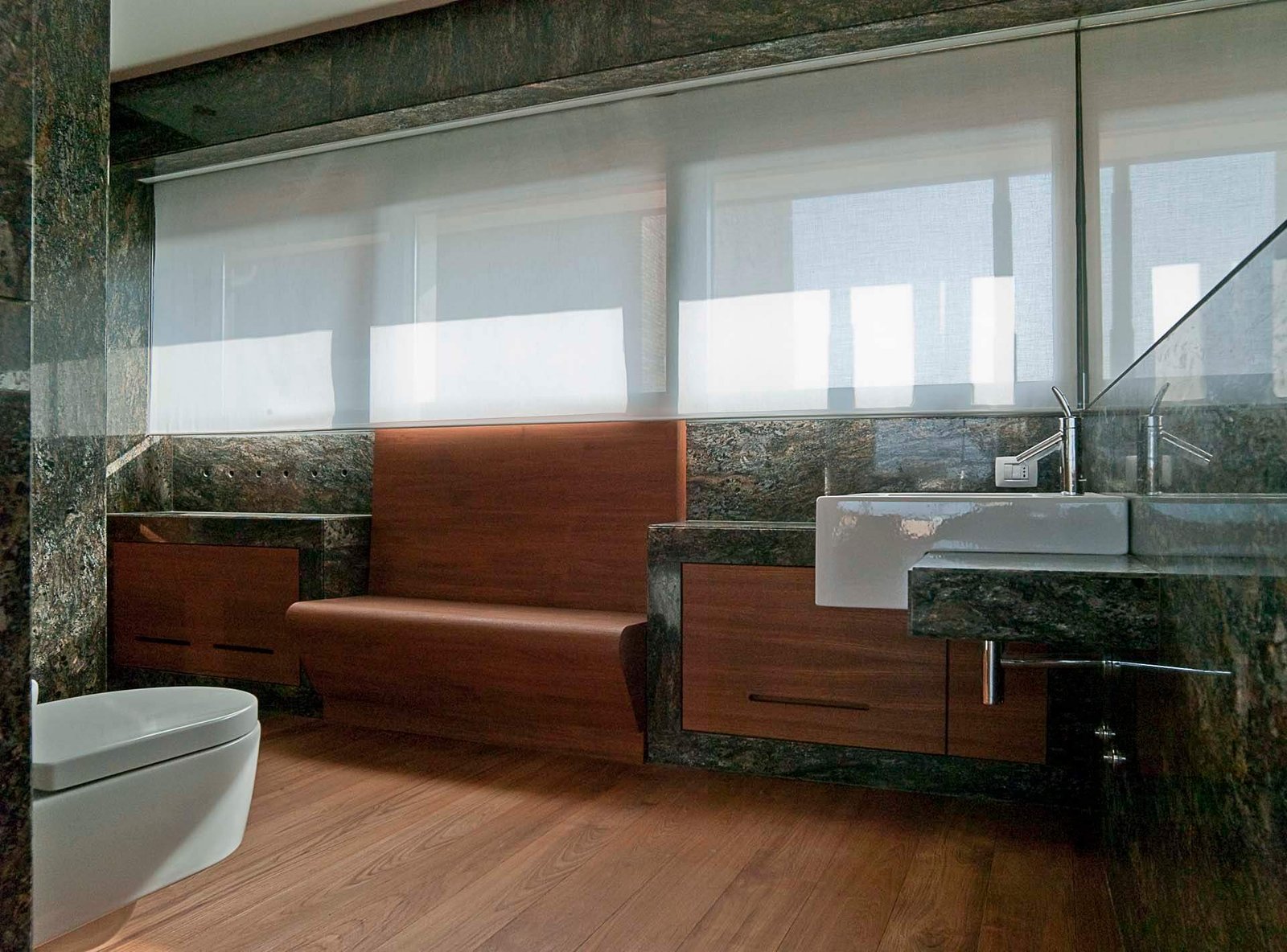
Lessons from real cladding projects
The bathrooms shown in this guide are from our Private Villa Milan project, and a few things from that job and others like it hold true across most of the cladding work we do.
Select the block, not the swatch. A ten-centimetre sample tells you almost nothing about how a veined stone will behave across an entire wall. For any cladding job using a dramatic marble, we ask clients to review full slabs or, ideally, the block itself before cutting begins.
Plan the joints before the stone is cut. Where a vein crosses a corner, how a pattern lands around a window or door, which slab goes where — these decisions belong on a layout drawing made before the saw runs, not worked out on site. Every cladding job we are unhappy with in hindsight skipped this step somewhere.
One dramatic stone is usually enough. Cladding an entire bathroom in a bold, veined marble works because the room commits fully to one material. Combining two bold stones on adjacent walls almost always fights rather than complements, however good each looks alone.
Vertical surfaces are the forgiving choice. If a client is nervous about committing to a dramatic or expensive stone because of maintenance, cladding is the lowest-risk application in the house. It never faces the acid exposure a worktop does, so the material can be as bold as the design calls for.
Choosing marble wall cladding with Purapietra
We select, cut and finish every cladding project as a bespoke job rather than from a fixed catalogue of tile sizes. Blocks are chosen with the client, slabs are laid out and numbered on the block face before cutting, and finishing is done by hand once the panels are on site, which is the stage where a good installation becomes a genuinely seamless one. The full range of whites, blacks, greys and coloured stones suited to cladding is shown in our materials catalogue. Write to us with a wall, a room or even just a photograph of what you have in mind, and we will talk through slab against tile, the right stone and what it will honestly cost.
Frequently asked questions about marble wall cladding
What is marble wall cladding?
It is the practice of covering a structural wall with a layer of marble — as full slabs, tiles or bookmatched panels — rather than building the wall from solid stone. The wall provides the structure and the marble provides the finish, fixed with adhesive and, for larger pieces, mechanical anchors.
Should I choose slabs or tiles for marble cladding?
Full slabs give a continuous surface with no repeated joints and suit stones with a bold or dramatic pattern. Tiles are more economical and easier to source or replace, and work best with quieter, more uniform stones such as travertine, where a repeating pattern is less noticeable.
How thick should marble wall cladding be?
Twenty millimetres is standard for most residential cladding. Thinner options around 10 to 12 millimetres exist for large-format, lightweight applications, usually bonded to a backing panel, while some monumental feature walls use full 30-millimetre slabs, which requires stronger structural fixing.
Is marble cladding suitable for a bathroom?
Yes, and it is one of the best applications for marble generally, because a wall never faces the acid exposure a worktop does. Running one stone from floor to ceiling and into the shower enclosure removes grout lines and gives even a small bathroom real depth.
Does marble wall cladding need much maintenance?
Less than a marble floor or worktop. A penetrating sealer applied at installation and refreshed every few years, plus cleaning with warm water and a pH-neutral stone soap, is normally sufficient, since nothing acidic or abrasive routinely touches a wall.
What is bookmatched marble cladding?
It is a technique where two slabs cut sequentially from the same block are mirrored along the joint, so the veining forms a symmetrical pattern. It requires the slabs to be selected and installed in the exact sequence they were cut, and it produces the most dramatic result of any cladding method.
Calacatta Borghini Marble: Characteristics, Origin and Design Uses
Of all the slabs that pass through the workshop labelled “Calacatta”, Borghini is the one a client recognises from a photograph before we say the name out loud. It runs warmer than the cold Apuan whites, bolder than a quiet Carrara, and it does something few marbles manage: it looks in the room almost exactly as it looked in the picture that sold the client on it.
Calacatta Borghini is a warm white marble with wide, decisive veining in grey and soft gold, quarried in the Apuan Alps alongside the more famous Calacatta varieties but with a character of its own — heavier veins, a creamier ground, and a contrast that reads as generous rather than sparse. It has become one of the most requested stones in high-end bathrooms and kitchens over the last decade, for reasons that hold up once you look past the photographs. This guide covers where it comes from, how to read a slab before you commit to one, the finishes worth considering, where it earns its place indoors, and what actually drives the price.
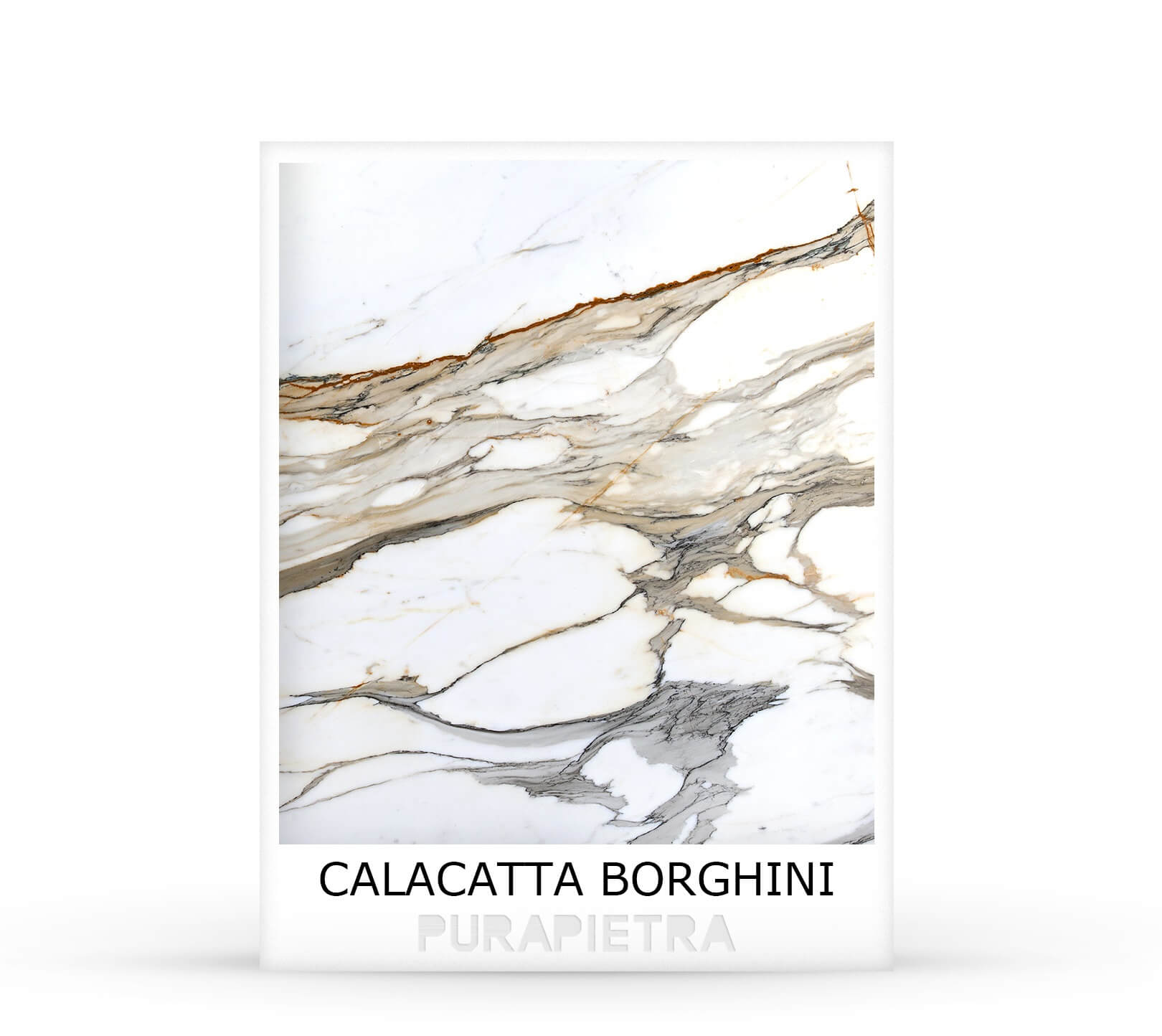
Where Calacatta Borghini comes from
Calacatta Borghini is extracted from the Apuan Alps above Carrara, the same district that produces Carrara, Statuario and the other Calacatta varieties. All of these whites start as the same limestone, recrystallised over millions of years under heat and pressure into the dense, interlocking calcite structure that gives marble its particular way of holding light. What separates one Calacatta name from another is which bench it comes from and how the mineral impurities in that specific bed arrange themselves into veining. The general geology of the district is covered well on Wikipedia’s entry on Carrara marble, though the commercial names used in the trade — Borghini among them — are a layer the geology alone does not explain.
In practice, “Borghini” refers to material from a specific quarry front known for producing a warmer, creamier ground than the classic Calacatta Oro or the cooler Calacatta Vagli, with veining that tends to run wide and continuous rather than fine and scattered. It is not a protected term the way a wine appellation is, so slabs sold under the name vary more than buyers expect. Judging the stone in person, or at least from full-slab photographs rather than a swatch, is the only reliable way to know what is actually being quoted.
Calacatta Borghini against its closest relatives
Clients most often compare Borghini with two other stones in our catalogue. Against Bianco Statuario, Borghini is warmer and its veining is bolder and more continuous, where Statuario stays cooler and sparser. Against a standard Calacatta, Borghini tends to carry more gold in the vein and a creamier field. Neither comparison makes one stone better than the other — they simply photograph and live differently, which is why we always recommend seeing full slabs side by side rather than choosing from memory or a name alone. If you want colour rather than gold, Calacatta Viola takes the Calacatta family in a very different direction.
Appearance: colour, veining and character
The ground in Calacatta Borghini sits somewhere between ivory and warm white, never the cold blue-white of the top Statuario grades. Against that field, the veining runs in broad, confident streaks of grey shot through with soft gold, often branching into secondary veins that give the slab a sense of movement rather than a static pattern. On the best material the veins have a directionality you can follow across the whole slab, which matters enormously once you get to layout.
Three things are worth checking before ordering. First, the density of veining: some blocks yield slabs with veining concentrated in bands, others scatter it more evenly, and the two look completely different once installed. Second, the gold content: it can range from a faint warmth to a pronounced ochre streak, and that shifts which metals and timbers will sit comfortably next to it. Third, consistency across slabs from the same block — because Borghini’s veining is bold, mismatched slabs on either side of a joint are more noticeable than they would be on a quieter stone. Our guide on how to identify quality marble goes through the habits we use to judge a block before it is cut.
Finishes for Calacatta Borghini
Polished
Polishing is the finish that made this stone famous. It deepens the contrast between the warm ground and the grey-gold veining, and it lets the surface catch light the way the photographs promise. Polished Borghini belongs on vertical surfaces and feature pieces — a bathroom wall, a kitchen splashback, a console — where nothing acidic touches it and the gloss has nothing to work against.
Honed
A honed finish softens the contrast slightly and takes the surface out of direct reflection, which makes daily etching from lemon, wine or vinegar far less visible. On worktops and floors, honed is almost always the more sensible specification, and on Borghini specifically it has the side benefit of calming a pattern that some clients find too busy in full gloss.
Brushed
Brushing leaves a fine, tactile texture that mutes the veining considerably. It suits a bench, a shower seat or an exterior application where grip and a softer visual read matter more than showing off the pattern. Given how much of Borghini’s appeal is in its veining, we rarely recommend brushing for a feature application — it is the right choice when the stone is doing textural rather than decorative work.
Best uses for Calacatta Borghini in interior design
Bathrooms
This is where Calacatta Borghini is asked for more than anywhere else, and for good reason. A bathroom is small enough that one bold stone can carry the whole room, and the veining reads as composition rather than noise when it is book-matched across a vanity wall or shower enclosure. Paired with a sculpted piece such as our wall-mounted Linear basin or a carved Unit Sink, the material becomes the room’s single organising idea rather than one surface among several.
Kitchens
Calacatta Borghini islands are a classic request, and the honest caveat applies here as it does to every calcite marble: it etches on contact with acid. Lemon juice, wine, vinegar and most descaling products will dull a polished surface. Specify a honed finish for the worktop, seal it properly at installation, and treat the surface’s evolving patina as part of owning the stone rather than a defect. If a perfectly unchanged worktop is the priority, quartzite is the honest recommendation, not this marble.
Cladding and feature walls
Because nothing acidic reaches a vertical surface, cladding is the safest and often the most dramatic use of Borghini. A polished wall in an entrance, behind a bed or lining a shower gives the veining room to run uninterrupted, and it is where the stone’s bold character becomes an asset rather than something to manage. The technical work is in the layout — matching veins across joints and deciding, before the block is cut, where a vein is allowed to cross a corner.
Worktops and vanity tops
On a smaller surface such as a vanity, Borghini’s wide veining can dominate a slab in a way that looks striking on some pieces and cramped on others, depending on where the cut falls. Selecting the actual slab rather than a swatch matters more here than on almost any other application, because a beautiful three-metre kitchen slab does not automatically yield a beautiful one-metre vanity top from the same block.
Design objects
Trays, vases and small sculptural pieces cut from Borghini offcuts carry the stone’s character at a domestic scale, letting a client own the material without committing a whole room to it. Our marble trays and vases are cut and finished this way, using material that would otherwise be waste from larger commissions.
Pairing Calacatta Borghini with other materials
Brushed brass and warm bronze. The gold in the veining makes warm, unlacquered metals the natural partner. The pairing gets better as the metal ages, which is part of why it is used throughout our New Era collection.
Walnut and other dark timbers. A dark, warm wood grounds the marble’s brightness and gives the eye somewhere to rest between the vein and the field. It is the pairing we default to in bathroom joinery.
Cream and travertine tones. Rather than contrast, pairing Borghini with a warm neutral palette lets the stone stay the single loud voice in the room, which suits clients who want drama without a busy scheme.
A quieter white elsewhere in the house. Because Borghini is one of the boldest whites we offer, using it in one room and a calmer stone such as Bianco Statuario or a classic white marble elsewhere keeps the house from feeling like every surface is competing for attention.
Maintenance and sealing
Seal on installation, then keep to a schedule. A penetrating, impregnating sealer reduces how much liquid the stone absorbs without changing its surface. Refresh it every two to four years on worktops and less often on walls, and avoid film-forming coatings, which peel unevenly over time.
Clean with pH-neutral products only. Warm water and a neutral stone soap deal with almost everything a household throws at marble. Bleach, vinegar and citrus-based cleaners all etch the surface directly, and most of the damage we are asked to repair traces back to a cleaning product rather than everyday use.
Blot spills, do not wipe. Oil and wine stain because they are absorbed into the stone; acid etches because it dissolves the surface chemically. Blotting a spill within a few minutes stops most staining before it starts. A poultice can lift an absorbed stain afterwards, but an etch mark has to be re-honed out.
What drives the price of Calacatta Borghini
There is no single reliable square-metre figure for this stone, and any quote given without seeing the specific slab should be treated cautiously. Price is set by four things: the grade of the block, the thickness specified, how much of the raw block ends up as usable finished material, and the hours of hand finishing involved. Because Borghini’s appeal is precisely its bold, continuous veining, blocks that yield large, well-matched slabs command a real premium over material with the same name but less dramatic patterning.
As a family, Calacatta marbles sit toward the top of the Italian white hierarchy, generally above standard Carrara and travertine, and broadly comparable to — sometimes above — Bianco Statuario depending on the specific grade and how dramatic the veining is. What a client pays for is the visual character and the selection process behind it, not a difference in hardness or how the stone performs day to day.
Why choose Calacatta Borghini with Purapietra
We treat marble as a structural material, not a surface to apply. Pieces are roughed on CNC for precision and finished entirely by hand, which is the stage where an edge stops looking machined and starts looking resolved. For any project using Calacatta Borghini we ask clients to select the block itself and we lay out the veining on the block face before the first cut, so nothing about the finished piece — the direction of a vein, the match across a joint — is left to chance.
Calacatta Borghini and the rest of our white, coloured and rare stones are shown in the materials catalogue. If the drama of Borghini is more than a project needs, Bianco Statuario and our broader guide to Italian white marble cover the calmer alternatives we most often propose instead. Write to us with a room, a drawing or simply a photograph, and we will tell you honestly what the stone can do and what it will cost.
Frequently asked questions about Calacatta Borghini
What is Calacatta Borghini marble?
It is a warm white marble quarried in the Apuan Alps near Carrara, part of the Calacatta family, defined by a creamy ground and bold, wide veining in grey and soft gold. It is one of the more dramatic and widely requested Calacatta varieties used in high-end interiors.
How much does Calacatta Borghini cost?
There is no fixed square-metre price, because cost depends on block grade, slab thickness, usable yield and finishing hours. It sits toward the top of the Italian white marbles, broadly comparable to or above Bianco Statuario depending on how dramatic and well-matched the veining is. We quote per project once the slab and finish are defined.
Is Calacatta Borghini good for a bathroom?
Yes, and it is one of the most requested applications for this stone. A bathroom is small enough for one bold material to carry the whole room, and book-matching the veining across a vanity wall or shower enclosure turns the pattern into composition rather than noise.
Can Calacatta Borghini be used for a kitchen worktop?
Yes, with the same caveat as any calcite marble: it etches on contact with acid from lemon, wine or vinegar. Specify a honed rather than polished finish, seal it at installation, and accept that the surface will develop a patina over time. If an unchanged worktop is essential, quartzite is the more suitable material.
What is the difference between Calacatta Borghini and Bianco Statuario?
Borghini has a warmer, creamier ground and bolder, wider, more continuous veining with a gold undertone. Bianco Statuario is cooler and brighter with sparser, more graphic grey veins. Both are premium Italian whites; the choice usually comes down to whether a room wants a bold, warm statement or a quieter, colder one.
How do I care for Calacatta Borghini marble?
Seal it with a penetrating impregnating sealer on installation and reapply every two to four years on worktops. Clean only with pH-neutral products, avoid bleach and citrus-based cleaners, and blot spills quickly rather than wiping them, since oil and wine stain while acid etches the surface directly.