
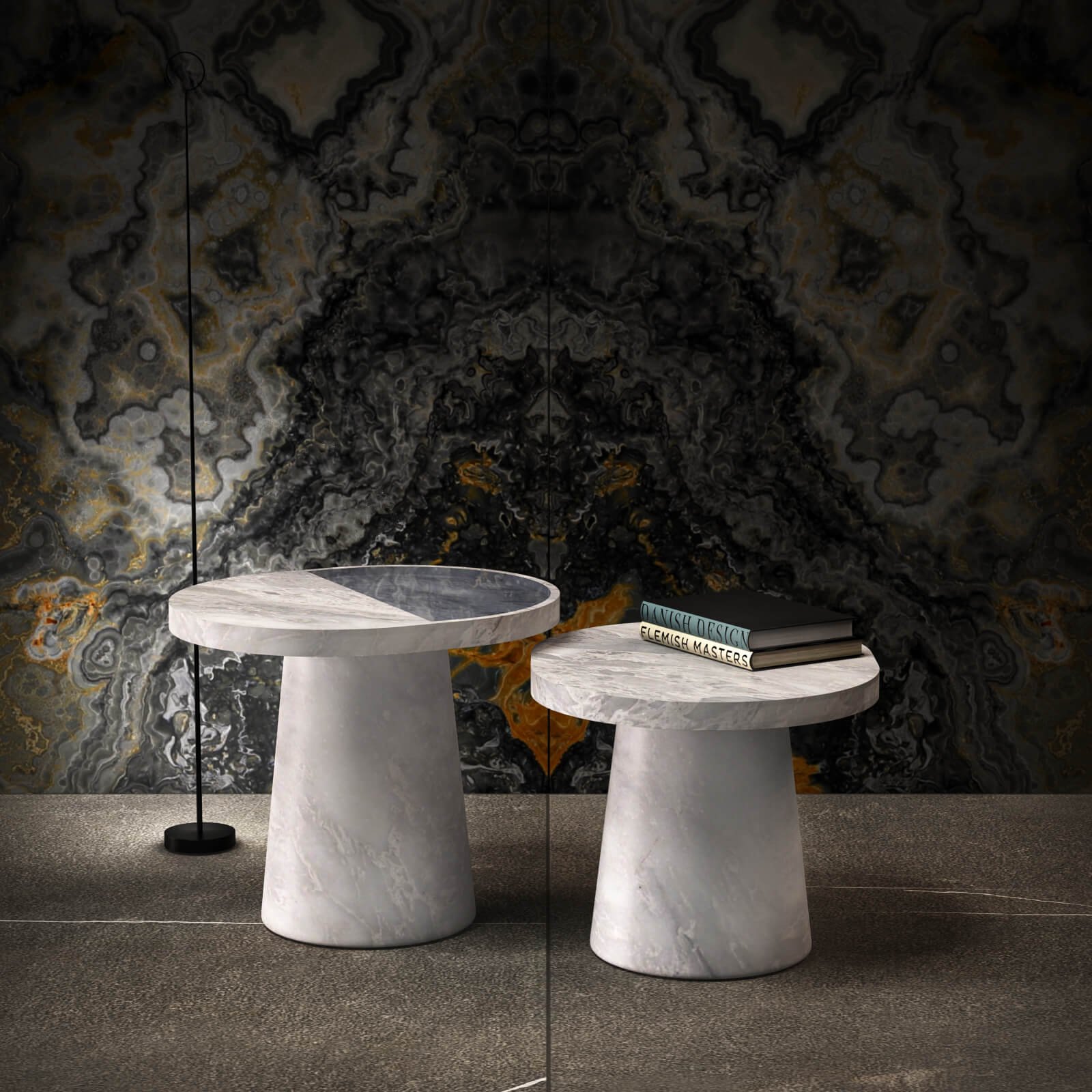
Marble durability is a subject full of contradictions. Roman marble floors are still walking surfaces two thousand years after they were laid, and the same material in a modern kitchen can pick up a dull ring from a lemon in under a minute. Both facts are true, and holding them together is the only honest way to answer the question.
Marble durability is what almost every client wants to know before they commit to a piece, usually phrased as some version of “will it get ruined?”. The short answer is that marble is structurally one of the longest-lived materials available to a builder and chemically one of the more reactive ones. It does not wear out. It records what happens to it. Understanding that distinction is what separates a client who is delighted with their stone after five years from one who is disappointed after five weeks.
This guide sets out what marble durability means in practice: how hard the stone actually is, the three things that genuinely damage it, what sealing does and does not achieve, and how long a marble surface lasts in each room of a house.

Marble durability starts with hardness
Any conversation about marble durability has to begin with a number. Marble sits at roughly 3 to 5 on the Mohs scale of mineral hardness, depending on the density of the recrystallised calcite. For comparison, a fingernail is about 2.5, a steel knife blade around 5.5, quartz is 7 and granite falls between 6 and 7. You can find the full scale on Wikipedia.
Those numbers explain a lot. A dropped fork will not mark marble. A ceramic bowl dragged across it might. Grit tracked in on a shoe is the real enemy of a marble floor, because quartz sand at hardness 7 will abrade a hardness-4 surface every time someone walks across it. This is why entrance matting matters more to a marble floor than any sealer ever will.
Compressive strength is a different story and a far more flattering one. This is the side of marble durability that gets forgotten: the stone handles enormous static load, which is why it has been a structural and monumental stone since antiquity. A 3-centimetre slab supported correctly will carry anything a domestic interior asks of it, and a solid carved piece such as a bath or a table base is effectively permanent.
Density is not uniform across the family
Marble durability varies within the family itself. The tightly crystallised Italian whites tend to be denser and less absorbent than softer, more porous decorative stones, and onyx behaves differently again. When we assess a block in the workshop we are looking at crystal size and porosity as much as at pattern, and those two properties predict how the finished piece will age. Our guide on how to identify quality marble goes through what to look for.
The three threats to marble durability
Three mechanisms account for nearly all the damage we see, and only one of them is what most people expect.
Acid etching
This is the big one. Marble is calcium carbonate, and calcium carbonate dissolves on contact with acid. Lemon juice, vinegar, wine, tomato, cola, and most limescale removers will leave a dull matt spot where the polish has been chemically removed. It happens in seconds and it is not a stain: the mark is a change in surface texture, not a discolouration, so scrubbing achieves nothing.
Etching is also the single most manageable problem in the list, because it is almost invisible on a honed surface. A matt finish has no gloss to interrupt, so an etch mark blends into the surrounding surface. Specifying honed rather than polished for any horizontal working surface removes most of the anxiety in one decision.
Staining
Staining is absorption rather than reaction, and it is the threat to marble durability that a sealer genuinely addresses. Oil, coffee, red wine and rust migrate into the pore structure and darken the stone from within. Unlike etching, staining is genuinely preventable: a penetrating sealer slows absorption enough that a spill can be blotted before it travels, and most stains that do take hold can be drawn back out with a poultice.
Abrasion and impact
The third limit on marble durability is mechanical. Scratches come from harder materials moving across the surface under pressure. On floors that means grit; on worktops it means unglazed ceramic bases and, occasionally, a knife used directly on the stone. Impact damage is rarer and tends to be confined to exposed edges and corners, which is a reason to specify a slightly softened edge profile rather than a sharp arris on anything in daily circulation.
Sealing: what it does and what it does not
Sealing is the most misunderstood part of marble durability, mostly because the word suggests a protective layer that is not actually there. It is also the only part of marble durability that an owner can meaningfully control after installation.
A modern impregnating sealer is not a coating. It penetrates the pore structure and lines it, so liquids bead and sit on the surface long enough to be wiped away instead of soaking straight in. It buys time. That is its entire job, and it is a genuinely useful one.
What a sealer does not do is make marble acid-proof. Etching happens at the surface, above the level the sealer occupies, so a sealed polished worktop will etch exactly as fast as an unsealed one. Any product sold on the promise of preventing etch marks is either a film-forming coating, which will scuff and yellow, or it is overselling.
A practical schedule. Seal on installation. Re-seal working surfaces such as kitchen tops and vanity units every twelve to eighteen months. Floors need it every two to three years depending on traffic. Vertical cladding rarely needs re-sealing at all. The test is simple: drop water on the surface, wait five minutes, and if the stone darkens where the water sat, it is time.
Everyday habits that protect marble durability
Marble maintenance is less demanding than its reputation suggests, but the small habits are the ones that compound.
Clean with pH-neutral products only. Warm water and a neutral stone soap handle almost everything. Every all-purpose spray containing citrus, every bathroom cleaner marketed as descaling, and every vinegar-based recipe from the internet will slowly dull the surface.
Blot spills, do not wipe them. Wiping spreads a spill across a wider area and pushes liquid into the pores. Press with a dry cloth, lift, repeat.
Use boards and trivets in kitchens. Not because heat damages marble, which it largely does not, but because a cutting board keeps acidic food and hard ceramic off the stone.
Keep grit off floors. Matting at entrances and regular dry sweeping do more for a marble floor over twenty years than any treatment applied to it.
Do not reach for abrasives. Scouring pads and cream cleaners will remove a polish permanently and unevenly. A deep etch or scratch is a job for a stone restorer, who can re-hone or re-polish the affected area and return it to a uniform surface.
Marble durability room by room
Lifespan is not a single number, because marble durability depends entirely on what the surface is asked to do.
Cladding and vertical surfaces. Effectively permanent. Nothing touches it, nothing spills on it, and a polished finish applied on installation will still be intact in fifty years. This is where marble is at its most reliable and its most luminous. It is also the reason we so often steer a client who loves polished stone towards a wall instead of a worktop.
Bathrooms. Decades, with the caveat that limescale and the products used to remove it are the main risk. Water alone is harmless. Descaler is not. Keeping a bathroom marble surface dry and using neutral cleaners is enough.
Kitchens. A honed marble worktop will last as long as the kitchen, but it will not look untouched. Expect a slow accumulation of faint marks that eventually read as a uniform patina rather than as individual defects. Most people stop noticing them within a year. Those who cannot accept the process should not specify marble, and we tell them so before the quotation stage.
Floors. Centuries in principle, and this is where the historic evidence is strongest. In practice a domestic marble floor will need re-honing once or twice in a lifetime to remove accumulated traffic wear. That is a restoration of the surface, not a replacement of the material.
Solid objects and furniture. This is marble durability at its best. Carved pieces such as vases, trays and freestanding basins are the most durable format of all, because the mass is uniform through the full thickness. There is no substrate to fail and no thin edge to chip. A solid marble piece is a generational object.
How marble durability compares to the alternatives
It is worth being clear about where marble sits, because the honest comparison usually helps rather than hurts.
Granite is harder and acid-resistant, so it etches far less and takes abrasion better. It also looks like granite, with a granular speckled field rather than veining, which is a different aesthetic proposition entirely.
Quartzite is the closest thing to marble that resists acid, because it is silica-based rather than carbonate-based. Some quartzites carry veining that reads convincingly marble-like. It is the material we recommend when a client wants the look and will not accept any change over time.
Engineered quartz is consistent, non-porous and requires no sealing. It is also visually flat, since the pattern is printed or scattered rather than geological, and it will not take a re-polish when it eventually scratches.
Marble’s argument against all three rests on a particular reading of durability: it is the only one of the four that improves rather than degrades. A resin surface at year fifteen looks tired. A marble surface at year fifteen looks lived in, and it can be brought back to new with a mechanical re-finish that no engineered material accepts.
Choosing a stone with marble durability in mind
Marble durability starts at selection. A denser block with a tighter crystal structure will absorb less, hold an edge better and take a re-polish more evenly than a soft, porous one, and that difference is visible in the slab long before it is visible in the finished piece.
In our workshop, pieces are cut from solid blocks, shaped on CNC and finished by hand by Italian craftsmen, which means the surface quality is controlled at the point where it matters most. Our full range of marbles, onyxes and rare stones, with notes on the character of each, is in the materials catalogue. If you are choosing between whites, the white marble guide covers the family in detail, and travertine is worth reading if you want a warmer stone with a different wear profile. For the geology behind all of it, Wikipedia’s marble entry is a reasonable starting point.
Frequently asked questions about marble durability
How long does marble last?
Structurally, indefinitely, which is why marble durability is usually a question about finish rather than about material. Roman and Renaissance marble surfaces are still in use today. What changes over time is the finish rather than the material, and a worn or etched surface can be re-honed or re-polished back to a uniform appearance, which is not possible with engineered alternatives.
Does marble stain easily?
Unsealed marble absorbs oil, wine and coffee fairly readily because it is porous. A penetrating sealer slows absorption enough that most spills can be blotted before they take hold, and stains that do set can usually be drawn out with a poultice rather than removed mechanically.
Does marble scratch?
Yes, from anything harder than about 4 on the Mohs scale. In practice that means quartz grit on floors and unglazed ceramic on worktops rather than cutlery or glassware. Honed surfaces disguise light scratching considerably better than polished ones.
Can etch marks be removed from marble?
Yes. An etch is a change in surface texture rather than a stain, so it is corrected by re-finishing the surface, not by cleaning it. Light etching on a honed surface can often be buffed out with a fine abrasive pad; deeper marks on polished stone need a stone restorer.
Is sealing marble really necessary?
For any horizontal surface in use, yes. Sealing does not prevent acid etching, but it substantially reduces staining, which is the damage most likely to be permanent. Vertical cladding that never gets touched can generally be left after the initial application.
Is marble a good choice for a family kitchen?
The answer depends on tolerance rather than on marble durability itself. Honed marble in a busy kitchen will develop a patina within the first year and then change very little afterwards. Households that want a surface to look identical in ten years are better served by quartzite or engineered quartz.
Does heat damage marble?
Marble is not combustible and tolerates normal cooking temperatures without discolouring. The risk from a very hot pan placed directly on stone is thermal shock cracking rather than scorching, which is rare but not impossible. A trivet removes the question entirely.
How often should marble be resealed?
Kitchen worktops and vanity tops every twelve to eighteen months, floors every two to three years, cladding rarely. Test by leaving a few drops of water on the surface for five minutes: if the stone darkens underneath, the sealer has stopped working.