
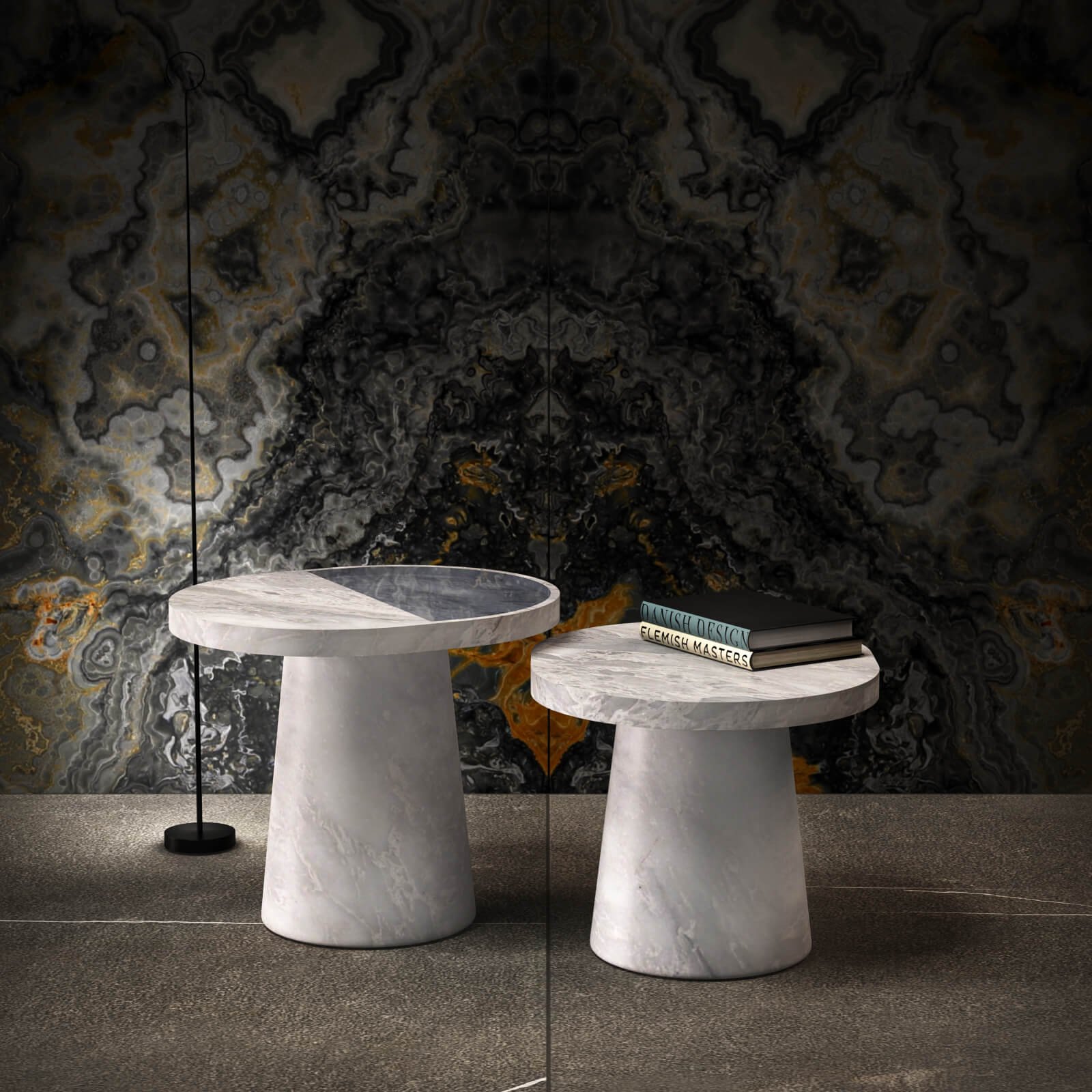
Travertine is the warm one. Where marble can feel cool and formal, travertine brings the temperature of a room up, and it does it with a surface that shows how it was made. This guide covers what the stone actually is, how the finish changes its character completely, where it belongs in a contemporary interior, how it compares with marble, and what looking after it really involves.
What travertine is and how it forms
Travertine is a form of limestone, but it is born in a way that sets it apart from every other stone we work with. It precipitates out of mineral springs, usually hot ones, where water saturated with dissolved calcium carbonate reaches the surface, loses pressure and carbon dioxide, and drops its mineral load layer by layer. The process is slow and it is atmospheric: gas escaping through the depositing calcite leaves behind the small open cavities that give the stone its signature. Those pores are not a defect. They are the fossil record of bubbles rising through water thousands of years ago.
The layering matters as much as the porosity. Because the stone builds up in seasonal bands, it has a clear grain, and the direction you cut it changes what you see. Cut across the bands, in what the trade calls a vein cut, and you get long linear striping that reads as calm and architectural. Cut with the bedding, a cross cut, and the same block gives clouded, flowery patterning with a much softer rhythm. Two surfaces from one block, two entirely different moods. It is one of the few materials where the fabricator’s decision is as visible as the quarry’s.
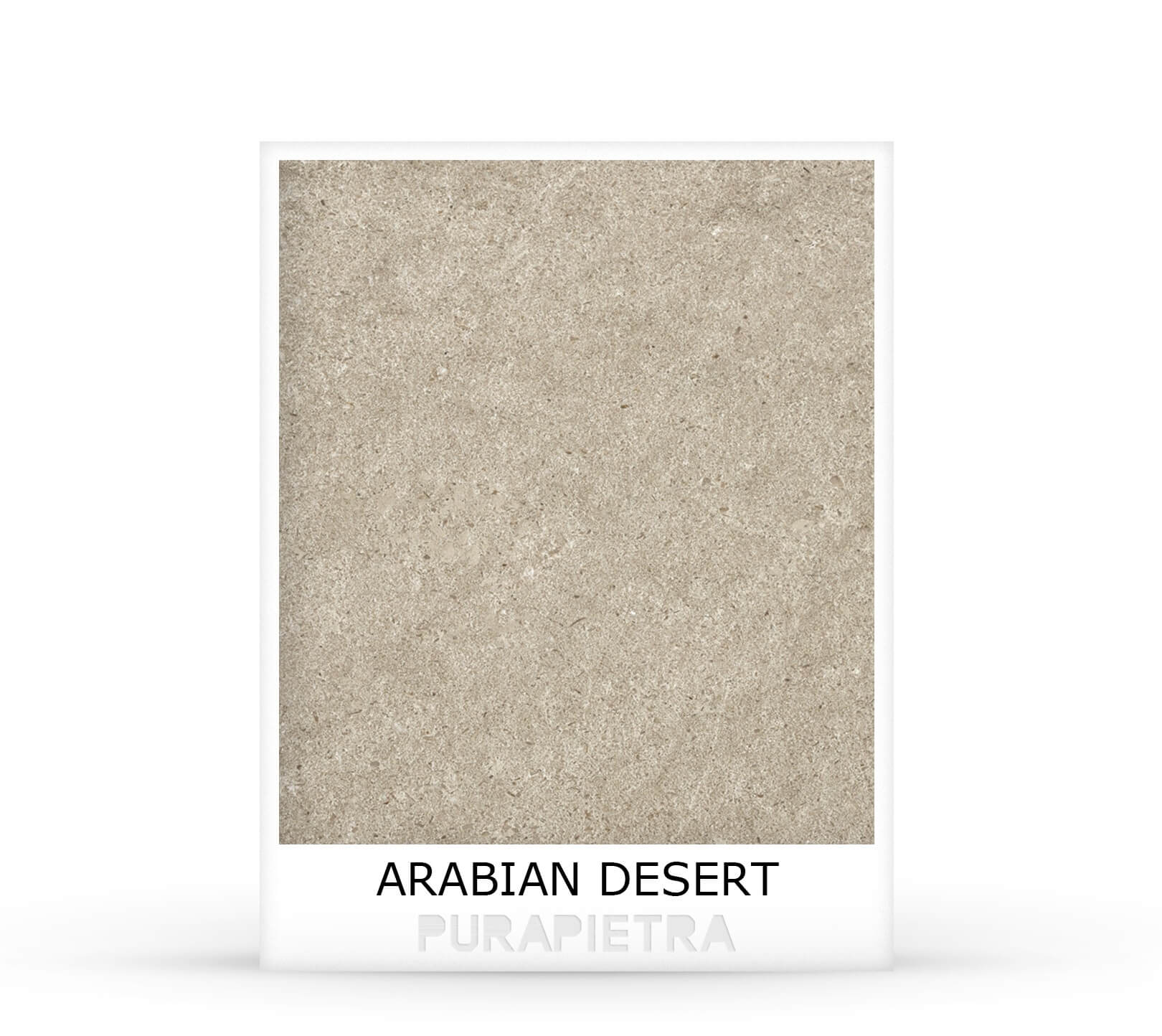
Colour comes from iron and other trace minerals in the source water, which is why it runs from near-white ivory through cream and honey to walnut and, less commonly, a silvery grey. The classic Roman travertine, quarried around Tivoli east of Rome, is the warm ivory most people picture. It has been quarried continuously for more than two thousand years, which tells you something about how the material wears.
Colours and finishes: the same stone, four different characters
More than with almost any other natural stone, the finish decides what the stone looks like in a room. Choosing the stone is only half the decision.
Filled and polished
The pores are filled with a matching resin or cement, then the surface is polished to a reflective sheen. This is the stone at its most formal. It reads closest to marble, catches light, and suits lobbies, feature walls and anywhere you want the stone to look deliberate and dressed. The trade-off is that polishing flattens some of the texture that makes travertine interesting in the first place.
Filled and honed
Filled, then ground to a smooth matt surface. For contemporary interiors this is the one we specify most often. It keeps the banding and the warmth, loses the glare, and does not show water marks or fingerprints the way a polish does. On floors it is also far less slippery, which is not a small point in a bathroom.
Brushed and unfilled
Left open, with the pores visible, and worked with abrasive brushes until the surface has a soft, slightly undulating touch. This is the most tactile version of the stone and the most rustic, though used with restraint it looks anything but. A brushed, unfilled wall in a room of otherwise flat surfaces gives the eye something to rest on.
Bush-hammered and split
Heavier textures, usually kept for exteriors, thresholds and cladding where grip and shadow matter more than smoothness. Worth knowing about even if the project is indoors, because a change of finish between two adjoining surfaces is often a better move than a change of material.
Where to use travertine in contemporary interiors
The reputation travertine carries from the 1970s, endless beige floors in endless beige rooms, is the main thing standing between the material and the credit it deserves. Used with a lighter hand, it is one of the most liveable stones there is.
Bathrooms
Travertine and water have an old relationship, and a honed travertine bathroom feels warmer underfoot and softer in the light than the same room in a cool white marble. Clad one wall rather than four, or run the stone from the floor up into the shower and stop it at a clean horizontal line. A rounded, hand-finished basin in a warm stone reads as sculpture rather than sanitaryware, which is the thinking behind pieces such as our Linear wall-mounted basin and the Unit freestanding basin.
Kitchens
Travertine is softer and more porous than granite, so a full run of worktop in a busy family kitchen asks for commitment and good sealing. Where it works beautifully is everywhere else in the room: a splashback, an island front, a shelf, a wall. The stone takes the hardness out of contemporary cabinetry without any of the noise a strongly veined marble would bring.
Walls, floors and objects
On walls, travertine behaves as a warm neutral. It gives a room a base temperature and then gets out of the way, which makes it unusually forgiving to live with. On floors, a filled and honed finish in a large format keeps the joints quiet and the surface calm. And at the scale of an object, warm stone is at its most persuasive: a bowl, a tray or a vase carries the material into a room with no building work at all. Several of our marble trays and vases exist for exactly that reason.
Travertine vs marble: which one for which job
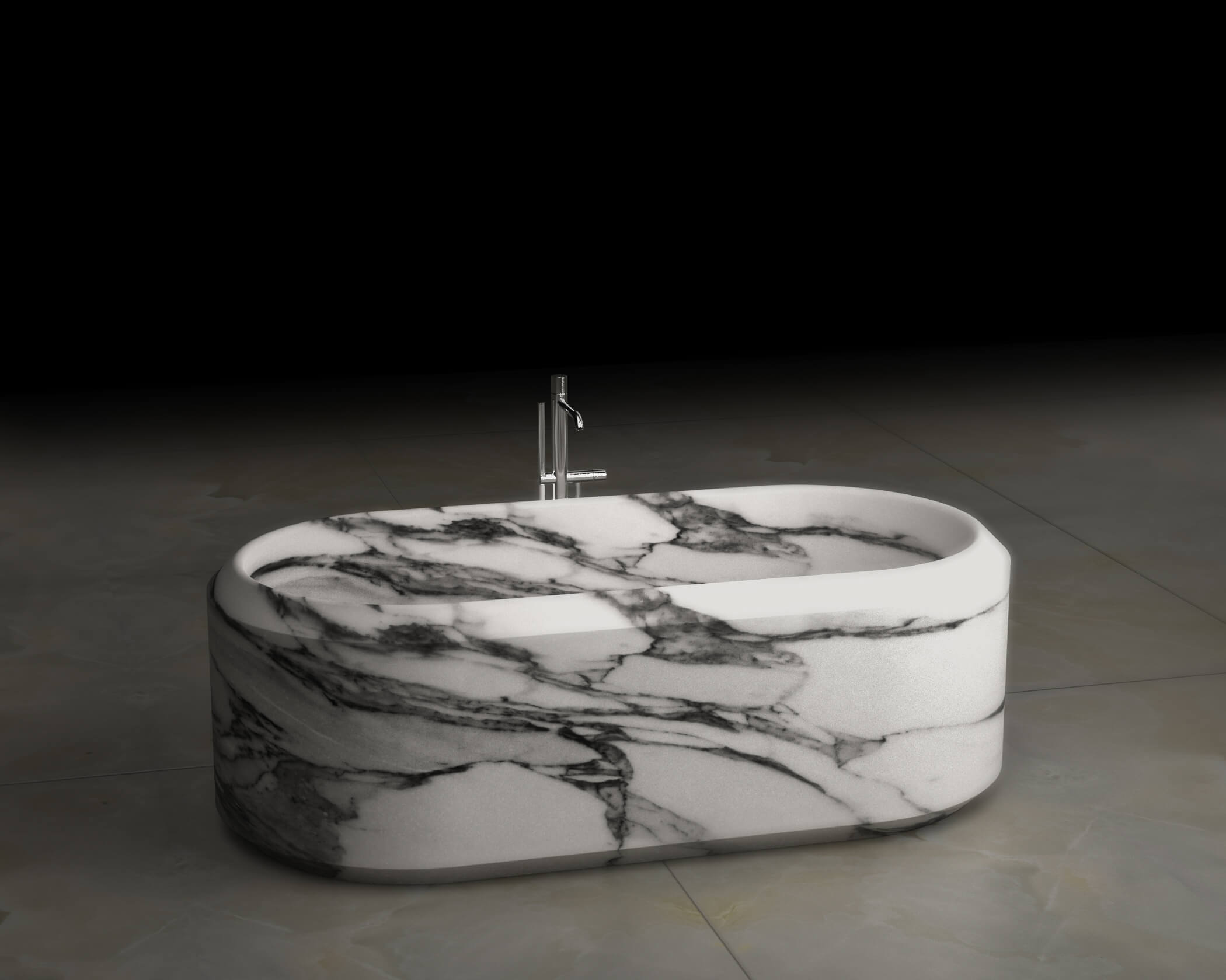
Both are calcium carbonate, both come out of the same broad geological story, and both etch if you leave lemon juice on them overnight. The differences are real, though, and they are practical rather than aesthetic snobbery.
Structure. Marble is metamorphic. Heat and pressure recrystallised the original limestone into a dense, closed mass. Travertine skipped that step, so it stays porous and slightly softer. In numbers, travertine sits around 3 to 4 on the Mohs scale against marble’s 3 to 5, but the porosity matters more day to day than the hardness does.
Look. Marble’s drama comes from veining that cuts across the stone. Travertine’s comes from banding that runs with it, plus the texture of the pores. Marble asks for attention; travertine gives a room a mood. If you want a comparison in the flesh, the white marble guide is a useful counterpoint on exactly this.
Care. Both want sealing and a pH-neutral cleaner. It wants the sealant more, and more often, particularly in wet areas and particularly if it is unfilled. Neither will forgive an acidic bathroom product.
Cost. Travertine is generally the more accessible of the two, which is part of why it appears so often in large-format flooring. Rarer varieties, silver and walnut among them, close that gap quickly.
For the wider picture on how stones compare across colour families, the full range is laid out on our materials page, and there is more background on the material itself on Wikipedia’s travertine entry.
Maintenance: what looking after travertine really means
Less than people fear, but not nothing. Seal on installation, and again every one to three years depending on traffic and whether the surface gets wet. Wipe spills when they happen rather than when you notice them, because the porosity that gives the stone its character also gives a spill somewhere to go. Clean with a pH-neutral stone cleaner and nothing else: no vinegar, no lemon, no generic bathroom spray, no abrasive cream. Put mats at external doors, because grit underfoot does more damage to a stone floor over ten years than any spill will.
If a filled travertine loses a plug of filler, it is a small repair rather than a problem, and a good fabricator will re-fill and re-hone the patch invisibly. Etching, the dull mark left where an acid has touched the surface, can usually be polished back on a honed finish. Deep staining is the one to avoid, and sealing is what avoids it.
Choosing a travertine slab
Three things are worth insisting on. See the actual slab, not a sample chip, because banding and colour vary enormously across a single block. Decide the cut direction and the finish before you fall in love with a photograph, since both change the material more than the choice of quarry does. And ask where the stone is going to be worked. It rewards careful fabrication: clean edge profiles, well-matched filling, joints planned so the banding runs continuously from one panel to the next. That last part is craft, not supply, and it is where a project either looks considered or looks bought.
If you are working towards something specific, whether it is a bathroom, a single carved piece or a full interior, we are happy to talk through the material before anything is committed. Write to info@purapietra.it and we will take it from there.
Frequently asked questions about travertine
Is travertine a type of marble?
No. Both are calcium carbonate stones, but marble is metamorphic, formed when limestone recrystallises under heat and pressure. Travertine is a sedimentary limestone that precipitates from mineral springs and never goes through that transformation, which is why it stays more porous and slightly softer.
Is travertine suitable for bathrooms?
Yes, and it is one of its best uses. Choose a filled and honed finish for grip and easy cleaning, seal it on installation, and use only pH-neutral products. Travertine feels warmer underfoot than marble and diffuses light softly, which suits a bathroom well.
What is the difference between filled and unfilled travertine?
Filled travertine has its natural pores filled with resin or cement before finishing, giving a smooth, closed surface that is easier to clean and better for worktops and floors. Unfilled travertine leaves the pores open for a more textured, tactile look, usually reserved for walls and feature surfaces.
Does travertine stain easily?
It can if it is unsealed, because the porosity gives liquids somewhere to go. Sealed on installation and resealed every one to three years, and with spills wiped promptly, travertine holds up well in daily use.
What is Roman travertine?
Roman travertine is the classic warm ivory stone quarried around Tivoli, near Rome, and used continuously since antiquity in buildings including the Colosseum. It is the reference point most people have in mind when they picture travertine.
Is travertine more expensive than marble?
Usually less, which is one reason it is widely used for large-format flooring and cladding. Rarer varieties such as silver and walnut travertine cost considerably more, and the final figure always depends as much on fabrication and finish as on the stone itself.
Keep exploring the Purapietra magazine. See also our guides to white marble, black marble and green marble, or browse the full materials collection.