
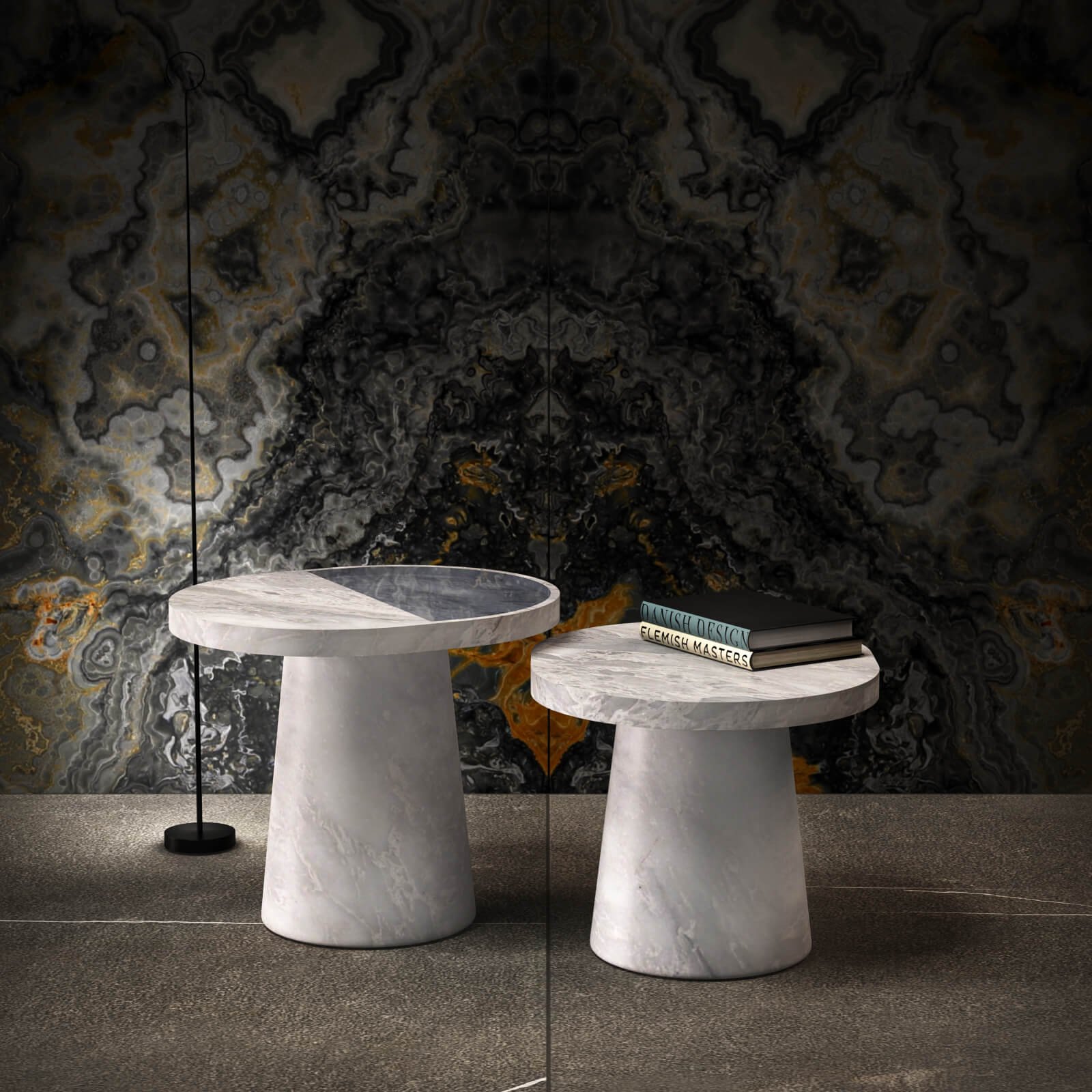
From Bianco Carrara to Statuario, from Calacatta to the whites of the Alps: where white marble comes from, what sets each variety apart, and why it keeps bringing light into the spaces it touches.
There is a moment, in the quarries of the Apuan Alps, when a block of marble freshly cut from the mountain catches the light for the first time after millions of years in the dark. It is a white unlike any other: deep, alive, able to hold the light rather than simply bounce it back. It is the same white Michelangelo searched for among the rocks, the same one the Romans carried into their baths, the same one that enters our homes today as a countertop, a basin, an object.
And yet when we say “white marble” we are not talking about a single stone, but about an entire family. The veining changes, the background changes, even the way light slides across the surface changes. It is worth slowing down to look at them closely, because each one has a story to tell.
Where the white begins
Before it was marble, this stone was the mud of an ancient sea. Marble is born from limestone, a sediment that forms on the seabed from the shells and remains of organisms settling over millennia. Then the Earth does its part: the layers sink, the weight of the rock above crushes them, and the planet’s inner heat wraps around them.
Under that pressure the calcium carbonate transforms. The calcite crystals dissolve and reassemble, fusing into a compact, luminous mass. It is a slow process, metamorphism, one that erases almost every trace of the original sea and leaves behind a fine-grained stone with a faintly sugary surface where it is cut. That whiteness, in the end, is geological time made solid.
The Apuan Alps, above Carrara, are where all of this is easiest to see. Their marble basins have been worked for more than two thousand years, and they still hold some of the most beloved white marbles in the world.
Why white marble is white
The secret of the colour is purity. The more the stone is made of calcium carbonate alone, the whiter it runs. Bianco Carrara, for instance, contains a very high proportion of it: few impurities, and so that clear, even background that made its name.
The veins, then, are purity’s opposite: they are the mark of other minerals trapped during the stone’s formation. A trace of graphite draws a grey vein; a little iron lights up a golden or rosy glow. They are the signature of a single quarry, the reason no two blocks are ever identical and every slab remains, quite literally, one of a kind.
The three souls of Carrara marble
Three great families live side by side in the Carrara district. From a distance they look alike, but anyone who works with them soon learns to tell them apart at a glance.
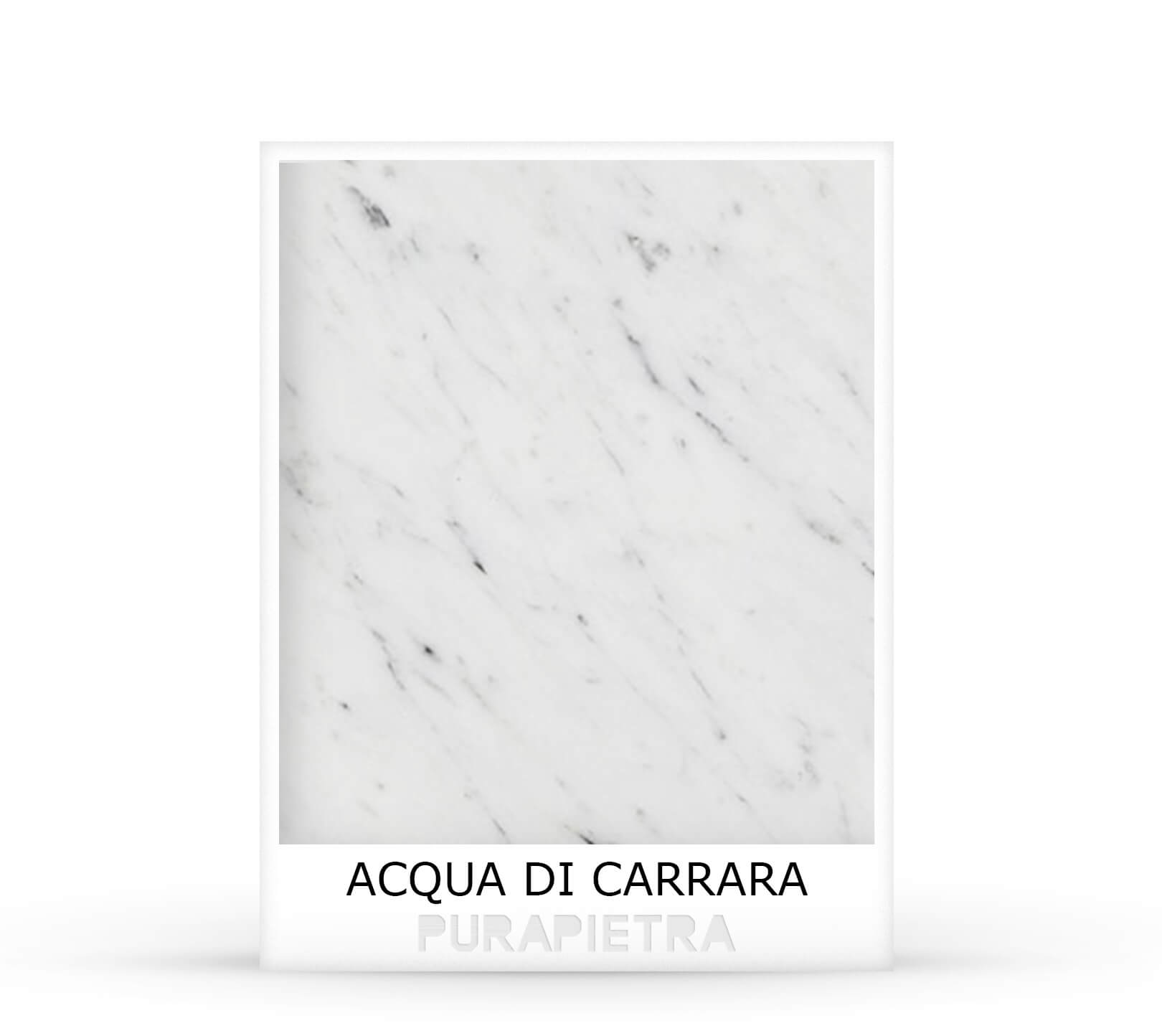
Bianco Carrara
This is the white marble we picture first. Fine grain, a background that runs from white to pale grey, soft and diffuse veining that never steals the scene. It is the most balanced of the three, the one that fits almost anything: floors, cladding, objects. If you want to see how it comes to life in different forms, the Purapietra selection of marbles starts right here.
Statuario
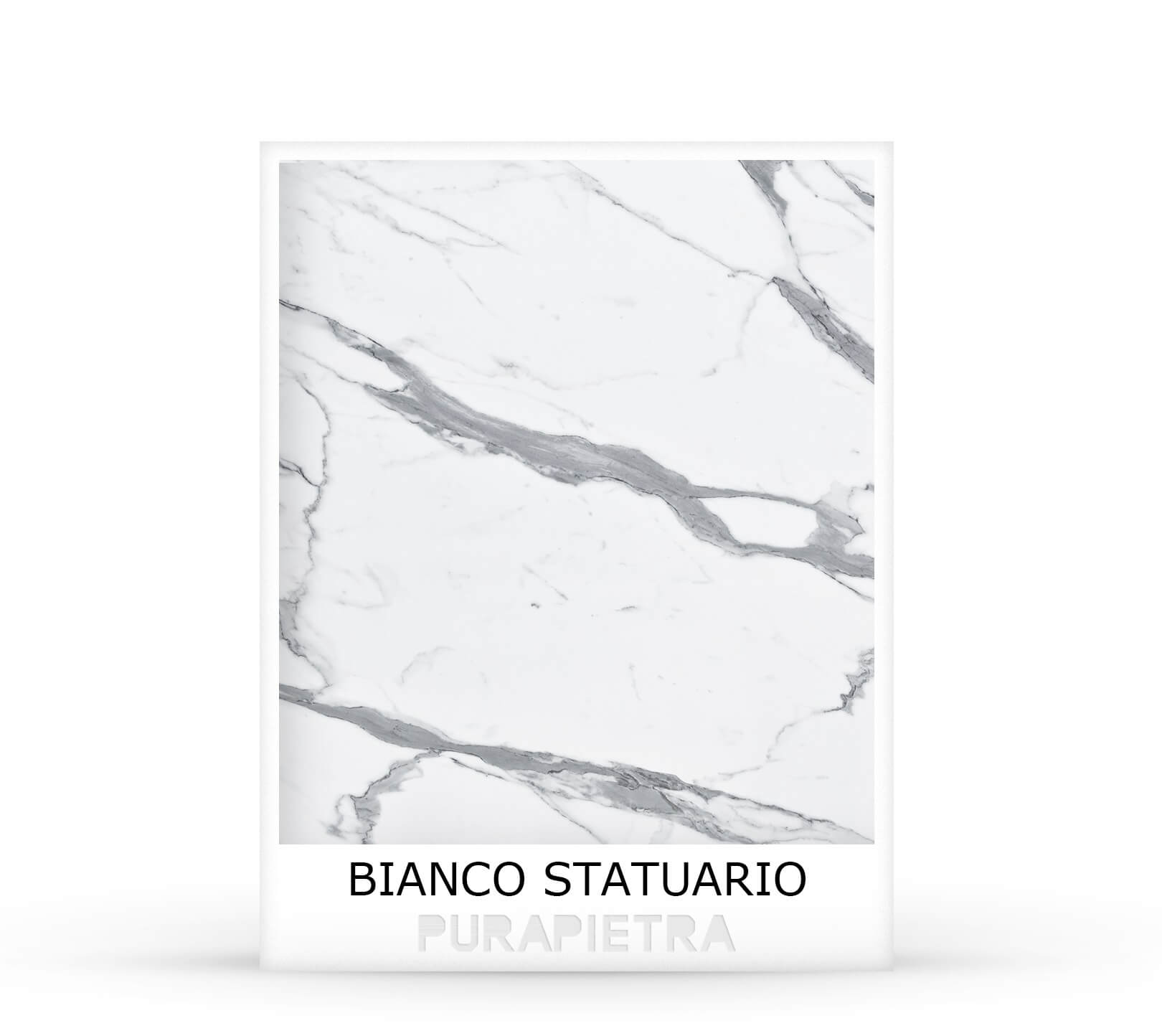
Statuario is the sculptors’ white. An intense, almost icy background, an extremely compact grain, and only a few grey veins, thin and decisive. That very evenness made it, from antiquity onward, the favourite stone for great works: Michelangelo’s David was born from a block of this marble. It is quarried in limited quantities, which is why it remains one of the rarest and most sought-after.
Calacatta
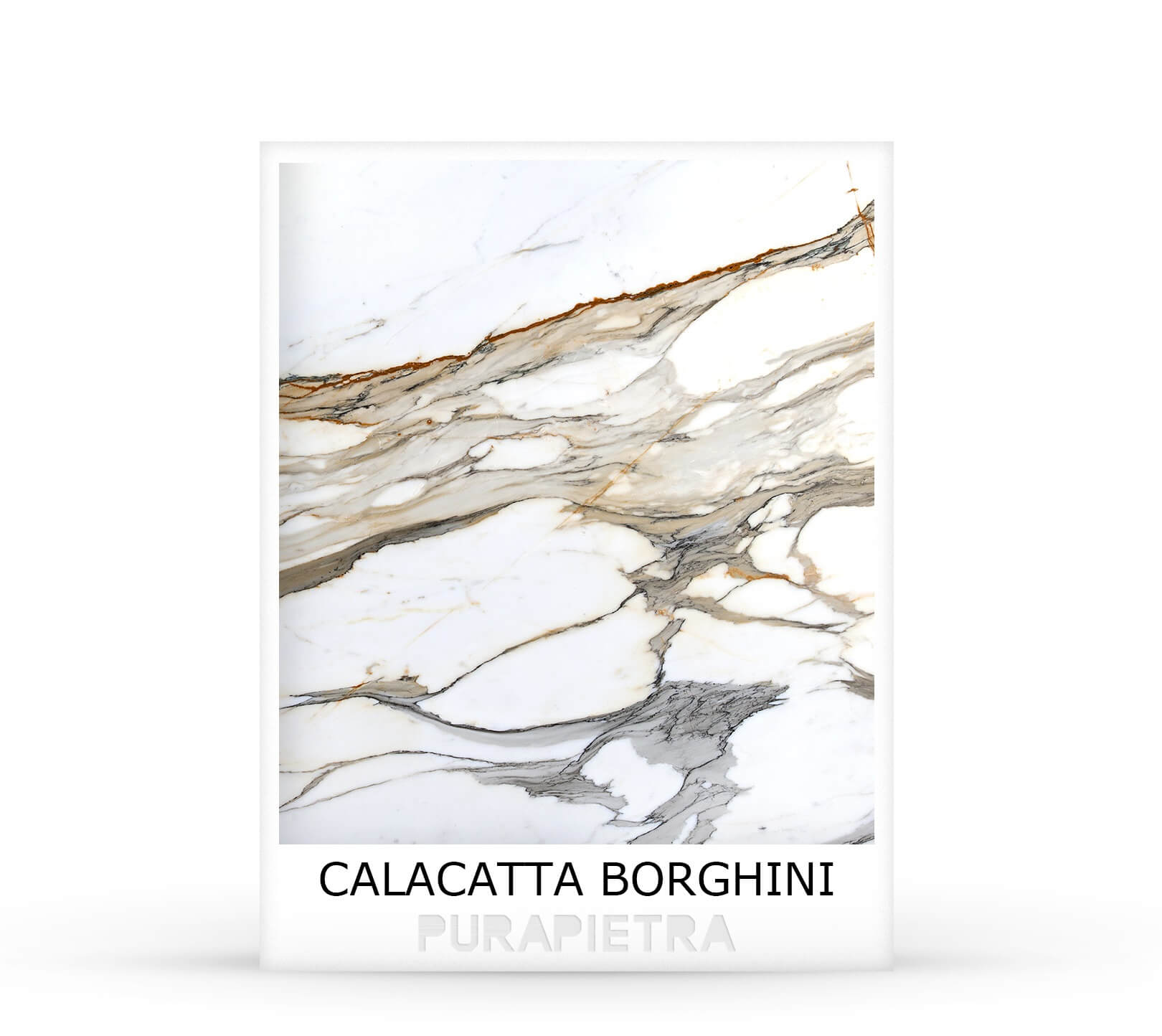
Calacatta is the most theatrical. Compared with Statuario it has a warmer, almost ivory background, and noticeably broader, bolder veins that become a design in their own right. There are many variants, each with its own temperament: some carry golden reflections, others shade toward dove grey or violet. It is the marble of large surfaces, where the veining has the room to tell its whole story.
Beyond the Apuans: whites from farther afield
Italy holds no monopoly on white marble. Other corners of the Mediterranean and of Europe guard stones with just as strong a character.
From the Greek island of Thassos comes one of the whitest and most luminous marbles in existence: a full white background, a fine grain, almost no veining at all. It is an absolute white, chosen when you want cleanliness and visual quiet. Greece also gives us the marble of Mount Pentelicus, the stone behind some of the most important works of antiquity.
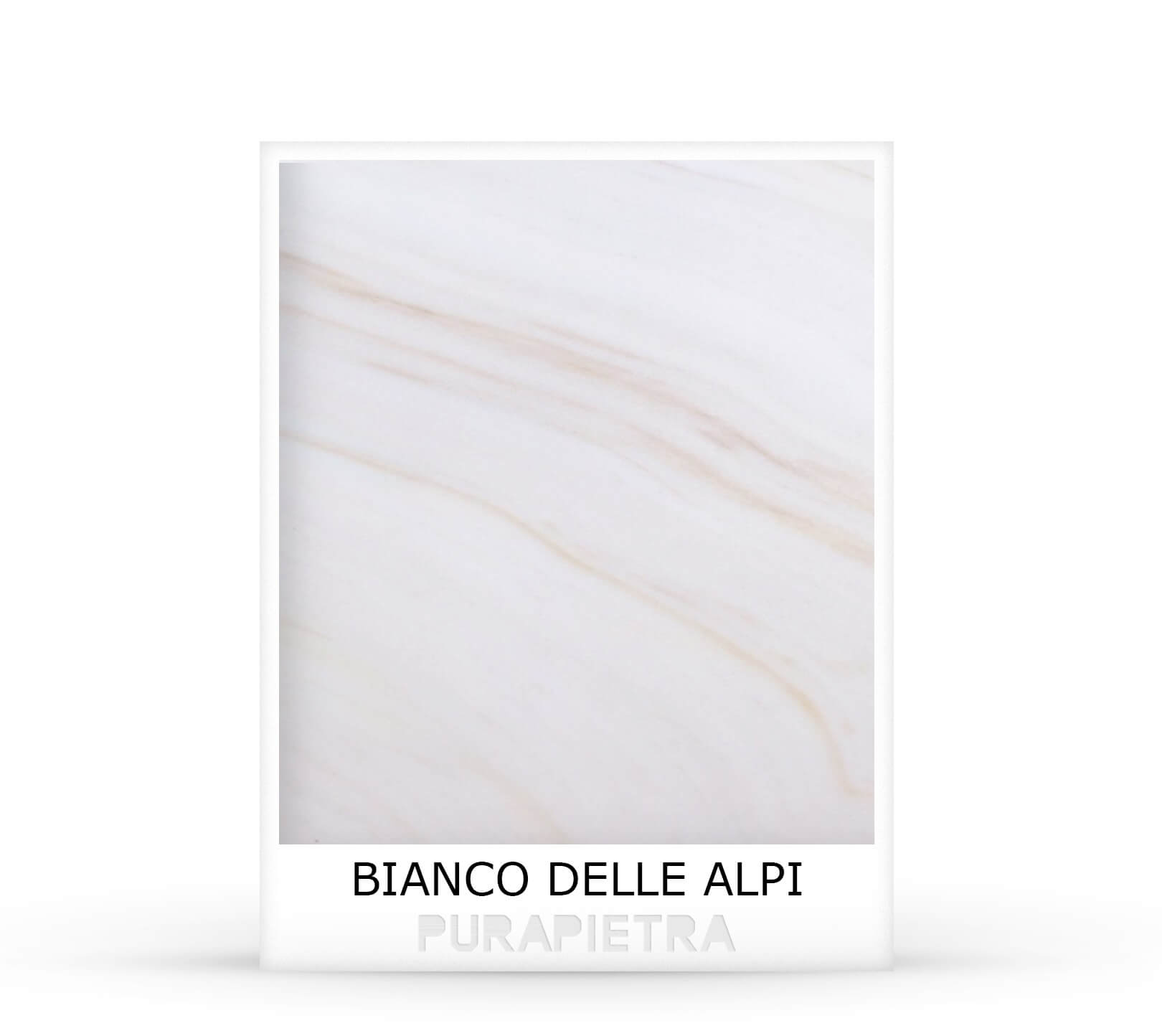
The Parthenon in Athens is built of Pentelic marble, a warm white that catches golden tones as the years pass. And then there are the Alpine whites, such as Bianco delle Alpi and South Tyrol’s Lasa, with their compact grain and delicate veins, long prized in architecture.
The character of the stone
Every marble has a personality, made of strengths and small sensitivities. Knowing them helps you treat the stone for what it is.
Softness. Marble is a relatively soft stone. It works and polishes easily, which makes it perfect for sculptural detail, but it also means it asks for a little more care than harder materials.
Porosity. Left bare, it absorbs liquids. That is why a good protective treatment changes everything, making the surface easier to live with and to clean.
Sensitivity to acids. Being calcium carbonate, it reacts to acidic substances. A forgotten drop of lemon or vinegar can leave a dull mark. It is not a flaw: it is simply how this stone converses with the world.
Finishes. The very same stone changes face depending on how it is worked. Polishing brings out the veins and the depth; honing, matte and silky, is quieter and more restrained; brushed finishes add texture to the touch.
When stone becomes an object
For centuries white marble dressed architecture: facades, staircases, floors, columns. It still does, but it has also learned to enter everyday life in smaller, more intimate forms. It becomes a top that gathers the light of a bathroom, as in Linear, where the marble turns into a single essential gesture, almost a sculpture.
It becomes vases that play with solids and voids, or trays worked in bas-relief, so thin they seem to weigh nothing. In these objects marble stops being a “building material” and goes back to being what it has always been: a living, warm substance, able to bring a piece of the mountain into the home.
Living with marble
White marble does not ask for much, but it asks for consistency. The rule is simple: protect it from acids and clean it gently.
Every day. Lukewarm water and a neutral cleaner, a soft cloth, no abrasive powders. It is surprising how little it takes to keep it luminous.
What to avoid. Acidic products, rough sponges, harsh substances. On surfaces where you cook, it is best to wipe away splashes of lemon, vinegar or wine right away, before they leave a mark.
A little care now and then. A protective treatment applied from time to time reduces porosity and keeps stains at bay. And if a surface loses a little of its shine over the years, re-polishing brings it back as good as new.
There is another way to see it, too: many people regard the small signs of time not as damage, but as a patina. On marble, a soft cloudiness tells a story of a life well lived, something synthetic surfaces will never have.
Questions that come up often
What is the difference between Carrara, Statuario and Calacatta?
Bianco Carrara has a more neutral background and light, diffuse veining; Statuario has the purest white and only a few fine veins, and it is the favourite for sculpture; Calacatta has a warm background and broad, dramatic veining. Three different characters born from the same mountain.
Does white marble stain easily?
It is porous and sensitive to acids, so it can stain if left unprotected. With a good treatment and careful cleaning, though, the risk drops dramatically and living with it becomes simple.
Which white marble is the whitest?
Among the most candid is Bianco Thassos, prized precisely for its full background and near-total absence of veining. Statuario also offers a very intense white, but with a different character, marked by its grey veins.
Is white marble suitable for a kitchen countertop?
Yes, and it is a choice many make gladly, provided you accept its nature: it needs to be protected, wiped clean of acids and treated with a little care. In return it offers a presence no other material can match.
How long does white marble last?
With the right attention it can last for generations. Many white marbles from antiquity are still intact after thousands of years: longevity is perhaps its most surprising quality.
A stone that never stops telling its story
“White marble” is a single phrase for an entire world: the candour of Thassos, the purity of Statuario, the generous drawing of Calacatta, the balance of Carrara. Understanding where it comes from and how it lives helps you choose it well and care for it over time. It is an ancient stone and a thoroughly contemporary one at once, able to bring light wherever it goes. If you would like to keep reading, you will find more stories of material and craftsmanship in the Purapietra magazine.
If white is where you started, the story continues elsewhere in the quarry. We compared the two most requested Apuan whites in Carrara vs Statuario, mapped the wider family in types of marble, and followed the palette into grey, beige and the far rarer blue marble. For the opposite end of the spectrum, read black marble. See also our guide to green marble and the comparison of Italian vs imported marble.