
A marble floor is the one surface in a house you touch every single day, usually barefoot. It is also the one people worry about most: will it stain, will it be slippery, will it crack, will it be cold? Some of those worries are fair. Most of them come down to choosing the right stone, the right finish and the right installer, and very little to do with marble itself.
Marble flooring has been used in European interiors for over two thousand years, and plenty of those floors are still walked on. That track record is the best argument for it. The honest counterpoint is that marble is softer and more reactive than porcelain or granite, and a floor that is badly specified will show it within months. This guide goes through the real pros and cons of marble flooring, the finishes that keep it safe underfoot, formats and layouts, which stones suit floors, installation with underfloor heating, day-to-day care, and what drives the cost.
Why choose marble flooring
The first reason is the look, and there is no point pretending otherwise. No printed tile reproduces the depth of real veining, because in marble the pattern runs through the full thickness of the stone and light enters the surface slightly before bouncing back. On a floor, where you see large areas at a low angle, that difference is obvious.
The second reason is longevity. A well laid marble floor does not wear out the way timber or vinyl does. It wears in. Scratches and etches can be honed away, and the whole surface can be restored to near new decades after installation. That is why marble floors in old palazzi and churches are still in use, often after several rounds of restoration.
The third is how it behaves in a warm climate or with underfloor heating. Stone is a good thermal conductor, so it feels cool in summer and passes heat efficiently from a heated screed in winter. A large share of our projects are in the Gulf, and marble flooring is a standard choice there for exactly this reason.
Marble flooring pros and cons
The pros
It lasts. With normal care a marble floor outlives almost every other finish in the house, and it can be restored instead of replaced.
Every floor is unique. No two blocks are the same, so no two floors are either. For a lot of our clients this is the whole point.
It works with heating. Marble flooring over underfloor heating is efficient and comfortable, provided the installation allows for movement (more on that below).
It adds value. Real stone floors are one of the finishes buyers notice. It is hard to put a number on, but it shows in how a room is perceived.
The cons
It etches. Marble is mostly calcium carbonate, and acids dissolve it. Spilled wine, lemon juice or the wrong floor cleaner will leave dull marks on a polished floor. On a honed floor they are far less visible.
It can stain. Unsealed marble absorbs oils and coloured liquids. A good impregnating sealer reduces this a lot but does not make the stone bulletproof.
Polished marble is slippery when wet. This is the most important point for safety, and the one most often ignored. Bathrooms, entrances and anywhere near a pool need a textured finish.
It is heavy and costs more to lay. Stone needs a flat, rigid subfloor and a skilled layer. Installation is a bigger share of the budget than with most other floors.
None of these cons is a reason to avoid marble flooring. They are reasons to specify it properly. If you want a floor you never have to think about, porcelain is the honest recommendation. If you want a floor that gets better with age and are willing to treat it a bit like good leather, marble is hard to beat.
Finishes and slip resistance
The finish you choose matters more on a floor than on any other surface, because it controls both how the floor looks and how safe it is.
Polished
Mirror gloss, full colour, maximum contrast. It is beautiful in a dry living room, a dining room or a hotel lobby with good mats at the door. It is the wrong choice in a bathroom, a kitchen or an entrance that sees rain. It also shows every etch mark.
Honed
A smooth, matte to satin surface. Honed is our default for residential marble flooring: calmer in colour, far more forgiving with etching, and better underfoot. It is still smooth, so it is not the right answer on its own for wet areas.
Brushed, sandblasted and bush-hammered
Textured finishes give real grip. Brushed marble has a soft, leathery feel and suits bathrooms and shower floors. Sandblasted and bush-hammered finishes are rougher and belong on terraces, pool surrounds and outdoor steps. Texture mutes the veining, so these finishes suit stones where colour matters more than pattern.
If you need a number, ask the supplier for slip test results for the specific stone and finish. In Europe the common references are the pendulum test and the German DIN 51130 ramp test, which rates surfaces from R9 (low grip) to R13 (high grip). The newer European standard for pedestrian surfaces, EN 16165, groups several of these methods together. A good supplier will have figures or will test a sample for you.
Marble flooring in modern interiors
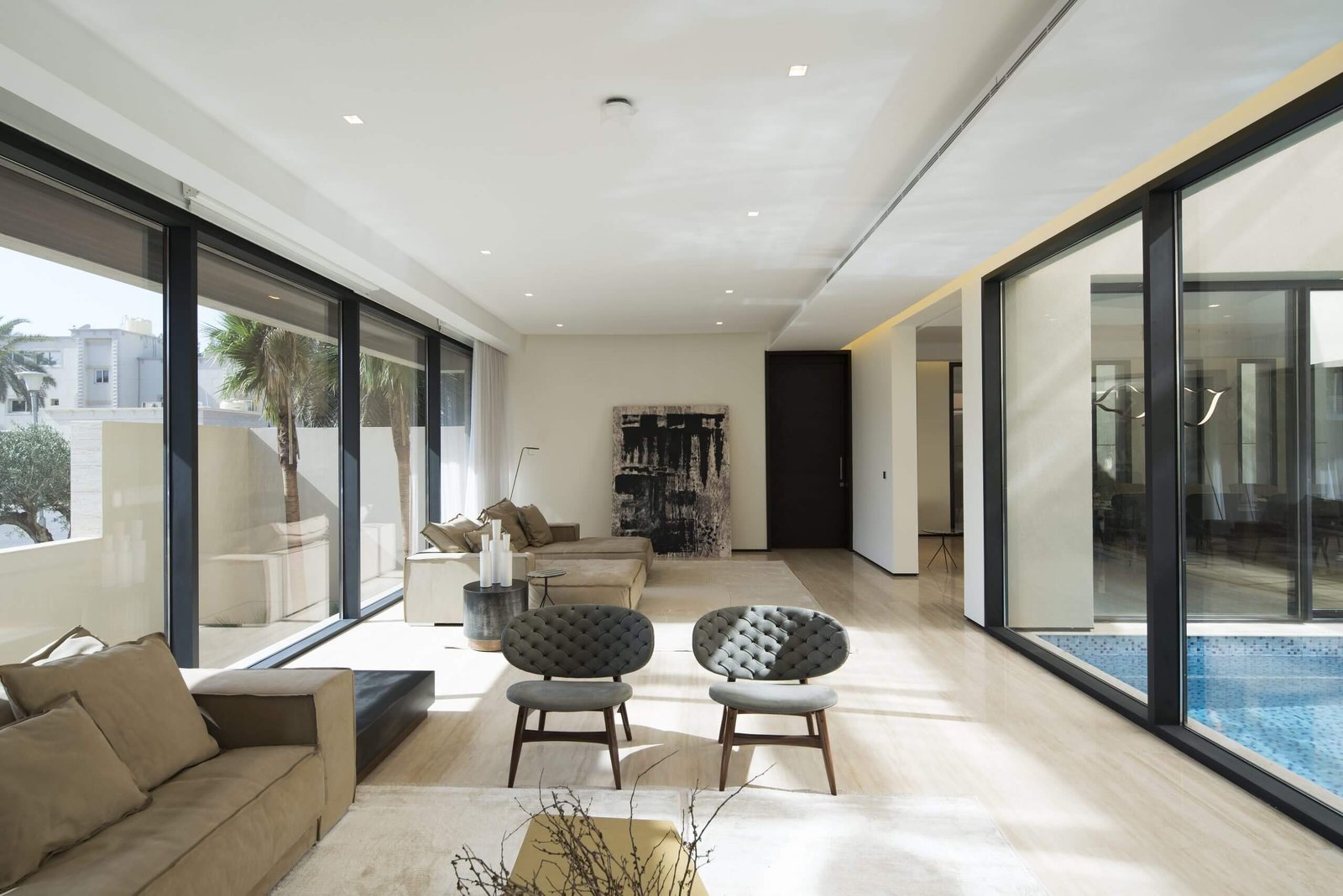
A lot of people picture marble flooring as black and white checkerboard in a grand hallway. That still has its place, but most of the floors we cut today look very different. In contemporary rooms marble flooring tends to be calmer: large honed formats, tight joints, one stone running through several rooms with no thresholds, so the floor reads as a single continuous plane.
Colour does a lot of the work. Pale greys and warm whites sit well with oak, plaster walls and linen, and they let furniture and art take the attention. A bolder stone can still work in a modern scheme if it is used in one place with intent: an entrance, a powder room, a strip of contrasting stone that marks the change from living to dining.
Texture is the other modern move. Brushed and honed marble flooring feels soft underfoot and photographs without glare, which is why it has largely replaced high gloss in private homes. And because stone handles underfloor heating so well, marble flooring pairs naturally with the open, glass-heavy plans of new builds, where a warm floor makes a big difference in winter.
Formats and layouts for marble flooring
Tiles
Standard marble floor tiles are usually 10 to 12 mm thick, in sizes such as 30 x 60 cm or 60 x 60 cm. They are the most economical way to get real marble flooring, quick to lay and easy to replace. The trade-off is more joints, and less chance to show large, continuous veining.
Large formats and slabs
Large formats (80 x 80 cm, 60 x 120 cm and up) or cut-to-size slabs, typically 20 mm thick, give fewer joints and let a vein cross the room. They need a very flat subfloor and more skilled laying, and they cost more, but they are what makes a marble floor look like architecture instead of tiling.
Patterns
Layout changes the feel of a room more than most people expect. A straight grid with tight joints is quiet and modern. A running bond (offset) pattern is more relaxed. Herringbone and chevron in marble strips bring movement and work well in corridors. Borders, inlays and geometric medallions in contrasting stones are a classical move, and one we still make regularly for entrance halls and villas in the Gulf.
One practical tip: decide which way the veins should run before ordering. Along the length of a corridor, veining makes a space feel longer. Across it, the room feels wider. On a bold stone, a floor laid with veins going in random directions can look restless.
Which marbles work best on floors
Almost any sound marble can be used for marble flooring, but some are easier to live with than others.
Mid-tone and patterned stones hide the most. Greys, beiges and busy veining disguise dust, small scratches and etch marks. Grey marble such as Grigio di Vagli and warm stones like those in our beige marble guide are the most forgiving choices for family homes.
White marble flooring is stunning but honest about dirt. A white marble floor lifts a room like nothing else, but it shows every footprint on a polished finish. Honed white floors are much easier to live with.
Dark marble flooring shows dust and etching. Black marble floors are dramatic, but on a polished finish every etch mark and every speck of dust is visible. We tend to use black as a border or inlay rather than across an entire room.
Travertine is a classic alternative. Strictly speaking it is not a marble, but travertine is one of the most popular stone floors in Italy, especially honed and filled.
Whatever the stone, check it for soundness. Heavily fissured or resin-filled material can be fine on a wall and a problem on a floor, where it is under load. Our guide on how to identify quality marble explains what to look for.
Installation and underfloor heating
Most failures in marble flooring are installation failures, not stone failures. Three things make the difference.
A flat, rigid base. Marble does not flex. The subfloor has to be stable, level and properly cured, or tiles will crack and edges will lip. On timber floors, a decoupling membrane or a rigid backer board is essential.
The right adhesive. Many light-coloured marbles can stain or warp with the wrong adhesive, especially green and some white varieties that are sensitive to water. Use a white, fast-setting or rapid-drying adhesive formulated for natural stone, and follow the stone supplier’s advice.
Movement joints with underfloor heating. Marble flooring over underfloor heating works very well, but the screed must be fully cured and the heating brought up to temperature slowly before and after laying. Perimeter and field movement joints let the floor expand and contract without cracking.
After installation the floor is cleaned, sealed with a penetrating sealer, and left to rest before heavy furniture goes back in. Final honing or polishing in place, once the whole floor is down, is how you get a completely even surface with no lipping at the joints.
Caring for marble flooring
Dust often. Grit is what scratches marble floors. A soft dust mop or a vacuum without a beater bar does more to keep a floor looking good than any product.
Mop with pH-neutral cleaner. Warm water and a neutral stone soap are enough. Avoid vinegar, bleach, ammonia and all-purpose “citrus” cleaners. They etch the surface.
Use mats and felt pads. A good mat at each entrance catches most of the grit. Felt pads under chairs and furniture stop scratches.
Reseal on schedule. Busy marble flooring usually needs resealing every one to three years. If water stops beading on the surface, it is time.
Restore instead of replace. When a floor looks tired, a professional can hone and repolish it in place. It is one of the big advantages of marble over materials that just wear out. Our article on marble durability goes deeper into how stone ages and how to restore it.
What does marble flooring cost?
We do not publish a single price per square metre, because the range is huge. Four things drive it: the stone itself (a common beige and a rare Calacatta are in different worlds), the format (tiles cost less than cut-to-size slabs), the finish and the amount of hand work, and the installation, which on a large-format floor can cost as much as the material. Patterns, borders and inlays add cutting time.
A realistic way to budget is to choose two or three candidate stones and ask for a quote on the same room in each. The difference between them often surprises people, and sometimes the cheaper stone in a better format gives the better floor.
Planning floors and walls together
The best marble flooring projects are designed together with the walls, not after them. Carrying the same stone from floor to wall in a bathroom makes a small room feel bigger. Using a quieter floor under a dramatic feature wall lets the wall do the talking. Our guide to marble interiors covers how to plan stone across a whole house, and our Private Villa Milan and Desert Chalet projects show how we handled it on real sites.
At Purapietra we select the blocks, cut and finish the stone in Italy, and follow the installation through. Browse the stones that work on floors in our materials catalogue, then send us a floor plan or a few photos. We will tell you which marble fits the way you actually live, and which finish will keep it safe underfoot.
Frequently asked questions about marble flooring
Is marble flooring a good idea?
Yes, if it is specified properly. Marble flooring lasts for decades, can be restored instead of replaced and works well with underfloor heating. It needs a suitable finish, a good sealer and pH-neutral cleaning. If you want a floor you never have to think about, porcelain is easier.
Is a marble floor slippery?
Polished marble is slippery when wet. Honed marble is better, and brushed, sandblasted or bush-hammered finishes give real grip for bathrooms, entrances and outdoor areas. Ask your supplier for slip test results such as a DIN 51130 R-rating or a pendulum test value.
Can you put marble flooring in a kitchen?
You can, but choose a honed finish and a forgiving, mid-tone or patterned stone. Seal it properly and wipe up acidic spills such as wine, citrus and vinegar quickly, because they etch the surface.
Does marble flooring work with underfloor heating?
Yes. Stone conducts heat well, which makes it one of the most efficient floors over underfloor heating. The screed must be fully cured, the heating brought up to temperature slowly, and movement joints included so the floor can expand and contract.
How thick should marble floor tiles be?
Standard marble floor tiles are usually 10 to 12 mm thick. Large-format tiles and cut-to-size slabs are typically 20 mm. Thicker stone is stiffer and less likely to crack over an imperfect subfloor, but it still needs a flat, rigid base.
How do you clean a marble floor?
Dust or vacuum often to remove grit, then mop with warm water and a pH-neutral stone cleaner. Avoid vinegar, bleach, ammonia and citrus cleaners. Use entrance mats and felt pads, and reseal the floor every one to three years in busy areas.
How long does a marble floor last?
A well installed marble floor can last for generations. Scratches and etch marks can be honed out, and the surface can be restored to near new condition, which is why historic marble floors are still in use today.