
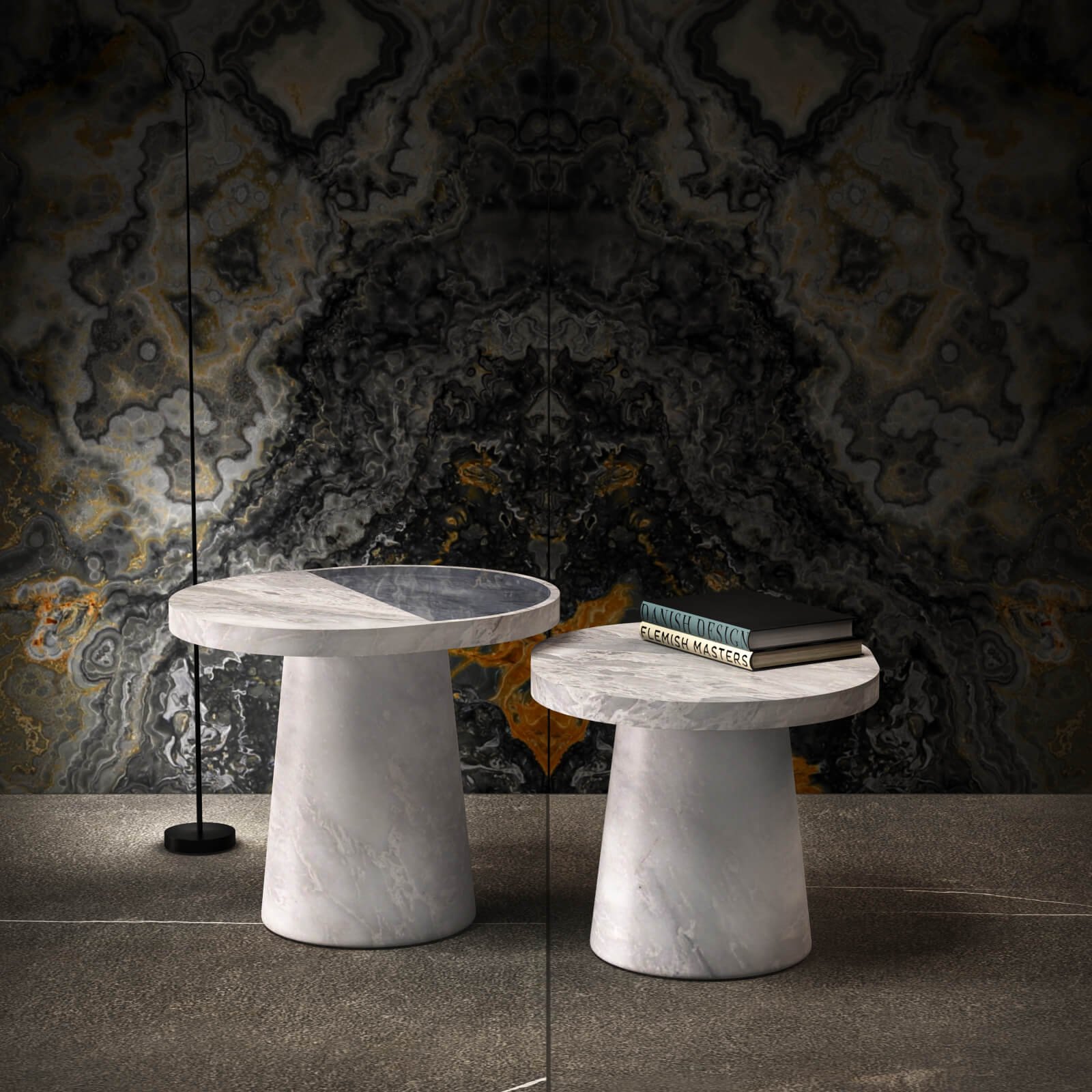
Most stones are opaque. Ivory Onix is not. Cut thin and lit from behind, this cream onyx lets the light travel through it and comes out the other side warm and honey-coloured, as though the wall itself had a pulse. In ordinary daylight it is a quiet pale stone. At night, with the right lighting, it is the most atmospheric surface in the house.
Ivory Onix is one of the onyx stones in the Purapietra catalogue, and probably the easiest way into the family. This guide covers what Ivory Onix really is, how to read a slab, which finish suits which job, where it works and where it should be kept away, what to pair it with, how to look after it, and what drives its cost.
What Ivory Onix is, and how it forms
A naming point first. The stone the design trade calls onyx is not marble, even though it is often sold next to it. Marble is limestone that has recrystallised under heat and pressure. Onyx is a banded form of calcite that grows slowly, layer by layer, from water rich in dissolved minerals, typically in caves and around mineral springs. Each layer is a little different from the one before, which is why a slab looks striped: you are reading thousands of years of deposits.
Those layers are also what makes onyx translucent. Calcite that grows slowly and in order lets far more light through than the tightly interlocked grains of a typical marble. The colour comes from trace minerals in the water. In Ivory Onix they are few and gentle, which is why the stone stays within cream, ivory and soft honey, with no strong colour anywhere.
If you want the wider context on how natural stone is classified, Wikipedia’s page on onyx is a clear primer. For the Italian marbles Ivory Onix often sits next to in a scheme, see our guide to Italian white marble.
Appearance: colour, banding and translucency
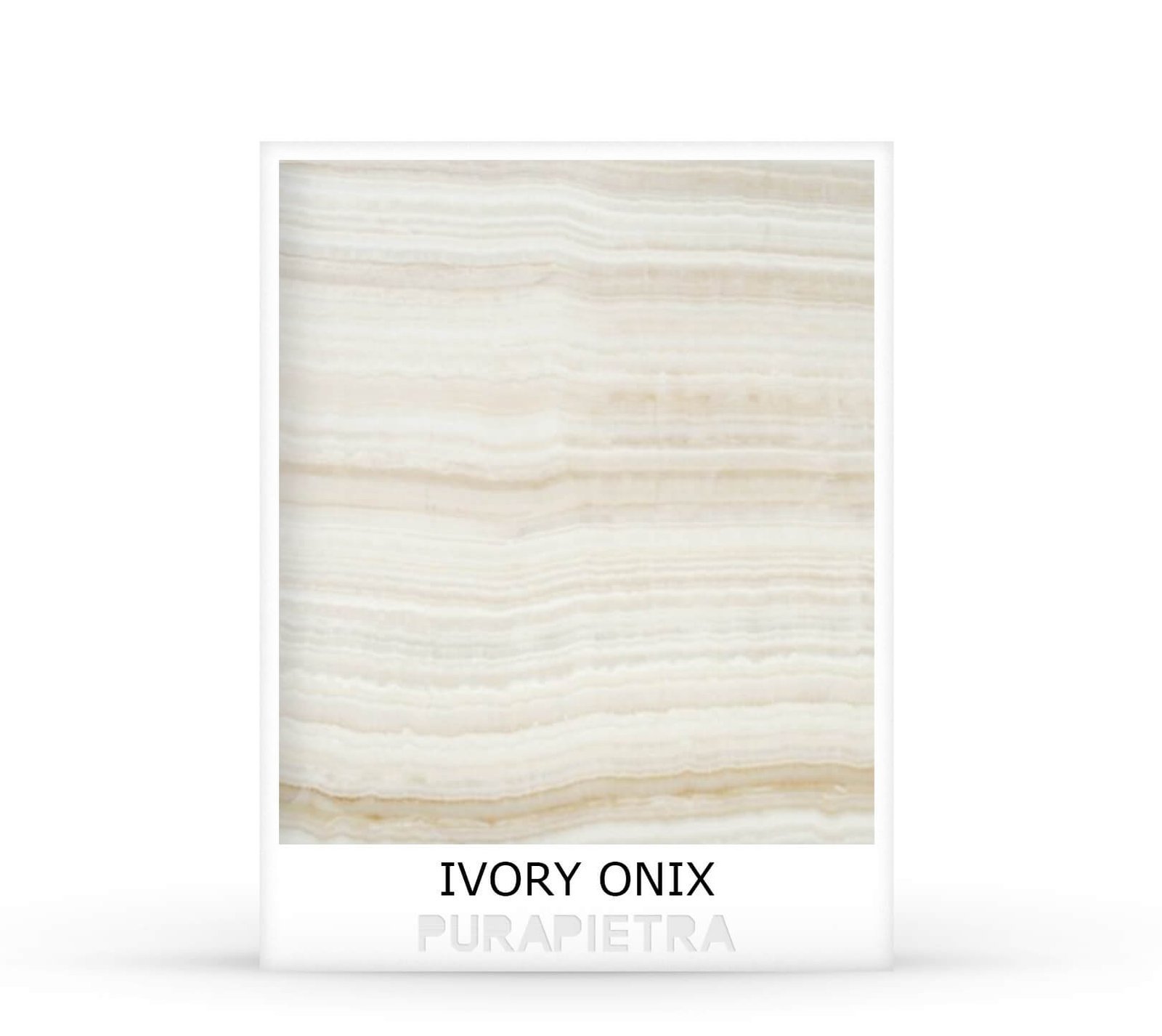
The ground is a warm cream. Running through it are horizontal bands in white, ivory and pale honey, sometimes thick and cloudy, sometimes fine as pencil lines. Unlike the irregular veining of a Calacatta, the pattern in onyx follows a direction, which gives a slab a calm, almost landscape-like rhythm.
Three things are worth checking before you commit to a slab:
The strength of the banding. Some Ivory Onix slabs are nearly uniform and read as a luminous pale stone. Others carry strong honey bands that turn into a feature. Both are Ivory Onix and they make different rooms. Decide which you want before you look at samples.
Translucency, as opposed to opacity. Cloudy, whiter areas pass less light than clear, honey-coloured ones. On a backlit wall, that difference becomes a glowing area next to a dull one. Hold a sample against a light source and look at it from behind, not only from the front.
Fissures and fills. Onyx is more prone to natural cracks and filled areas than marble, and a hairline that looks harmless on the front can become a bright line when lit from behind. Ask to see the slab with a light behind it. Our guide on how to identify quality stone covers the checks we apply to a block before it is approved for cutting.
Finishes for Ivory Onix
Polished
Polished is the finish onyx is made for. It deepens the banding, brightens the cream and gives the stone its fullest sense of depth, and it lets the most light through. For feature walls, backlit panels, furniture and decorative pieces, polished is the default and the right answer in almost every case.
Honed
A honed surface is matte to satin. It softens the stone, hides small marks better and keeps the pale, calm character, but it also dims the translucency and makes the banding less crisp. We use it where the surface will be touched and handled, such as a vanity top, and where the glow is not the point.
Brushed
Brushing adds a fine texture and noticeably mutes the pattern. For a stone whose whole appeal is clarity and light, it is rarely the first choice. When we suggest it, it is for a tactile detail rather than for a surface that has to glow.

Best uses for Ivory Onix in interior design
Backlit feature walls
This is where Ivory Onix is at its best, and where it earns its reputation. A thin onyx panel with a light source behind it turns a wall into a soft, glowing surface: the bands light up in sequence, from pale ivory to deep honey. Behind a bed, a bath, a reception desk or a bar, one panel is usually enough. Because a wall does not face spills or footsteps, it can be fully polished.
Lighting design matters as much as the stone. An even, diffused source gives a glow. Bright points of light close to the surface give hotspots that look like mistakes. Keep the light source at a sensible distance from the back of the stone, choose a lamp that runs cool, and plan access for replacing it, because the stone is not coming off the wall every time a bulb fails.
Bathrooms
A bathroom is small enough for a single glowing surface to set the mood. Ivory Onix on a vanity wall, behind a freestanding bath or at the back of a shower niche looks calm in daylight and luminous at night. Pair it with a carved piece such as our Unit Sink or the Linear basin and the stone does the work. Keep it out of the wettest zones unless it is sealed and properly specified, and read the care section below before choosing floors, which we do not recommend.
Vanity tops, tables and furniture
A single tabletop or vanity top is a good way to use Ivory Onix without committing a whole room. The surface is small enough to choose the exact slab and place the banding where it will be seen. It is also the best way to discover whether you like living with onyx before you use it at larger scale.
Kitchens
We would be cautious. Onyx is a calcite stone like marble and reacts to acids in the same way, but it is also more sensitive to knocks and to heat, and the banding can hide weak planes. An island front, a bar face or a splashback behind a hob-free area can work well. A busy worktop beside the cooker is not what this stone is for. If you want a stone worktop that looks like light, speak to us first, and we will tell you honestly what will last.
Floors
Not recommended. Onyx is not the stone for walking on. It is softer in daily use than most flooring materials, it scratches and marks, and it is expensive to lay on a scale that makes sense for a floor. For a pale stone floor, a harder white marble is the better choice. Our guide to marble flooring covers the alternatives.
Design objects
Trays, vases and bowls cut from onyx let you have the glow at a domestic scale. A small piece on a console near a lamp is often all it takes. Our marble trays and vases show how we use stone at this size.
Ivory Onix next to its relatives
Ivory Onix has two close relatives in our catalogue: Sky Onix, with cooler blue and grey tones, and Pink Onix, which leans warm and rosy. Ivory is the most neutral of the three, and the one that goes with the widest range of schemes. All three are on our materials page. Against a white marble such as Bianco Statuario, Ivory Onix is warmer, softer and far more luminous, and less hard-wearing. They work well together in the same room, as long as the marble takes the surfaces that are used and the onyx takes the ones that are looked at.
What to pair with Ivory Onix
Warm wood. Oak and walnut bring out the honey in the banding and keep a cream stone from feeling cold. This is the pairing we reach for first.
Brass and bronze, sparingly. Warm metals follow the colour of the bands. Use them on small things, such as taps, handles and a frame around the panel. Check them against the real stone before you order.
Dark, matte surfaces. A deep charcoal or a nero marble beside Ivory Onix makes the glow look brighter. A black marble floor or cabinet in the same room gives the onyx somewhere to be seen against. Our guide to black marble interiors has ideas for that contrast.
Quiet walls. Because the stone already does a lot, keep the walls around it plain: warm plaster, soft off-white, a muted grey. One statement is enough.
For wider room planning, our overview of marble interiors covers how to balance a statement stone with calmer surfaces elsewhere.
Maintenance and care
Seal it at installation. Use a penetrating sealer made for natural stone and ask your installer which one suits onyx. Like marble, onyx absorbs liquids, and a pale stone shows stains.
Clean with pH-neutral products only. Warm water and a neutral stone soap handle most things. Bleach, vinegar, citrus cleaners and limescale products etch the surface, and the effect is much more visible on a polished pale stone than on a veined one.
Treat it gently. Do not drop hard objects on it, do not stand hot items on it and do not clean it with anything abrasive. Onyx is less forgiving than marble, and repairs to cracks are possible but visible.
Check the lighting. Cool-running lamps, even spacing and a way to replace them without taking the panel down will protect the stone as much as any sealer. For a wider view of how stone ages, see our piece on marble durability.
What drives the price of Ivory Onix
We do not publish a square-metre price for Ivory Onix, and we would be wary of anyone who quotes one without seeing the slab. Four things set the cost: the grade of the block and the quality of its banding and translucency, the thickness you specify, the yield, which is how much of the raw block ends up as usable finished material, and the hours of hand finishing. Onyx is a stone where yield matters a great deal, because fissures and weak planes mean not every part of a block can be used. Backlit work also adds the reinforcement of thin panels and the lighting itself, so the budget for an onyx wall is more than the stone alone.
How to choose a slab
If you can, go to the yard, and ask to see the slab lit from behind. Photos flatten colour and hide translucency completely. Stand back a few metres, because that is the distance from which a wall will actually be seen, then look closely for cracks and filled areas. Ask for the slab numbers so you know which ones are consecutive, because a bookmatched pair of onyx panels is spectacular when the bands line up.
Bring the drawing with you. The position of a light, a joint or a cut-out changes which slab is right, and a honey band that looks perfect in the yard can fall exactly where you need a fixing.
Why choose Ivory Onix with Purapietra
We treat stone as a building material, not a skin. Every piece is roughed on CNC for accuracy and finished by hand, which is where an edge stops looking machined. With a stone as delicate as onyx, we ask clients to choose the block, and we plan where the banding falls, where the joints go and how the lighting will sit before the first cut.
You can see Ivory Onix alongside our other white, coloured and rare stones in the materials catalogue. If onyx turns out to be more fragile than your project needs, our guides to white marble and Calacatta Viola cover the stronger and more dramatic options. Send us a plan, a sketch or just a photo of the room, and we will tell you what the stone can do there and roughly what it will cost.
Frequently asked questions about Ivory Onix
What is Ivory Onix?
Ivory Onix is a cream-coloured onyx with soft white and honey-coloured banding. Onyx is a banded form of calcite, not a marble, and it is known for its translucency: a thin slab with a light behind it glows.
Is Ivory Onix a marble?
Not strictly. Marble is recrystallised limestone. Onyx is a banded calcite deposited in layers from mineral-rich water. The two are sold together and share some care rules, but onyx is more translucent and more delicate.
How much does Ivory Onix cost?
There is no fixed price per square metre. Cost depends on the grade of the block, the strength of the banding and translucency, the thickness, the usable yield and the hours of finishing. A backlit wall also needs reinforcement and lighting. We quote each project once the slab and finish are chosen.
Can Ivory Onix be backlit?
Yes, and that is the best use of it. It needs an even, diffused, cool-running light source at a sensible distance from the back of the stone, and thin panels are normally reinforced on the back. Plan the lighting and access before you order the stone.
Is Ivory Onix good for a bathroom?
Yes, on walls, around a bath or on a vanity top, where it can be sealed and kept away from heavy wear. We do not recommend it for bathroom floors.
Can I use Ivory Onix for a kitchen worktop?
We advise caution. Onyx etches in the same way as marble and is also more sensitive to knocks and heat. It suits an island front, a bar or a splashback better than a working worktop next to the cooker.
How do I care for Ivory Onix?
Seal it at installation, clean only with pH-neutral products, avoid acids, abrasives and hot items, and blot spills quickly. Use cool-running lamps behind backlit panels.