
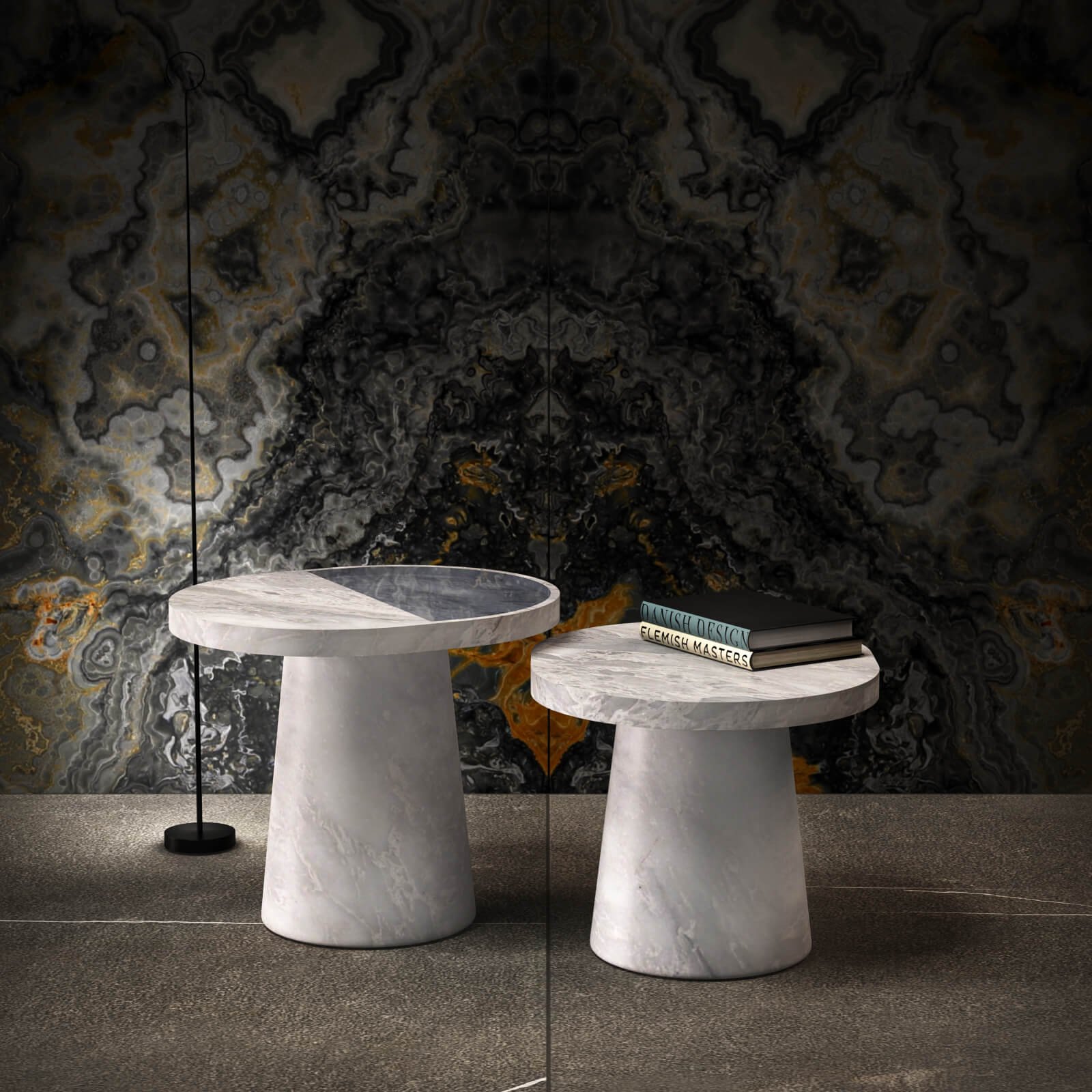
The most common mistake we see in marble interiors is not too much marble. It is marble asked to do a job it was never suited to — a polished white worktop in a house where someone actually cooks, a rare slab cut into pieces so small that the veining stops making sense. Marble is not a finish you apply. It is a material with a temperament, and rooms go right when the design is built around what the stone wants to do.
Used well, marble interiors have a quality no engineered surface reproduces: depth. That comes from the material itself — a recrystallised limestone whose calcite grains are partly translucent, as Wikipedia’s entry on marble explains. Light travels a few millimetres into the stone before it scatters, which is why a marble wall looks alive at eight in the morning and different again at six in the evening. This guide is about getting there deliberately — how marble behaves in different styles, where to be bold and where to hold back, which trends are worth following, the mistakes we are most often called in to fix, and what real projects teach that mood boards do not.
Styles compared: how marble interiors change with the language of the room
The same slab reads completely differently depending on the language of the room around it. Three broad approaches cover most of the marble interiors we are asked to work on.
Classic
In a classic interior, marble is architecture. It arrives as a chimneypiece, a threshold, a stair, a bathroom lined floor to ceiling. Veining is welcome and symmetry is the organising idea: book-matched panels, a vein that lands centrally over a fireplace opening, a floor laid in a formal pattern. Polished finishes belong here, because a classic room is built to reflect light rather than absorb it. The stones that suit this register are the Italian whites and the warm beiges — Statuario, Calacatta, Crema — where the veining has enough drawing in it to hold a formal composition.
The risk in classic schemes is accumulation. Marble floor, marble skirting, marble fireplace, marble console and marble lamp base in one room stops reading as luxury and starts reading as a showroom. Choose the two elements that carry the architecture and let plaster, timber and textile do the rest.
Modern
A modern interior treats marble as a graphic element. Here the stone is usually deployed as a single large plane — an island, a bathroom wall, a kitchen splashback run in one continuous piece — against otherwise quiet materials. Book-matching becomes a deliberate visual event rather than a period reference, and stronger stones come into play: green, black, blue, the more dramatic Calacattas. Our survey of coloured marble covers the palette that works in this register.
The technical demand in modern schemes is precision. When marble is used as a plane, every joint is visible and every mitred corner has to be exact. This is where the difference between a good fabricator and an average one becomes impossible to hide.
Minimal
Minimal interiors are the hardest place to use marble well, and the most rewarding when it works. The stone has to carry warmth and depth into a room that has deliberately removed everything else, which means quiet veining and matt surfaces rather than statement slabs. Honed whites, soft greys and travertine belong here. So do sculpted solid objects: a basin, a bench, a low table cut from one block, where the interest comes from mass and silhouette rather than pattern.
The counter-intuitive rule is that in minimal rooms you generally use less marble but thicker marble. A twenty-millimetre slab on a plywood carcass reads as a surface; a solid piece reads as an object. In a room with nothing to hide behind, that distinction is everything.
Where to be bold in marble interiors
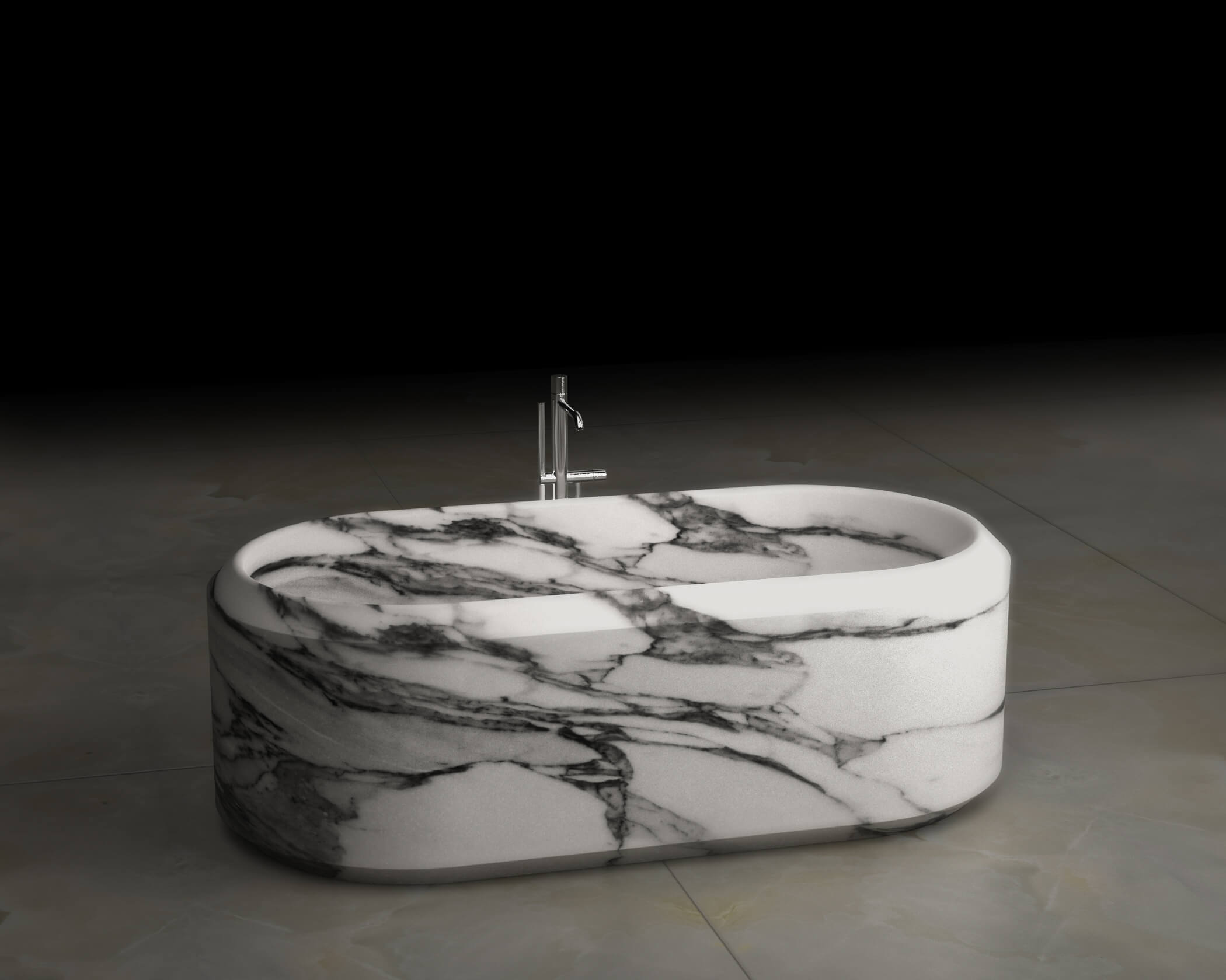
The bathroom. This is the room that rewards commitment. It is small, it is used in soft light, and it does not take the acid abuse a kitchen does. Running a single stone from floor to ceiling and into the shower enclosure gives a bathroom a coherence that tiling never achieves. Add a sculpted basin such as our Unit Sink or the wall-mounted Linear and the room resolves into one material.
One wall, not four. A full-height marble wall behind a bed, in an entrance hall or in a lift lobby is the highest-impact and lowest-risk use of a dramatic stone. Nothing acidic touches it, the veining can be laid out properly across the whole surface, and the rest of the room stays free.
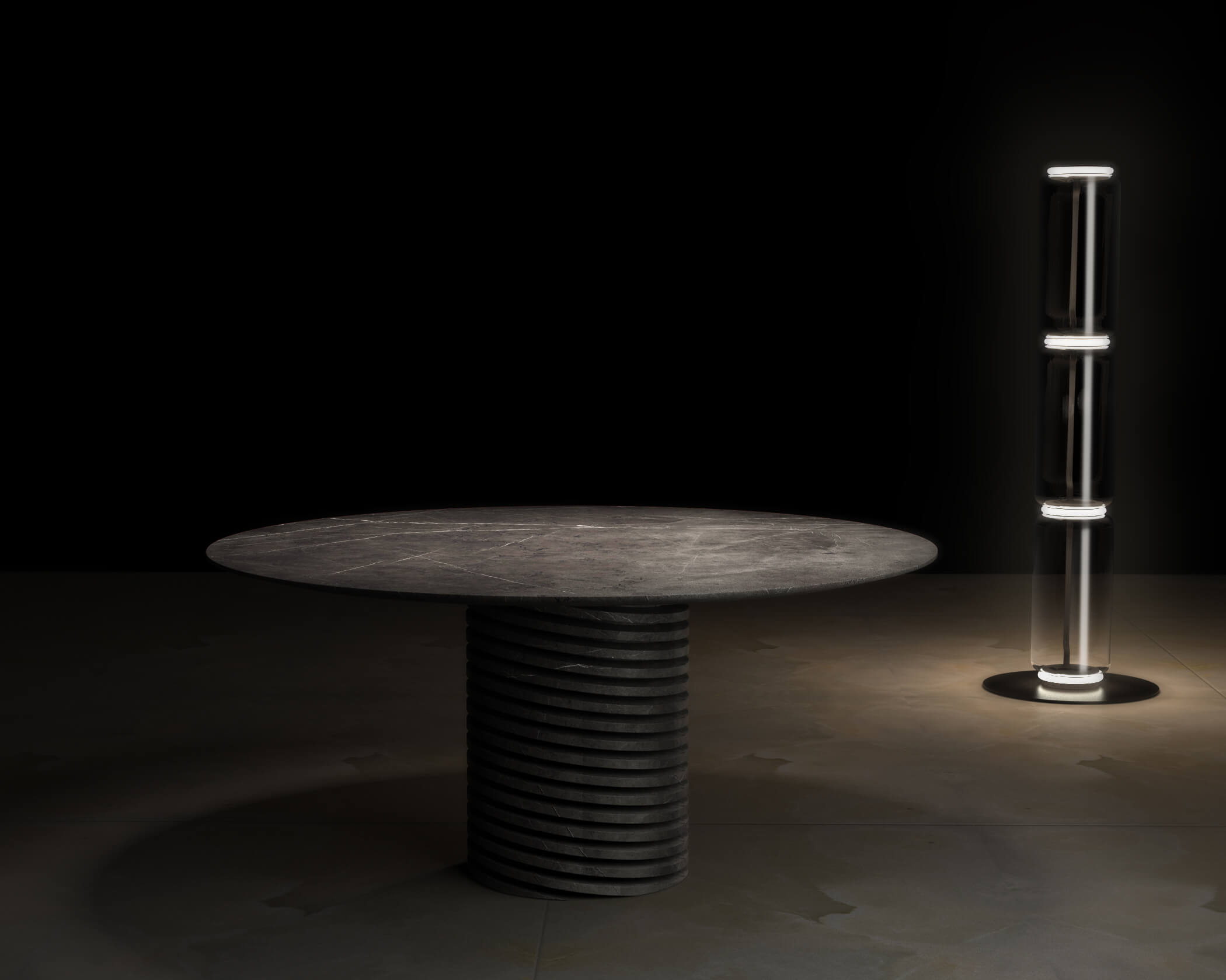
A single object. The move we recommend most often is also the cheapest: one carved piece in a room that is otherwise plain. A Groove coffee table, a set of marble trays, a group of vases. It gives a room the depth of stone without committing the architecture to it, and it can be moved when the room changes.
Where to hold back
Busy floors. Marble is soft and it scratches. In a hallway that takes shoes and grit daily, a white marble floor will dull within a couple of years. Use it in bedrooms, dressing rooms and bathrooms, or specify a honed finish and accept a light re-hone every decade or so. Our guide to marble durability goes through the wear question room by room.
Working kitchen worktops, if you are anxious. Marble etches on contact with lemon, vinegar and wine. Honed surfaces disguise this well and most owners grow to like the patina, but the conversation belongs before the order. If an unchanged worktop is a hard requirement, quartzite is the correct material and any good workshop will tell you so.
Small mosaic cuts of expensive stone. Cutting a rare slab into 10 x 10 pieces destroys the only thing you paid for. If the design calls for small formats, use a stone with uniform colour rather than one bought for its veining.
Current trends in marble interiors worth following
Colour, finally. After a decade of white and grey, the interesting work is happening in green, blue, pink and the deep browns. We are cutting more Verde Alpi, Sodalite and Rosa di Venezia than at any point in the last ten years. The pillar articles on green marble and pink marble cover what each family does in a room.
Matt over gloss. Honed, brushed and leathered finishes now outsell polished in domestic work. Partly it is fashion; mostly it is that matt surfaces are more forgiving and photograph better in the soft, indirect light people actually live in.
Solid rather than clad. Thicker, carved, monolithic pieces are replacing thin slabs on substrate. It is more expensive and considerably better, because the edge profile becomes a design decision instead of a concealment problem.
Fewer materials per room. The direction across the good projects we see is towards restraint: one stone, one metal, one timber, repeated. It is harder than it sounds and it is what separates a resolved room from a collected one.
Marble as sculpture. Stone is moving out of the kitchen and bathroom and into the living room as freestanding objects — tables, seats, vessels. It is the oldest use of the material and the one that suits contemporary interiors best, because it does not commit the building to anything.
Five mistakes to avoid in marble interiors
1. Choosing from a sample. A ten-centimetre chip cannot tell you what a three-metre slab will do. For any veined stone, select the actual slab or the block, and photograph the layout before cutting. Every disappointment we have been called to look at started here.
2. Ignoring the direction of the veining. Veins have direction. Running them one way across a room and the other way in the adjoining space is the single most common reason a finished job feels wrong without anyone being able to say why. Decide the direction at the drawing stage.
3. Specifying polished where honed belongs. Gloss on a horizontal working surface makes every etch mark legible. Almost every “the marble is ruined” call we take involves a polished worktop and an ordinary kitchen.
4. Using the wrong cleaning products. Bleach, vinegar, lemon sprays and limescale removers attack marble directly. More damage is done by cleaning than by use. pH-neutral stone soap and warm water handle almost everything.
5. Mixing too many stones. Two marbles in one room is a decision; three is an accident. If a scheme needs variety, get it from finish rather than from material — the same stone honed on the floor and polished on the wall reads as sophistication.
Room by room: a quick reference
If you want the short version, this is how we allocate stone across a house when a client asks us to plan marble interiors from scratch.
Entrance. High visual return, high wear. Use marble on the walls rather than the floor, or accept a honed floor in a hard-wearing grey or travertine. This is the one room where a dramatic slab pays for itself, because everyone sees it and nobody lingers.
Living room. Objects, not surfaces. A carved table, a bench, a fireplace surround. Polished finishes are safe here because nothing acidic reaches them, and it is the right room for a stone with real character.
Kitchen. Honed, sealed, and chosen with the etching conversation already had. If the client cooks seriously and hates change, put the marble on the splashback and a harder material on the worktop — a compromise that keeps the look and removes the risk.
Bathroom. The room to commit to. One stone, floor to ceiling, plus a solid basin or bath. Marble interiors rarely look better than in a bathroom lined in a single material.
Bedroom. A headboard wall, a windowsill, a pair of bedside tops. Low traffic, soft light, no acids: everything is permitted here, and marble floors survive well.
Lessons from real marble interiors we have built
The projects in our portfolio — private villas in Milan and the Emirates, a chalet on the Kuwaiti coast, retail work including an Apple Store — have taught a few things that mood boards never do.
Plan the block, not the room. On large jobs we start from how much usable material a block will yield and design the layout backwards from it. A scheme drawn without reference to block sizes generates joints in places nobody wanted them.
Light is a material decision. The same stone looks warm under 2700K and clinical under 4000K. We ask for the lighting specification before finalising the marble, not after, and we look at samples in the actual room whenever the site allows it.
Contrast comes from finish as much as colour. A honed field with polished detailing in the same stone gives a richer result than two different marbles, and it never dates.
The best rooms have one stone doing one job. Across every project that still looks right five years on, the marble had a defined role — the bathroom, the island, the object — and stopped there. The marble interiors that age badly are almost always the ones where the stone was asked to be everywhere at once.
If you are working with a single colour family, the pillars on white marble and black marble interiors go deeper into pairings and room-by-room use than this overview can.
Designing marble interiors with Purapietra
We work stone as a structural material rather than a finish. Pieces are cut from solid blocks, roughed on CNC for accuracy and finished by hand by Italian craftsmen, which is the stage where a sculpted edge stops looking machined. For bespoke work we help clients select the block itself and lay out the veining before anything is cut.
The full range of whites, greys, greens, blues and rare onyxes is in the materials catalogue, and the design collection is in New Era. If you want a broader grounding in the material first, our guide to the types of marble is the place to start. Write to us with a drawing, a photograph or just a room, and we will tell you honestly what the stone can and cannot do.
Frequently asked questions about marble interiors
Are marble interiors a practical choice for a family home?
Yes, with the right specification. Marble is durable but reactive: it scratches more easily than granite and etches on contact with acid. Choose honed rather than polished finishes for horizontal surfaces, seal on installation, use pH-neutral cleaners, and accept that surfaces in daily use will develop a patina. Handled that way it outlasts almost every alternative.
How much marble is too much in one room?
There is no fixed limit, but a useful rule is that marble should have a defined role rather than appear everywhere. Cladding a bathroom entirely in one stone works because the stone is the architecture. Adding a marble floor, fireplace, console and lamp base to the same living room does not, because nothing is left to give the eye a rest.
Which marble is best for a living room?
For a living room the stone usually appears as an object rather than a surface, so choose for character. Quiet whites and greys suit minimal schemes; green, blue and pink marbles work well when the piece is meant to be the focal point. Because these surfaces rarely meet acid, polished finishes are safe here.
Can marble be used on floors?
Yes, in the right rooms. Marble floors work well in bedrooms, dressing rooms and bathrooms. In busy hallways and entrances, grit and shoes will dull the surface within a few years. If you want marble in a high-traffic area, specify a honed finish, use a good doormat, and plan on periodic re-honing rather than treating wear as damage.
What are the current trends in marble interiors in 2026?
Four things are consistent across the good work being done now: a return to coloured stones after years of white and grey; matt finishes overtaking polished; solid carved pieces replacing thin slabs on substrate; and fewer materials used per room, with variety coming from finish rather than from mixing stones.
How do I stop marble from staining?
Apply a penetrating impregnating sealer on installation and refresh it every two to four years on horizontal surfaces. Blot spills quickly, particularly oil, wine and coffee. Avoid film-forming sealers, which look good briefly and then peel unevenly. Note that sealing reduces staining but does not prevent acid etching, which is a physical change to the surface.
Is marble more expensive than engineered stone?
Usually yes for the material, though the gap narrows once fabrication is included and it varies enormously by stone. Commercial Carrara and travertine are affordable; Statuario and rare onyxes are not. The more useful comparison is lifespan: a marble surface can be re-honed and returned to new condition many times over, which engineered surfaces cannot.