
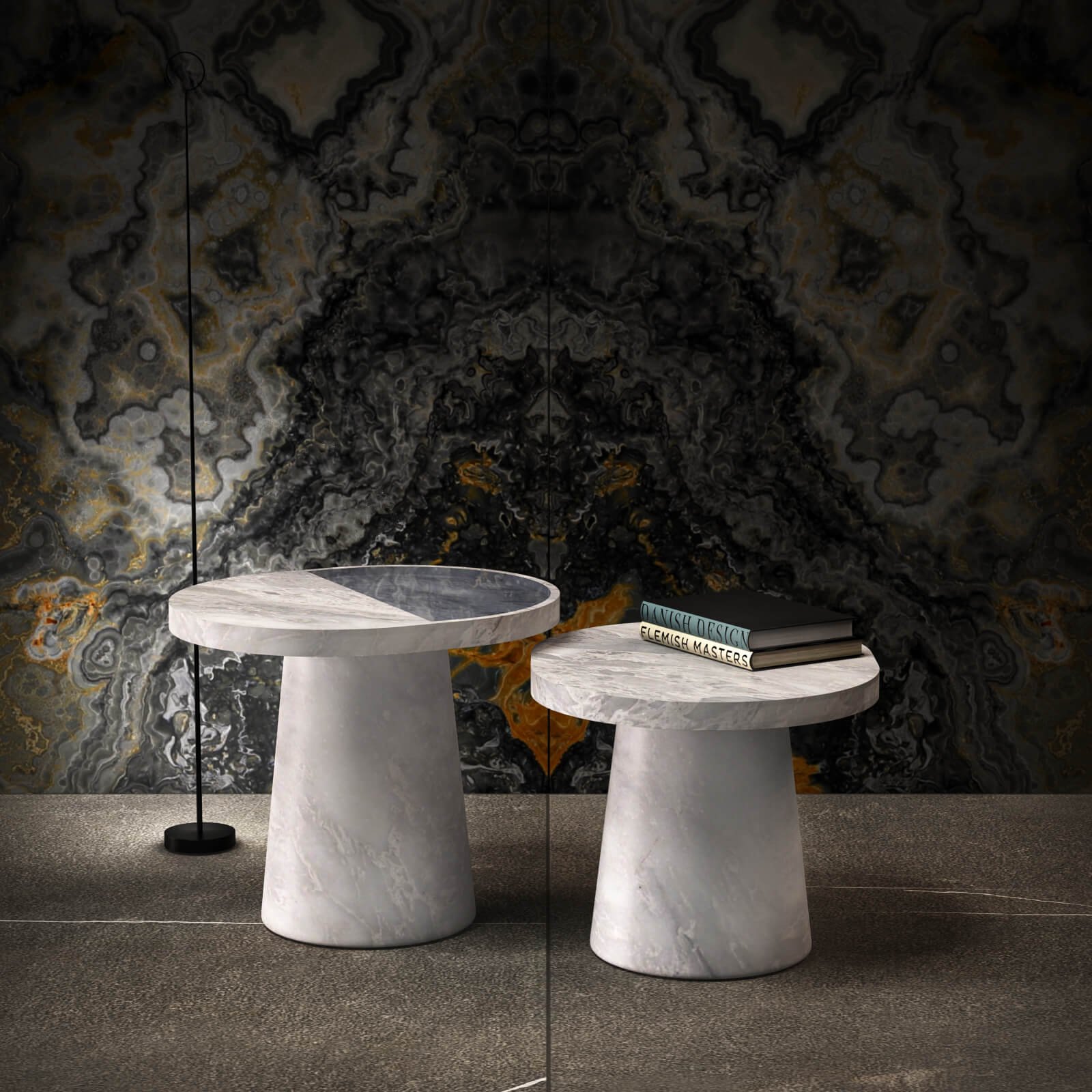
From the warm tones of Grigio Agata to the banded light of Zebrato di Londra: what grey marble is, the main varieties, and how to choose it for interiors, from the bathroom to the kitchen.
Grey marble never tries to be the star of the show. It has neither the luminous candour of the whites nor the drama of the blacks: it sits in between, and that is exactly where its strength lies. It is the stone that holds a room together without raising its voice, the one that makes an elegant backdrop for other materials while finding a character all its own. People who choose it usually do so for that reason: they are after calm, restraint, a refinement that feels no need to prove itself.
Behind the word “grey”, though, hides a surprising range of shades. There is the warm grey that leans toward sand, the cool one that shifts toward blue, the near-white grey and the one so dark it borders on black. The background changes, the veining changes, the way the surface catches the light changes. It is worth looking closely, because choosing well among the types of grey marble makes all the difference.
The character of grey marble
Like every marble, grey too is born from limestone, a marine sediment that time and pressure turn into stone. The colour is decided by the impurities trapped during its formation: traces of graphite, clays, iron oxides. Depending on which minerals prevail, the background slides toward pearl-grey, smoke-grey or lead-grey. Grey marble is, in a sense, the memory of whatever the ancient sea held in suspension.
Its personality is made of balance. It is a neutral colour, and so it pairs with almost anything: light and dark wood, brass, steel, glass, warm-toned fabrics. In a contemporary space it brings order and depth; in a more classic one it adds a note of sober elegance. That is why architects and designers reach for it so often when they want a solid base to build the rest upon.
The grey marble varieties at Purapietra
Every grey stone tells a different story. Here are the varieties in the Purapietra catalogue, each with its own temperament.
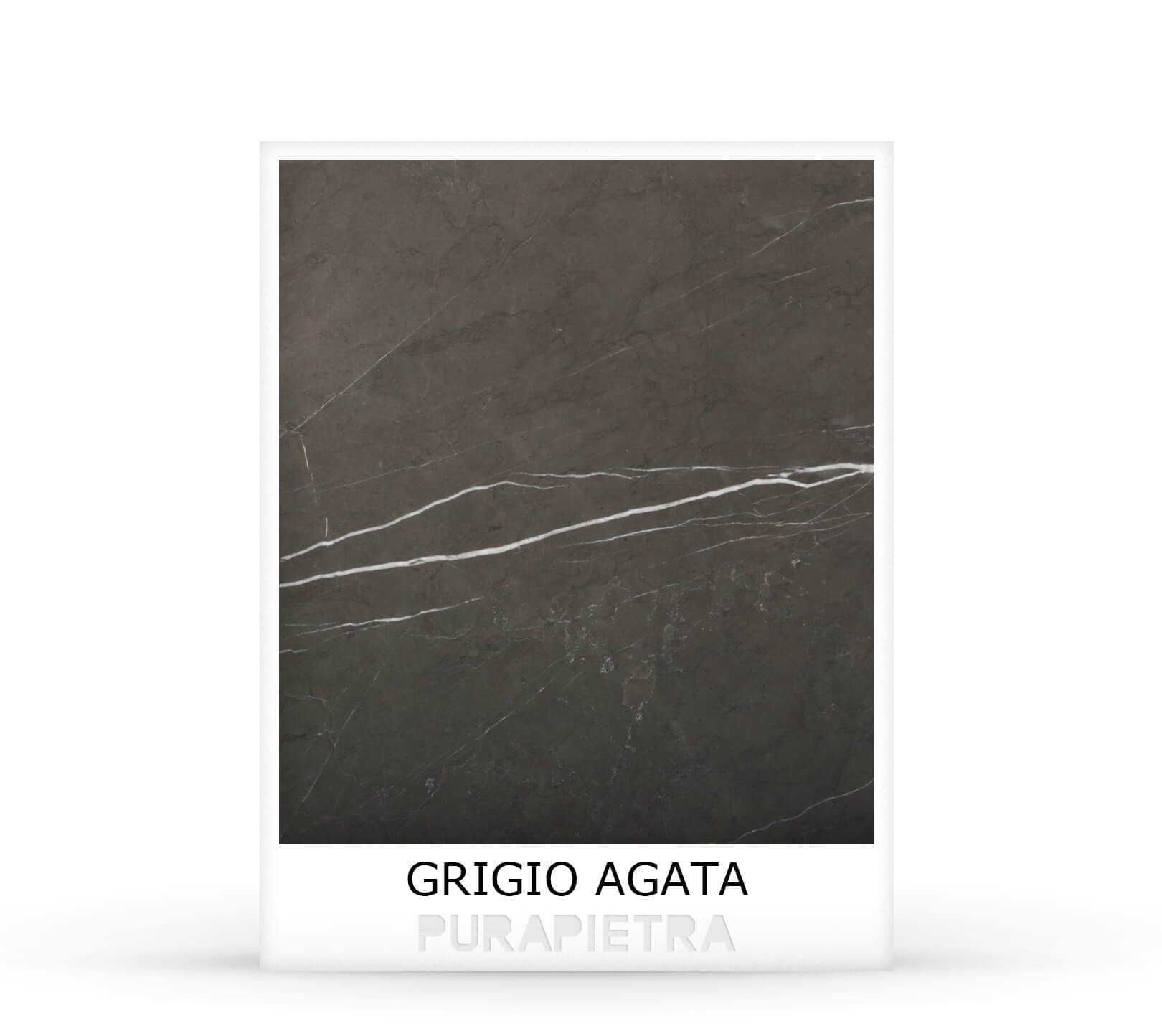
Grigio Agata
A warm, enveloping grey with a soft background crossed by veins that recall the drawing of agate. It is a welcoming stone, perfect when you want grey without the chill: it sits beautifully with light woods and warm lighting, and can make even a large room feel intimate.
Grigio di Vagli
Quarried near Vagli, in the Apuan Alps, it has a uniform, composed grey background with discreet veining. It is the grey of Tuscan restraint: elegant, never excessive, ideal for large surfaces where you need continuity and visual calm.
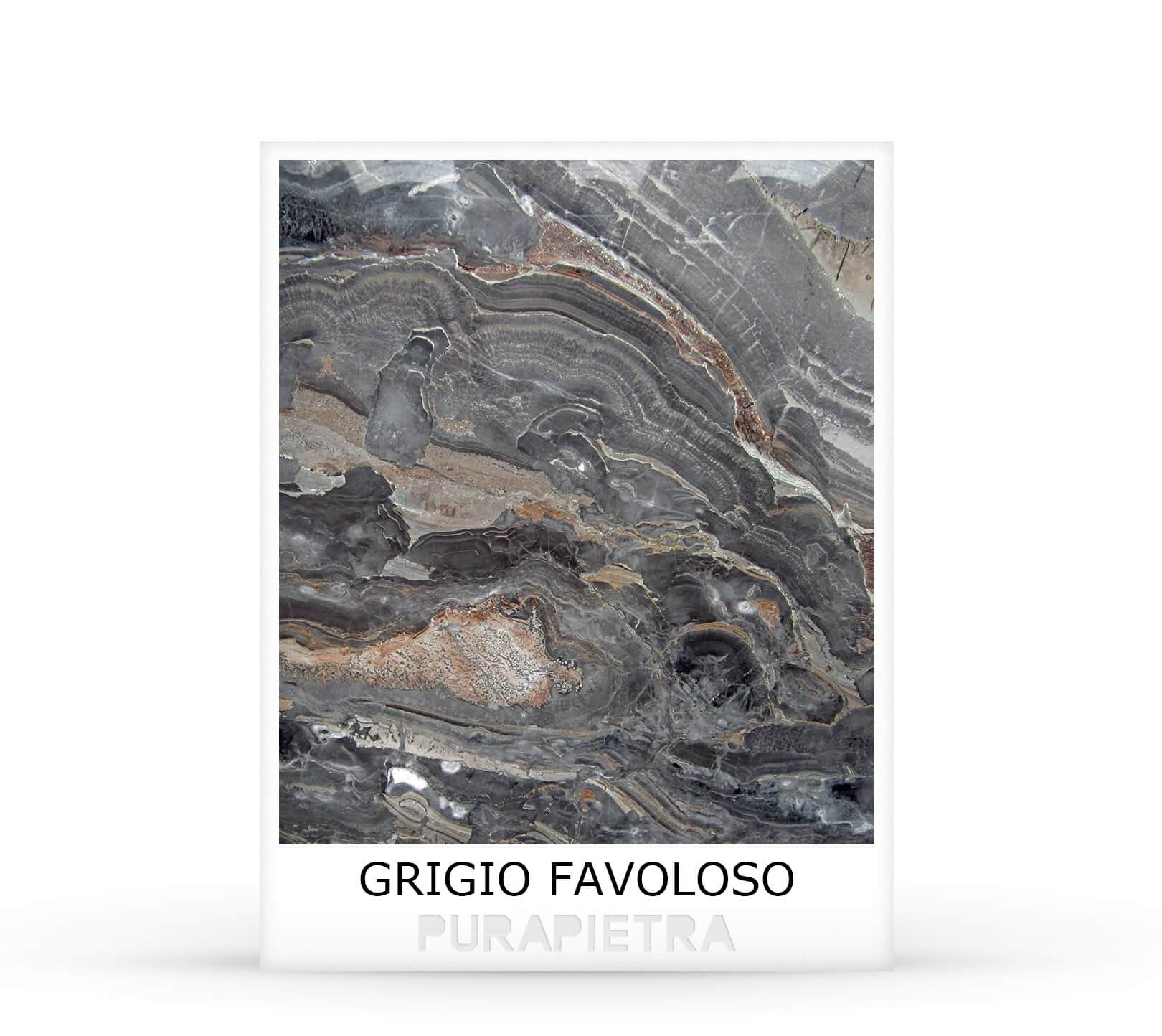
Grigio Favoloso
The name says it all. This is a more expressive grey, with pronounced veins that animate the background and turn each slab into a small painting. It needs room to tell its story and is the right pick when you want the stone to be the strong gesture of a space, not just the backdrop.
Wolf Grey
A grey with a more contemporary, urban character, cool in tone and almost metropolitan in its elegance. It works wonderfully in minimalist interiors, alongside steel, concrete and glass. It is the grey that speaks the language of today’s design.
Zebrato di Londra
The most theatrical of the family. Alternating bands of light and dark grey run along the slab like a graphic rhythm, hence the name. It is a stone that does not go unnoticed: perfect for a signature cladding or a detail meant to catch the eye.
Grey marble in interiors: bathroom, kitchen, cladding
The neutrality of grey marble makes it one of the most versatile stones of all. In interiors it finds a home almost everywhere, changing its role to suit the space.
In the bathroom grey marble is at its best: a wall cladding, a basin top, a tub carved from stone build a spa-like atmosphere, calm and material. With the right protection grey stands up to humidity and gives back that sense of cleanliness and order that, in a bathroom, is worth more than any decoration.
In the kitchen it works as a worktop and as a splashback: the grey surface hides the marks of daily life better than an absolute white, and makes brass or steel fittings stand out. For floors and large cladding, uniform greys like Grigio di Vagli offer continuity, while more veined ones like Zebrato di Londra are best used in measure, perhaps on a single wall, so the eye is not overwhelmed.
Colour and material pairings
Being neutral is a superpower. Grey marble dialogues with almost any palette, but a few pairings make it shine more than others. With warm tones (oak, terracotta, burnished brass) grey softens and creates welcoming rooms. With cool tones (white, steel, glass, blue) it turns crisp and contemporary. Set against green, whether plants or a green marble, it forms a natural, sophisticated contrast; paired with black, it builds interiors of real depth. The practical rule: if the stone has bold veining, keep everything else sober; if it is uniform, you can afford a few stronger accents.
Care and durability
Grey is perhaps the most forgiving colour among marbles, because it hides marks and small imperfections better. Still, the usual attentions apply.
Porosity. Marble is a porous stone: an impregnating treatment applied now and then reduces absorption and keeps the surface compact, especially in the bathroom and kitchen.
Sensitivity to acids. Being calcium carbonate, it reacts to lemon, vinegar and harsh cleaners, which can leave dull marks. Best to wipe away splashes at once and clean with a soft cloth and a neutral, marble-specific product.
Longevity. Treated with care, a grey marble lasts generations. And if it loses its shine over the years, re-polishing brings it back as good as new. It is a stone made for the long run, not for the season.
How to choose the right variety
The choice starts with a simple question: do you want the stone to lead or to accompany? If you are after calm and continuity, look to the warm, uniform greys like Grigio Agata or Grigio di Vagli. If you want a strong gesture, a background that becomes drawing, turn to Grigio Favoloso or Zebrato di Londra. For a contemporary, minimalist space, Wolf Grey is the right voice.
Light matters too: a very bright room carries even the darker greys well, while a room in shadow calls for lighter tones so it does not go flat. The advice is always the same: look at the stone in person, because no photograph truly captures the way light runs across it. You can see all the grey varieties in the Materials section, next to the pillars on white marble and black marble.
Questions that come up often
What are the most common types of grey marble?
Among the most requested varieties are Grigio Agata, Grigio di Vagli, Grigio Favoloso, Wolf Grey and Zebrato di Londra. They differ in tone (warm or cool) and in veining, from nearly uniform to boldly graphic.
Is grey marble suitable for a bathroom?
Yes, it is one of the best choices. With an impregnating treatment it handles humidity well and creates a calm, material atmosphere, ideal for cladding, basin tops and tubs.
Does grey marble stain easily?
It is porous and acid-sensitive like any marble, but the grey background hides marks better than a white. With good sealing and gentle cleaning it stays beautiful for a long time.
What colours does grey marble go with?
Practically all of them, because it is neutral. It is at its best with warm woods and brass for cosy rooms, or with white, steel and glass for contemporary interiors.
A stone to see in person
Grey marble is a choice of balance: it brings elegance without clamour, adapts to countless settings and ages with dignity. But between a warm Grigio Agata and a graphic Zebrato di Londra there is a whole world, and the right variety depends on the space, the light and the result you are after. The best way to decide is to touch the stone and see it in the light of your own room: request a sample or tell us about your project. And if you would like to keep reading, you will find more stories of material and craftsmanship in the Purapietra magazine.
Grey sits between the extremes, so it helps to know them. See white marble and the Carrara vs Statuario comparison, the depth of black marble, the warmth of beige marble and the rarity of blue marble — or read the whole family in types of marble. See also our guide to green marble and the comparison of Italian vs imported marble.