
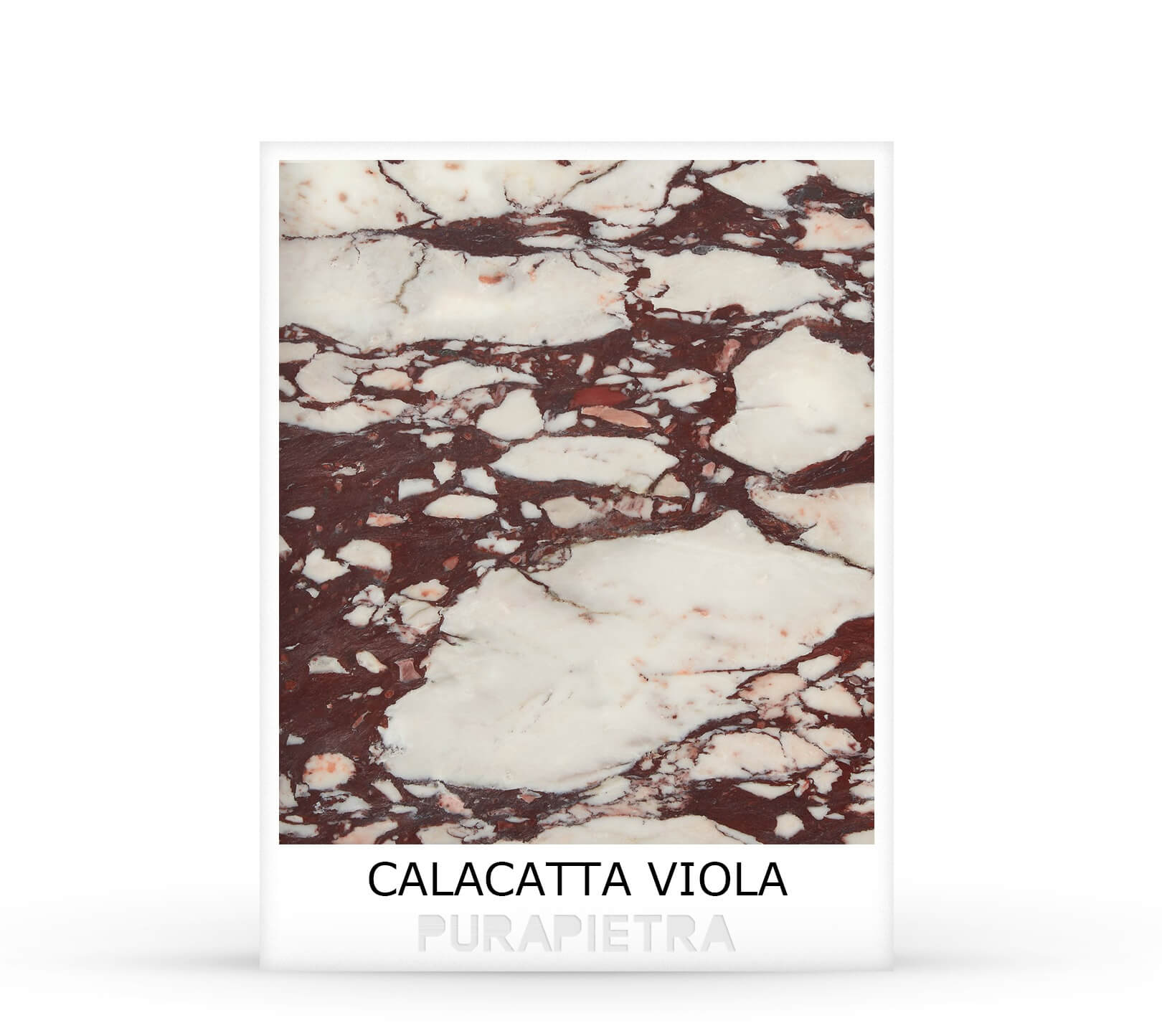
Most white marbles are quiet about their colour. Calacatta Viola is not. Across a warm white ground it carries veins in violet, burgundy and grey, and in the right light the whole slab shifts between plum, rose and ash. It is one of the few natural stones that makes people stop mid-sentence. It is also a stone that can overwhelm a room if you treat it like any other white.
Calacatta Viola belongs to the Calacatta family of Italian marbles, the white stones of the Apuan Alps known for bold, irregular veining. What sets it apart is the colour of the veins, which lean violet and burgundy instead of the usual grey or gold. This guide covers what Calacatta Viola actually looks like, how to read a slab before you buy it, which finish suits which job, where it earns its place in a home, what to pair it with, how to look after it, and what sets the price.
What Calacatta Viola is, and where it comes from
Like the other Calacatta marbles, Calacatta Viola is a white Italian marble from the Apuan Alps, the mountain range behind Carrara that has supplied white marble since Roman times. All of these stones began as limestone and recrystallised under heat and pressure into a dense mass of interlocking calcite crystals, which is what gives marble its slight translucency. Wikipedia’s page on Carrara marble is a good primer on the district if you want the long version.
The violet is the interesting part. Colour in marble comes from trace minerals caught in the calcite as the stone formed, and in Calacatta Viola those traces show up as purple, plum and burgundy veins instead of the usual grey. That is why the colour is not the same from one block to the next, and why no two slabs match.
A word of caution on the name. “Calacatta Viola” is a trade name, not a protected appellation. Two suppliers can sell quite different material under it, and a slab that is mostly grey with a hint of lilac is not the same purchase as one with deep burgundy veins. The name gets you into the right family. The slab in front of you is what you are actually buying.
Calacatta Viola next to its relatives
Clients usually compare it with the other Calacattas we work with. Against Calacatta Borghini, which tends towards a creamy ground and gold veining, Viola is cooler and far more colourful. Against Calacatta Impero, with its wide, scenic grey veins, Viola is less about sweeping lines and more about colour. Against Bianco Statuario, the contrast is bigger still: Statuario is graphic and restrained, Viola is expressive. If you are still deciding between the calm and the dramatic end of white marble, our comparison of Carrara vs Statuario is a useful starting point.
Appearance: colour, veining and character of Calacatta Viola
The ground is a warm white, sometimes with a faint cream or grey cast depending on the block. The veins are what you remember. They run from pale lilac to deep burgundy, often with grey alongside, and they tend to be irregular: patches, clouds and broken lines rather than one clean sweep. Under warm light the stone reads rosy. Under cool daylight it goes greyer and more violet.
Before you commit to Calacatta Viola, three things are worth checking:
How much colour is on the slab. Some slabs are mostly white with a few violet accents. Others are densely veined and read as a purple stone with white in it. Both are Calacatta Viola, and they make very different rooms. Decide which one you want before you look at samples.
The undertone of the violet. Burgundy leans warm and sits well with wood and brass. Lilac and grey-violet lean cool and suit steel and glass. Look at the slab in the light of the room it is going into, not only under the showroom lamps.
Consistency across slabs. With a pattern this irregular, a mismatch at a joint shows. For book-matched walls and large surfaces, ask for consecutive slabs from the same block and lay them out side by side. Our guide on how to identify quality marble covers the other checks we run on a block (fissures, filled cracks, resin backing) before it is approved for cutting.
Finishes for Calacatta Viola
Polished
Polishing gives Calacatta Viola its fullest colour. The violet deepens, the white brightens and the surface takes on the glassy depth that photographs love. We recommend polished for walls, furniture, fireplace surrounds and feature pieces: places where nothing acidic will sit on the surface and nobody walks across it every day.
Honed
A honed finish is matte to satin. It softens the colour slightly and, more importantly, it hides the dull marks that acid leaves on marble. For a worktop, a vanity top or a floor, honed Calacatta Viola is almost always the sensible choice. The violet comes across as softer and more chalky, which many clients find easier to live with than full gloss.
Brushed
Brushing leaves a fine, tactile texture and noticeably mutes the pattern. It suits shower floors and steps, where grip matters. Because the appeal of Calacatta Viola is almost entirely visual, we rarely brush it for feature work. When we do, it is because the stone has to do a practical job in a room where most of the rest is polished.

Best uses for Calacatta Viola in interior design
Feature walls and bookmatched panels
This is where Calacatta Viola is at its best. A vertical surface never meets lemon juice or red wine, so you can polish it, and a bookmatched pair of panels turns the pattern into a symmetrical composition that holds a room. Behind a bed, a bath or a dining table, one wall is usually all you need. We map the veins on the block face before cutting so the joints fall where they should.
Bathrooms
A bathroom is small enough for one bold stone to set the whole mood. Calacatta Viola on a vanity wall or around a shower, with quieter surfaces everywhere else, looks deliberate and calm at the same time. Paired with a carved piece like our Unit Sink or the Linear basin, the stone becomes the room’s main idea. On bathroom floors, go honed or brushed.
Tabletops, vanities and furniture
A single tabletop or vanity top is the classic way to use a stone like this. The surface is small enough to choose the exact slab and place the veins where they will be seen. It is also forgiving: you get the full effect of the colour without committing a whole room to it.
Kitchen islands and worktops
It can be done, and the caveat is the same one we give for every calcite marble: acid etches it. Lemon, wine, vinegar and many descaling products leave dull marks on a polished surface, sometimes within minutes. Choose a honed finish, seal it at installation and accept that the surface will pick up a patina. A coloured stone also shows its marks less than a plain white one, which helps. If the worktop has to stay exactly as it was on day one, a quartzite is a better choice than any marble, and we will say so.
Design objects
Trays, vases and bowls cut from Calacatta Viola let you have the stone at a domestic scale. Our marble trays and vases are made from material left over from larger commissions, so the pieces carry the same veining as the architectural work.
What to pair with Calacatta Viola
Warm oak and walnut. Timber takes the edge off the cool end of the violet and brings out the burgundy. A walnut vanity under a Calacatta Viola wall is a combination we come back to often.
Brass and bronze, used sparingly. Warm metals sit well with burgundy veining. Check them against the real stone before ordering taps, because the violet can look different next to gold than it does on its own.
Blackened steel and brushed nickel. Cool metals pick up the grey in the veining and make the colour look more contemporary.
Quiet walls and floors. Because the stone does so much on its own, keep the surrounding colours soft: warm plaster, off-white, stone-grey. Let one surface be the statement.
A calmer stone in the next room. Using Calacatta Viola in one room and a quieter white such as Bianco delle Alpi or Acqua di Carrara elsewhere keeps a house from feeling like every surface is shouting. Our overview of marble interiors covers this kind of room-to-room planning.
Maintenance and sealing
Seal it when it is installed. Use a penetrating, impregnating sealer, not a film-forming coating that will peel unevenly over time. Re-seal worktops every twelve to eighteen months and walls much less often. A quick test: if a drop of water still beads on the surface after a few minutes, the sealer is working.
Clean with pH-neutral products. Warm water and a neutral stone soap handle almost everything. Bleach, vinegar, citrus cleaners and most bathroom descalers etch the surface directly. In our experience most of the damage we are asked to repair comes from a cleaning product, not from daily life.
Blot, do not wipe. Oil and wine stain because the stone absorbs them. Acid etches because it dissolves the surface. Blotting a spill quickly prevents most stains, and a poultice can pull out an absorbed one later. An etch mark is different: it has to be honed out. For a longer view of how marble ages, see our piece on marble durability.
What drives the price of Calacatta Viola
We do not publish a square-metre price for Calacatta Viola, and we would be wary of anyone who quotes one without seeing the slab. Four things set the cost: the grade and rarity of the block, the thickness you specify, the yield (how much of the raw block ends up as usable finished material), and the hours of hand finishing. For a stone valued for its colour, rarity and selection are the big ones. A block with strong, well-placed violet veining is worth considerably more than one sold under the same name that is mostly grey.
As we say in our guide to the most prized Italian marbles, Calacatta Viola is among the most valuable of them, because violet veining occurs in very few places. What you pay for is the look and the selection work behind it. It is not harder or tougher than a cheaper white, and it behaves in daily use the way any calcite marble does.
How to choose a slab
If you can, go to the yard. Photos flatten colour and make every slab look more even than it is. Stand back a few metres, because that is the distance from which a wall or a tabletop will actually be seen, then walk up close and look at the surface in raking light for fills and hairline cracks. Ask for the slab numbers so you know which ones are consecutive, and photograph them together with a tape measure for scale.
Bring the drawing with you. Knowing where the sink cut-out, a tap hole or a door will fall changes which slab is right. A violet vein that looks perfect in the yard can end up running straight through a cut-out. We mark the pieces out on the slab in chalk, or on a photo, before anything is cut. It takes an extra hour and saves a lot of regret.
Why choose Calacatta Viola with Purapietra
We treat marble as a building material, not a skin. Every piece is roughed on CNC for accuracy and finished by hand, which is where an edge stops looking machined. For Calacatta Viola we ask clients to choose the block, and we draw the vein layout on the block face before the first cut, so the colour, the direction of the veins and the match at every joint are decided in advance.
You can see Calacatta Viola alongside our other white, coloured and rare stones in the materials catalogue. If Viola turns out to be more colour than a room needs, our guides to Italian white marble and white marble cover the calmer options we usually suggest instead. Send us a plan, a sketch or just a photo of the room, and we will tell you what the stone can do there and roughly what it will cost.
Frequently asked questions about Calacatta Viola
What is Calacatta Viola marble?
Calacatta Viola is a white Italian marble from the Calacatta family, from the Apuan Alps near Carrara. It is known for violet, burgundy and grey veining across a warm white ground, a colour combination that occurs in very few places.
How much does Calacatta Viola cost?
There is no fixed price per square metre. Cost depends on block grade, how strong and well placed the violet veining is, slab thickness, usable yield and hours of hand finishing. Calacatta Viola is among the most valuable Italian marbles. We quote each project once the slab and finish are chosen.
Is Calacatta Viola good for a bathroom?
Yes. Walls, vanity surrounds and shower enclosures are some of the best places for it, because a bathroom is small enough for one bold stone to set the mood. Use a polished finish on walls and a honed or brushed finish on floors for better grip.
Can I use Calacatta Viola for a kitchen worktop?
You can, but like every calcite marble it etches on contact with acids such as lemon, wine and vinegar. Choose a honed finish, seal it at installation and expect a patina over time. If the worktop must stay unchanged, a quartzite is the better material.
What is the difference between Calacatta Viola and Calacatta Borghini?
Both are premium Calacatta marbles from the Apuan Alps. Calacatta Borghini tends to have a creamier ground and gold veining. Calacatta Viola is defined by violet and burgundy veins and is usually cooler and more colourful. Slabs vary a lot under both names, so always compare real slabs side by side.
How do I care for Calacatta Viola?
Seal it with a penetrating sealer at installation and re-seal worktops every twelve to eighteen months. Clean only with pH-neutral products, avoid bleach, vinegar and citrus cleaners, and blot spills quickly instead of wiping them. Etch marks can be removed by re-honing.
Where does Calacatta Viola look best?
On a single deliberate surface: a bookmatched feature wall, a bathroom vanity wall, a tabletop or a vanity top. Used sparingly with calm materials around it, the colour reads as a statement. Spread across a whole house it loses its effect.