
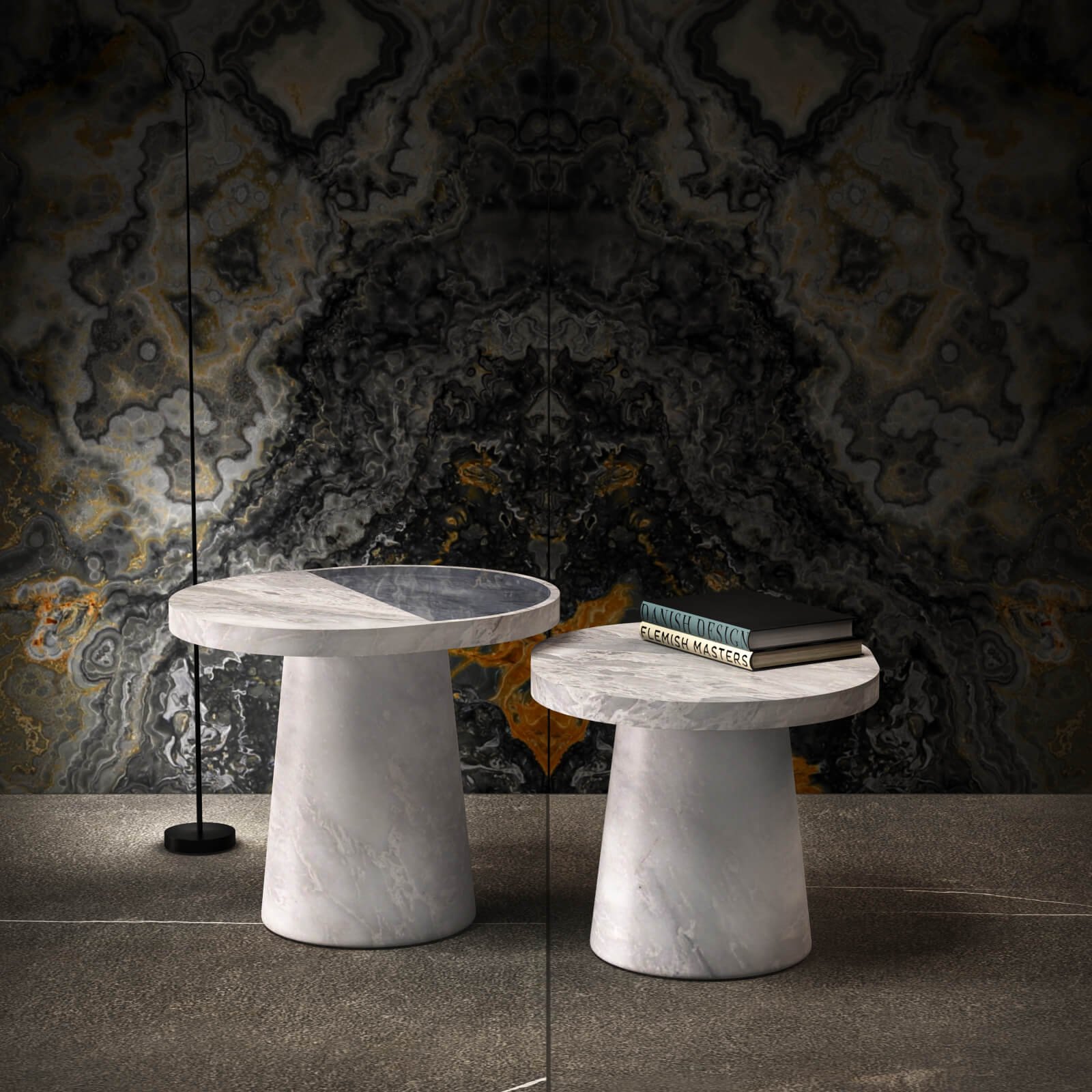
A marble kitchen is the most beautiful way to make your life slightly more complicated. Nothing else gives a worktop that depth and variation. Nothing else will also show you, with a faint dull ring, exactly where a glass of wine once stood. The question is not whether marble is a good idea in a kitchen. It is whether you are the right person for it, and which parts of the kitchen deserve it.
Marble has been used for work surfaces for as long as people have cooked on stone. Pastry chefs still prefer it for the cool, flat surface it offers for dough. Used in a home, it comes with trade-offs that are worth understanding before you sign an order. This guide goes through where marble works in a kitchen (worktops, islands, splashbacks), the finish that makes it livable, how staining and etching really behave, how to seal and care for it, which stones to choose, what drives the cost, and when another material is the better answer.
Is marble a good choice for a kitchen?
It depends on how you cook and how you feel about wear. Marble is a calcium carbonate stone. That makes it softer than granite or quartzite and chemically reactive: acids dissolve a thin layer of the surface and leave a dull mark, which is called an etch. Oil and wine can also soak into unsealed stone and stain it. Marble is a metamorphic rock, and these traits come with the territory.
What you get in return is real. The veining runs through the full thickness of the stone, so an edge or a cut-out shows the same pattern as the face. The surface stays cool, which is why bakers like it. It can be re-honed: scratches and etches are not permanent damage but a surface that can be refreshed. And no printed or engineered material gives the same movement and depth.
The honest summary: marble suits people who accept that a kitchen worktop is a working surface and will carry a patina. It does not suit people who want it to look identical in ten years.
Where to use marble in a kitchen
Splashbacks and wall panels
If you are unsure, start here. A splashback does not face the same risks as a worktop: cutting boards and hot pans do not land on it, and acids rarely reach it. You can specify a polished finish, run the veining up the wall in one book-matched piece, and enjoy the stone with very little maintenance. The same logic applies to our guide on marble wall cladding, where we go into layout and fixing in more detail.
Islands
An island is where marble earns its place in a kitchen. It is the surface people see first, lean on and gather around, and a single slab with a waterfall edge makes the whole room. It is also the surface that sees the most use, so the finish and the sealing matter. For an island that will be cooked on, choose a honed finish and think about a second, sacrificial surface (a wooden board, a smaller stainless area) for the messiest work.
Worktops
A marble worktop along a wall is the more demanding case: it sits next to the hob, the sink and the kettle. It can work very well. The best results come when the stone is chosen for how it ages, the finish is honed, and the sink and hob cut-outs are planned with the slab in front of you, not after the fact. If you want the look of marble but the worktop will be heavily used, consider marble on the island and a harder stone beside the hob.
Sinks and integrated elements
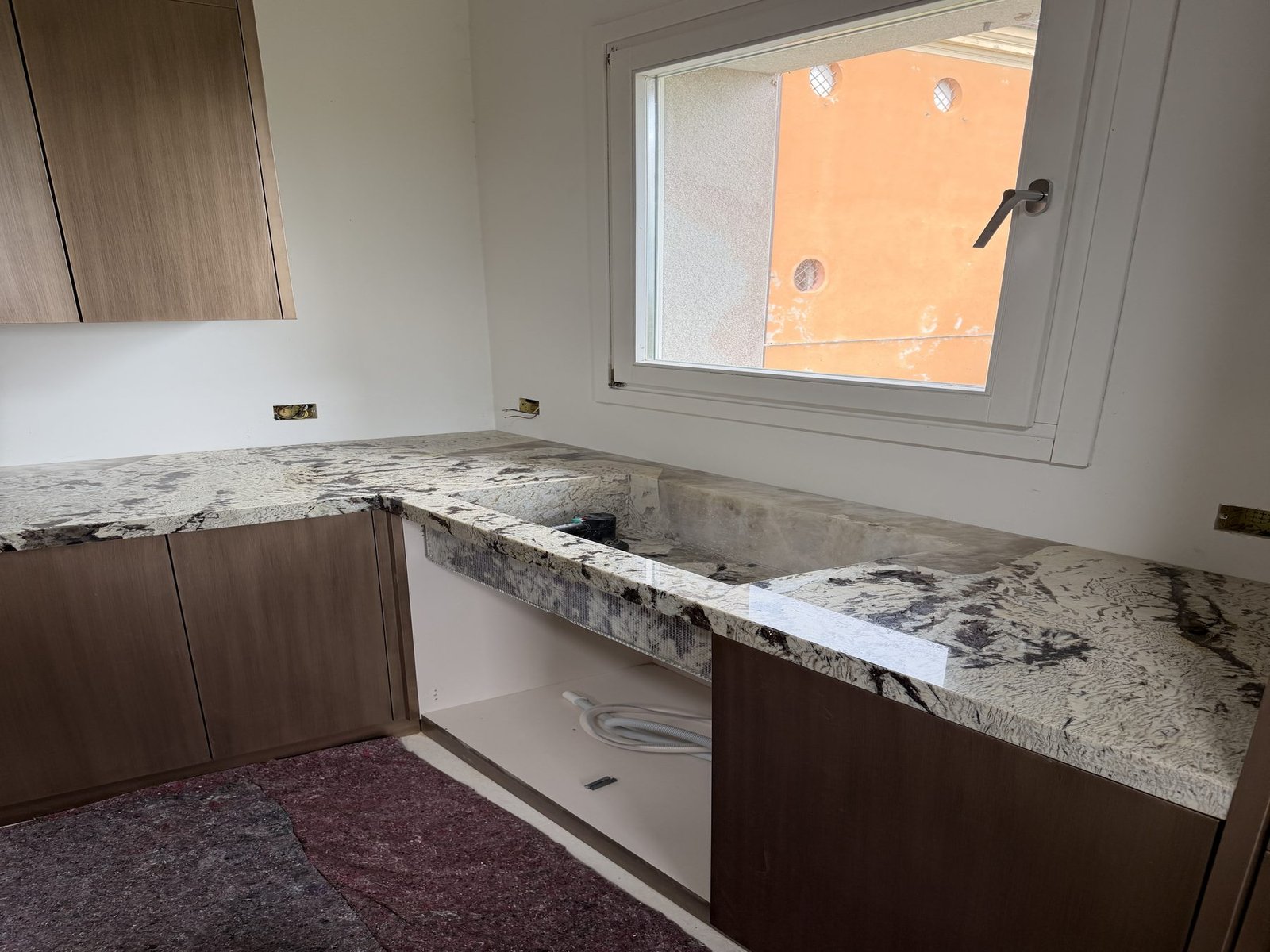
One of the nicer things stone allows is a sink worked directly into the worktop. In the Bologna kitchen shown above, the sink is carved from the same stone as the surface, which removes the usual rim and joint and leaves one continuous piece. It is more work than dropping in a stainless steel sink, and it is the kind of detail that makes a kitchen look built rather than assembled. We cover the wider idea in our piece on bespoke marble.
Choosing the finish for a marble kitchen
Honed. This is the finish we recommend for most kitchen worktops and islands. A honed surface is matte to satin, so the dull marks left by acids blend in far better than they do on gloss. It also looks more relaxed and shows fewer fingerprints. Honed stone is slightly more porous than polished stone, so sealing is more important.
Polished. Polished marble has the deepest colour and the strongest veining, and it is the best choice for splashbacks and wall panels. On a worktop it is unforgiving. Every etch is a dull patch on a mirror finish, and the more acidic your cooking, the sooner you will see them.
Brushed or leathered. A textured finish masks marks well and feels good under the hand. It also holds crumbs and can be harder to wipe clean. We use it where texture is part of the design, not by default.
Stains, etches and scratches: what to expect
It helps to know the three kinds of damage, because they look similar and are fixed differently.
Stains come from liquids the stone absorbs: oil, wine, coffee, tea, some cosmetics. They sit under the surface. Sealing slows absorption but does not stop it forever, which is why spills should be blotted promptly. An absorbed stain can often be drawn out with a poultice.
Etches come from acids: lemon, tomato, vinegar, wine, many cleaning products. They dull the surface and do not go away with wiping, because the polish itself has been dissolved. On a honed finish they are far less visible. When they bother you, a stone specialist can re-hone the area.
Scratches come from hard objects dragged across the surface. Marble is softer than most of the things in a kitchen, so fine scratches will happen. They are usually superficial, and on a honed surface they tend to blend into the pattern.
For a longer view of how marble behaves over the years, see our piece on marble durability.
Sealing and caring for a marble kitchen
Seal it at installation. Use a penetrating, impregnating sealer, not a film-forming coating that wears unevenly. Re-seal worktops and islands every twelve to eighteen months, as we explain in our marble durability guide; walls and splashbacks rarely need it. A simple test: if a few drops of water bead on the surface after a few minutes, the sealer is still working.
Use pH-neutral cleaners. Warm water and a neutral stone soap are enough for daily cleaning. Avoid bleach, vinegar, citrus-based sprays and most bathroom and oven cleaners. In our experience the damage we are asked to repair comes more often from the wrong cleaning product than from cooking.
Blot, do not wipe. Wiping spreads a spill over a larger area. Blotting lifts it before it has time to soak in.
Use boards and trivets. Marble tolerates heat better than many engineered surfaces, but a very hot pan can still leave a mark, and cutting directly on the stone will scratch it and dull your knives. A wooden board and a trivet cost little and save the surface.
Which marble for a kitchen?
The stone matters as much as the finish. Whites with active veining, such as Calacatta Borghini and Bianco Statuario, hide marks better than a plain, even white, because the pattern distracts the eye. Greys and darker stones tend to disguise wear more than very pale ones. A calmer Carrara-type stone is the practical, forgiving option. Our guide to Italian white marble compares the options.
It is also worth saying that not every natural stone in a kitchen needs to be marble. Some of the harder stones are more resistant to acids and can be a better fit for a heavily used worktop. We will tell you if we think another stone suits your use better than marble does. You can see the range in our materials catalogue, and our guide on how to identify quality marble explains what we check on a block before it is cut.
What affects the cost of a marble kitchen
We do not publish a price per square metre, and we would be wary of anyone who quotes one without seeing the project. The main drivers are the stone itself, the thickness you specify, how much material the layout uses (an island with waterfall edges needs more stone than a straight run), the complexity of the edges, cut-outs and any carved elements such as a sink, and the hours of hand finishing. Book-matching slabs also raises the cost, because it needs consecutive slabs from the same block and more material.
The best way to control the budget is to decide where marble matters most. A single island or a splashback in a fine stone, with practical surfaces elsewhere, often gives more effect than marble everywhere. If you are planning a whole ground floor, our guides to marble flooring and marble interiors show how to make the stone work from room to room.
When another material is the better answer
If the worktop will be used hard, every day, with little tolerance for marks, an engineered or harder material may be the more honest recommendation. Marble is not a good fit for someone who wants a surface that never changes. It is a good fit for someone who accepts that it will age, and who likes that it does.
A common middle route is to mix: marble on the island or in a splashback, and a harder surface where the heavy cooking happens. You get the visual weight of the stone without asking it to do all the work.
Working with Purapietra on a marble kitchen
We treat marble as a building material, not a skin. Pieces are roughed on CNC for accuracy and finished by hand by Italian artisans, which is where an edge stops looking machined. For a kitchen we begin with the block and the layout, so we can decide where the veins run, where the joints fall and where the sink and hob sit before anything is cut. Our projects include residential interiors where stone carries the whole room, and the same approach applies to a kitchen of any size.
If you are planning one, send us a plan, a sketch or a photo of the room, and we will tell you which parts of it deserve marble, which finish makes sense and roughly what it will cost. For smaller touches, our marble trays and vases bring the stone into a kitchen without a worktop commitment.
Frequently asked questions about a marble kitchen
Is marble a good choice for kitchen worktops?
It can be, if you accept that it is a soft, reactive stone that will pick up a patina. Choose a honed finish, seal it at installation and use pH-neutral cleaners. If you want a surface that never changes, a harder material is a better fit.
Does marble stain in the kitchen?
Unsealed or poorly sealed marble can stain from oil, wine, coffee and other liquids it absorbs. A penetrating sealer slows this, and blotting spills quickly prevents most stains. An absorbed stain can often be drawn out with a poultice.
What is etching, and can it be repaired?
Etching is a dull mark left when an acid such as lemon, vinegar or wine dissolves the polish on marble. It is not a stain. On a honed surface it is far less visible, and a stone specialist can re-hone the area to remove it.
Should a marble worktop be polished or honed?
Honed is the better choice for most kitchen worktops and islands, because it hides etches and fingerprints. Polished suits splashbacks and wall panels, where acids and wear are rare.
Can I use marble only for the splashback or the island?
Yes, and it is often the best approach. A marble splashback faces few risks and shows the stone at its best. An island gives you a feature surface, with a more resistant material beside the hob if you cook heavily.
How do I clean a marble kitchen?
Use warm water and a pH-neutral stone soap. Avoid bleach, vinegar, citrus cleaners and oven or bathroom products, which can etch the surface. Blot spills rather than wiping, and use boards and trivets.
How much does a marble kitchen cost?
There is no fixed price. Cost depends on the stone, thickness, the amount of material the layout needs, edges, cut-outs, any carved elements such as a sink, and hand finishing. We quote each project once the layout and stone are chosen.