
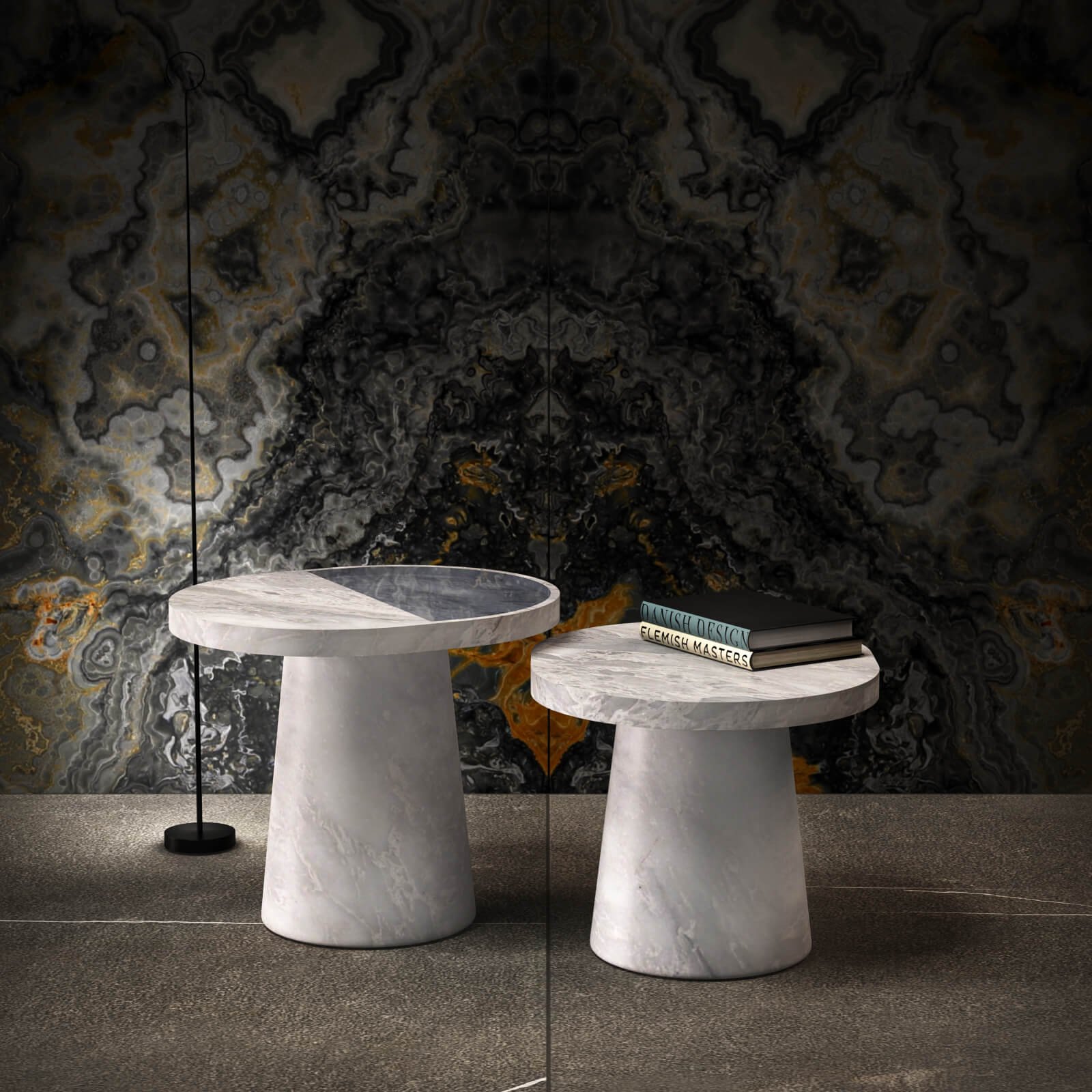
Coloured marble is back in serious projects, and the interesting part is not that people are using green or yellow again but how differently they are using it. For twenty years the safe answer in stone was white. That consensus is loosening. This is a guide to the coloured marble worth knowing, how much of it a room can actually take, and the pairings that hold together once the mood board is off the wall.
Why coloured marble came back
The all-white interior was a reaction to the heavy, dark, over-decorated rooms of the decades before it, and like most reactions it went further than it needed to. What replaced the excess was a period of restraint that eventually became its own kind of default: white marble, white walls, pale oak, everywhere, in every price bracket.
Two things pushed colour back into the conversation. The first is that natural stone is one of the only materials in a modern interior that has colour built into it rather than applied to it. A green marble is green all the way through, and it got that way through millions of years of mineral chemistry. That is a different proposition from a painted surface or a printed ceramic, and once you have seen the two next to each other the difference is hard to unsee.
The second is scale. Contemporary projects tend to use coloured marble in small, deliberate quantities: an inset, a single wall, a bath, an object, rather than the wall-to-wall applications that gave the material its dated reputation in the first place. Small doses changed everything.
Green: the coloured marble that behaves
Green is the easiest coloured marble to live with, because green already exists in most interiors in the form of plants and daylight through leaves. The eye does not experience it as a departure.
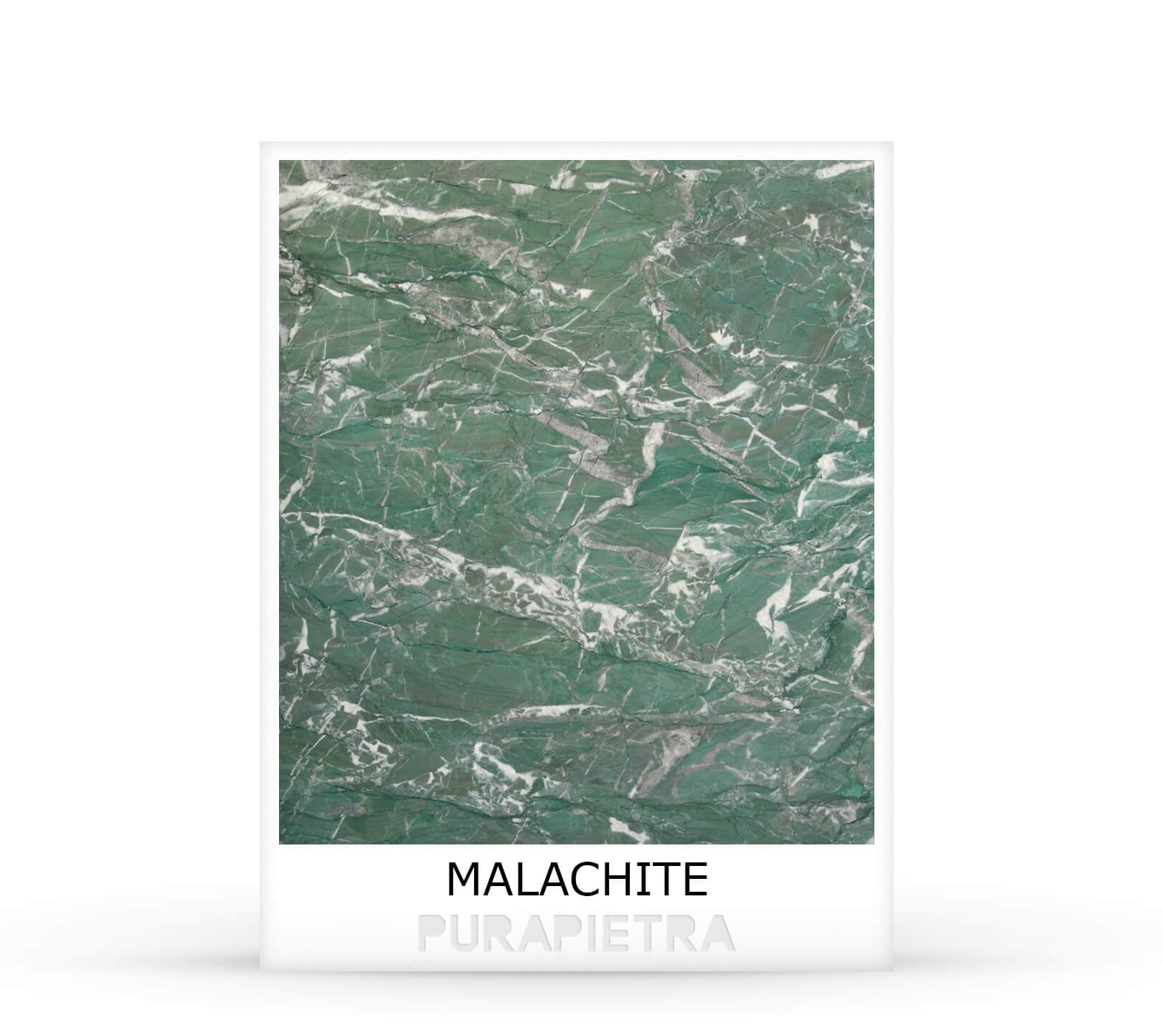
The range is wide. Verde Alpi is the deep, almost black-green with white fracture veining that most people picture, an Italian serpentinite quarried in the Aosta valley. Verde Mediterraneo and Verde Positano run lighter and more mottled, closer to the colour of shallow water over rock. Malachite is the theatrical one, banded in concentric rings like the mineral it takes its name from, and it is a stone to use once in a room and no more.
Green pairs unusually well with brass and with warm woods, and it is the coloured marble that most reliably survives being put next to a white one. A green inset in a white bathroom, a green plinth under a white basin, a green shelf in a white kitchen: all of these work. Our guide to green marble goes further into the varieties and their uses.
Yellow: warmth without weight
Yellow coloured marble does something no other colour does, which is raise the temperature of a room without darkening it. Giallo di Bolgheri, quarried in the Tuscan Maremma, is honey to amber with soft cloudy movement rather than hard veining. Crema Amalfi and Avorio Striato sit at the pale end, closer to a warm neutral than a colour, and are useful when you want warmth but not a statement.
The risk with yellow is that under warm artificial light it can tip from honey to something closer to nicotine. It is worth seeing a yellow slab under the actual lighting temperature the room will have, and worth avoiding it altogether in a space lit only by low-Kelvin bulbs. Under daylight, or under neutral 3500K to 4000K light, it is a beautiful stone. There is more on the varieties and where they sit in our yellow marble guide.
Pink: the least obvious success
Pink carries more baggage than any other coloured marble and rewards you for ignoring it. The stones themselves are subtle: Rosa di Venezia is a soft dusty rose with grey drifting through it, Flora is paler and more clouded, and Pink Onix is translucent enough to be lit from behind. None of them are the saturated bubblegum that the word suggests.
Pink works best where you would otherwise have used a warm white, and it works particularly well in bathrooms, because it is the one colour that flatters skin under artificial light. Used as a full-height cladding in a small windowless room it turns what would have been a cold box into something enveloping. Paired with grey, with unpolished brass or with a deep green it stops reading as pink at all and starts reading as a warm neutral with more going on than usual. Our pink marble guide covers the varieties in more detail.
Blue: the rarest and the most demanding
Genuine blue in stone is uncommon, because the minerals that produce it are uncommon. Sodalite Lapis is the deepest of them, a dense royal blue shot through with white calcite. Sky Onix is pale and translucent, closer to a winter sky than to a pigment. Stormo Blue and Mare d’Inverno sit in the grey-blue middle where the colour reads as atmosphere rather than as a decision.
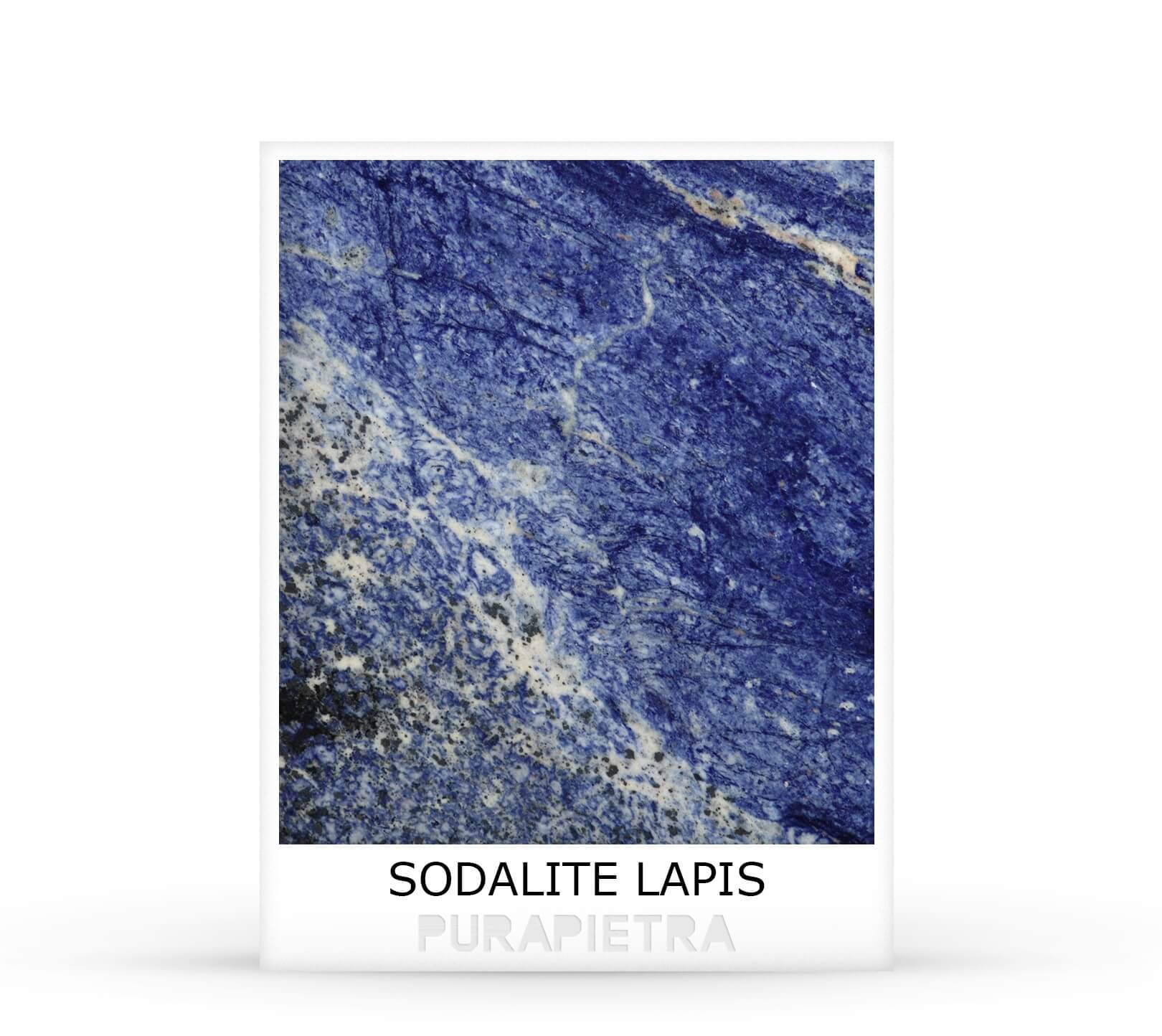
Blue is the hardest coloured marble to place, for a simple reason: it is a cool colour, and most of the materials people put around stone are warm. Blue against oak, blue against brass and blue against terracotta all fight. Blue against white, against grey, against blackened steel or against another blue works immediately. The other constraint is supply. Sodalite and the deep blues come in limited block sizes, so a continuous run of any length is often not possible and a small, framed application is the honest way to use them.
How much coloured marble a room can take
This is where most coloured stone projects succeed or fail, and the answer is usually “less than the mood board suggests”.
One coloured marble per room. Two of them in the same space almost always end up in competition, because both are strongly figured and neither will yield. If you want a second material with presence, make it a metal or a wood.
Keep the proportions unequal. A coloured stone occupying somewhere between five and twenty per cent of the visible surface reads as intentional. At fifty per cent it reads as indecision. A green inset in a white floor, a yellow band at splashback height, a pink alcove in a grey bathroom: all of these are the right size.
Put it where the eye already goes. Behind a basin, around a fireplace, on the front of an island, on a single wall at the end of a sightline. Colour in a place the eye passes over is wasted, and colour everywhere is noise.
Let quiet stone carry the volume. A calm white or grey does the structural work and the coloured marble does the accent. Our guides to white marble and grey marble cover the backgrounds that coloured stone sits best against.
Finishes: how the surface changes a coloured marble
Finish matters more with colour than it does with white, because the surface decides how saturated the stone looks.
Polished pulls the colour up to its maximum. A polished Verde Alpi is almost black-green and reflective; the same slab honed is noticeably lighter and softer. If the colour is the reason you chose the stone, polishing is how you get all of it, at the cost of showing every fingerprint and every etch mark.
Honed takes roughly a shade out of the colour and gives it a chalky, matt quality. On floors it is the safer choice for grip, and on a strong colour it stops the surface becoming a mirror in a room that did not need one.
Brushed and leathered finishes sit between the two and are the most forgiving for horizontal surfaces that get used. On a deep coloured marble the faint texture catches light unevenly, which reads as depth rather than as wear.
The practical point is that a sample is only meaningful in the finish you are actually going to specify. Comparing a polished sample of one stone against a honed sample of another tells you almost nothing about how they would look side by side.
Lighting: the part most schemes get wrong
Colour in stone is entirely at the mercy of the light falling on it, and a coloured marble chosen in a daylit warehouse is a different material under warm downlights at night.
Warm light at 2700K deepens reds, pinks and yellows and pushes greens towards olive. It flatters Rosa di Venezia and Giallo di Bolgheri and does no favours at all to blue. Neutral light at 3500K to 4000K is the most honest across the whole range and the safest default when a room contains more than one stone. Daylight varies with orientation: a north-facing room cools every colour by a noticeable degree, which is worth knowing before choosing a blue for one.
Backlighting is a separate technique and it only applies to the translucent stones. Onyxes such as Pink Onix and Sky Onix, cut thin and lit from behind, stop reading as surfaces and start reading as light sources. It is a beautiful effect and an unforgiving one: the panel has to be evenly lit or every variation in thickness shows.
Coloured marble at object scale
The lowest-risk way into coloured stone is not a wall. It is an object.
A bowl in green marble, a tray in a warm yellow, a vase in something deep and figured: at that scale you get the whole colour and none of the commitment, and if the room changes around it, the piece moves. It is also the scale at which the material is most legible, because you are seeing the stone as a solid rather than as a surface, with the edges and the thickness visible.
Several pieces in our trays and vases collections exist for exactly this reason, and a single object is often what convinces someone that a coloured marble belongs in the house at all. The larger applications tend to follow later.
Pairings that hold together
A few combinations come up repeatedly in projects because they work rather than because they are fashionable. Green with brass and pale oak, which is warm without being heavy. Yellow with off-white and blackened steel, where the metal stops the yellow becoming sweet. Pink with mid grey and unlacquered bronze, which keeps the pink honest. Blue with white and chrome, cool throughout and deliberately so. And any coloured marble against a large plain field of the same stone’s palest relative, which is the most reliable trick there is.
The pairing to avoid is coloured stone against a patterned non-stone surface. A green marble next to a patterned tile, a printed wallpaper or a strongly grained veneer produces two competing rhythms, and the stone always loses, because the other material is cheaper to replace and therefore usually wins the argument later.
Practical notes before you specify
Coloured marbles are not all the same material underneath. Serpentinites such as Verde Alpi are harder than calcitic marbles but more prone to fracture along their veins, which is why green slabs are often resin-backed and net-reinforced. Onyxes, including the pink and blue translucent stones, are softer, more brittle and best used vertically or backlit rather than as a working horizontal surface. The saturated colours also show etching and wear more visibly than a white does, because there is more contrast to lose.
Sealing follows the same rules as it does for any calcium carbonate stone: an impregnating sealer on installation, pH-neutral cleaners only, and no acids anywhere near the surface. The one difference is that on a dark coloured marble an unsuitable sealer can leave a visible sheen where it pools, so it is worth testing on an offcut first.
Two rules cover most of the rest. See the actual slab, not a photograph, because colour reproduction on a screen is unreliable and colour is the entire point here. And view it under light close to the light in the room it is going into. Our full range is on the materials page, organised by colour family, and there is a broader introduction to the material itself on Wikipedia’s marble entry.
If you are working on something specific and want to talk the material through before committing, write to info@purapietra.it.
Frequently asked questions about coloured marble
What is coloured marble?
Coloured marble is natural stone whose colour comes from minerals present when the rock formed, rather than from any surface treatment. Iron oxides give reds, pinks and yellows, serpentine and chlorite give greens, and rarer minerals such as sodalite give blue. The colour runs through the whole thickness of the stone.
Which coloured marble is easiest to use in a home?
Green, in most cases. It sits comfortably alongside wood, brass and white stone, and the eye accepts it readily because green already appears in most interiors through plants and daylight. Pale yellows and dusty pinks are almost as forgiving. Deep blue is the most demanding, both to pair and to source.
Is coloured marble more expensive than white marble?
It varies more than it does with the whites. Common greens and warm creams can cost less than premium Italian white marble, while rare blues, translucent onyxes and strongly figured stones such as Malachite cost considerably more. Block size limits are often the real constraint rather than the price per square metre.
Can coloured marble be used in a bathroom?
Yes, and small bathrooms are one of its best applications, since the surface area is limited and the impact is high. Choose a honed finish for floors, seal on installation, and use only pH-neutral cleaners. Translucent onyxes are better on walls and backlit panels than on floors or worktops.
Does coloured marble fade over time?
Not indoors. The colour is mineral and stable. What changes is the surface: a polished finish will dull where acids touch it, and heavy traffic will wear a sheen down over years. Both are surface conditions and both can be restored by a stone specialist without the colour being affected.
How much coloured marble should a room have?
As a working rule, somewhere between five and twenty per cent of the visible surface, concentrated in one place the eye already goes. One coloured stone per room, with a quiet white or grey doing the rest of the work.
Which finish is best for coloured marble?
Polished gives the deepest, most saturated colour but shows every mark. Honed takes about a shade out of the colour and is the safer choice on floors and in bathrooms. Brushed sits between the two and hides daily wear best on horizontal surfaces.
Keep exploring the Purapietra magazine. See also our guides to green marble, yellow marble and pink marble, or browse the full materials collection.