
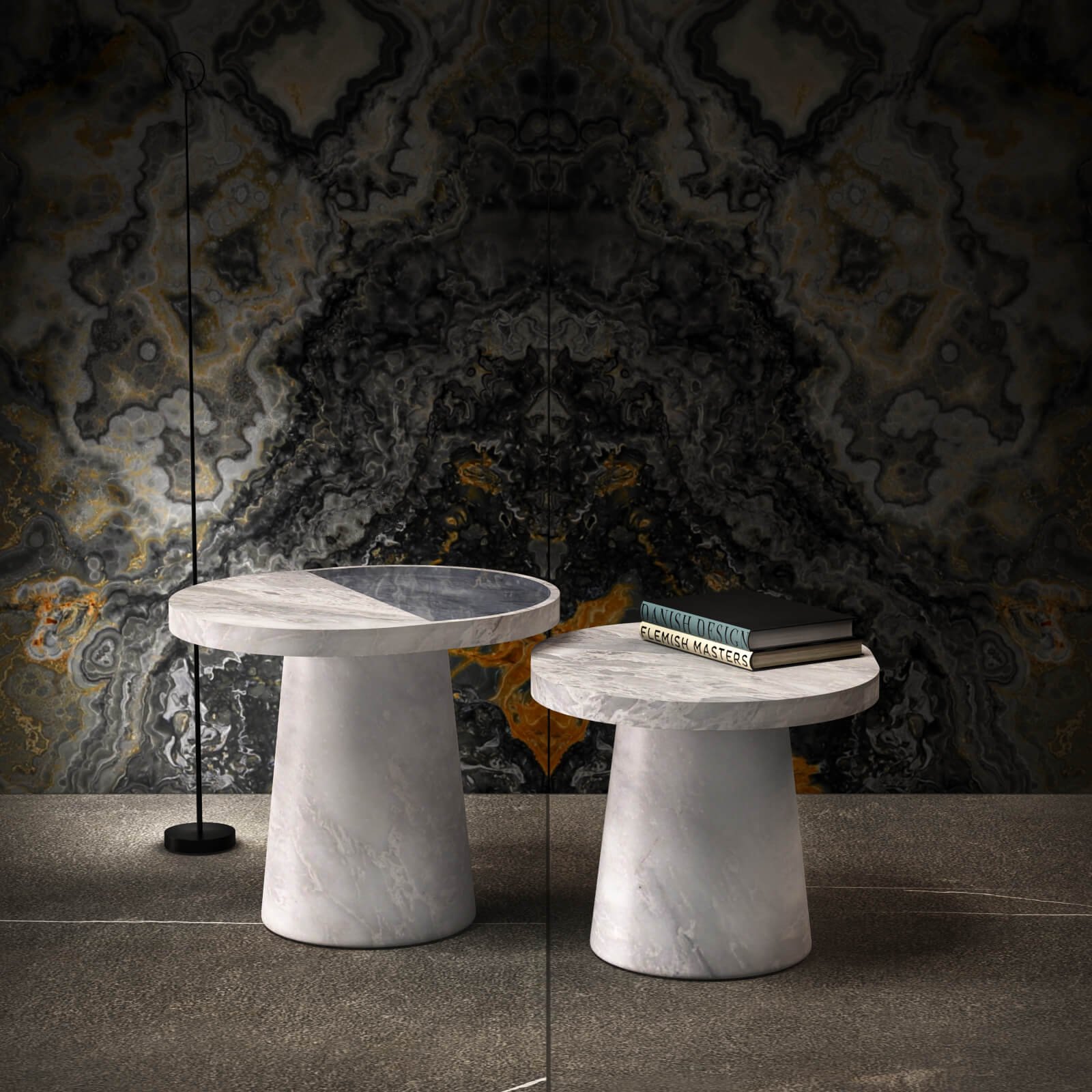
Most black marbles try to disappear. Kenya Black does the opposite. Look at a polished slab and you do not see a flat dark surface, you see layers: bands of charcoal and graphite that fold and flow like the grain in a cut log, picked out by thin white lines. It is a black stone with a direction, and that changes how you use it.
Kenya Black is one of the black stones in the Purapietra catalogue, and one of the few where the pattern leads as much as the colour. This guide covers what it looks like, how to read a slab, which finish suits which job, where it works best, what to pair it with, how to look after it and what drives its cost.
What Kenya Black looks like
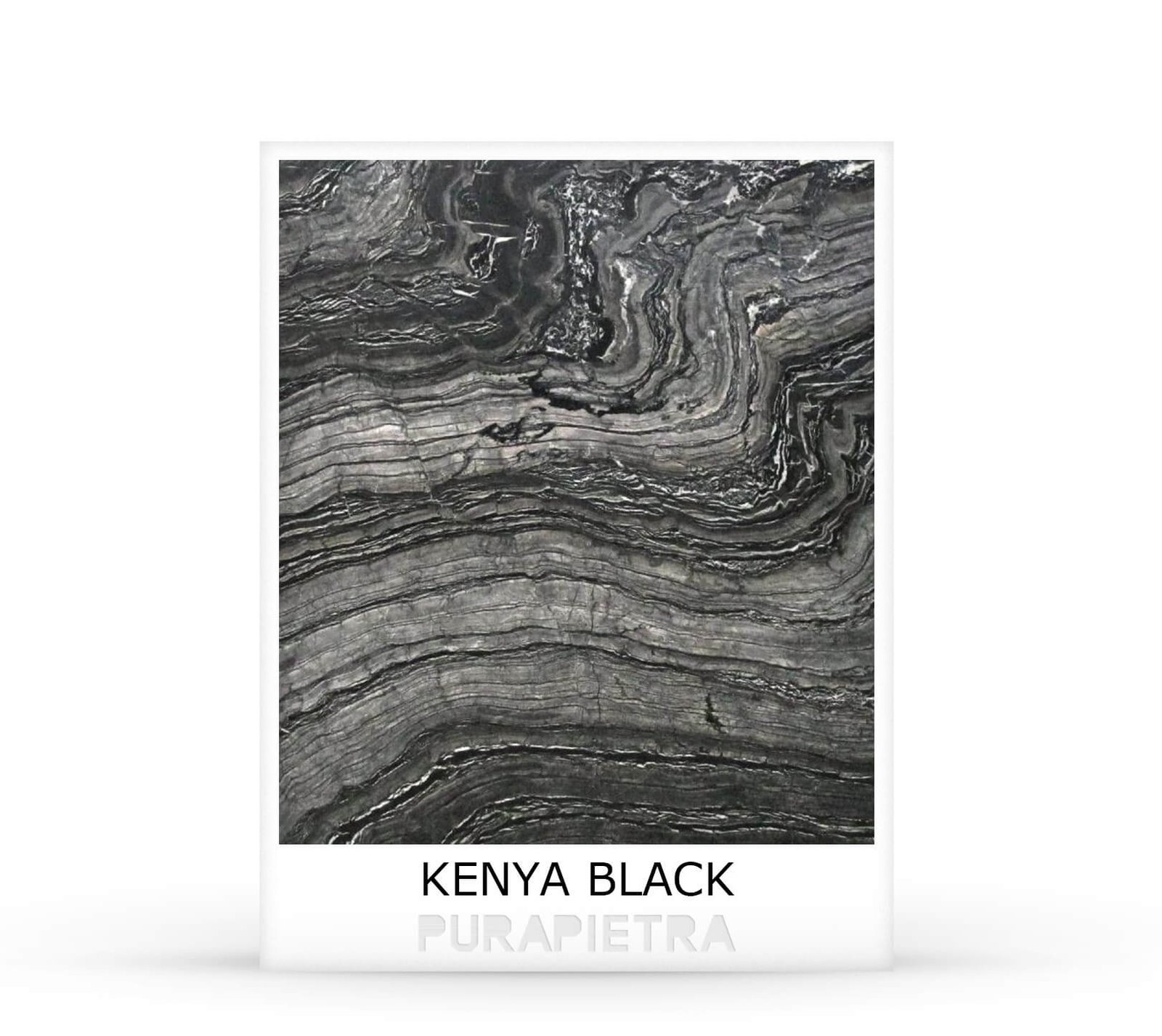
The first thing to know is that Kenya Black is not a uniform black. The swatch above shows it clearly. The ground is a deep charcoal, but the stone is built of long, wavy bands that range from almost black to a lighter, smoky grey. In places the bands run straight and parallel. In others they buckle into folds and ripples, and where they do, thin white veins and small bright flecks gather along the edges.
That layered, directional pattern is why many people describe it as a wood-grain stone. It is a useful comparison, because it tells you how the slab will behave in a room: the pattern has a flow, and the flow can be used. Run it horizontally across a wall and it calms the space. Turn it vertically and it adds height. Cut a long piece along the grain and the stone looks like one continuous surface.
If you are comparing it with the other blacks, the difference is clear. Our guide to black marble in interiors sets the main options side by side, and Kenya Black sits at the more expressive end: it has far more movement than a plain, even black, and it is quieter than the sharp white veining that stone from the Basque Country is known for. For the wider background on where black marble gets its colour and how the family behaves, the pillar guide to black marble goes deeper. For a plain-language definition of the rock itself, Wikipedia’s page on marble is a clear primer.
How to read a slab
Because the pattern is the point, two slabs of Kenya Black can feel quite different. Before you choose, look at four things.
The balance of dark and light bands. Some slabs are mostly deep charcoal with fine pale lines. Others have broad smoky-grey bands and read as noticeably lighter. Both are Kenya Black. Decide whether you want a room that feels dark and dense or one that has visible movement, and choose the slab to match.
The amount of white. White veins and flecks bring contrast. A few of them add sparkle. A lot of them make the slab busier, and a busy slab will compete with everything else in the room. Look at the slab from a few metres away, because that is the distance from which the wall or table will be seen.
Where the folds fall. The wavy areas are the most dramatic part of the stone. On a feature wall you want them where the eye lands. On a worktop you do not want a fold in the exact spot where a tap or a sink has to be cut out. Bring the drawing with you.
Fissures. Like any natural stone, a slab can carry hairline cracks or filled areas. Against a dark ground they are easy to miss in a photo and obvious in the finished piece, so ask to see the real slab. Our guide on how to identify quality stone sets out the checks we apply before a block is approved for cutting.
Finishes for Kenya Black
Polished
Polished brings out the full depth of the stone. The dark bands turn glassy, the white veining sharpens and the folds seem to sit below the surface. It is the right finish for a feature wall, a bar front or a statement table, where you want the stone to be looked at. The cost is practical: a dark polished surface shows dust, water spots and fingerprints more than a pale one.
Honed
Honed turns the same stone from glossy to velvet. The pattern is still there, but softer, and the surface stops reflecting the room. We recommend it wherever the stone will be touched every day, such as a vanity top, a table or a bath surround, because marks and small scratches are much less visible on a honed surface. If you are unsure, honed is the safer choice for anything that people lean on or put things down on.
Brushed
Brushing adds a fine texture and mutes the contrast between the bands. It can look beautiful on a wall, and it is worth asking for a sample, but for a stone whose main attraction is the flow of its pattern it is rarely the first choice.

Best uses for Kenya Black in interior design
Feature walls
This is where the pattern gets room to work. A wall of Kenya Black, with slabs bookmatched so the bands mirror each other, becomes a large graphic surface without a single added decoration. Behind a bed, a fireplace, a reception desk or a dining table, one wall is usually enough. It also benefits from good lighting: a soft wash of light along the surface picks out the folds and the white veining. Our guide to marble wall cladding covers panels, joints and fixing in more detail.
Bathrooms
In a bathroom, Kenya Black works best where the stone has a clear job. A vanity wall, a bath surround or a basin carved from a single piece looks dramatic and stays calm. Pair it with a carved piece such as our Unit Sink or the Linear basin, or surround a freestanding Unit Bath, and the stone does the work. We would keep it honed in wet zones, and we do not suggest dark polished floors in a small bathroom, where every drop of water will show.
Tables and furniture
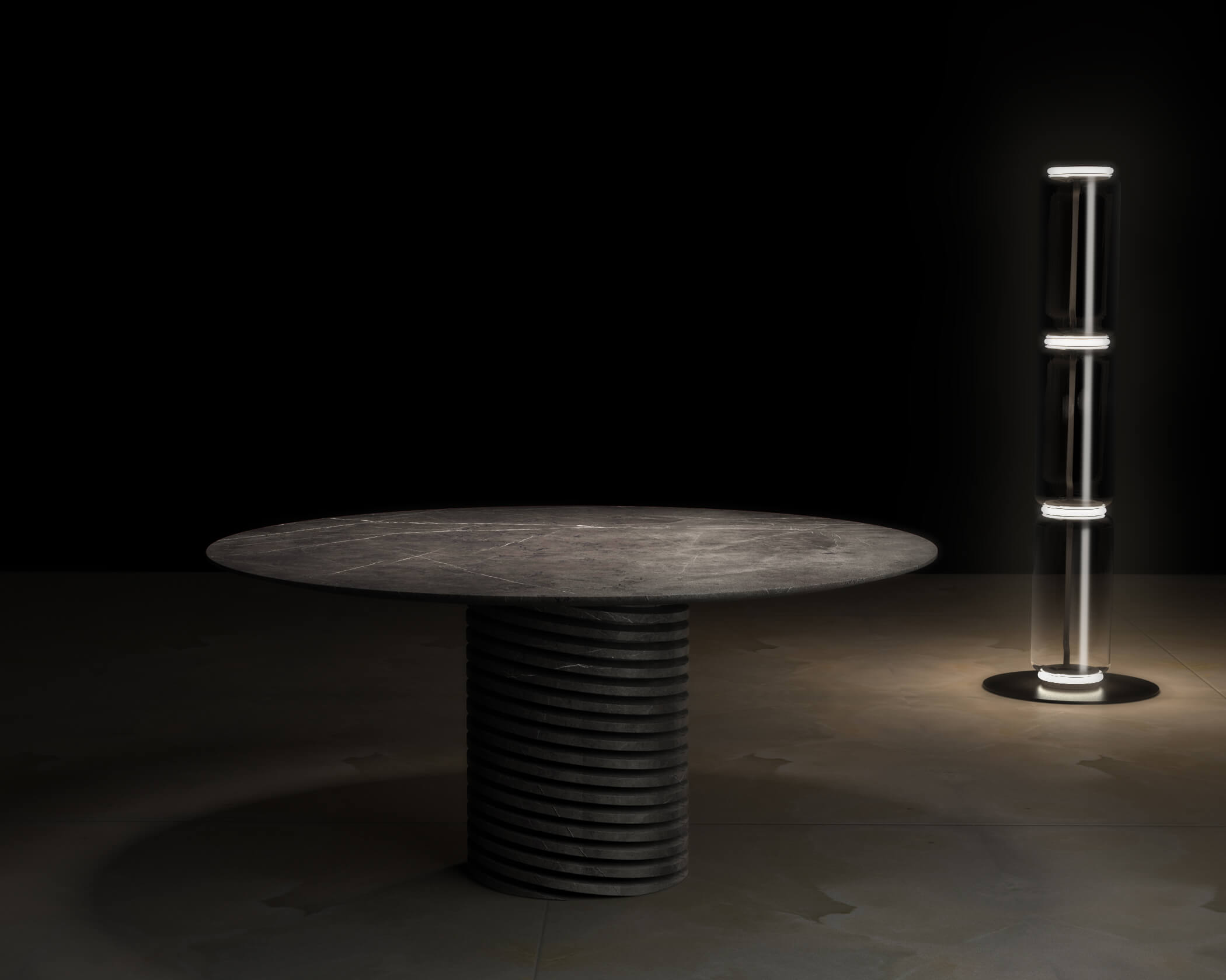
A table top is a good way to use a stone this expressive without committing a whole room. You can choose the exact slab, place the folds where they will be seen and keep the rest of the room quiet. It is also the easiest way to find out whether you like living with a dark, patterned surface. Pieces such as Groove and Tato show how a single dense stone can anchor a room.
Kitchens
A kitchen is possible but it asks for decisions. Kenya Black is a marble, so it etches when acid sits on it, and a dull patch is more visible on a dark surface than on a pale one. A honed island or a wall behind the hob can be excellent. A working worktop that sees lemon, vinegar and wine every day needs a careful finish, a sealer and a household that wipes spills quickly. Our guide to marble in the kitchen goes through the trade-offs honestly.
Floors
Floors are the most demanding use. A dark floor shows dust and scratches, and a polished one adds a risk of slipping. If you want Kenya Black underfoot, a honed finish is the sensible starting point, and our guide to marble flooring covers what to ask your installer. For a first project we would normally suggest a wall or a table instead, and keep the floor for a more forgiving stone.
What to pair with Kenya Black
Kenya Black has a lot to say on its own, so the rest of the room should be quieter. Three habits help.
Keep other patterns calm. If the stone has strong bands, use plain surfaces around it: smooth plaster, a flat paint, a plain textile. Two patterns of the same strength fight each other.
Use warm materials to soften it. Mid and dark woods, oiled timber and brass warm a dark stone without competing with its pattern. Because Kenya Black already looks a little like wood grain, a plain timber is better than a heavily grained one. Our guide to pairing marble with other materials explains how to match undertones and finishes.
Add one light stone, not three. A pale stone next to Kenya Black gives instant contrast. For a quiet, translucent partner, Ivory Onix is a cream stone that works well against dark surfaces. For a calmer white with soft veining, see Calacatta Viola.
Caring for Kenya Black
The care is the same as for any calcite marble, with a few notes for a dark surface. Seal it at installation and again from time to time, and clean it only with a pH-neutral stone product. Avoid vinegar, lemon, bleach and abrasive creams, and wipe spills quickly, particularly anything acidic. Use coasters and a cloth rather than a scourer. On a polished surface, wipe water spots dry so they do not leave rings, and use a soft cloth for dust. Our guide to how long marble lasts explains what to expect over the years and what you can do to keep the surface looking its best.
What sets the price of Kenya Black
There is no fixed price per square metre, and we would rather say so than quote a number that means nothing without the slab. Four things set the cost: the quality of the block and how attractive and balanced its banding is, the thickness you specify, the yield, which is how much of the raw block ends up as usable finished material, and the hours of hand finishing. For a patterned stone like this one, the pattern itself is part of the value: a slab with a striking fold in the right place is worth more than a plain one. Bookmatching also uses more material, because adjacent slabs have to be cut and kept in order.
How to choose a slab
If you can, go to the yard. Photos flatten dark stone and hide the depth of the bands. Look at the slab from a distance first, then close up. Ask for the slab numbers so you know which ones are consecutive, because a bookmatched pair of Kenya Black panels is spectacular when the bands line up. Bring the drawing with you: the position of a joint, a tap or a cut-out changes which slab is right.
Why choose Kenya Black with Purapietra
We treat stone as a building material, not a skin. Every piece is roughed on CNC for accuracy and finished by hand, which is where an edge stops looking machined. With a patterned stone, we ask clients to choose the slab, and we plan where the bands fall, where the joints go and how the lighting will sit before the first cut. If you need something that is made to your own drawing, our page on bespoke marble explains how we work.
You can see Kenya Black next to our other stones in the materials catalogue, and if you are still deciding between dark and light, our guide to marble interiors covers the options. Send us a plan, a sketch or a photo of the room, and we will tell you what the stone can do there and roughly what it will cost.
Frequently asked questions about Kenya Black
What is Kenya Black?
Kenya Black is a black marble with a layered, flowing pattern. The ground is deep charcoal, with wavy bands of near-black and smoky grey and fine white veining, which is why it is often compared to wood grain.
Is Kenya Black a plain black?
No. It is a patterned black, with visible bands and folds. If you want a flat, even black with almost no pattern, there are quieter options in our black marble range, and our black marble interiors guide compares them.
How much does Kenya Black cost?
There is no fixed price per square metre. Cost depends on the quality of the block, the pattern of the banding, the thickness, the usable yield and the hours of finishing. We quote each project once the slab and finish are chosen.
Is Kenya Black good for a bathroom?
Yes, on walls, around a bath or as a vanity top, ideally honed in wet zones. We do not suggest dark polished floors in a small bathroom, where water marks will show.
Can I use Kenya Black for a kitchen worktop?
It is possible, but it is a marble and it etches under acids, which shows more on a dark surface. A honed finish, a good sealer and quick wiping help. An island or a wall behind the hob is an easier use than a busy worktop.
Should I choose polished or honed Kenya Black?
Polished gives the deepest colour and the sharpest veining, and suits walls and statement pieces. Honed is softer, shows fewer marks and is the safer choice for anything touched every day.
How do I care for Kenya Black?
Seal it at installation, clean with a pH-neutral stone product, avoid acids and abrasives, wipe spills quickly and dry water spots on polished surfaces.