
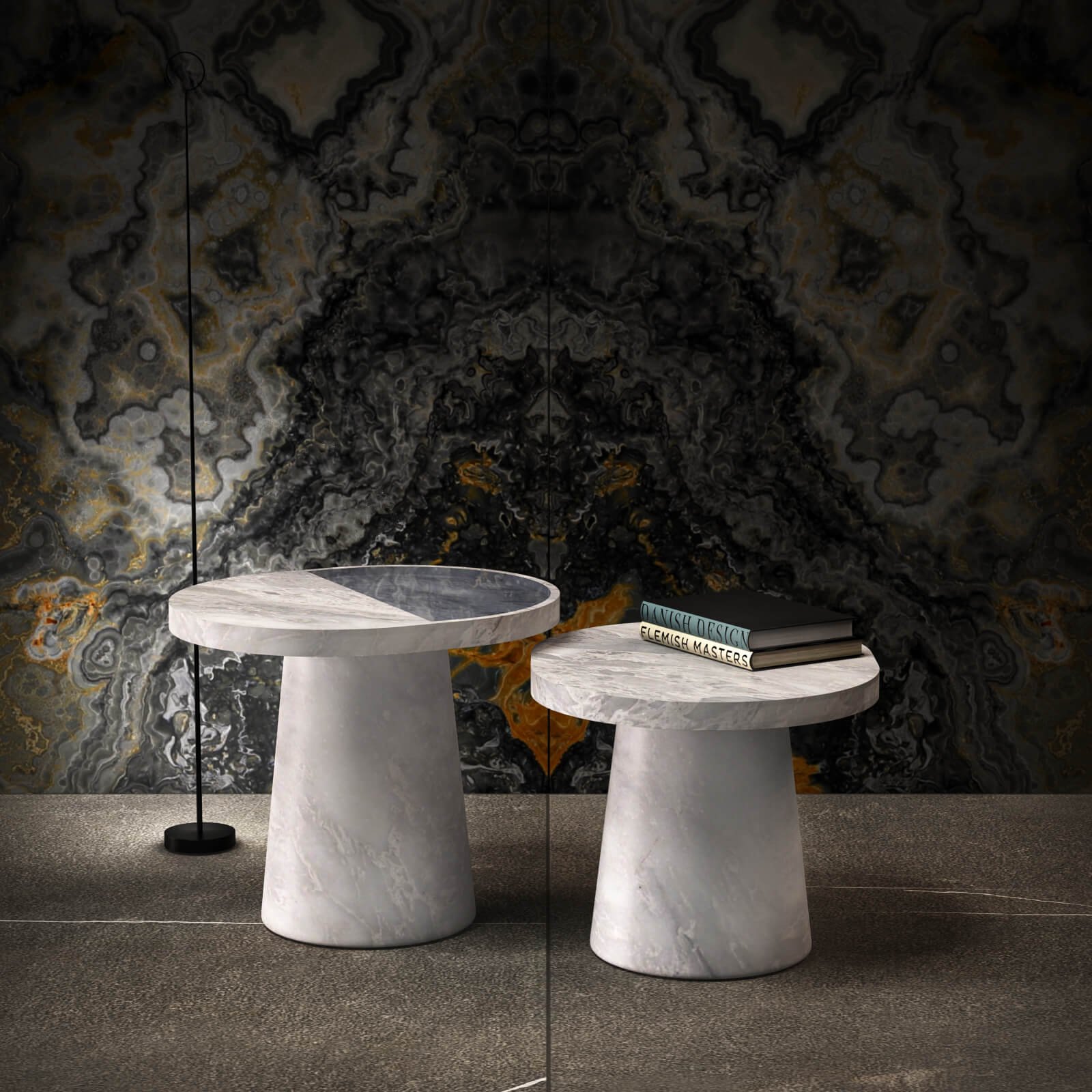
There is a moment in the workshop that never gets old. A block of Bianco Statuario comes off the saw, someone throws water across the cut face, and the grey veining surfaces out of the white like handwriting appearing on wet paper. Michelangelo went up the mountain looking for this stone. Six centuries later we are still choosing it for the same reason: no other white marble draws a line quite so deliberately.
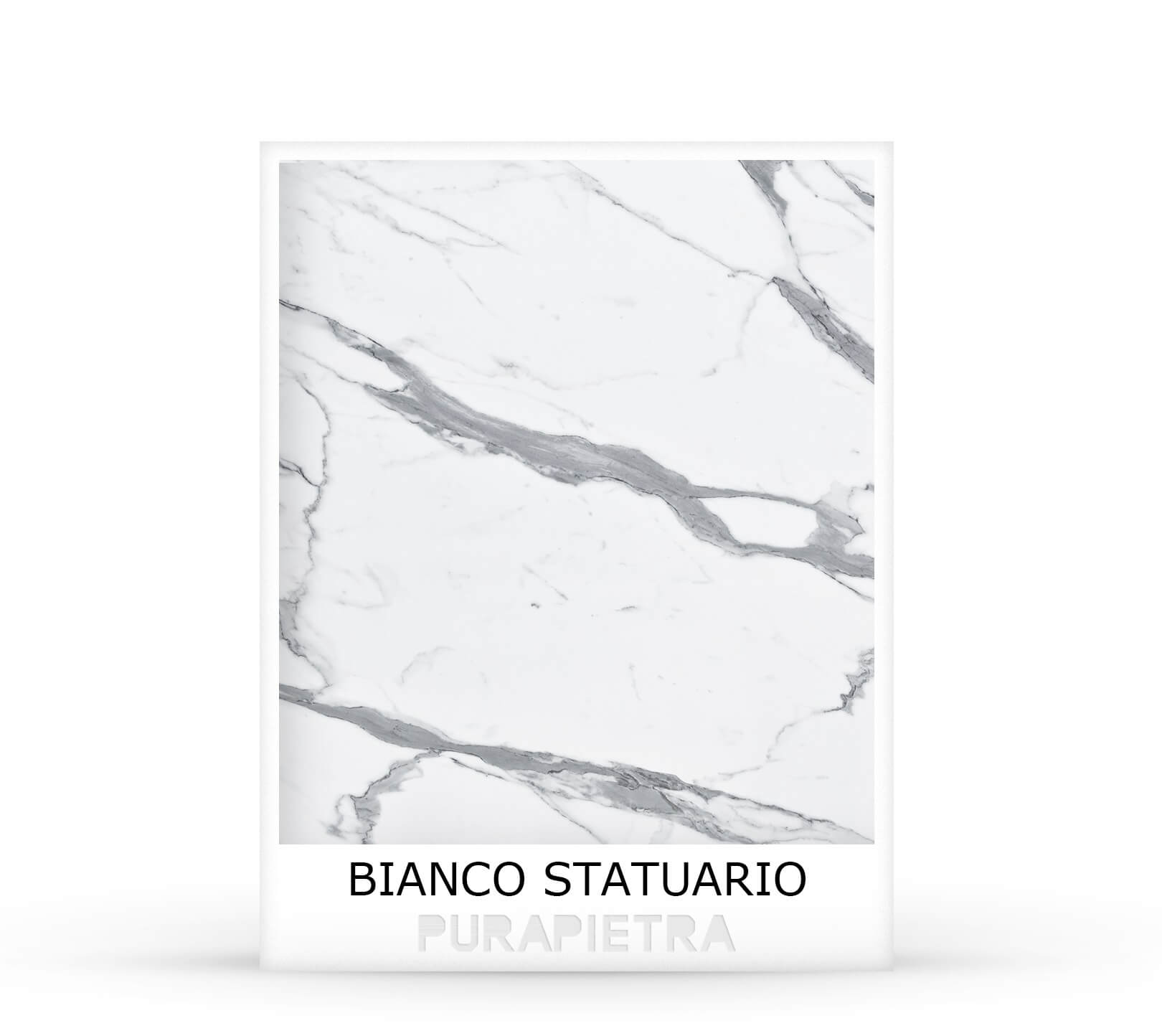
Bianco Statuario is the most prized of the Italian white marbles, quarried in the Apuan Alps above Carrara and valued for a luminous, almost translucent white ground crossed by sparse, decisive grey veins. It is the stone people picture when they say “marble”, and it is also the most misunderstood, because the name covers a narrow band of exceptional material and a much wider band of commercial slabs sold under the same label. This guide covers where it comes from, how to read a slab, which finishes suit it, where it earns its place indoors, and what it honestly costs to work with.
Where Bianco Statuario comes from
Statuario is extracted from a small group of quarries in the Apuan Alps, in the basins above Carrara in northern Tuscany. The geology is the same across the whole district: limestone recrystallised under heat and pressure into a dense, fine-grained calcite marble. What sets the Statuario benches apart is purity. The beds that produce it carry very little of the mineral contamination that gives most Apuan whites their faint grey cast, so the ground reads brighter and the veining stands out against it with far more contrast. The broader geological picture is set out well on Wikipedia’s entry on Carrara marble.
The practical consequence matters more than the geology. Those benches are small, they are worked slowly, and the yield of true Statuario from a given block is low. A quarry may cut a hundred blocks and classify a handful at the top grade. That scarcity is the reason the material has always been reserved for sculpture and for architecture that intends to be looked at, and it is also the reason the name gets stretched. Plenty of stone sold as “Statuario” is a good white Carrara with strong veining, which is not the same thing and should not carry the same price.
The name, and why it means something
“Statuario” means, literally, the marble for statues. The classification came from sculptors long before it came from the stone trade, and the criteria were sculptural: an even crystal structure that would take an edge in any direction, a translucency that let light travel a few millimetres into the surface before scattering, and a ground clean enough that the veining could be treated as a compositional element rather than noise. Those criteria still describe the best material today. When we are asked to define the grade for a client, we do not start with the vein pattern. We start with what the stone does to light.
If you are still deciding between the great Italian whites, our comparison of Carrara vs Statuario sets the two side by side, and the wider survey of Italian white marble covers Calacatta and the alpine whites alongside them.
Reading a Bianco Statuario slab
Four things tell you what a slab is going to do once it is on a wall.
The ground. Look at the field between the veins under indirect daylight, never under the yard lights. True Statuario holds a cold, clean white with a faint blue-grey undertone. A warm or creamy ground is not a fault, but it is not Statuario either, and it will fight a cool palette once the room is finished.
The translucency. Hold a thin offcut up to the light. Good material glows at the edge rather than blocking the light entirely. This is the property that gives a polished Statuario surface its depth, and it is the single hardest thing to judge from a photograph.
The vein. Statuario veining is sparse, grey to charcoal, and linear. On the finest blocks the veins run in a clear direction with long empty stretches between them. Dense, ropey or yellowish veining usually indicates material from an adjacent bench. It can still be beautiful, but it belongs to a different conversation about price.
The block, not the sample. Because the veining is graphic, two slabs from opposite ends of the same block can look like different stones. For any project that involves more than one slab we ask clients to come and select the block itself. A ten-centimetre sample of Bianco Statuario tells you almost nothing about what a three-metre surface will do. The habits we use to grade material are written up in more detail in our guide on how to identify quality marble.
Finishes: the same stone, three different materials
Finish changes Bianco Statuario more than any other decision you will make about it.
Polished
Polishing closes the surface and lifts the crystal, which is where the translucency becomes visible. The white gets brighter, the veins sharpen into black-grey lines, and the surface picks up light from across a room. This is the historic finish and the right one for vertical work: cladding, a fireplace surround, a stair, a reception wall. On a kitchen worktop we advise against it, because acid etching leaves dull patches that gloss makes impossible to ignore.
Honed
Honing grinds the surface smooth and stops short of gloss. The stone reads softer and slightly warmer, the veining loses a little of its edge, and the whole surface becomes far more forgiving in daily use. Etch marks still happen, but on a matt ground they are barely readable. For horizontal surfaces in a working house, honed Bianco Statuario is almost always the better specification.
Brushed and bush-hammered
Brushing runs abrasive heads across the face until it takes a fine leathery texture; bush-hammering goes further and leaves a rough, tactile surface. Both suppress the veining and both hide wear well. They are worth considering when the stone is doing textural work — a feature wall, a bench, an exterior detail — but they waste what makes Statuario expensive. If the veining is not going to be seen, there are better value whites for the job.
Six places Bianco Statuario earns its keep
1. Bathrooms
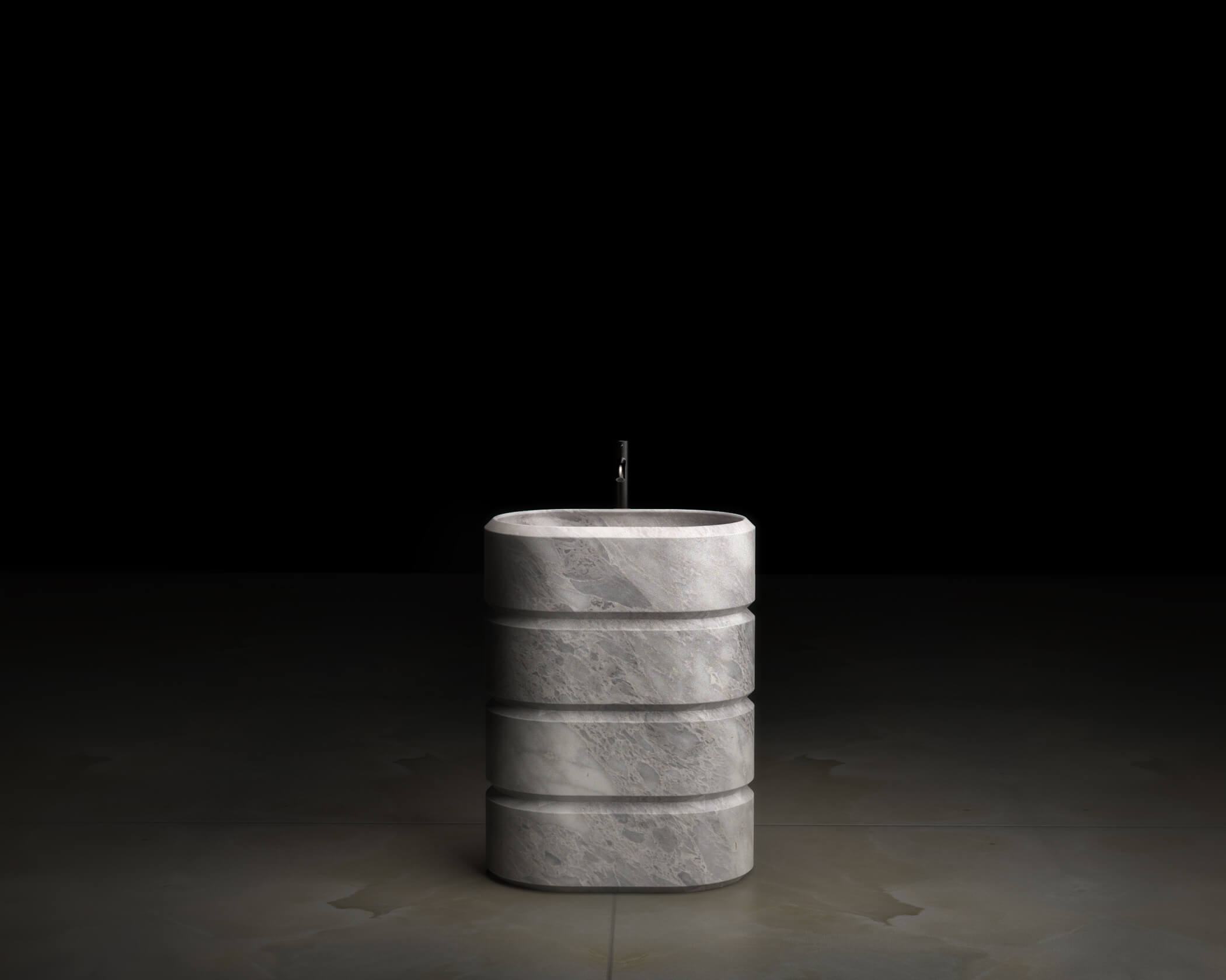
A bathroom is where Statuario does its most convincing work, because the room is small enough that a single material can take it over. A polished wall running floor to ceiling gives depth that no tile will reproduce, and the veining reads as composition rather than pattern when it is book-matched across a shower enclosure. Pair it with a sculpted basin such as our Unit Sink or the wall-mounted Linear, and the room resolves into one gesture. Keep descaling products away from the surface and the stone will outlive the fittings by decades.
2. Kitchen islands and worktops
Bianco Statuario makes a spectacular island, with one honest caveat that we repeat to every client. Marble is calcium carbonate and it reacts with acid: lemon juice, vinegar, wine and most limescale removers will etch it. Specify a honed finish, seal it on installation, and accept that the surface will acquire a history. If an unchanged worktop is a hard requirement, quartzite is the correct material and we will say so.
3. Cladding and full-height walls
Vertical surfaces are the safest place to use the material, because nothing acidic ever touches them. A polished Statuario wall in an entrance hall, a lift lobby or behind a bed does exactly what the stone was quarried to do. The technical work here is in the layout: matching the veining across joints, deciding where a vein is allowed to cross a corner, and planning the cutting sequence before the block is opened.
4. Fireplaces and thresholds
Statuario has been used for chimneypieces since the Renaissance for a reason. It takes carving cleanly in any direction, it holds a crisp arris, and it looks correct next to both period mouldings and a plain modern opening. On a fireplace, the heat is not a problem; the soot is, so a penetrating sealer and a soft brush are worth the small effort.
5. Sculptural and design objects
The properties that made this stone the sculptor’s default still hold. In our workshop it is the material we reach for when a piece has to survive being carved thin: a tray with a rolled edge, a vase whose wall thins towards the lip, a table with a shadow gap cut into the underside. You can see the range in our marble vases and trays, both cut from solid stone and finished by hand.
6. Floors, with conditions
Bianco Statuario can be laid as a floor and it is beautiful when it is, but it is a soft stone and a white one. In a hallway that takes shoes and grit every day it will dull and scratch. In a bedroom, a dressing room or a bathroom it holds up well. If the floor is going to be busy, use a honed finish, keep a mat at the door, and plan on a light re-hone somewhere around year fifteen rather than treating that as a failure.
Pairings that work
Aged brass and bronze. The classic answer, and still the best one. Warm unlacquered metal against a cold white ground is the pairing that carries most of the Purapietra New Era pieces, and it improves as the metal darkens.
Dark timber. Walnut, smoked oak and dark-stained ash give Statuario something to push against. The contrast is high but the materials share a grain logic — both have direction, both reward being run in one continuous piece.
Black marble. Statuario against a black marble such as Nero Marquina is a strong, formal pairing that works better in small doses than as a whole scheme. A black plinth under a white basin, or a black threshold against a white floor, gives the eye a full stop.
Plaster and lime paint. The quietest option and often the most successful. A hand-applied matt wall gives the stone somewhere to sit without competing for attention, and it is the treatment we recommend most often when the marble is already doing a lot of work.
Care, sealing and the honest limits
Seal it, then seal it again. A penetrating impregnating sealer does not coat the surface, it reduces absorption inside the pores. Apply it on installation and refresh it every two to four years on horizontal surfaces, less often on walls. Avoid film-forming products: they look good for a season and then peel unevenly.
Clean with pH-neutral products only. Warm water and a neutral stone soap handle almost everything. Bleach, vinegar, lemon-based sprays and bathroom limescale removers all attack the stone directly. Most damage we are asked to repair was caused by a cleaning product, not by use.
Deal with spills quickly. Oil and red wine stain because they are absorbed; acid etches because it dissolves. Blotting a spill within a few minutes prevents nearly all of it. A poultice will lift most absorbed stains later, but etching has to be re-honed out.
Accept the patina, or choose another stone. This is the conversation worth having before the order rather than after. A Bianco Statuario surface in daily use changes over years into something softer and slightly uneven, which most owners come to prefer. If that prospect is uncomfortable, the right answer is a different material, and no amount of sealing will change it. We wrote about the wider question in our guide to marble durability.
What Bianco Statuario costs, and why
There is no useful square-metre price for this stone, and any figure quoted without seeing the piece should be treated with suspicion. Cost is driven by four things: the grade of the block, the thickness required, the yield (how much of the block ends up in the finished piece and how much becomes offcut), and the finishing hours. A sculpted basin cut from a solid block consumes an enormous volume of material relative to its finished size, which is why solid pieces price very differently from slab work.
As a family, Statuario sits at the top of the Italian whites, above Calacatta in the finest grades and well above commercial Carrara. What you are paying for is scarcity and selection, not a difference in hardness or durability. A good Carrara will perform identically in use. It simply will not look like this.
Working with Bianco Statuario at Purapietra
We treat marble as a structural material rather than a veneer. Pieces are cut from solid blocks, roughed on CNC for accuracy and then finished by hand, which is the stage where a sculpted edge stops looking machined and starts feeling resolved. For bespoke work we ask clients to select the block, we lay out the veining on the block face before cutting, and we photograph the sequence so nothing about the finished piece is a surprise.
Bianco Statuario and the rest of our white, coloured and rare stones are shown in the materials catalogue. If Statuario turns out to be more stone than a project needs, Acqua di Carrara and Bianco delle Alpi are the two whites we most often propose instead. Write to us and we will send current block availability, finish samples and a quotation for the piece you have in mind.
Frequently asked questions about Bianco Statuario
What is Bianco Statuario marble?
It is the top classification of white marble quarried in the Apuan Alps above Carrara, in Tuscany. It is defined by a cold, luminous white ground, a fine and even crystal structure, partial translucency and sparse grey veining. The name comes from sculpture: it was historically the grade reserved for statuary.
How is Bianco Statuario different from Carrara marble?
Both come from the same district, but Carrara is the general commercial white and Statuario is a narrow top grade within it. Carrara typically has a faint grey cast and soft, cloudy veining spread across the slab. Statuario has a whiter, colder ground and fewer, sharper, more graphic veins, and it is considerably scarcer.
How much does Bianco Statuario cost?
Price depends on block grade, slab thickness, the yield of the piece and the finishing hours, so a square-metre figure is misleading for bespoke work. It is the most expensive of the Italian whites, above Calacatta at the finest grades and well above commercial Carrara. We quote per project once the piece and the finish are defined.
Can Bianco Statuario be used in a kitchen?
Yes, and it is a beautiful island material, provided you accept that marble etches on contact with acid. Specify a honed rather than polished finish, seal it on installation, and keep lemon, vinegar and descaling products off the surface. If a permanently unchanged worktop is essential, quartzite is the better specification.
Does Bianco Statuario yellow over time?
Good material does not yellow on its own. Discolouration nearly always has an external cause: an unsuitable adhesive bleeding through a thin slab, iron oxidation where the stone stays permanently wet, or a film-forming sealer breaking down. Correct installation and a penetrating sealer prevent all three.
Is Bianco Statuario suitable for a bathroom?
It is one of the best uses for it. Water alone does not harm marble; the risks are acidic cleaning products and standing limescale. Use a penetrating sealer, clean with pH-neutral products, and dry horizontal surfaces after use. A honed finish is the more forgiving choice on shower floors and vanity tops.
How thick should a Bianco Statuario worktop be?
Twenty millimetres is standard for a fully supported worktop and thirty for spans, overhangs or a heavier visual edge. Solid pieces such as basins, bathtubs and tables are cut from full blocks, so thickness there is a design decision rather than a structural minimum.