
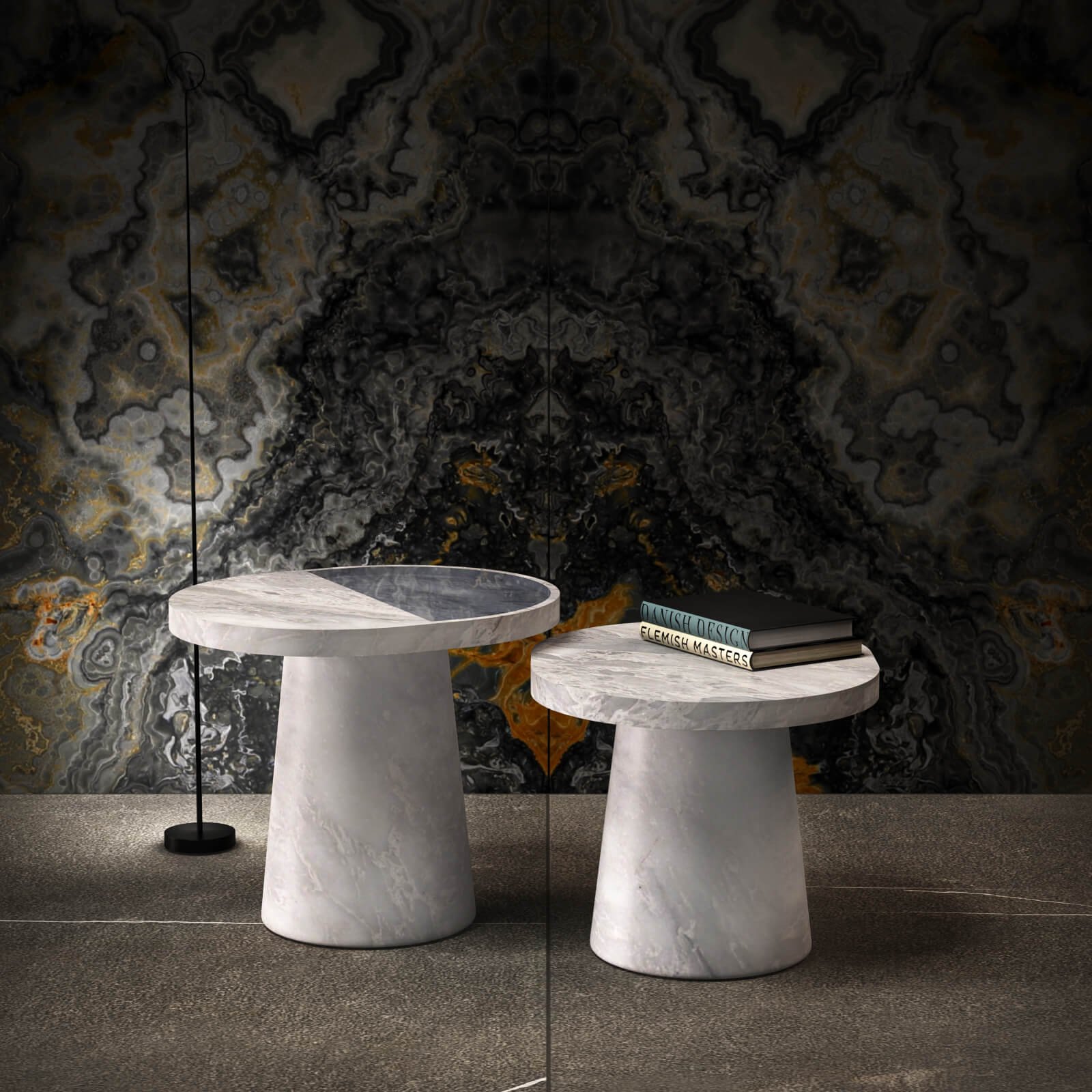
Black marble interiors have a reputation for being severe. In practice the opposite is true: black is the most flattering background a room can have, as long as you know how much of it to use and what to put next to it. This is a guide to the varieties worth knowing, the pairings that work, the rooms that suit the stone, and the small habits that keep a black surface looking right.
Why black works in a room
Black absorbs light instead of returning it, and that single property does most of the work. A black surface recedes, so the objects in front of it come forward. Put a pale ceramic bowl on a black marble table and the bowl looks better than it did on oak. Set brass taps against a black wall and the metal reads as warm rather than yellow. This is the whole argument for black marble interiors, and designers reach for the stone for the same reason galleries paint walls a flat neutral: it makes everything else legible.
The second thing black does is give a room a floor, in the compositional sense. Interiors built entirely from mid-tones tend to feel unresolved, as though nothing has been decided. One black element anchors the whole arrangement. It does not need to be large. A single carved object, a threshold, a plinth, a table top is enough to settle a room that was not quite working.
Where black marble interiors go wrong is quantity. Black takes light out of a space, and a small room clad floor to ceiling in a dark stone will feel like a vault regardless of how good the marble is. The rule most of our clients arrive at, usually after some persuasion, is that black should be the accent that everything else is measured against, not the field.
The varieties worth knowing for black marble interiors
Not all black marble behaves the same way, and the difference between them is mostly about how loud the veining is.
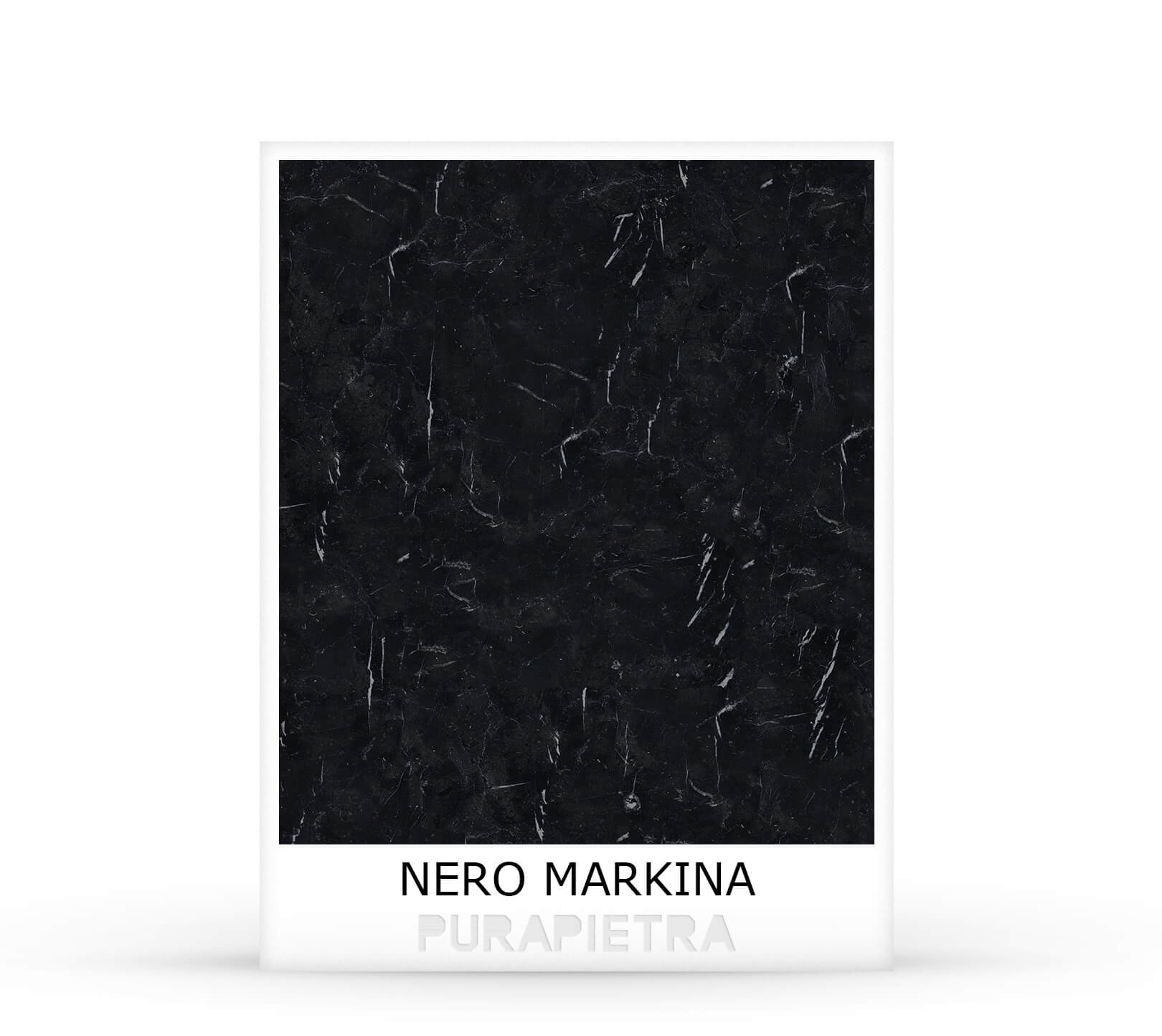
Nero Marquina
The one most people picture. A dense, near-uniform black from the Basque Country, crossed by white veins that can be fine and scattered or thick and dramatic depending on the block. It is graphic, high contrast and photographs beautifully, which is why it turns up in so many hotel bathrooms. In a home it wants a calm setting: the stone is doing enough on its own.
Nero Tempesta
Softer and more atmospheric. The black is less absolute and the veining reads as movement rather than as line, closer to weather than to graphics. Where Nero Marquina is a statement, Nero Tempesta is a texture, and it is often the better choice for larger surfaces because the eye does not tire of it.
Nero di Francia and Nero di Milano
Deeper, quieter blacks with restrained veining. These are the ones to specify when you want darkness itself rather than pattern, and they work particularly well for carved pieces where the form should be doing the talking, not the surface.
Kenya Black
An intense, even black with very little interruption. Close to a monolith when polished, and striking when the same stone is honed instead, which turns it from glossy to velvet.
All of these sit in the Purapietra catalogue alongside the other colour families, and they are worth comparing side by side on the materials page before deciding. For the geology and the fuller technical picture, our pillar guide to black marble goes deeper into where the colour comes from and how the stone behaves.

Pairings: what makes black marble interiors work
Black and gold, or better, black and brass
The classic, and the one most at risk of tipping into pastiche. Gold against black is undeniably rich, but polished gold on polished marble in a small room reads as a hotel lobby. Unlacquered brass, which dulls and warms as it ages, gives the same warmth with none of the glare. Keep the metal to the small things: taps, handles, an edge detail, the rim of a tray.
Black and wood
The most forgiving pairing there is, and the one we specify most. Mid and dark woods, walnut and oiled oak in particular, share black marble’s warmth without competing with it. Wood also brings grain, which stops a dark scheme from going flat. A black marble top on a walnut base is a combination that has never really dated.
Black and white
Maximum contrast, so it needs a light hand. Rather than splitting a room in half, let one material dominate and use the other as a line: a black threshold in a pale floor, a white basin on a black surround. The pillar guide to white marble is useful here if you are trying to match the two families in a single scheme.
Black and green
Less obvious and quietly excellent. Deep greens, whether in a stone such as Verde Alpi, in textiles or in planting, sit naturally against black because both are dark and neither is neutral. Our guide to green marble covers the tones that pair best.
Black and warm neutrals
Plaster, linen, travertine, unglazed terracotta. This is the softest way to use black marble and the one that suits a home best. The black stops being dramatic and starts being grounding, which is usually what you actually want to live with.
The rooms that suit black marble
Bathrooms
The room where black marble interiors are most tempting and most often overdone. The version that works: one black surface, generous natural or well-placed artificial light, and everything else pale. A black vanity top against plaster walls, or a black-clad shower enclosure in an otherwise light room. A sculpted basin in a dark stone becomes the object the room is built around, which is the thinking behind pieces such as the Unit freestanding basin and the wall-mounted Linear.
Kitchens
Black marble is beautiful on an island and demanding on a worktop. Polished black shows water marks, dust and every fingerprint, so if the stone is going somewhere that gets used, specify a honed finish. It hides marks better and it looks more contemporary. Reserve the polish for a vertical surface where nothing touches it.
Living rooms
This is where black marble interiors are at their easiest, because the stone is not being asked to work. A low table, a fireplace surround, a plinth. The material gets to be sculpture, and the room gets its anchor.
Objects, at any scale
The lowest-commitment way into black marble interiors, and the one we would suggest to anyone unsure. A tray, a bowl, a vase in a dark stone gives a room the same weight a large surface would, on a shelf instead of a wall. A good number of our trays and vases were designed with exactly this in mind, turned and hollowed from a single block and finished by hand in Italy.
Living with a black surface
Black marble interiors are not more fragile than any other stone. It is simply more honest about what happens to it. Dust reads on a dark polish. A ring left by a glass shows immediately. Limescale is visible in a way it never is on white. None of this is damage, and most of it disappears with a wipe, but it does mean black rewards a honed finish in any room where life happens.
The care itself is standard. Seal on installation and periodically after that. Clean with a pH-neutral stone product, never with vinegar, lemon, bleach or an abrasive cream. Wipe spills promptly, particularly anything acidic, because black marble etches like every other calcite marble and a dull patch is more visible against black than against grey. Coasters under glasses, and a cloth rather than a scourer.
One habit worth adopting: keep a soft dry microfibre cloth near any black marble surface you use daily. Most of what shows on black is dust and water, and both come off dry in seconds. It is a smaller commitment than people imagine before they own the stone.
Starting a project
Black marble interiors repay being decided early rather than added at the end, because the whole palette of a room ends up arranged around it. If you are weighing it for a bathroom, a piece of furniture or a single carved object, we are glad to talk it through before anything is committed. Write to info@purapietra.it.
Black is one register among several. If you are working out how marble should behave across a whole house rather than in a single dramatic room, our guide to marble interiors covers the styles, the rooms worth committing to and the mistakes most worth avoiding.
Frequently asked questions about black marble interiors
Does black marble make a room look smaller?
It can if it covers large surfaces, because black absorbs light rather than reflecting it. Used as an accent, on a worktop, a table, a threshold or a single clad wall, it does the opposite: it gives the room a visual anchor and makes lighter materials read more clearly against it.
Which is the best black marble for interiors?
It depends on how much pattern you want. Nero Marquina gives high contrast with sharp white veining and suits smaller statement surfaces. Nero Tempesta is softer and more atmospheric, better across large areas. Nero di Francia, Nero di Milano and Kenya Black are quieter, near-uniform blacks that suit carved pieces where the form should lead.
What colours go with black marble?
Unlacquered brass, walnut and oiled oak, warm neutrals such as plaster and linen, and deep greens. Crisp white works too but needs restraint, since maximum contrast in a small room can feel harsh. Polished gold and cool chrome are the two to use most sparingly.
Should black marble be polished or honed?
Honed in any room that gets used. A honed finish hides dust, water marks and fingerprints far better and reads as more contemporary. Keep polished black for vertical surfaces and feature areas where nothing touches the stone.
Is black marble hard to maintain?
No harder than other marbles, but less forgiving visually, because dust, water rings and limescale all show against a dark surface. Seal it, clean it with a pH-neutral product, wipe spills promptly and keep a dry microfibre cloth to hand. That is most of it.
Can black marble be used in a small bathroom?
Yes, with one condition: keep it to a single surface and make sure the room is well lit. A black vanity top or a black-clad shower wall in an otherwise pale bathroom gives depth. Cladding every surface in a small room is what makes the space feel closed in.
Keep exploring the Purapietra magazine. See also our pillar guide to black marble, our guides to white marble and green marble, or browse the full materials collection.