
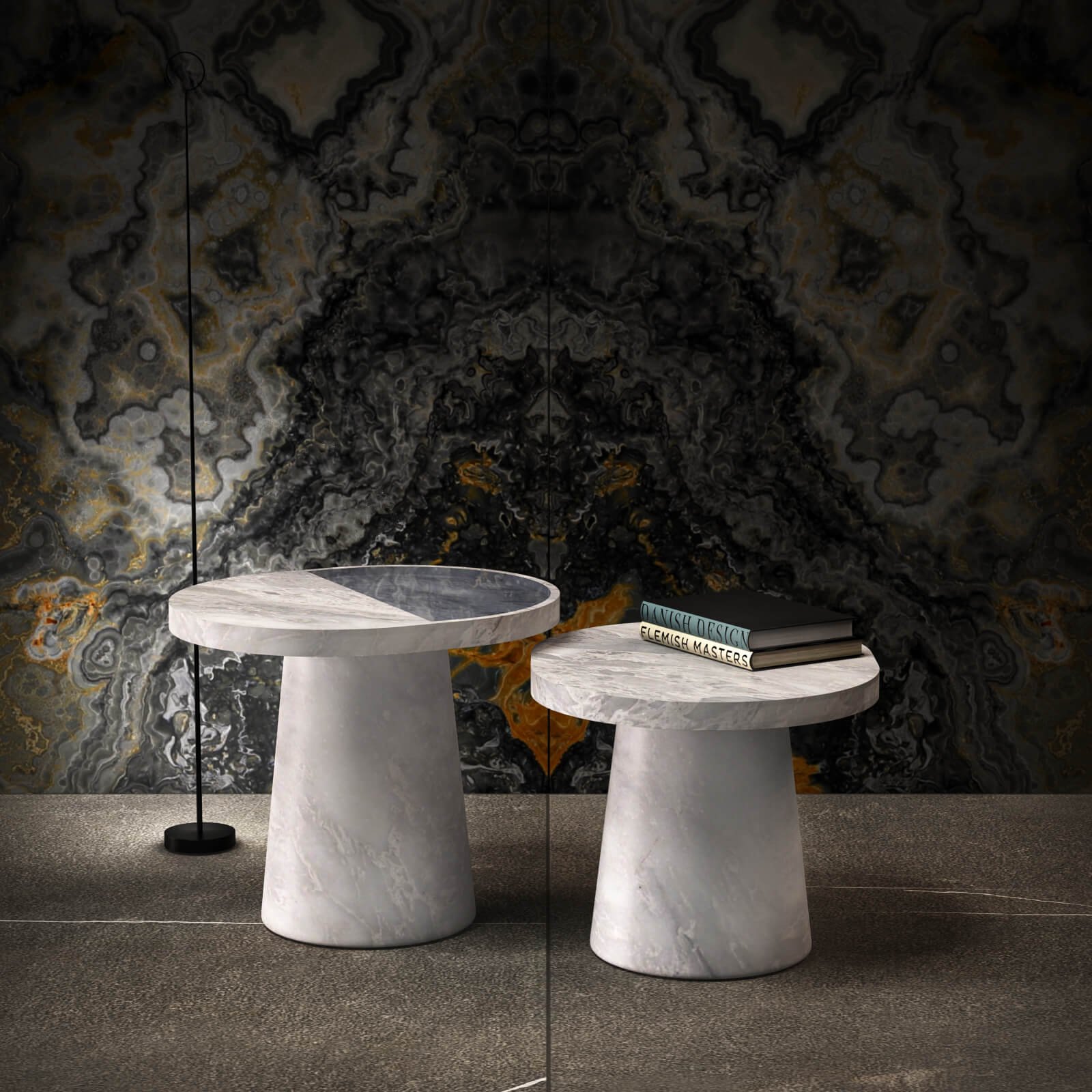
Acqua di Carrara is the quietest stone in the Carrara family. It has the white ground everyone recognises and almost none of the drama, which is exactly why designers keep coming back to it. This guide covers where Acqua di Carrara is quarried, how to read its veining, the four finishes that change it completely, the best ways to use it in a house, and what it asks of you once it is installed.
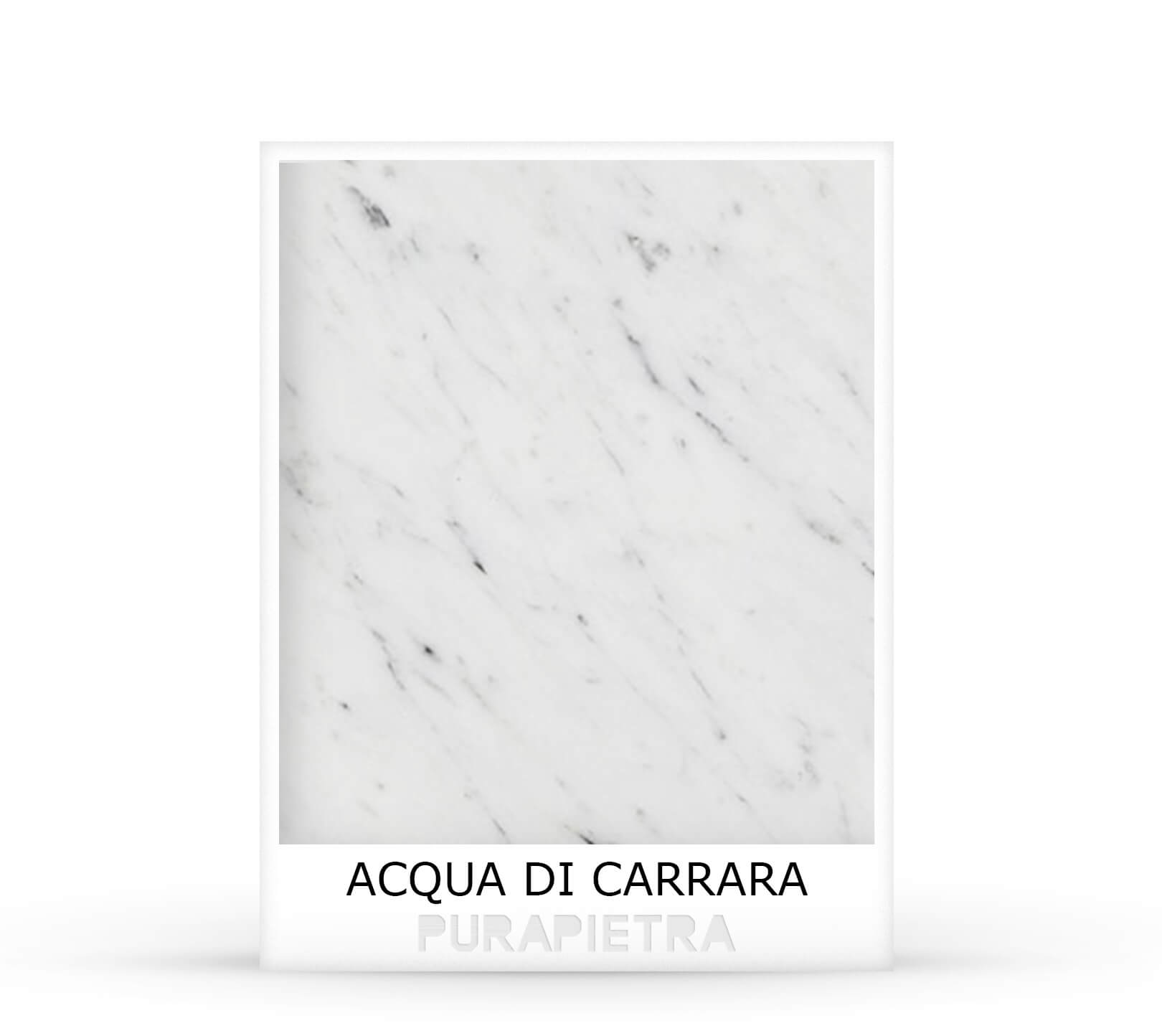
Where Acqua di Carrara comes from
Acqua di Carrara is quarried in the Apuan Alps above Carrara, in northern Tuscany, from the same basin that has supplied sculptors and architects since Roman times. Geologically it is a metamorphic marble: limestone laid down on an ancient seabed, then buried, heated and compressed until the calcite recrystallised into the dense, close-grained white the area is known for.
The Apuan basin runs to more than a hundred active and historic quarries. The commercial names attached to the stone that comes out of them describe the character of a particular seam rather than a different mineral. Statuario, Calacatta, Bianco Carrara and Acqua di Carrara are all the same rock with different personalities.
This one sits at the calm end of that spectrum. The name translates roughly as “water of Carrara”, and it is a good description of the effect: the veining moves through the slab the way sediment moves through still water, in soft grey drifts rather than the sharp black lines of a Bardiglio or the gold-brown branching of a Calacatta. Where Statuario is the stone you choose when you want the marble to be the event in the room, Acqua di Carrara is the one you choose when you want the room to be the event and the marble to hold it together.
That distinction matters commercially as well as visually. Statuario blocks are rare and priced accordingly. Acqua di Carrara comes out of the mountain in usable volume, which means larger continuous surfaces are realistic, and it means the price sits in a more workable range for a whole bathroom or a full run of cladding. If you want the wider context on the Tuscan whites, our guide to Italian white marble sets them side by side, and there is background on the quarrying district itself on Wikipedia’s Carrara marble entry.
Reading the stone: ground, veining and colour
Three things are worth learning to look at before you commit to a slab.
The ground. The base is a cool white with a faint grey cast, not the warm ivory of a Crema or the optical, almost blue-white of a top-grade Statuario. Under warm artificial light it reads as soft white. Under north daylight it can look faintly silver. Neither is a fault, but it does mean Acqua di Carrara behaves differently in a north-facing bathroom than it does in a south-facing kitchen, and it is the reason we always ask where a slab is going before recommending a finish.
The veining. Fine, diffuse and directional. It tends to run as a soft grey wash with occasional darker threads, and it holds the same rhythm across the block, which is what makes bookmatching straightforward. There is no sudden change of key from one metre to the next.
The uniformity. This is the practical advantage. Because the pattern is consistent, offcuts still look like the main surface, joints are easier to plan, and a mistake at the fabrication stage is easier to recover from. On a heavily figured marble, a badly placed cut ruins the panel. On Acqua di Carrara it rarely does.
Acqua di Carrara compared with the other Carrara whites
Most of the confusion around Tuscan white marble comes from the names, so it is worth putting them side by side. All four stones below come out of the same mountains, and the differences are of degree rather than of kind.
Against Bianco Carrara
Bianco Carrara is the commercial workhorse, and it comes in graded qualities: C, CD, Venato and so on. The lower grades carry a greyer ground and a busier, more scattered veining that can read as noisy over a large surface. Acqua di Carrara is cleaner and more directional, so it holds together better when the surface gets big. If you have seen a Bianco Carrara bathroom that felt slightly restless, this is usually why.
Against Statuario
Statuario is the trophy stone: a brighter, more optical white with bold, well-separated grey veining, quarried in limited volume and priced for it. It is a feature material and behaves like one. Acqua di Carrara does the opposite job. It is a background, and on a project where the joinery, the metalwork or a single sculptural piece is meant to lead, that is the more useful behaviour.
Against Calacatta
Calacatta has a warmer ground and thicker veining that often carries gold or ochre. It is beautiful and it is emphatically not neutral, which means everything else in the room has to agree with it. Choosing Acqua di Carrara instead is usually a decision about how much of the room you want the stone to decide.
Against Bardiglio and the greys
Bardiglio is the grey of the same district, and it makes a natural companion rather than a competitor. A Bardiglio floor under Acqua di Carrara walls, or a Bardiglio inset in a white surface, keeps everything within one geological family while giving the eye a change of tone. Our grey marble guide covers those varieties in more depth.
The 4 finishes: how the surface changes the stone
Honed
Ground to a smooth matt surface with no reflection. This is what we specify most often for Acqua di Carrara, because the softness of the veining suits a soft surface. Honed marble diffuses light instead of bouncing it, hides water marks and fingerprints far better than a polish, and gives the stone a chalky, almost fabric-like quality up close. The trade-off is that a honed surface is slightly more open and wants sealing more attentively.
Polished
Buffed to a reflective sheen. Polishing deepens the grey of the veins and pulls up whatever contrast the slab has, so it is the finish to choose if you want the pattern to read from across the room. It also closes the surface, which helps with staining. On floors it is the least forgiving option underfoot when wet.
Brushed and leathered
Worked with abrasive brushes until the surface has a faint texture and a low satin lustre. It is a good middle ground for horizontal surfaces that get used, because the slight irregularity disguises the small marks that daily life leaves on stone. On a kitchen island in particular, brushed Acqua di Carrara ages better than polished.
Sandblasted and split
Heavier textures, mostly kept for exterior cladding, steps and thresholds where grip matters. Worth knowing that changing the finish between two adjoining surfaces of the same stone is often a better move than changing material altogether.
The best ways to use Acqua di Carrara in interiors
Bathrooms
This is the stone’s natural home. A bathroom clad in a strongly veined marble can feel busy the moment you put a mirror, a tap and a towel rail in front of it. Acqua di Carrara absorbs all of that. Run it from the floor up through the shower, stop it at a clean horizontal line, and let the fittings do the talking. A carved basin in the same stone turns a functional object into something closer to sculpture, which is the thinking behind our Linear wall-mounted basin and the Unit freestanding basin.

Kitchens
Marble in a kitchen is a decision, not a default. Acqua di Carrara is a calcium carbonate stone, so it will etch where an acid touches it: lemon, wine, tomato, vinegar, most descalers. What people find, though, is that a lightly veined white takes a patina better than a dramatic one, because the dull marks that build up over years read as part of the surface rather than as damage to a pattern.
If you want stone in the kitchen but not the maintenance conversation, use it as a splashback or an island front and put a harder material on the worktop. That combination gives you the material where you see it and something more forgiving where you work.
Walls, floors and stairs
On walls Acqua di Carrara behaves as a warm-cool neutral: it gives a room a base tone and then stops asking for attention. On floors, large formats with tight joints keep the surface calm, and a honed finish is the sensible choice for grip. On stairs, the directional veining can be run continuously up the flight, which is one of those details nobody consciously notices and everybody feels.
Objects
At object scale, a quiet white marble is at its most persuasive, because you are seeing the whole piece at once and there is nothing to compete with the form. Our marble vases and trays exist for that reason: they bring the material into a room with no building work involved.
Pairings that work
Acqua di Carrara is generous with other materials, which is part of its appeal. With pale oak or walnut it warms up and reads domestic. With brushed brass or unlacquered bronze the grey in the veins picks up the metal and the whole scheme settles. With blackened steel it goes graphic and architectural. And with another stone, the contrast can be very effective if you keep the proportions unequal: a dark green or black inset against a field of white works, while a fifty-fifty split usually does not. Our guides to green marble and black marble cover the counterparts if you are planning that kind of pairing.
The pairing to be careful with is a warm white. Acqua di Carrara next to an ivory or cream stone tends to make both look slightly wrong, because the eye reads the temperature difference as a mismatch rather than a choice. Either commit to the cool family or put enough distance between the two.
Formats, thickness and how the stone is supplied
Slabs arrive from the Apuan district at roughly 300 by 160 centimetres, though the usable area is always smaller once edges and any fractured zones are taken out. Two thicknesses cover most interior work: 2 cm for cladding, shower walls and lighter horizontal surfaces, and 3 cm for worktops, thresholds and anywhere an exposed edge has to look substantial.
Where a thicker edge is wanted without the weight of a solid 6 cm slab, a mitred build-up is the standard solution: two pieces cut at 45 degrees and joined so the veining continues around the corner. Done well the joint is invisible and the surface reads as a solid block. Done badly it is the first thing anyone notices, which is why it is worth asking to see a fabricator’s mitres before committing a project to them.
One more supply note. Because Acqua di Carrara is quarried in volume, matching slabs from the same block is realistic in a way it is not with the rarer whites. If a project needs continuity across several rooms, reserve the block rather than the square metres. It costs nothing extra to ask and it is the difference between a scheme that looks planned and one that looks assembled.
Maintenance and sealing
Less demanding than its reputation suggests, but it does want a routine. Seal on installation with a good impregnating sealer, and again every one to two years on surfaces that get wet or used, less often on walls. Clean with a pH-neutral stone cleaner and nothing else: no vinegar, no lemon, no generic bathroom or kitchen spray, no abrasive cream. Wipe spills when they happen rather than when you notice them.
Etching, the dull matt mark left where an acid has touched a polished surface, is the thing people mistake for staining. It is not a stain, it is a change in the surface, and on a honed finish it is often invisible. On a polished finish a marble polishing powder will usually bring it back. Deep staining is the harder problem, and sealing is what prevents it. Put mats at external doors if the stone is on a floor, because grit underfoot does more damage over ten years than any spill will.
Choosing a slab
Three things are worth insisting on. See the actual slab rather than a sample chip, because the grey cast and the density of the veining vary from block to block and a 10 cm sample tells you almost nothing. Look at it in light similar to where it is going, or at least know which way the room faces. And ask where the stone will be worked, because with a quiet marble the craft is all in the edges and the joints.
A clean edge profile, veining that runs continuously from one panel to the next, a mitred corner that reads as a solid block: that is what separates a considered surface from a bought one. It is also the part of the process that no photograph will show you, and the part worth spending on. Our guide to how to identify quality marble goes through what to look for in the slab itself.
If you are working towards something specific, a bathroom, a single carved piece or a whole interior, we are happy to talk the material through before anything is committed. Write to info@purapietra.it, or browse the full range on our materials page.
Frequently asked questions about Acqua di Carrara
What is Acqua di Carrara marble?
Acqua di Carrara is a white marble quarried in the Apuan Alps above Carrara, in Tuscany. It has a cool white ground and fine, diffuse grey veining that drifts through the slab rather than cutting across it, which makes it the calmest of the well-known Carrara whites.
What is the difference between Acqua di Carrara and Statuario?
Both come from the same quarrying basin. Statuario has a brighter, more optical white ground and bold grey veining that makes it a feature material, and it is considerably rarer and more expensive. Acqua di Carrara has softer, more diffuse veining and a slightly greyer ground, so it works as a background rather than a focal point.
Is Acqua di Carrara suitable for a bathroom?
Yes, and it is one of its best uses. Choose a honed finish for grip and to keep water marks invisible, seal on installation, and use only pH-neutral cleaning products. Avoid acidic descalers and limescale removers on the stone itself.
Can Acqua di Carrara be used as a kitchen worktop?
It can, provided you accept that it will etch where acids touch it and develop a patina over time. Many people like that. If you want a surface that stays exactly as installed, use the marble on the splashback or island front and choose a harder material for the working top.
How much does Acqua di Carrara cost?
It sits in the mid range for Italian white marble, below Statuario and Calacatta and above the most common commercial Bianco Carrara grades. The final figure depends on slab thickness, finish, block selection and fabrication far more than on the stone name, so it is best quoted against a specific project.
What is the difference between Acqua di Carrara and Bianco Carrara?
They come from the same district, but Bianco Carrara is a graded commercial category whose lower grades have a greyer ground and busier, more scattered veining. Acqua di Carrara has a cleaner ground and more directional veining, which holds together better across large surfaces.
Does Acqua di Carrara yellow over time?
Not on its own. Yellowing in white marble is almost always caused by an unsuitable sealer, an oil-based product, iron in the water reaching the stone through an open surface, or a cementitious adhesive bleeding through a thin slab. Correct sealing and the right installation method prevent it.
Keep exploring the Purapietra magazine. See also our guides to white marble, Italian white marble and travertine, or browse the full materials collection.