
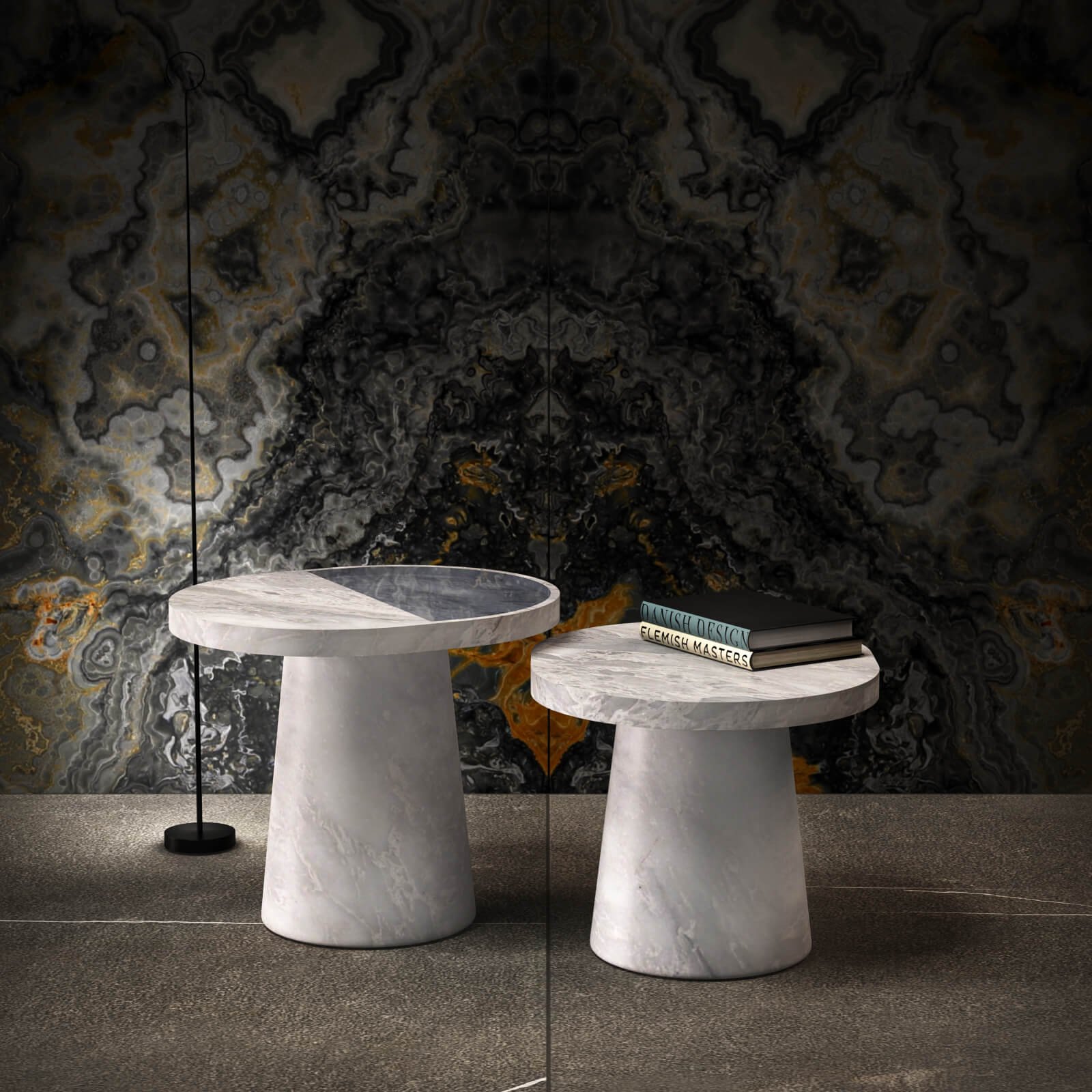
Some white marbles announce themselves. Bianco delle Alpi does the opposite: it waits until the light moves across a room before it shows you anything at all. Of every white stone we cut in the workshop, this is the one that clients come back to when they want calm rather than drama, and it rewards a designer who knows how to leave a surface alone.
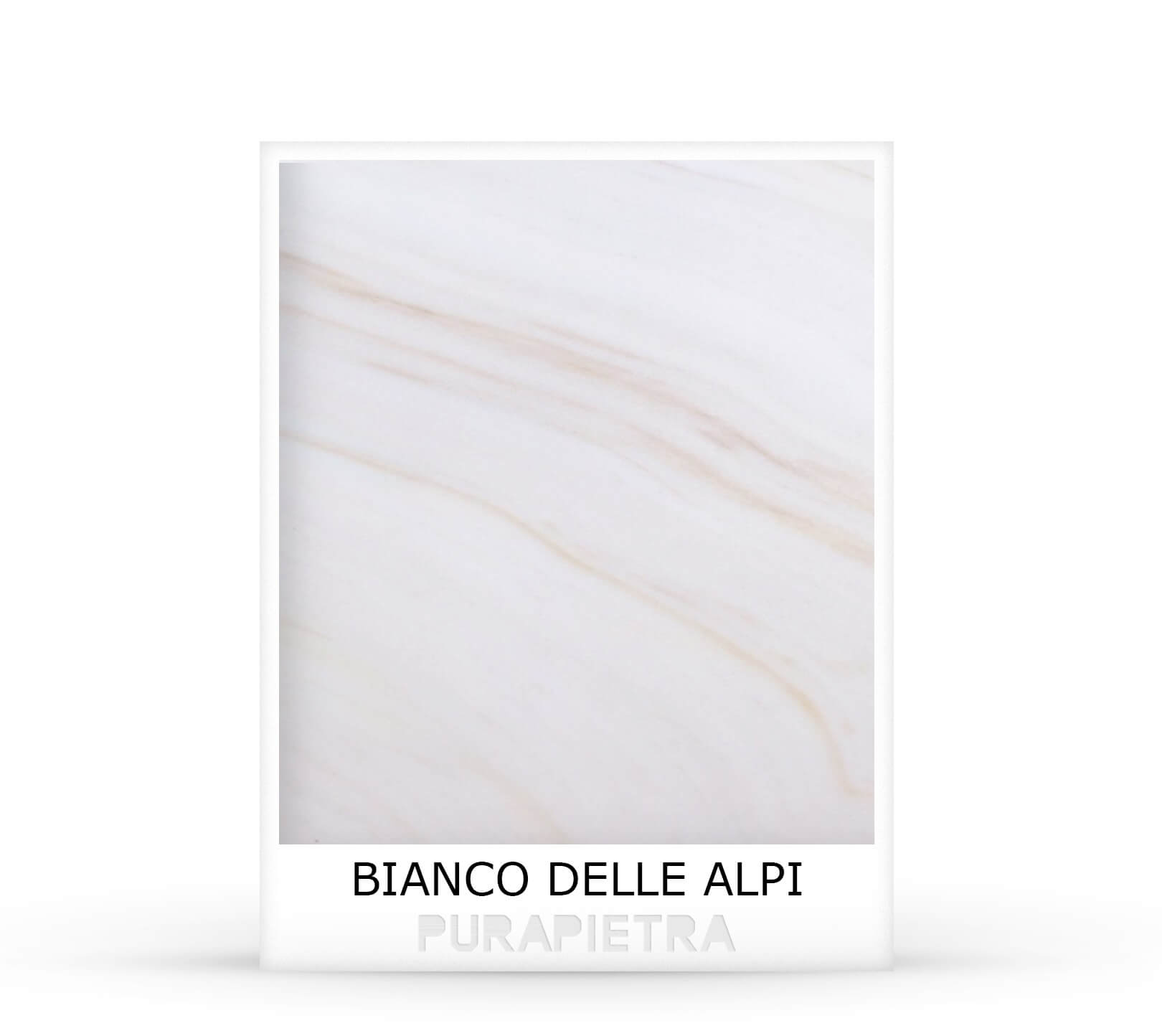
Bianco delle Alpi is an Italian white marble quarried in the alpine arc of northern Italy, prized for a background that reads almost snow-white and for veining so restrained it can disappear at three metres. It sits at the quiet end of the white family, a long way from the theatrical golds of Calacatta and a step cleaner than most Carrara grades. This guide covers where it comes from, how to read a slab, which finishes suit it, and where it earns its place indoors.
Where Bianco delle Alpi comes from
The name is geographic rather than commercial. Bianco delle Alpi is extracted from metamorphic deposits along the Italian alpine belt, in basins where limestone was recrystallised under pressure over millions of years. That process is the same one that produced the more famous Apuan whites further south, and it explains why the two families look related without being interchangeable. You can read the general geology on Wikipedia’s entry on marble, but the practical consequence is simpler: a tighter, more uniform crystal structure than a decorative breccia, and therefore fewer surprises when the block is opened.
Alpine quarrying has its own rhythm. Blocks come out in smaller volumes than the industrial basins of Carrara, and extraction is seasonal in the higher sites. For a workshop like ours that means availability moves in waves rather than a steady supply, and it is worth reserving material early when a project needs several matching slabs. It also means each batch has a character of its own. Two blocks from the same quarry, cut a year apart, will not be twins.
How it differs from Carrara and Statuario
Designers often ask us to line up the Italian whites side by side, and the differences become obvious the moment you do. Classic Carrara carries a faint grey cast and a soft cloudy veining that reads as texture across a large surface. Bianco Statuario is brighter and colder, with more decisive grey veins that make a statement piece. Bianco delle Alpi lands between them but closer to the quiet side: whiter than Carrara in the ground, less graphic than Statuario in the vein.
If you already know the family, our guide to Italian white marble sets out the whole group, and the broader white marble pillar covers how these stones behave as a category.
Reading the slab: ground, vein and movement
Three things tell you what a Bianco delle Alpi slab will do in a room.
The ground. Look at the field between the veins under indirect daylight. A good slab holds a clean, cool white with no yellow drift. Warm patches are not a defect, but they will fight a cool palette and become obvious once the surface is polished.
The vein. Alpine white veining tends to be fine, grey to grey-green, and irregular. On the best blocks it behaves like pencil shading rather than a drawn line. Heavy, dark or ropey veining usually signals material from a different bench and should be judged on its own merits rather than dismissed.
The movement. Because the veining is soft, book-matching is less dramatic here than it is with a Calacatta. That is often the point. On a long kitchen island or a full-height shower wall, the eye reads a continuous field rather than a mirrored pattern, which is exactly what you want when the stone is meant to hold the room together rather than dominate it.
The habits we use to grade a slab apply to any white stone, and we have written them up in more detail in our guide on how to identify quality marble.
Finishes: how the surface changes the stone
Finish does more to a white marble than colour ever will. The same block can look like three different materials depending on how it is treated.
Honed
A honed surface is ground smooth and left matt. On Bianco delle Alpi this is our default recommendation for anything horizontal. Matt white reads soft rather than clinical, etch marks from acids are far less visible because there is no gloss to interrupt, and fingerprints stay invisible. The trade-off is a slightly more absorbent surface, so sealing matters more.
Polished
Polishing closes the surface and lifts the crystal, which makes the white brighter and the veins sharper. It is the right choice for vertical cladding, for a fireplace surround, or for a piece meant to catch light across a hallway. On a kitchen worktop we advise against it. Lemon juice, vinegar and wine leave dull patches on a gloss white that no amount of care will fully prevent.
Brushed and bush-hammered
Brushing runs abrasive heads over the surface until it takes on a fine, leathery texture. It hides wear well and gives Bianco delle Alpi an unexpected warmth. Bush-hammering goes further and produces a rougher, tactile face suited to feature walls and exterior work. Both finishes suppress the veining, so choose them when the material is doing textural work rather than decorative work.
Five places Bianco delle Alpi earns its keep
1. Bathrooms
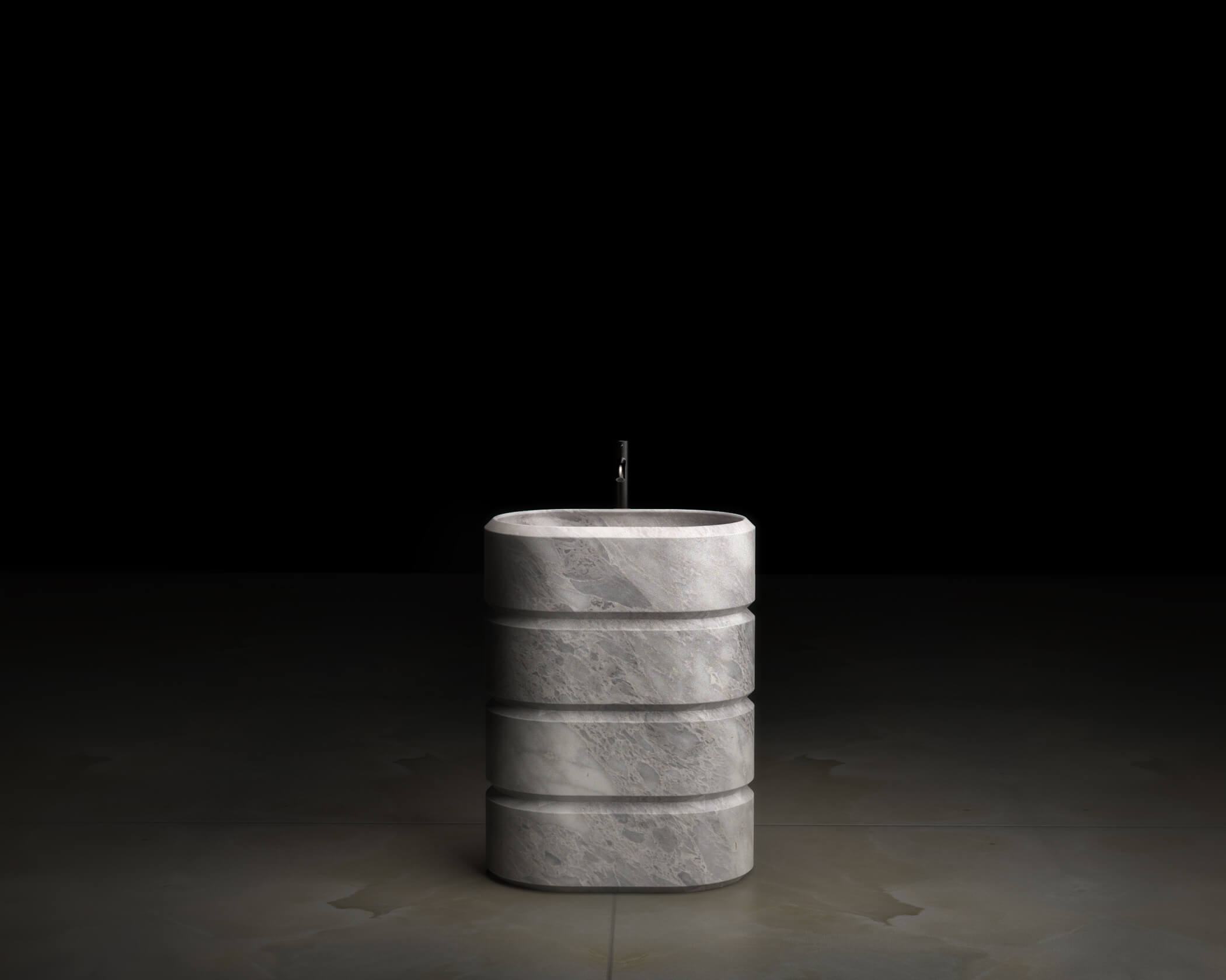
This is the stone’s natural home. A honed Bianco delle Alpi wall running from floor to ceiling gives a bathroom depth without pattern, and because the veining is faint you can turn corners and run into niches without the joints becoming visible seams. Pair it with a sculpted basin such as our Unit Sink or the wall-mounted Linear, and the room resolves into one material rather than a collection of surfaces.
2. Kitchens
Bianco delle Alpi makes a beautiful island top, with one honest caveat. Marble is calcium carbonate and it reacts to acid. If a client wants a white stone worktop and will not tolerate any change over time, we steer them towards quartzite. If they accept that a kitchen surface acquires a history, honed Bianco delle Alpi is one of the most forgiving whites we work with, because matt hides etching far better than gloss.
3. Cladding and full-height walls
Polished slabs on a vertical plane are where this marble becomes luminous. Cladding takes no wear, so the polish stays perfect, and the fine veining scales well: it reads as texture from across a room and as detail from a metre away. This is the application we recommend when a client falls in love with the polished sample but has an active household.
4. Furniture and monolithic pieces
Solid marble furniture asks a lot of the stone. A tabletop or a carved bath is a single mass with no substrate behind it, so the material has to be structurally sound and visually consistent through its full thickness. The tight alpine crystal structure suits this well, and the restrained veining means a curved edge does not slice through a pattern in an awkward place.
5. Small objects
At the scale of a tray or a vase, a quiet white is worth more than a dramatic one. Heavy veining on a small object turns into visual noise. Bianco delle Alpi keeps its calm even at 20 centimetres, which is why it turns up so often in our trays and vases.
What to pair it with
A quiet white is generous. It sits under almost anything, which makes the pairing decision a question of intention rather than compatibility.
With brass and bronze. Unlacquered brass that is allowed to patinate gives a cool white marble the warmth it lacks. This is the pairing we return to most often for bathrooms.
With dark stone. Setting Bianco delle Alpi against a Nero Marquina or a Nero di Milano produces a contrast that feels architectural rather than decorative. Our notes on black marble interiors cover how to balance the two without the scheme tipping into a chessboard.
With pale timber. Oak, ash and larch bring grain to a room that has very little of it. The combination reads alpine in the best sense, and it stops a white-on-white scheme from feeling like a showroom.
With plaster and lime. Matt mineral wall finishes share the same family of surface as honed marble. Used together they make the stone feel native to the building rather than applied to it.
Care and sealing
Bianco delle Alpi is not difficult to live with, but it does have preferences.
Seal it, then seal it again. A penetrating impregnating sealer sits inside the pores rather than forming a film on top. Apply it on installation and reapply roughly every twelve to eighteen months on working surfaces, less often on cladding. A sealer slows absorption; it does not make the stone acid-proof.
Use pH-neutral cleaners only. Anything containing citrus, vinegar or descaler will dull the surface. Warm water and a neutral stone soap handle almost everything.
Deal with spills quickly. Red wine, oil and coffee are the usual culprits. Blot rather than wipe, so the liquid is not spread across a wider area. Persistent stains can be drawn out with a poultice, which is worth doing before anyone reaches for an abrasive.
Accept a patina. Marble in daily use changes. On a honed surface those changes accumulate into something closer to a leather finish than to damage, and most of the clients who were nervous about it at the start end up preferring the stone at year five.
Working with Bianco delle Alpi at Purapietra
We treat white marble as a structural material, not a veneer. Pieces are cut from solid blocks, shaped on CNC for accuracy and then finished by hand, which is where a sculpted edge stops looking machined and starts feeling resolved. For bespoke work we ask clients to select the actual block rather than a sample, because a 5-centimetre chip cannot tell you what a 3-metre slab is going to do.
Bianco delle Alpi and the rest of our white and coloured stones are shown in the materials catalogue. If you are weighing it against the other Italian whites, Acqua di Carrara is the closest alternative in feel, with a slightly softer, more atmospheric ground. Write to us and we will send current availability, finish samples and a quotation for the piece you have in mind.
Frequently asked questions about Bianco delle Alpi
Is Bianco delle Alpi a real Italian marble or a trade name?
It is a genuine Italian marble, quarried in the alpine districts of northern Italy. The name describes the geographic origin rather than a processing treatment, though as with most stone names it covers a range of grades rather than a single fixed appearance.
How much does Bianco delle Alpi cost?
Price depends on block quality, slab thickness and how much of the material a piece consumes, so a square-metre figure is misleading for bespoke work. As a family it sits below Statuario and Calacatta and roughly alongside good commercial Carrara. We quote per project once the piece and the finish are defined.
Can I use Bianco delle Alpi on a kitchen worktop?
Yes, provided you accept that marble etches on contact with acid. Specify a honed finish rather than polished, seal it on installation, and keep lemon, vinegar and descaling products away from the surface. If a permanently unchanged worktop is the requirement, quartzite is the better material.
Does Bianco delle Alpi turn yellow over time?
Good-quality material does not yellow on its own. Discolouration almost always comes from something else: an unsuitable adhesive bleeding through a thin slab, iron oxidation where the stone stays permanently damp, or a film-forming sealer degrading. Correct installation and a penetrating sealer prevent all three.
Is it suitable for outdoor use?
In mild climates and in a brushed or bush-hammered finish, yes. In locations with hard freeze-thaw cycles or heavy acid rain, exposed marble will lose definition over decades. Granite and some quartzites are the safer specification for fully exposed exterior work.
What is the difference between Bianco delle Alpi and Carrara?
They come from different Italian basins. Carrara is quarried in the Apuan Alps in Tuscany and typically shows a faint grey cast with cloudy veining. Bianco delle Alpi comes from further north and generally reads whiter in the ground with finer, more scattered veins.
How thick should a Bianco delle Alpi worktop be?
Twenty millimetres is standard for a supported worktop and thirty for spans, overhangs or a heavier visual edge. Solid pieces such as basins and tables are cut from full blocks, so thickness there is a design decision rather than a structural minimum.