
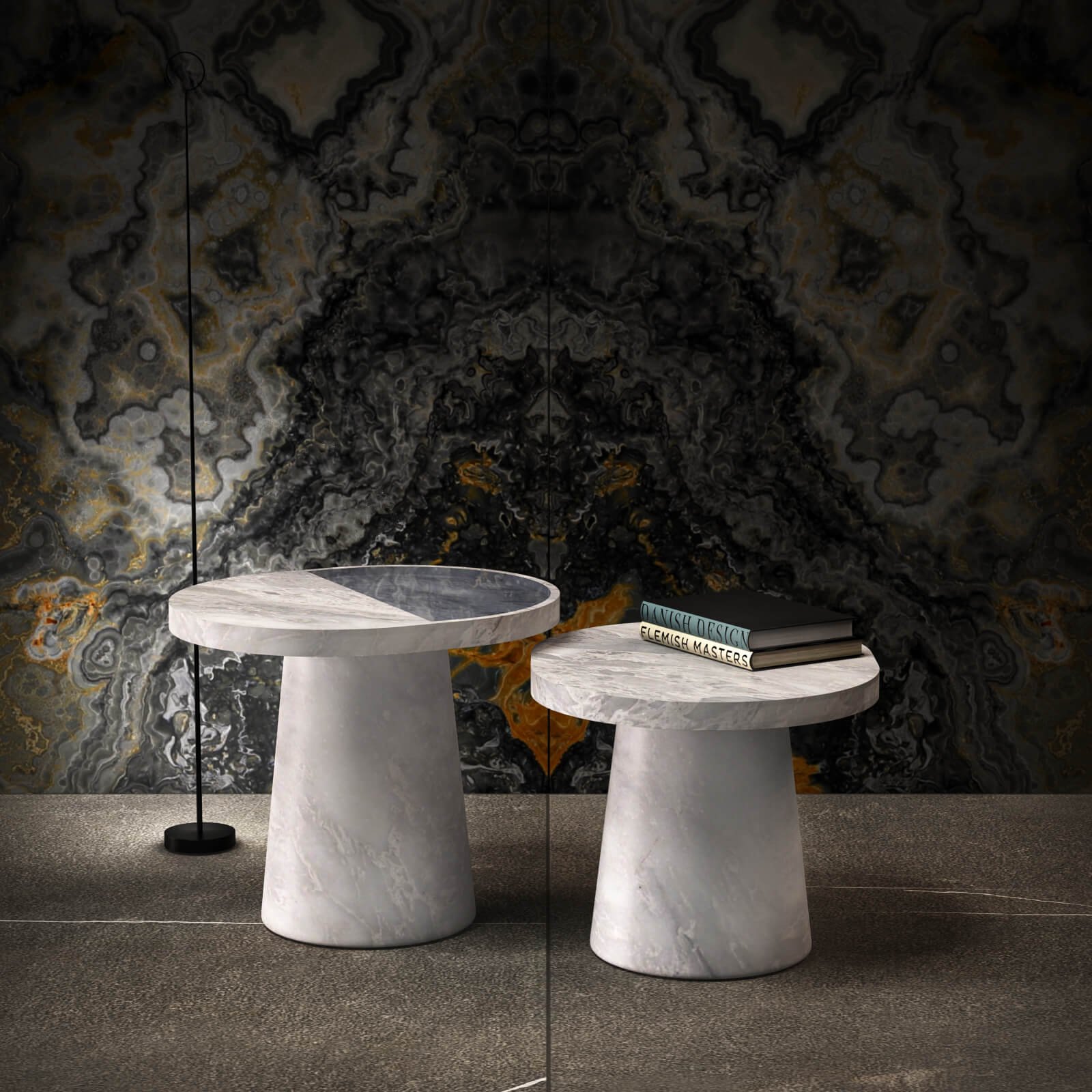
Of all the slabs that pass through the workshop labelled “Calacatta”, Borghini is the one a client recognises from a photograph before we say the name out loud. It runs warmer than the cold Apuan whites, bolder than a quiet Carrara, and it does something few marbles manage: it looks in the room almost exactly as it looked in the picture that sold the client on it.
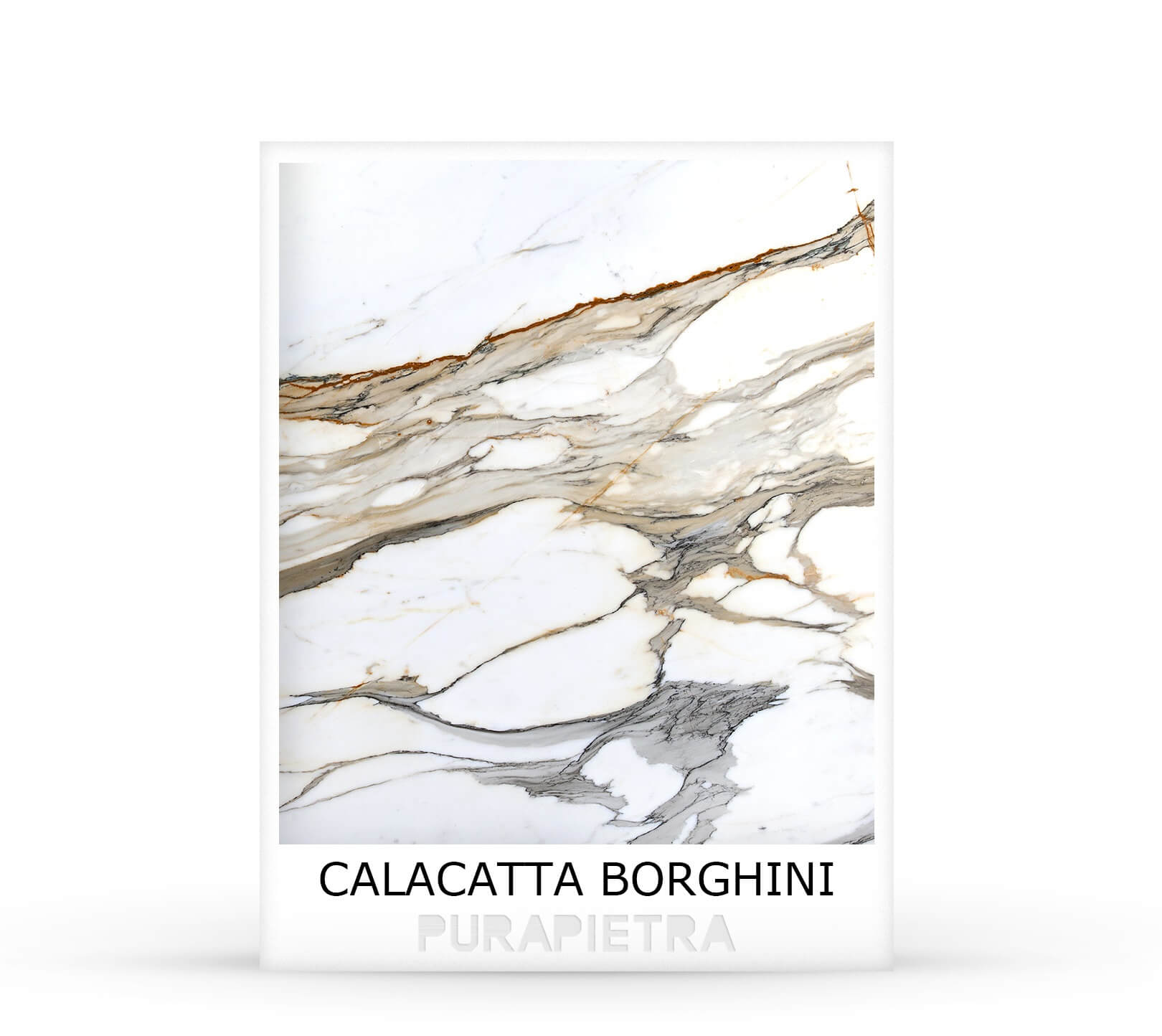
Calacatta Borghini is a warm white marble with wide, decisive veining in grey and soft gold, quarried in the Apuan Alps alongside the more famous Calacatta varieties but with a character of its own — heavier veins, a creamier ground, and a contrast that reads as generous rather than sparse. It has become one of the most requested stones in high-end bathrooms and kitchens over the last decade, for reasons that hold up once you look past the photographs. This guide covers where it comes from, how to read a slab before you commit to one, the finishes worth considering, where it earns its place indoors, and what actually drives the price.
Where Calacatta Borghini comes from
Calacatta Borghini is extracted from the Apuan Alps above Carrara, the same district that produces Carrara, Statuario and the other Calacatta varieties. All of these whites start as the same limestone, recrystallised over millions of years under heat and pressure into the dense, interlocking calcite structure that gives marble its particular way of holding light. What separates one Calacatta name from another is which bench it comes from and how the mineral impurities in that specific bed arrange themselves into veining. The general geology of the district is covered well on Wikipedia’s entry on Carrara marble, though the commercial names used in the trade — Borghini among them — are a layer the geology alone does not explain.
In practice, “Borghini” refers to material from a specific quarry front known for producing a warmer, creamier ground than the classic Calacatta Oro or the cooler Calacatta Vagli, with veining that tends to run wide and continuous rather than fine and scattered. It is not a protected term the way a wine appellation is, so slabs sold under the name vary more than buyers expect. Judging the stone in person, or at least from full-slab photographs rather than a swatch, is the only reliable way to know what is actually being quoted.
Calacatta Borghini against its closest relatives
Clients most often compare Borghini with two other stones in our catalogue. Against Bianco Statuario, Borghini is warmer and its veining is bolder and more continuous, where Statuario stays cooler and sparser. Against a standard Calacatta, Borghini tends to carry more gold in the vein and a creamier field. Neither comparison makes one stone better than the other — they simply photograph and live differently, which is why we always recommend seeing full slabs side by side rather than choosing from memory or a name alone.
Appearance: colour, veining and character
The ground in Calacatta Borghini sits somewhere between ivory and warm white, never the cold blue-white of the top Statuario grades. Against that field, the veining runs in broad, confident streaks of grey shot through with soft gold, often branching into secondary veins that give the slab a sense of movement rather than a static pattern. On the best material the veins have a directionality you can follow across the whole slab, which matters enormously once you get to layout.
Three things are worth checking before ordering. First, the density of veining: some blocks yield slabs with veining concentrated in bands, others scatter it more evenly, and the two look completely different once installed. Second, the gold content: it can range from a faint warmth to a pronounced ochre streak, and that shifts which metals and timbers will sit comfortably next to it. Third, consistency across slabs from the same block — because Borghini’s veining is bold, mismatched slabs on either side of a joint are more noticeable than they would be on a quieter stone. Our guide on how to identify quality marble goes through the habits we use to judge a block before it is cut.
Finishes for Calacatta Borghini
Polished
Polishing is the finish that made this stone famous. It deepens the contrast between the warm ground and the grey-gold veining, and it lets the surface catch light the way the photographs promise. Polished Borghini belongs on vertical surfaces and feature pieces — a bathroom wall, a kitchen splashback, a console — where nothing acidic touches it and the gloss has nothing to work against.
Honed
A honed finish softens the contrast slightly and takes the surface out of direct reflection, which makes daily etching from lemon, wine or vinegar far less visible. On worktops and floors, honed is almost always the more sensible specification, and on Borghini specifically it has the side benefit of calming a pattern that some clients find too busy in full gloss.
Brushed
Brushing leaves a fine, tactile texture that mutes the veining considerably. It suits a bench, a shower seat or an exterior application where grip and a softer visual read matter more than showing off the pattern. Given how much of Borghini’s appeal is in its veining, we rarely recommend brushing for a feature application — it is the right choice when the stone is doing textural rather than decorative work.

Best uses for Calacatta Borghini in interior design
Bathrooms
This is where Calacatta Borghini is asked for more than anywhere else, and for good reason. A bathroom is small enough that one bold stone can carry the whole room, and the veining reads as composition rather than noise when it is book-matched across a vanity wall or shower enclosure. Paired with a sculpted piece such as our wall-mounted Linear basin or a carved Unit Sink, the material becomes the room’s single organising idea rather than one surface among several.
Kitchens
Calacatta Borghini islands are a classic request, and the honest caveat applies here as it does to every calcite marble: it etches on contact with acid. Lemon juice, wine, vinegar and most descaling products will dull a polished surface. Specify a honed finish for the worktop, seal it properly at installation, and treat the surface’s evolving patina as part of owning the stone rather than a defect. If a perfectly unchanged worktop is the priority, quartzite is the honest recommendation, not this marble.
Cladding and feature walls
Because nothing acidic reaches a vertical surface, cladding is the safest and often the most dramatic use of Borghini. A polished wall in an entrance, behind a bed or lining a shower gives the veining room to run uninterrupted, and it is where the stone’s bold character becomes an asset rather than something to manage. The technical work is in the layout — matching veins across joints and deciding, before the block is cut, where a vein is allowed to cross a corner.
Worktops and vanity tops
On a smaller surface such as a vanity, Borghini’s wide veining can dominate a slab in a way that looks striking on some pieces and cramped on others, depending on where the cut falls. Selecting the actual slab rather than a swatch matters more here than on almost any other application, because a beautiful three-metre kitchen slab does not automatically yield a beautiful one-metre vanity top from the same block.
Design objects
Trays, vases and small sculptural pieces cut from Borghini offcuts carry the stone’s character at a domestic scale, letting a client own the material without committing a whole room to it. Our marble trays and vases are cut and finished this way, using material that would otherwise be waste from larger commissions.
Pairing Calacatta Borghini with other materials
Brushed brass and warm bronze. The gold in the veining makes warm, unlacquered metals the natural partner. The pairing gets better as the metal ages, which is part of why it is used throughout our New Era collection.
Walnut and other dark timbers. A dark, warm wood grounds the marble’s brightness and gives the eye somewhere to rest between the vein and the field. It is the pairing we default to in bathroom joinery.
Cream and travertine tones. Rather than contrast, pairing Borghini with a warm neutral palette lets the stone stay the single loud voice in the room, which suits clients who want drama without a busy scheme.
A quieter white elsewhere in the house. Because Borghini is one of the boldest whites we offer, using it in one room and a calmer stone such as Bianco Statuario or a classic white marble elsewhere keeps the house from feeling like every surface is competing for attention.
Maintenance and sealing
Seal on installation, then keep to a schedule. A penetrating, impregnating sealer reduces how much liquid the stone absorbs without changing its surface. Refresh it every two to four years on worktops and less often on walls, and avoid film-forming coatings, which peel unevenly over time.
Clean with pH-neutral products only. Warm water and a neutral stone soap deal with almost everything a household throws at marble. Bleach, vinegar and citrus-based cleaners all etch the surface directly, and most of the damage we are asked to repair traces back to a cleaning product rather than everyday use.
Blot spills, do not wipe. Oil and wine stain because they are absorbed into the stone; acid etches because it dissolves the surface chemically. Blotting a spill within a few minutes stops most staining before it starts. A poultice can lift an absorbed stain afterwards, but an etch mark has to be re-honed out.
What drives the price of Calacatta Borghini
There is no single reliable square-metre figure for this stone, and any quote given without seeing the specific slab should be treated cautiously. Price is set by four things: the grade of the block, the thickness specified, how much of the raw block ends up as usable finished material, and the hours of hand finishing involved. Because Borghini’s appeal is precisely its bold, continuous veining, blocks that yield large, well-matched slabs command a real premium over material with the same name but less dramatic patterning.
As a family, Calacatta marbles sit toward the top of the Italian white hierarchy, generally above standard Carrara and travertine, and broadly comparable to — sometimes above — Bianco Statuario depending on the specific grade and how dramatic the veining is. What a client pays for is the visual character and the selection process behind it, not a difference in hardness or how the stone performs day to day.
Why choose Calacatta Borghini with Purapietra
We treat marble as a structural material, not a surface to apply. Pieces are roughed on CNC for precision and finished entirely by hand, which is the stage where an edge stops looking machined and starts looking resolved. For any project using Calacatta Borghini we ask clients to select the block itself and we lay out the veining on the block face before the first cut, so nothing about the finished piece — the direction of a vein, the match across a joint — is left to chance.
Calacatta Borghini and the rest of our white, coloured and rare stones are shown in the materials catalogue. If the drama of Borghini is more than a project needs, Bianco Statuario and our broader guide to Italian white marble cover the calmer alternatives we most often propose instead. Write to us with a room, a drawing or simply a photograph, and we will tell you honestly what the stone can do and what it will cost.
Frequently asked questions about Calacatta Borghini
What is Calacatta Borghini marble?
It is a warm white marble quarried in the Apuan Alps near Carrara, part of the Calacatta family, defined by a creamy ground and bold, wide veining in grey and soft gold. It is one of the more dramatic and widely requested Calacatta varieties used in high-end interiors.
How much does Calacatta Borghini cost?
There is no fixed square-metre price, because cost depends on block grade, slab thickness, usable yield and finishing hours. It sits toward the top of the Italian white marbles, broadly comparable to or above Bianco Statuario depending on how dramatic and well-matched the veining is. We quote per project once the slab and finish are defined.
Is Calacatta Borghini good for a bathroom?
Yes, and it is one of the most requested applications for this stone. A bathroom is small enough for one bold material to carry the whole room, and book-matching the veining across a vanity wall or shower enclosure turns the pattern into composition rather than noise.
Can Calacatta Borghini be used for a kitchen worktop?
Yes, with the same caveat as any calcite marble: it etches on contact with acid from lemon, wine or vinegar. Specify a honed rather than polished finish, seal it at installation, and accept that the surface will develop a patina over time. If an unchanged worktop is essential, quartzite is the more suitable material.
What is the difference between Calacatta Borghini and Bianco Statuario?
Borghini has a warmer, creamier ground and bolder, wider, more continuous veining with a gold undertone. Bianco Statuario is cooler and brighter with sparser, more graphic grey veins. Both are premium Italian whites; the choice usually comes down to whether a room wants a bold, warm statement or a quieter, colder one.
How do I care for Calacatta Borghini marble?
Seal it with a penetrating impregnating sealer on installation and reapply every two to four years on worktops. Clean only with pH-neutral products, avoid bleach and citrus-based cleaners, and blot spills quickly rather than wiping them, since oil and wine stain while acid etches the surface directly.