
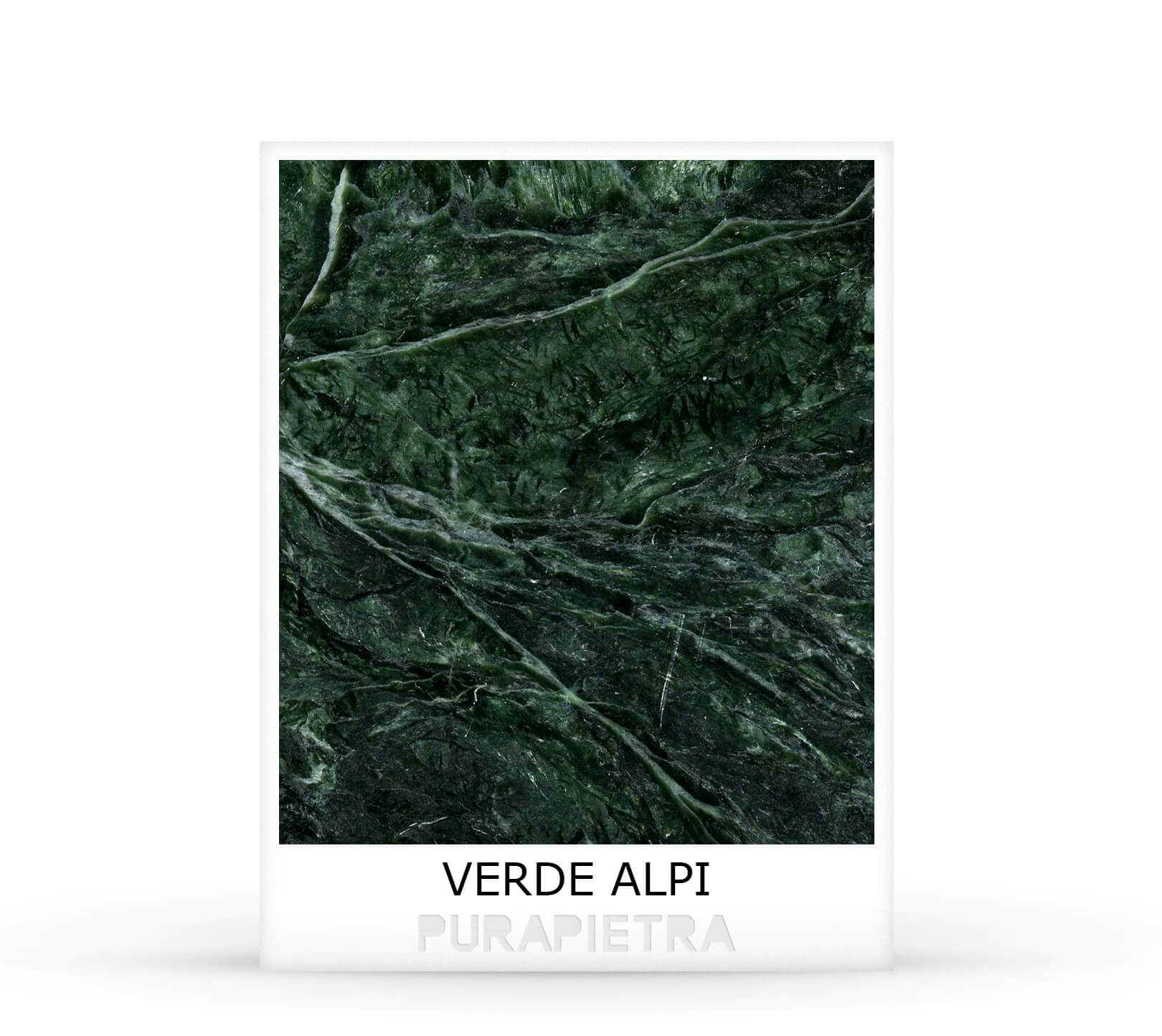
Verde Alpi is the green people mean when they say “classic green marble”. It is dark, almost bottle-coloured, and a fine network of pale veins runs through it like the branches of a leaf seen against the light. It is also one of the few greens that you can use on a surface that gets daily use.
Verde Alpi is one of the green stones in the Purapietra catalogue, and the one we point people to first when they want green but not a statement piece that has to be handled with gloves. This guide covers what it looks like, why it behaves differently from a white marble, which finish suits which job, where it works best, what to pair it with, how to care for it and what sets the cost. We also say where it is not the right choice.
What Verde Alpi looks like
The first thing you see in the swatch is depth. The ground is a dark, saturated green that moves between true bottle green and something close to black, with a slightly fibrous, feathery texture in places, as if the colour had been brushed on in layers. Across it run thin, pale veins. They are not regular. They branch, cross, thicken for a few centimetres and fade out, and in our sample they range from near white to a light green. There are no wide bands and no large clouds of colour. What you read is a dark field with a web of fine lines on it.
That is the character of the stone, and it is why it works in so many rooms. The colour is strong, but the pattern is busy at a small scale and calm at a large one, so a big surface of Verde Alpi looks textured rather than loud. If you are comparing it with the rest of the family, our pillar guide to green marble puts the main greens side by side, and our guide to coloured marble explains how to choose a colour for a whole room. For a plain definition of the rock family, Wikipedia’s page on serpentinite is a clear primer.
A classic Italian green
Verde Alpi is quarried in the Alpine valleys of north-west Italy, and it has a long history in Italian architecture, from church floors to the lobbies of mid-century palazzi. It is a stone that people have been choosing for a long time because it signals permanence without looking old-fashioned, and it fits both a traditional room and a contemporary one. If origin matters to your project, our guide to Italian marble versus imported stone explains what it changes in practice, and our list of the most prized Italian marbles shows where this stone sits among the others.
Why Verde Alpi is harder than most marbles
Most of what is sold as marble is a calcite stone. Verde Alpi is different: it is a serpentinite, a rock made mainly of serpentine minerals rather than calcite. In practice this makes it harder and denser than a soft white marble, and less porous. It resists scratching and staining better, which is why it is one of the more practical greens for surfaces that see daily life.
We want to be precise about what this means and what it does not. It does not make the stone indestructible, and we do not quote a hardness figure here because we would rather not give you a number that means nothing without a slab in front of you. It does not make the surface immune to acids either. Lemon, vinegar, wine and most limescale removers can still leave a dull mark on a polished surface. What it does give you is a more forgiving stone than a pale marble, which is often the deciding factor for a kitchen or a bathroom. Our guide to how long marble lasts explains what to expect over the years.
How to read a slab
The swatch is a small square of a larger surface, and two slabs of Verde Alpi can differ more than you expect. Before you choose, look at four things.
The density of the veining. Some slabs carry a fine, even web of pale lines. Others have fewer, longer veins that cross the surface in a more dramatic way. Neither is a defect. They give two different rooms: the first is calm and textured, the second is graphic. Decide which one you want before you look at slabs.
The depth of the green. The ground moves between a clear bottle green and something much darker. In a small bathroom the difference is minor. On a wall with strong light across it, it is obvious. If several pieces will sit side by side, ask to see them together, not one by one.
Where the veins fall. A vertical vein reads as height and a horizontal one as width. On a worktop or a vanity, check that no heavy vein lands exactly where a tap, a sink or a joint has to go. Bring the drawing with you.
Fissures and fills. Like any natural stone, a slab can carry hairline cracks or filled areas. They are easy to miss in a photograph and clear in the finished piece, so ask to see the real slab. Our guide on how to identify quality stone sets out the checks we apply before a block is approved for cutting.
Finishes for Verde Alpi
Variety and finish cannot be chosen separately. A honed Verde Alpi and a polished Verde Alpi are, for design purposes, two different materials, so ask to see the same slab in both before you decide.
Polished
Polished deepens the green until it looks almost wet, and it sharpens the pale veins so that they seem to sit just under a clear surface. It suits a feature wall, a bar front, a hotel reception or a table that is meant to be looked at. The cost is practical: a dark polished surface shows dust, water spots and fingerprints more than a pale one, and an acid spill leaves a dull patch that is easy to see against the dark ground.
Honed
Honed turns the same stone from glossy to velvet. The green becomes softer and a little greyer, the veins lose some of their sparkle and the surface stops reflecting the room. For anything touched every day, such as a vanity top, a table, a worktop or a shower, we recommend honed, because marks, water spots and small scratches are much less visible on it, and etching hides better. If you are unsure, honed is the safer choice for any surface that people lean on.
Brushed or leathered
A brushed or leathered surface adds a fine texture and mutes the pattern. It can be a good choice for a wall that people will touch, but with a stone whose main attraction is the network of veins, it takes away some of what you are paying for. Ask for a sample before you commit.

Best uses for Verde Alpi in interior design
Bathrooms
A bathroom is where Verde Alpi reads as timeless rather than trend-led. A shower wall, a vanity or a bath surround in this stone gives a small room depth and a calm, slightly botanical mood, without the beige that fills most bathrooms. A carved piece such as our Unit Sink or the Linear basin lets the stone do the work, and a freestanding Unit Bath in a pale stone looks sharp against a green wall. Keep it honed in wet zones, where it hides watermarks and etching.
Kitchens
This is where the serpentinite character earns its place. An island or a run of worktop in Verde Alpi is harder and less porous than a pale marble, so it is better suited to a surface that is actually cooked on. A Verde Alpi island against pale oak is a richer and more considered pairing than the usual marble and brass. Choose honed, seal the stone at installation and wipe acidic spills quickly. It is not a surface you can ignore. Our guide to marble in the kitchen goes through the trade-offs.
Feature walls and bookmatched panels
Bookmatched, the white veining of Verde Alpi opens into a symmetrical pattern that can carry a whole wall. Bookmatching means two slabs cut one after the other from the same block, opened like a book so the veins mirror along the joint. It is the most dramatic way to use this stone and the most demanding to install, because the slabs have to stay in sequence. Our guide to marble wall cladding covers slabs, tiles, thickness and fixing. With a stone this dark, one wall is usually enough.
Tables and furniture
A table top is a good way to try the stone without committing a whole room. You choose the exact slab, place the veins where they will be seen and keep the rest of the space quiet. It is also the easiest way to find out whether you enjoy living with a dark green surface.
Floors
Floors are possible, and the stone has a long history there, but they are the most demanding use. A dark floor shows dust, and a polished one can be slippery when wet. If you want Verde Alpi underfoot, honed is the sensible starting point. Our guide to marble flooring covers what to ask your installer.
What to pair with Verde Alpi
A dark green with a busy vein is already a strong statement, so the rest of the room should be calm. Three habits help.
Warm it with metal. Brushed brass and aged gold warm green and push the scheme toward the classical and the decorative, which suits Verde Alpi well. Blackened steel and dark bronze keep it moody and architectural. Our guide to marble and metal shows how to match tone and finish.
Warm it with wood. Pale oak lifts the green, and warmer woods such as walnut deepen it. Our guide to marble and wood shows how to match tone and grain, and our wider guide to pairing marble with other materials explains undertones and finishes.
Give it a pale neighbour, or a dark one. A cream stone beside the green makes both look better. Ivory Onix is a quiet, translucent partner, and Calacatta Borghini brings long grey and warm bands. For a darker, more enveloping scheme, put it next to a black stone such as Nero Markina. Choose one neighbour, not three.
Caring for Verde Alpi
The care is close to that of any marble, with one useful difference: the serpentinite is harder and less porous than a soft white, so it resists scratching and staining better. Seal it at installation and reseal every year or two, depending on use. Clean it only with a pH-neutral stone product. Avoid vinegar, lemon, bleach, limescale removers and abrasive creams, and wipe spills quickly, particularly anything acidic. Use coasters and a soft cloth, not a scourer. On a polished surface, dry water spots so they do not leave rings.
One honest limit: on a dark polished surface, an etch mark shows as a pale dull patch, and it is more visible than on a light stone. A honed finish hides this better. If a mark does appear, do not try to repair it with an abrasive. A stone restorer can re-polish a surface without losing its character.
What sets the price of Verde Alpi
There is no fixed price per square metre, and we would rather say so than quote a number that means nothing without the slab. Serpentine greens such as Verde Alpi are quarried in reasonable quantities and are priced in line with a mid-range Italian marble. Four things then set the cost of your project: the quality of the block and how well balanced its veining is, the thickness you specify, the yield, which is how much of the raw block ends up as usable finished material, and the hours of hand finishing. Bookmatching uses more material, because adjacent slabs have to be cut and kept in order.
The honest way to budget is to treat Verde Alpi as a feature material and price the surface, not the square metre. A single vanity or island delivers most of the impact for a fraction of the cost of cladding a whole room, which is how we tend to use it.
How to choose a slab
If you can, go to the yard. Photos flatten dark stone and hide the depth of the green. Look at the slab from a distance first, then close up, and look at it under the kind of light it will have in the finished room, not under a showroom spotlight. Ask for the slab numbers so you know which are consecutive, because a bookmatched pair of Verde Alpi panels is spectacular when the veins line up. Bring the drawing: the position of a joint, a tap or a cut-out changes which slab is right.
When Verde Alpi is the wrong choice
Verde Alpi is not a good fit if you want a pale, light-reflecting room: it absorbs light, and in a small room with little daylight a large area of it can feel heavy. It is also not the stone for someone who wants a surface that never changes. It is still a natural stone that can etch, and a polished dark surface shows every mark. If either of those is a concern, a lighter stone or a honed finish is the better answer, and we will tell you so before you order.
Why choose Verde Alpi with Purapietra
We treat stone as a building material, not a skin. Every piece is roughed on CNC for accuracy and finished by hand, which is where an edge stops looking machined. With a veined stone, we ask clients to choose the slab, and we plan where the veins fall, where the joints go and how the lighting will sit before the first cut. If you need something made to your own drawing, our page on bespoke marble explains how we work.
You can see Verde Alpi next to our other stones in the materials catalogue, and our guide to marble interiors covers how to build a room around a stone. Send us a plan, a sketch or a photo of the room, and we will tell you what the stone can do there and roughly what it will cost.
Frequently asked questions about Verde Alpi
What is Verde Alpi?
Verde Alpi is a classic Italian green stone: a dark bottle green threaded with a fine network of pale veins. It is quarried in the Alpine valleys of north-west Italy and is a serpentinite rather than a calcite marble.
Is Verde Alpi a marble?
It is sold and specified as green marble, but it is a serpentinite. That is why it is harder, denser and less porous than most white marbles.
Is Verde Alpi durable enough for a kitchen?
Often yes. It resists scratching and staining better than a soft white marble. It can still be etched by acids such as lemon, vinegar and wine, so we recommend a honed finish, sealing at installation and wiping spills quickly.
Can I use Verde Alpi in a bathroom?
Yes, and it is one of its best uses. Use a honed finish in wet areas, where it hides etching and watermarks, and seal it at installation.
How much does Verde Alpi cost?
There is no fixed price per square metre. It is priced in line with a mid-range Italian marble, and the final figure depends on the block, the veining, the thickness, the yield and the hours of finishing. We quote each project once the slab and finish are chosen.
Should I choose polished or honed Verde Alpi?
Polished gives the deepest green and the sharpest veins and suits walls and statement pieces. Honed is softer, shows fewer marks and is the safer choice for anything touched every day.
What goes with Verde Alpi?
Brushed brass or aged gold for a classical mood, blackened steel for a darker one, pale oak or walnut for warmth, and a cream stone such as Ivory Onix as a pale neighbour.