
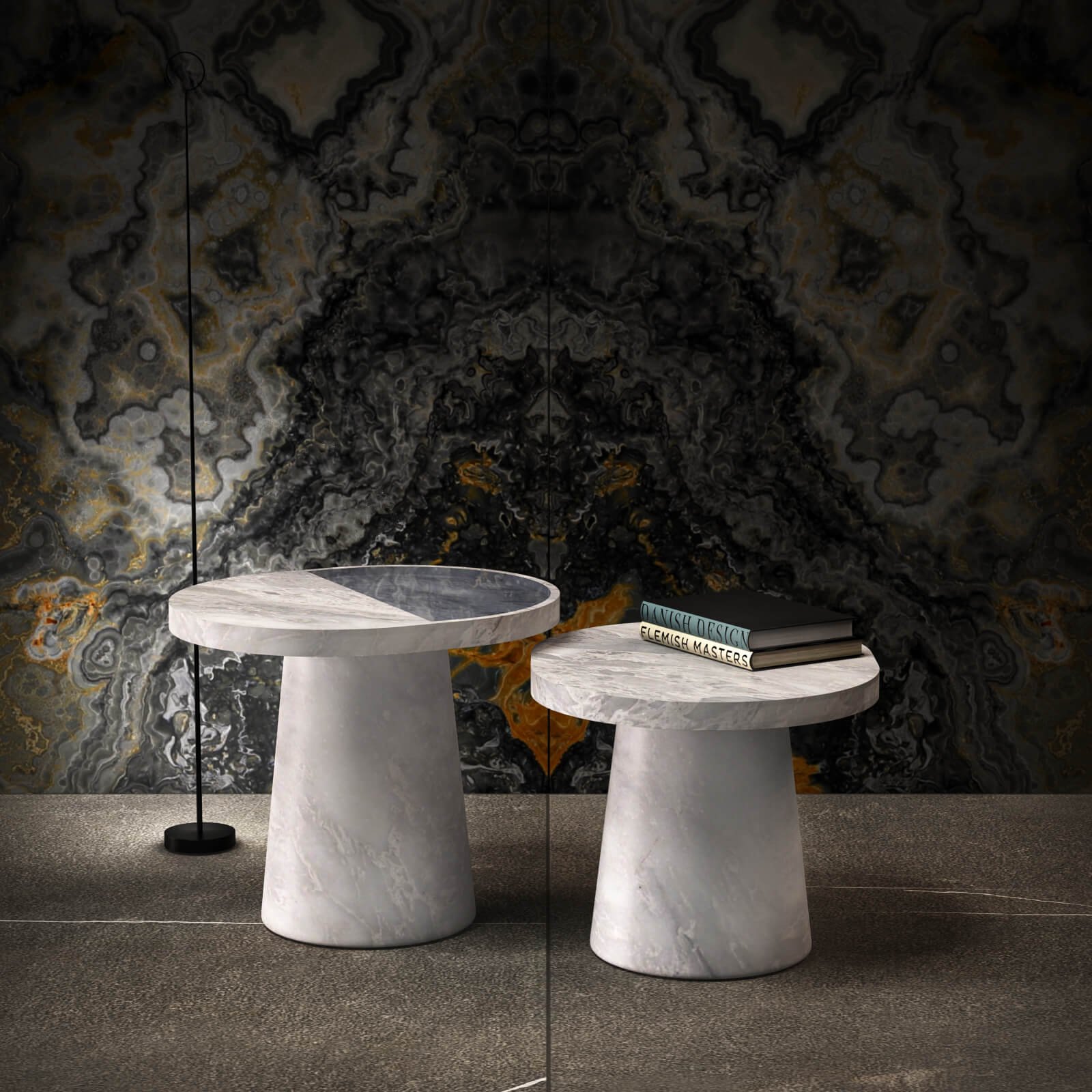
Green marble is the colour that walks the line between nature and jewellery. It carries the green of moss, malachite and deep water, and it changes a room the way a plant does, by bringing something living into it. This is a guide to the green marbles we work with at Purapietra: where the colour comes from, what each stone does in a space, and how to choose the one that belongs in yours.
Most marble colours read as background. Green does not. It is a real colour with a mood, and it shifts a room the moment it arrives, from cool sage through bottle green to the near-black depth of a Verde Positano. Some green slabs are quiet and cloudy, closer to a painted wall than a stone. Others carry veining so vivid you would frame them. Knowing which is which is most of the choice.
The character of green marble
Green marble owes its colour to a small group of minerals that were present when the rock formed. Marble is recrystallised limestone, and its tone comes from whatever was trapped in the stone during that process. Iron gives reds and yellows, graphite gives black, and green comes mainly from serpentine, chlorite and related silicates. Several of the stones sold as green marble are, strictly speaking, serpentinites or ophicalcites rather than pure calcite marbles, which is part of why their colour runs so deep and their veining so dramatic. Wikipedia has a clear primer on how marble forms if you want the geology in full.
That mixed origin has a practical side worth knowing. The serpentine-based greens are often harder and less porous than a classic white marble, which makes them more forgiving on surfaces that get used. The trade-off is that green rarely comes in the calm, uniform sheets you get from a Carrara. It is a stone with movement, so it belongs where that movement can be seen: a vanity top, a bookmatched panel, a fireplace, a table, an island. If you want to see how it sits among the other Italian stones we work with, our guide to the types of marble maps the whole range.
The green marble varieties at Purapietra
Our green selection is small and chosen slab by slab. Four stones, each with a different temperature and a different job, picked for grain and for the way the colour holds under a hand finish.
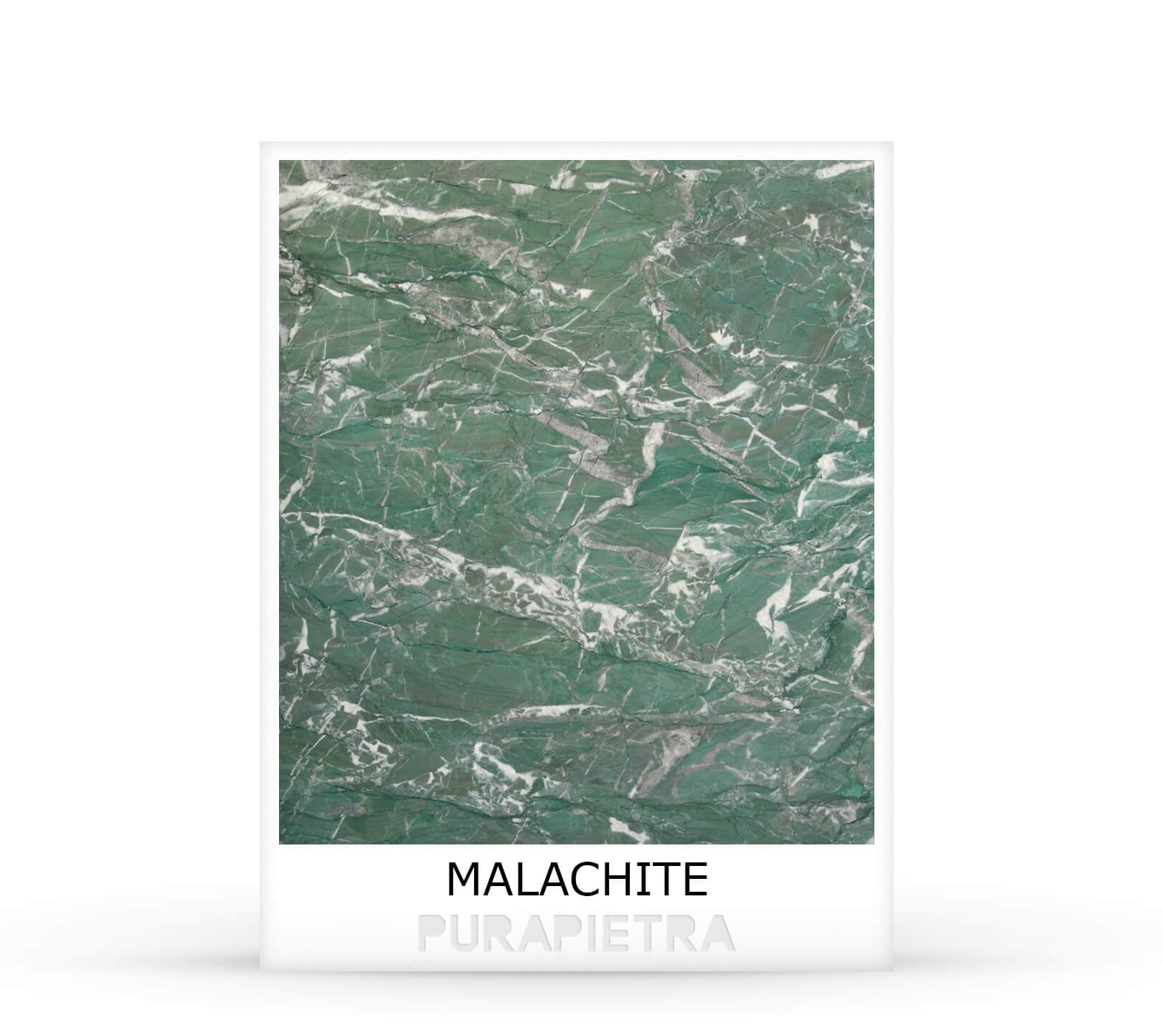
Malachite
Named for the mineral it echoes, Malachite is the most jewel-like green we offer. A saturated deep green ground is crossed by white and pale-green veining that swirls rather than runs straight, so the slab reads as pattern as much as colour. It behaves like a precious material rather than a building one, and it is best used that way: a single tabletop, an inlay, a small vanity, a run of objects. Give it one place to be extraordinary and everything around it can stay quiet.
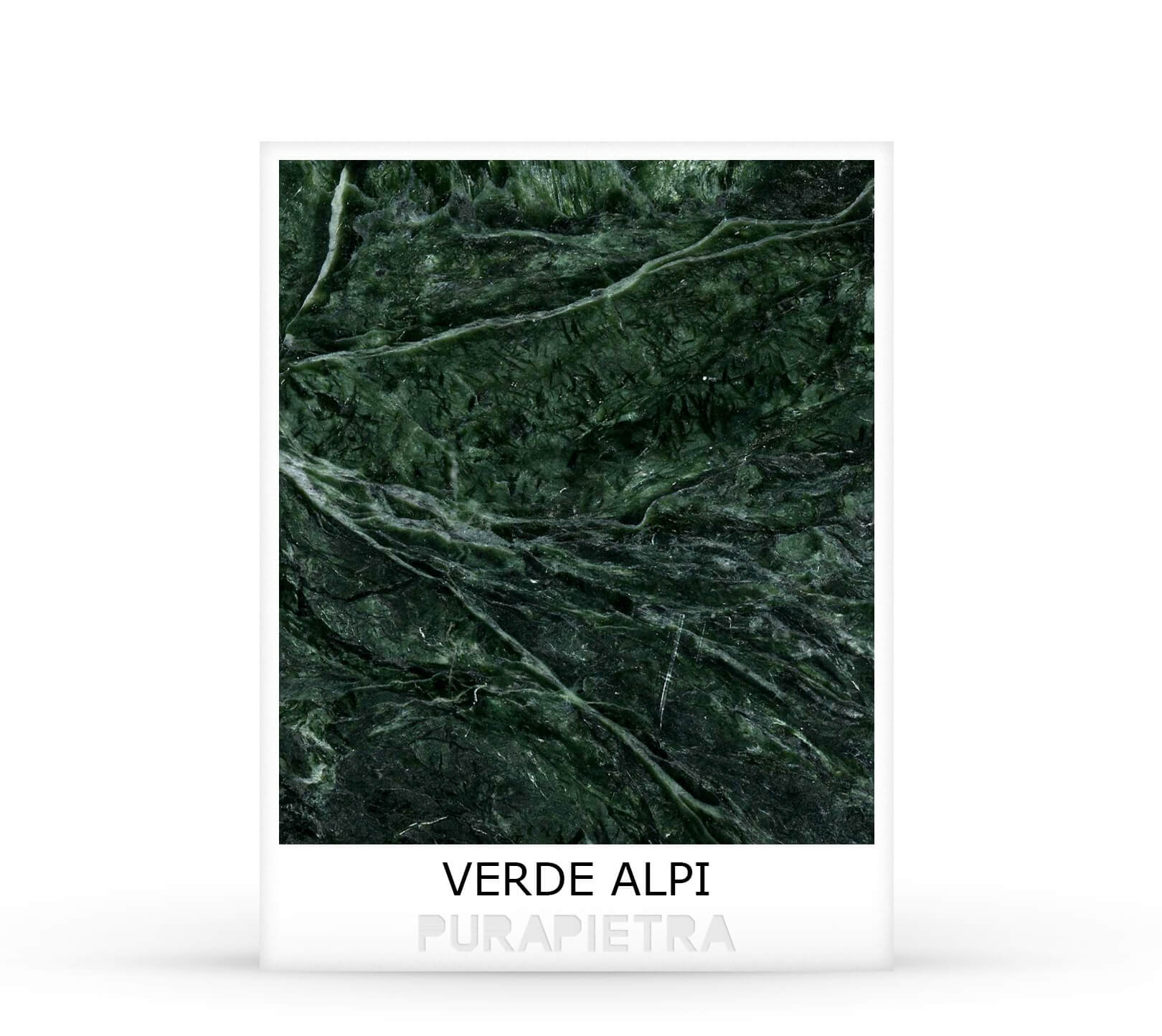
Verde Alpi
The classic Italian green, quarried in the Alpine valleys of the north-west. Verde Alpi is a dark bottle green threaded with a fine white network of veins, and it has a long history in Italian architecture, from church floors to the lobbies of mid-century palazzi. It is harder and denser than most marbles because it is a serpentinite, which makes it one of the more practical greens for surfaces that see daily life. Bookmatched, its white veining opens into a symmetrical pattern that carries a whole wall.
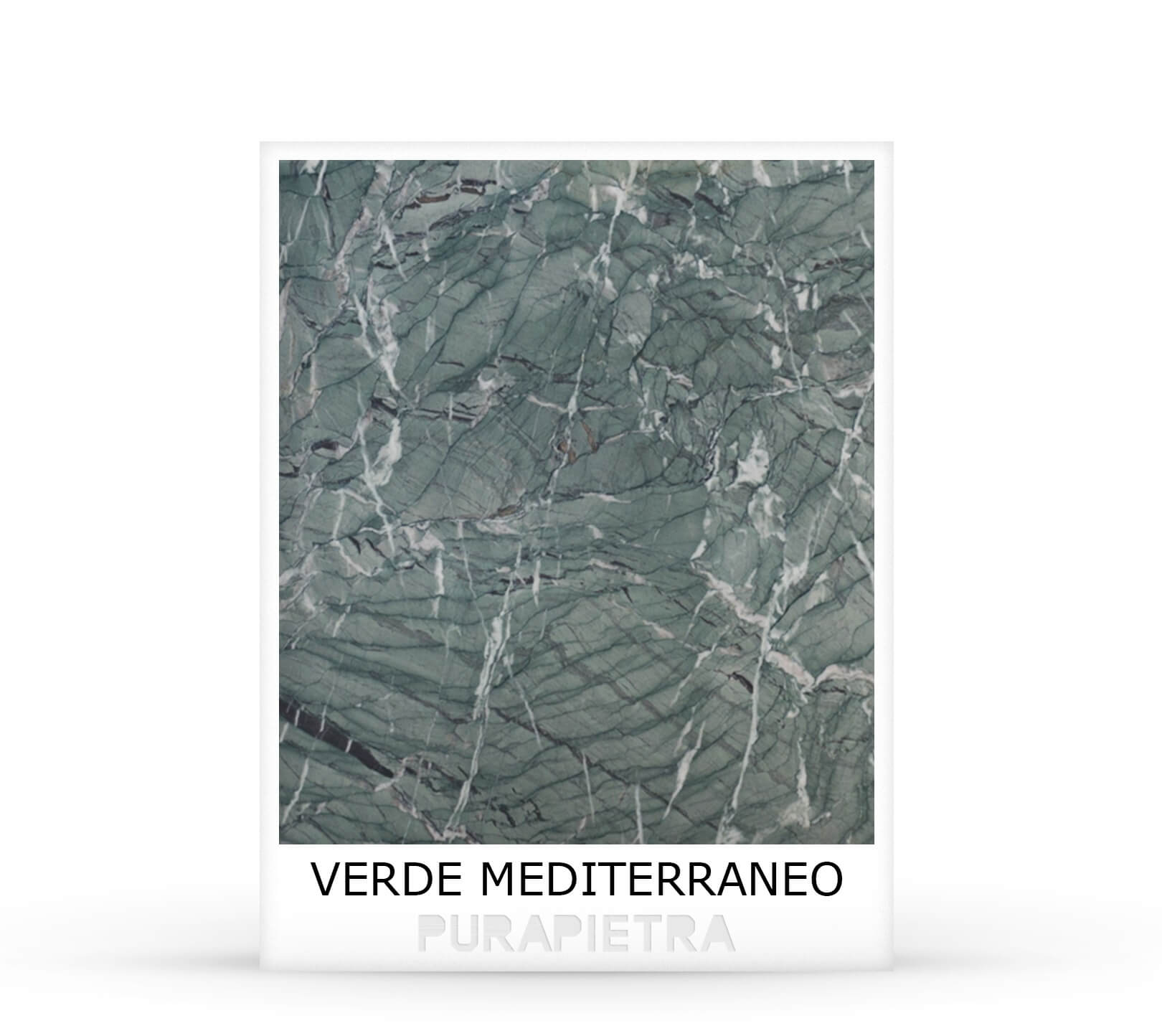
Verde Mediterraneo
The most relaxed of the four. Verde Mediterraneo is a softer, greyer green, closer to sage and olive than to bottle, with gentle veining and a calmer overall movement. Because it sits so near a neutral, it is the green you can use across a larger area without the room becoming loud: a stretch of bathroom cladding, a kitchen island, a fireplace surround that reveals itself slowly. This is the stone for people who want the colour without the declaration.
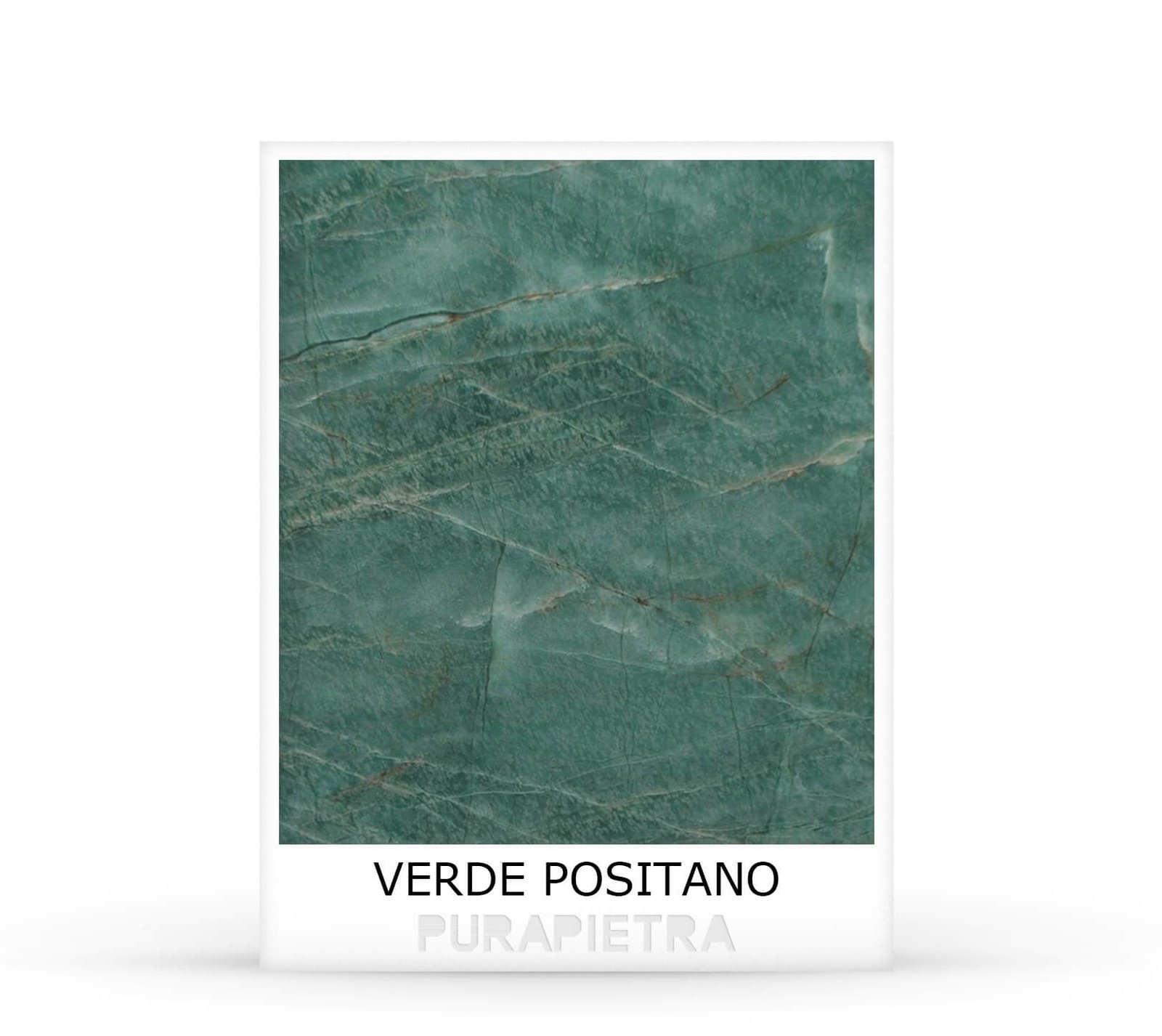
Verde Positano
The darkest and most dramatic green in the collection. Verde Positano has an almost black-green ground broken by bold veining, and it has the same effect as a very deep stone in any colour: it makes a surface feel weighty and expensive. It works best where you want one element of a project to anchor everything else, a console, a bar front, a bathroom feature wall. Pair it with light and it comes alive; sink it into a dark room and it turns quietly luxurious.
Where to use green marble in interiors
Green is the colour that connects an interior to the natural world, which is why it feels so at home in rooms meant to be restful. Bathrooms take it beautifully. A Verde Mediterraneo vanity with a carved freestanding stone basin gives you something calm and slightly botanical without the usual beige, and a Verde Alpi shower wall reads as timeless rather than trend-led. Green also flatters brass and warm timber, so it slots into both classical and contemporary bathrooms without a fight.
In the kitchen, green is the natural counterpoint to wood and to warm metals. A Verde Alpi island against pale oak, or a Malachite splashback behind a run of walnut, is a richer and more considered pairing than the marble-and-brass default. The denser serpentine greens hold up better than a soft white under daily use, which makes them a sensible choice for a surface that will actually be cooked on. Keep the perimeter simple and let the green be the event.
In living spaces, green does its best work in furniture and objects. A coffee table in Malachite, a console in Verde Positano, a shelf of vases and trays in the same stone: small pieces carry a strong colour further than square metres of it ever could. Our design collection exists partly for this, to put remarkable stone into a room at a scale that makes sense.

Pairing green marble
Green takes metal well, and the metal sets the mood. Brushed brass and aged gold warm it and push the scheme toward the classical and the decorative, which suits Malachite and Verde Alpi. Blackened steel and dark bronze keep it moody and architectural, which is where Verde Positano wants to be. Nickel and chrome cool the whole thing down and read more contemporary, a good match for Verde Mediterraneo. Copper is the one to test rather than assume; against the right green it is gorgeous, against the wrong one it turns muddy.
For woods, warm species are the reliable contrast. Oak, walnut and teak give the green something to sit against and echo its natural feeling. If you are combining stones, green is happiest next to a calm neutral. A green island in a room of white marble reads as deliberate and fresh, while green against another strong colour usually reads as noise. Deep greens such as Verde Positano also sit well beside our black marble for a darker, more enveloping scheme, and the greyer grey marble family shares Verde Mediterraneo’s cool temperament.
Care and durability
Green marble needs the same basic care as any marble, with one useful difference. The serpentine-based greens like Verde Alpi are harder and less porous than a soft white, so they resist scratching and staining better. But they are still calcite and silicate stones, which means acids can still etch a polished surface: lemon, vinegar, wine and most limescale removers will leave a dull mark. Seal the stone on installation, reseal every year or two depending on use, wipe spills promptly, and clean with pH-neutral products only.
Finish matters here as much as material. Dark and saturated greens show etching more clearly than pale ones, so a dull ring is more visible on Verde Positano or Malachite than on Verde Mediterraneo. For any green surface that will be used rather than admired, a honed finish is the smart choice: it removes the reflective layer that makes etch marks obvious and gives the stone a matte, almost velvet depth. Save the polish for vertical panels and objects, where the colour can shine without the wear.
Finishes: how the surface changes the colour
Finish changes green marble more than it changes a neutral stone. Polished, the green deepens and gains a wet, saturated intensity, which is how Malachite and Verde Positano look in the photographs that make people want them. Honed, the same slab lightens by a visible degree and turns matte and soft, which reads more contemporary and hides wear far better. Leathered or brushed adds a fine texture that catches light unevenly and gives the stone a hand-worked, less industrial character.
The consequence is that variety and finish cannot be chosen separately. A honed Verde Alpi and a polished Verde Alpi are, for design purposes, two different materials. Ask to see the same stone in both before you decide, and look at it in the light of the room where it will live rather than under a showroom’s spotlights.
How to choose the right green marble
Start with how loud you want the room to be. If the stone should sit in a scheme without dominating it, Verde Mediterraneo is the answer, since it behaves almost like a sage-toned neutral. If you want one surface people remember, Verde Positano or a bookmatched Verde Alpi will do it. If the point is luxury at a small scale, Malachite, used like the jewel it resembles.
Then check the practical constraints early. Confirm block availability before you commit to a design, because the more dramatic greens come out of the ground in limited numbers. Confirm the slab dimensions against your layout, since heavily veined stones are chosen for pattern and are not endlessly repeatable. And confirm the finish on a physical sample, in your own light, at the time of day the room is actually used.
The whole family is on our materials page. Once you have narrowed it to one or two, ask for a sample. Green changes more between the photograph and the room than most people expect, and no screen has ever reproduced the depth of a polished Malachite in daylight.
How much does green marble cost?
Green marble sits across a wide price range, and the variety matters more than the colour itself. The serpentine greens such as Verde Alpi are quarried in reasonable quantities and priced in line with a mid-range Italian marble, while a heavily figured Malachite or a deep Verde Positano climbs quickly because the good blocks are rare and the slabs are chosen for pattern. As a rule, expect green marble to cost more than a standard white and less than a semi-precious blue, with the exact figure driven by block availability, slab size and finish. Fabrication adds to the total: bookmatching, curved edges and carved basins all take time, and green’s natural movement means more slabs are set aside during selection.
The honest way to budget is to treat green marble as a feature material and price the surface rather than the square metre. A single Malachite tabletop or a Verde Alpi vanity delivers most of the impact for a fraction of the cost of cladding a whole room, which is exactly how we tend to use it. Ask for a quotation against a specific slab rather than a generic rate, because two blocks of the same green marble can differ in price as much as they differ in beauty.
A short history of green marble
Green marble has decorated important buildings for two thousand years. The Romans prized a green serpentine they called Verde Antico, cut from Greek and Alpine quarries and set into the floors of temples and palaces. Renaissance and Baroque architects returned to it for altars, columns and inlays, and the deep greens of the Italian Alps lined the grand interiors of the nineteenth and twentieth centuries. When you specify green marble today you join a long line of builders who reached for the same colour to signal permanence and craft.
That history is part of why green still reads as considered rather than trendy. It has never really left use, only moved in and out of fashion, and a green marble surface carries a little of that association indoors: the colour of nature, growth and calm. In a world of grey kitchens and beige bathrooms, choosing green marble is a quiet signal that the room was designed by someone with a point of view. It is a colour that rewards patience: live with a sample for a few days, watch how the green shifts from morning light to lamplight, and the right stone will make itself obvious long before you have finished deciding.
Related reading
Keep exploring the Purapietra magazine: our pillar guides to white marble, black marble, grey marble and blue marble, plus the complete guide to the types of Italian marble. Browse every stone on the materials page, or bring the material home through our design collection. See also the comparison of Italian vs imported marble.
Frequently asked questions
What is green marble?
Green marble is natural stone whose colour ranges from soft sage through bottle green to near-black. The tone comes from minerals present when the stone formed, mainly serpentine, chlorite and related silicates. Several stones sold as green marble are serpentinites or ophicalcites rather than pure calcite marbles, which is why their colour runs so deep.
Is green marble durable enough for a kitchen?
Often yes. The serpentine-based greens such as Verde Alpi are harder and less porous than a soft white marble, which makes them more resistant to scratching and staining on worktops and islands. They should still be sealed and cleaned with pH-neutral products, and a honed finish is preferable to polished for surfaces in daily use.
Can green marble be used in a bathroom?
Yes, and bathrooms are one of its best uses. Green feels calm and slightly botanical, and it flatters both brass and warm timber. Use a honed finish in wet areas because it hides etching and watermarks, seal the stone on installation, and reseal periodically.
What is the difference between Verde Alpi and Malachite?
Verde Alpi is a classic Italian serpentinite: a dark bottle green with a fine white network of veins, hard and practical enough for surfaces. Malachite is a deeper, more jewel-like green with swirling white veining, best treated as a feature material for tabletops, inlays and objects rather than large worked surfaces.
What colours go with green marble?
Warm woods such as oak and walnut, warm metals such as brass for a classical mood, or blackened steel and nickel for a cooler, more contemporary one. Green also sits well against calm neutrals, especially white and grey marble. Avoid pairing it with another saturated colour unless the contrast is the whole idea.