
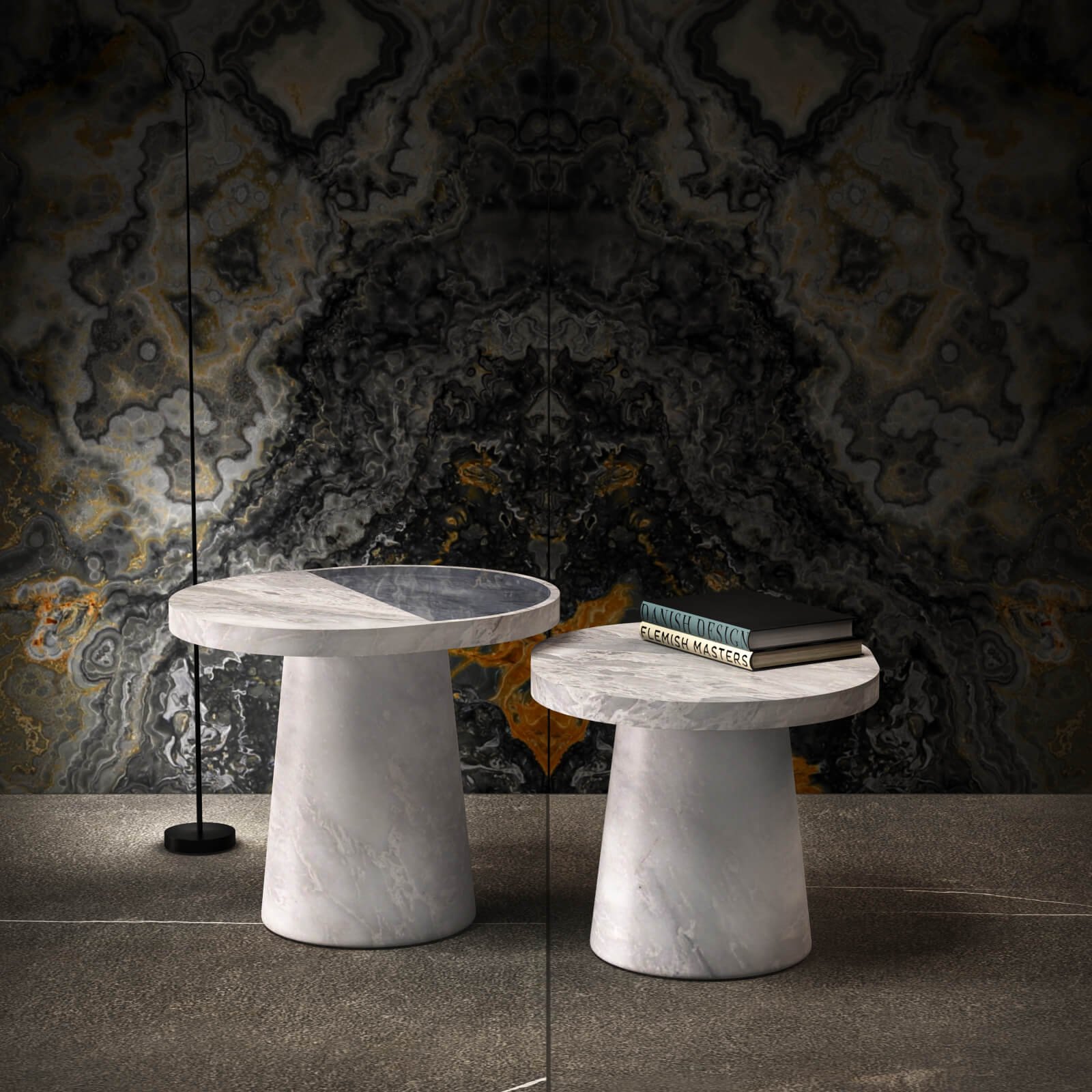
Marble is cold, heavy and quiet. Metal is sharp, light and bright. Put them side by side and each makes the other look more like itself, which is why a thin line of brass across a white stone, or a steel frame around a black slab, can do more for a room than another expensive surface.
This guide is about getting that pairing right: what brass, stainless steel and bronze each do next to stone, where metal belongs in a marble room, which combinations to avoid and how to care for both materials so that neither damages the other. We also say where the pairing goes wrong, because it does, and usually in the same few ways.
Why marble and metal work together
The pairing works because the two materials disagree about almost everything. Marble is mineral and matt or soft-glossy, with a pattern that never repeats. Metal is manufactured, hard-edged and consistent. Marble absorbs light a little and scatters it, while polished metal throws it back in a line. When you set a precise metal edge against a natural, irregular stone, the eye reads one as crafted and the other as found, and the room gets more interesting for it.
There is a second reason, which is practical. A stone surface needs something to define its edges, to hold it, to light it or to let you operate it: a frame, a tap, a leg, a handle, a lamp. Metal does those jobs without competing with the stone’s pattern, which is why it is the natural partner. Our wider guide to pairing marble with other materials covers the full list of partners, and our guide to marble and wood covers the warm alternative. This article is the sharper, cooler one.
Brass, steel and bronze: what each one does
The metal you choose changes the mood of the room more than most people expect, so it is worth treating the three main options as three different characters.
Brass
Brass is an alloy of copper and zinc, and its colour runs from pale gold to a deeper, redder yellow. It is the warmest of the common choices and the classic partner for stone with warm undertones: cream, beige, honey and the golden veining in some white marbles. It is also very good against black, where it glows. Our guide to Nero Markina describes a black stone with fine white veins, and brass is a pairing worth testing against that kind of surface.
Brass comes in two kinds, and you should choose on purpose. Lacquered brass keeps its bright colour for years. Unlacquered brass reacts with air and hands, and over time it darkens and softens to a brown patina. Some people love this and some find it messy. Decide before you order, because you cannot easily go back.
Stainless steel
Stainless steel is cool, neutral and almost silent. It suits white and grey stones, and any room where you want the marble to be the only thing with personality. Brushed steel hides fingerprints and small scratches well, and polished steel reads almost like a mirror line. It is also the most forgiving metal to live with: it resists rust and does not need regular polishing, which matters in a bathroom or a kitchen.
Bronze
Bronze is traditionally an alloy of copper and tin, and in interiors it usually means a deep brown, slightly warm metal with a soft sheen. It is the quietest of the warm options, less showy than brass, and it is lovely against dark stone, grey stone and the darker brown and green marbles. Like unlacquered brass, bronze changes with age, and it tends to settle into a richer, darker tone.
Chrome, nickel and black metal
Chrome is the brightest and coldest option. It looks sharp against a white stone and a little hard against a warm one. Nickel is softer and slightly warmer. Black or blackened metal, on the other hand, works best with pale stones: against a dark marble it vanishes, which can be exactly what you want and is usually a missed opportunity.
How to match the metal to the stone
Rather than choose a metal and hope, look at the undertone of the stone first. It is the quickest way to get a pairing that looks deliberate.
Warm stone, warm metal. Cream, beige, honey and stones with golden or brown veining sit naturally with brass and bronze. Calacatta Borghini, with its long grey and warm bands, has enough of both to take either a warm or a cool metal, and the choice then becomes a mood: brass for glow, steel for restraint.
Cool stone, cool metal. White and grey stones with blue or grey veining look clean with steel, chrome or nickel. Brass against them can look yellow, especially in cool daylight.
Dark stone, either one. Black marble is the most flexible partner. Brass gives it warmth and drama, steel gives it a modern, graphic edge. Kenya Black, with its flowing charcoal bands, takes a muted metal best, because the stone already has its own movement and a loud metal would fight it.
Translucent stone, restraint. A glowing stone such as Ivory Onix is the centre of attention when it is lit from behind, so keep the metal thin and the finish matt. If you want the stone to be the star, let the metal be the frame.
Where to use metal in a marble room
Taps and fittings
This is the simplest and most common use, and it is where choosing well matters most, because you touch it every day. A slim tap next to a carved basin lets the shape of the stone do the talking. Our Linear basin and the Unit Sink are good examples of carved pieces where a thin, quiet fitting is all the stone needs.

Inlays and edge lines
A narrow strip of brass or steel set into a stone floor or a table top is one of the cleanest ways to add metal. It defines a border, hides a joint or separates two stones, and it adds almost no visual weight. It also asks for good workmanship, because the edge has to be cut and set with precision. This is the kind of detail that is hard to fake and easy to see.
Table bases, frames and legs
A stone top on a slim metal base makes the stone look lighter, almost as if it were floating. It is the usual solution for a dining or coffee table when you want the top to be the main feature. For the opposite effect, a heavy carved base such as the one on Groove makes the stone look monumental. Both are valid, and they say different things. Our Tato table is another stone-led piece worth looking at for proportions.
Lighting, shelves and handles
Lamps, wall lights, shelf brackets and cabinet handles are small but they repeat across a room, so they set the metal tone. If you choose brass for one, choose it for the others, and the stone in between will look as if it were chosen with them in mind.
Mirrors, trays and objects
Metal does not have to be fixed. A metal-framed mirror above a stone vanity, or a stone tray with a metal object on it, adds the contrast without any installation, and you can change your mind later. It is the best way to test a pairing before you commit to it in the building. Stone vases next to metal candlesticks or a brass bowl work the same way.
What to avoid
Too many metals. One metal is usually enough, and two is the limit. A warm brass and a cool steel can work together if one is clearly the main character and the other appears briefly. Three finishes in a single room look like a showroom.
Polished chrome beside polished black stone. Both show fingerprints, water spots and dust, and together they need cleaning every day. If you like the look, choose a brushed or satin finish for one of them.
Plain iron or carbon steel. It is the one pairing we advise against. Ordinary steel rusts when it gets wet, and rust leaves a brown stain on marble that is difficult to remove. If a piece is likely to be wet, use stainless steel, brass or bronze, or a metal with a sealed or coated finish.
Copper-bearing metals left damp on pale marble. Brass and bronze both contain copper. If damp residue sits against a pale stone for a long time, it can leave a faint green or brown mark. This is rare with a good installation and a dry habit, but it is one more reason to seal the stone and to wipe the area around a tap.
Caring for marble and metal together
The two materials need opposite care, and that is the main trap. Marble is a calcium carbonate stone and it etches when acid sits on it. Many metal polishes, and the home remedies people use on brass, contain acid or abrasive. If you polish a brass handle next to a marble surface, mask the stone first, and wipe up any splash at once.
For the stone, seal it at installation and again from time to time, clean with a pH-neutral stone product, and use a soft cloth. Our guide to how long marble lasts explains what to expect over the years. For the metal, follow the maker’s advice: lacquered brass wants a soft cloth and nothing abrasive, stainless steel wants a damp cloth and a dry one after, and unlacquered brass or bronze can simply be left to age if you like the patina.
Marble and metal in practice
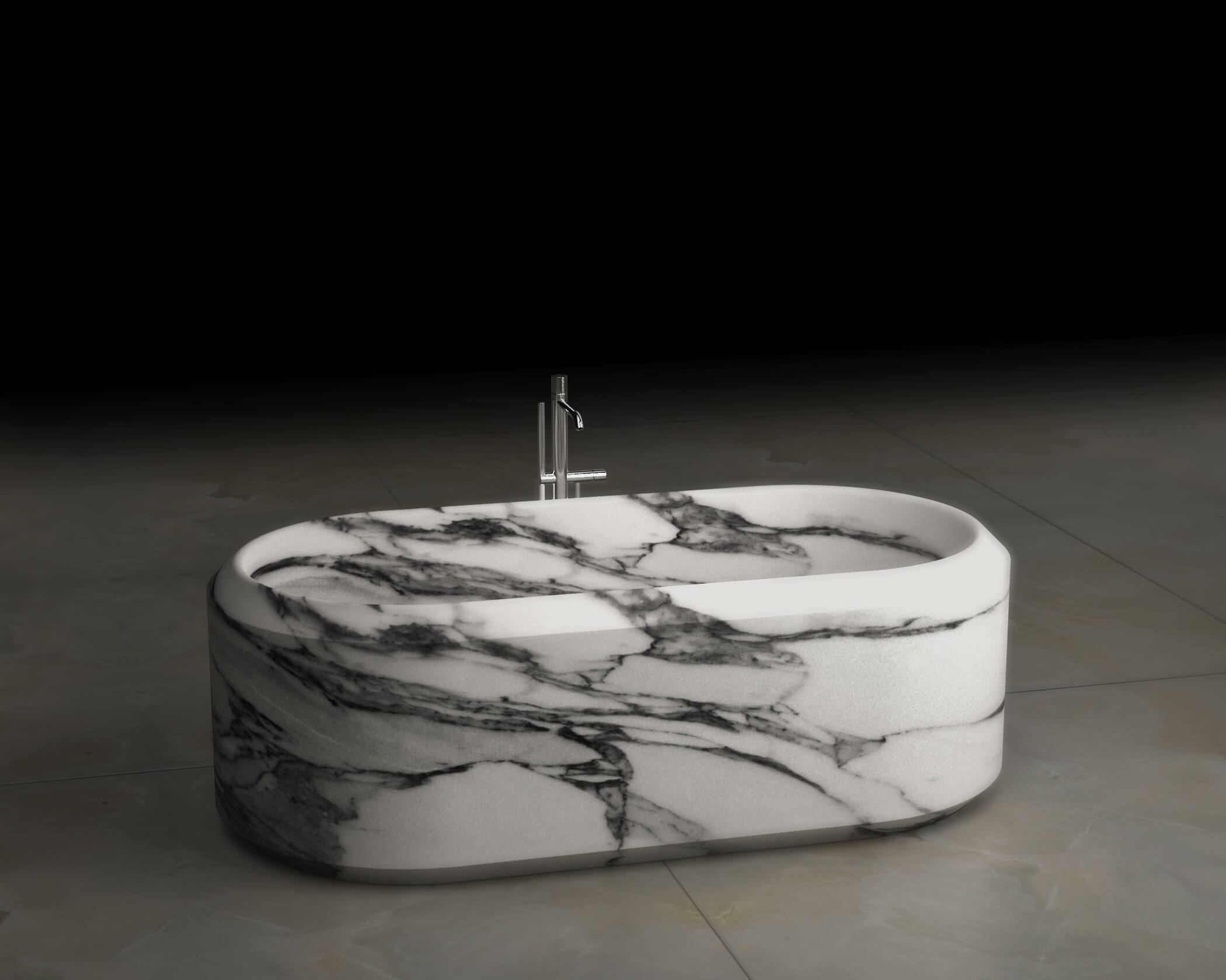
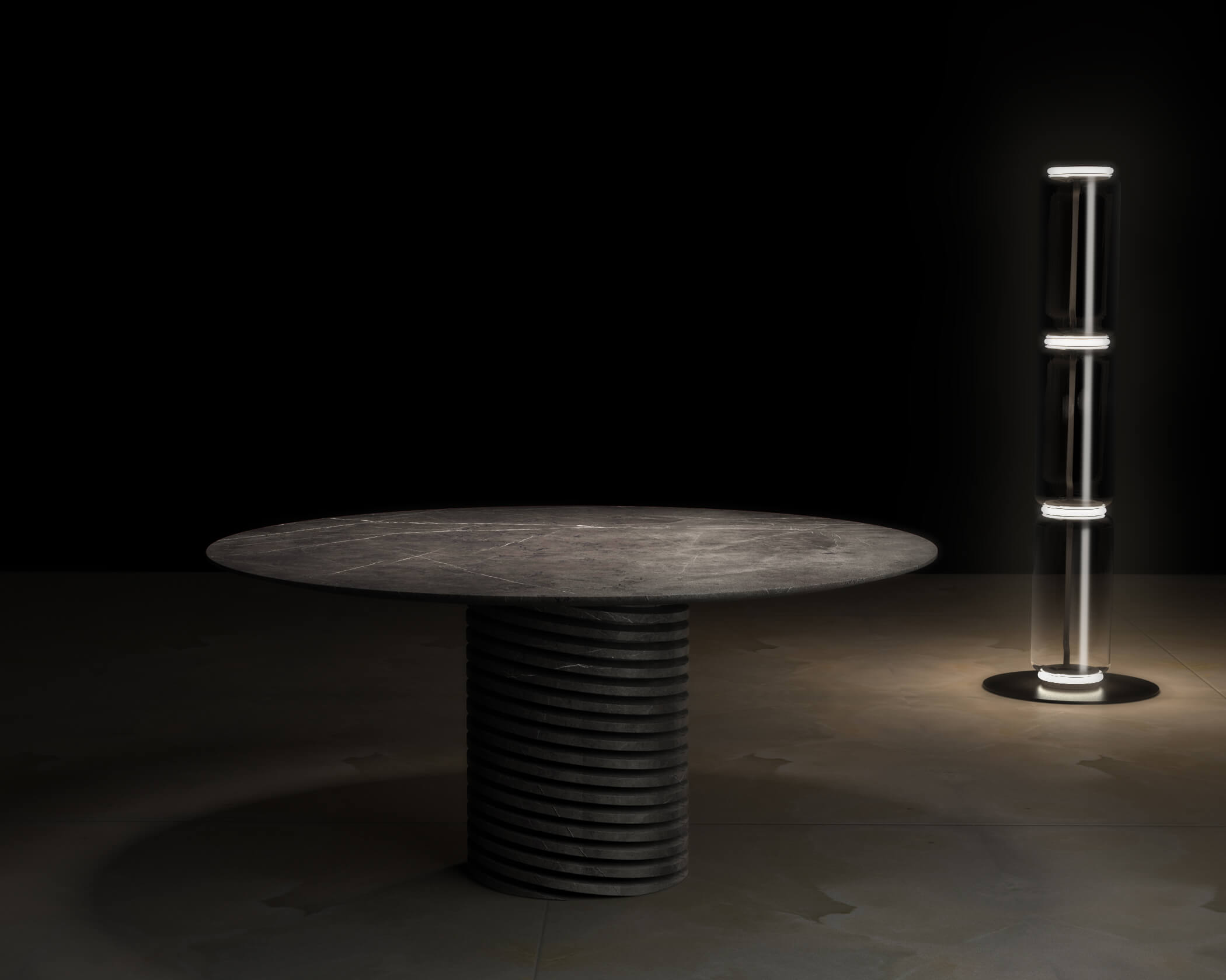
Three photographs from our catalogue show the idea in the plainest way. In the Unit Bath photograph, a pale stone with dark veining stands in a black room, and the only other element is a thin metal tap: the room has one stone, one metal and one dark ground. The Linear photograph does the same with a single vertical tap. And the Groove table, in a dark stone with fine pale veins, shows what happens when a stone object is placed next to a glass and metal floor lamp: the lamp’s slim structure frames the table without competing with it.
If you want to see how this works in a finished project, our projects page shows stone in real rooms, and our guide to black marble interiors and marble interiors discuss how dark and light stones sit with other materials in the room.
Marble and metal with Purapietra
We treat stone as a building material, not a skin. Every piece is roughed on CNC for accuracy and finished by hand, so a detail such as an inlay or a recess is cut to the drawing. If you want an inlay, a recess for a fitting or a stone top made to fit a metal base, our page on bespoke marble explains how we work, and the materials catalogue shows the stones you can choose from. Send us a plan, a sketch or a photo of the room and we will tell you what the pairing can do there and roughly what it will cost.
Frequently asked questions about marble and metal
Which metal goes best with marble?
It depends on the stone’s undertone. Brass and bronze suit warm and dark stones, stainless steel and chrome suit white and grey stones. Black marble works with either, and the choice is a matter of mood.
Does brass go with white marble?
Yes. It is a classic pairing, especially with white marble that has warm or golden veining. Against a cool, blue-grey white, brass can look yellow, so check the pairing in the room’s actual light.
Can metal damage marble?
Ordinary iron or carbon steel can rust and leave brown stains, and copper-bearing metals can leave a faint mark if damp residue sits on pale stone for a long time. Stainless steel, a good installation and a dry habit avoid most problems.
Can I use metal polish near marble?
Be careful. Many metal polishes contain acid or abrasive that can dull a marble surface. Mask the stone before polishing a nearby metal piece, and wipe up any splash at once.
How many metals should I use in one room?
One is usually enough and two is the limit. If you use two, make one the main character and the other a small accent.
Is brushed or polished metal better with marble?
Brushed or satin finishes are easier to live with and hide marks, and they sit calmly next to a polished stone. Polished metal gives a sharper contrast and needs more cleaning.
Do I need to seal marble next to a metal fitting?
Yes, we recommend sealing marble in any area where it meets water or a fitting, and wiping the area around a tap dry. It protects the stone from both stains and etching.