
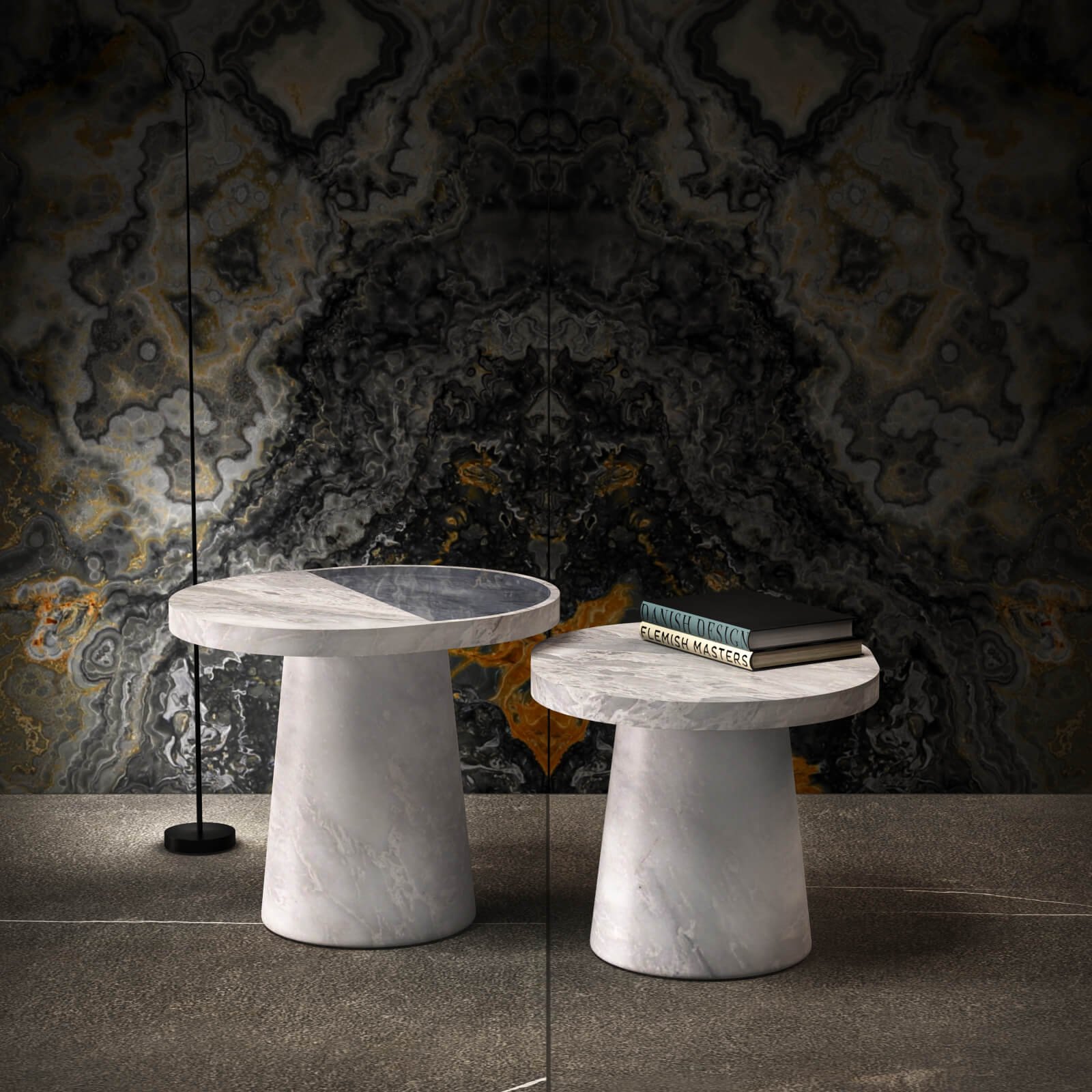
Marble and wood is the pairing nobody has to be talked into. One is cool, dense and still. The other is warm, soft to the touch and visibly alive. Put them next to each other and each one makes the other look better. But “works in most houses” is not the same as “works by itself”, and the difference between a calm room and a confused one is almost always in the details: undertone, finish and grain.
This guide goes further than the usual advice to put a walnut table next to a white wall. It explains why the combination works, how to match a stone to a timber, what to do about grain and veining when both are strong, how to use the pairing room by room, and the mistakes we see most often. If you want the wider picture first, our guide to pairing marble with other materials covers wood, metal, glass and other stones in one place.
Why marble and wood work together
Marble is a metamorphic rock. It is cold to the hand, heavy and, once polished, reflective. Wood is organic. It is warm, slightly soft, absorbs light instead of returning it and changes over the years. In a room where everything is stone, the space feels hard. In a room where everything is timber, it can feel closed and a little ordinary. Mix them and each corrects the other.
There is also a visual reason. Both materials have a pattern, but a different kind. Marble has veining, which is irregular and runs through the whole stone. Wood has grain, which is directional and follows the growth of the tree. Because they are different, they can sit together without repeating each other, as long as you manage how much of each pattern the eye has to take in. For a plain-language definition of the rock itself, Wikipedia’s page on marble is a clear primer.
Step one: match the undertone
The single most useful habit is to look at the undertone of the stone before choosing a timber. Marble is rarely a pure colour. A white can lean cool and blue-grey, or warm and cream. A black can be neutral or slightly brown. A grey can carry green or pink. Timber has the same range: oak runs from pale and yellow to honey, walnut from chocolate to nearly black with a purple note.
The rule we use is to let the warm and cool balance fall on one side. A warm cream stone, such as Ivory Onix, sits naturally beside honey oak and ash. A cooler white with grey veining, the kind covered in our guide to Carrara and Statuario, suits a mid-brown walnut that supplies the warmth the stone lacks. A dark stone takes a rich, dark timber. Put a cool grey marble against a yellow pine and the pair will look wrong, even if you cannot say why.
Take both samples to the same window, in the same light, and look at them together at the time of day the room is used most. A sample in a showroom under spotlights tells you very little.
Step two: choose the wood by character
Oak and ash
Pale, open-grained and easy. Oak, particularly when oiled, suits white and cream stones and keeps a room light. Ash is paler and straighter in grain, and it is a good choice when you want the timber to recede. Both are forgiving, and both will take a honed marble well.
Walnut
Richer and darker, with a visible grain that gives a room depth. Walnut is the timber we reach for most often with pale marble that has strong grey veining, because it supplies contrast and warmth in one move. With dark stone it creates a deep, enveloping scheme. Our guide to black marble interiors describes mid and dark woods as the most forgiving pairing for black stone, and that holds across the range.
Pale and lightly stained timbers
Pale timbers suit a Scandinavian or Japanese feel and let the stone take the lead. The risk is a room that goes flat, with nothing to anchor it. Add one dark element, a black frame or a dark stone table, to give the eye somewhere to rest.
Woods to approach with care
Strongly coloured timbers, such as cherry or a heavily red-stained wood, rarely sit comfortably with cool marble. High-gloss, lacquered timber beside polished stone can look like the lobby of a hotel. If you love a bold timber, give it a plain, honed stone and leave the veining quiet.
Step three: pair the finishes
Finish matters as much as colour. As a rule, match the sheen. A honed or matt marble sits best with an oiled or waxed timber, because neither shines and the room feels calm. A polished marble can take a satin timber, but a lacquered one will compete with it for reflections. If you want both to be glossy, keep the area small, such as a tray or a table top, rather than covering a whole room in shine.
Texture can help. A honed stone next to a brushed or lightly textured timber gives the hand something to notice. A rough, wire-brushed oak beside a polished stone gives you contrast that feels deliberate rather than accidental.
Grain against veining: how to manage two patterns
This is the problem most guides skip. If you put a strongly veined marble next to a strongly grained timber, the eye has too much to read. Choose one to lead. If the stone is dramatic, like Calacatta Viola with its strong colour and veining, pick a timber with a quiet, even grain and a plain finish. If the timber is the star, a walnut with a prominent figure, pick a calm stone with soft veining.
Some stones already look like timber. Kenya Black, for example, has layered bands that flow like wood grain, so it pairs best with a plain timber rather than a heavily figured one. The same logic applies to travertine, whose horizontal banding has its own rhythm, and which we cover in our guide to travertine.
Marble and wood room by room
Kitchens
The classic is a marble island with oak floors, or a stone splashback with timber cabinets. Wood keeps a large marble surface from feeling clinical, and marble gives timber cabinets a cleaner edge. Keep the number of finishes down: two surfaces plus metal is plenty. Our guide to marble in the kitchen covers the stone side, including the realistic care a worktop needs.
Bathrooms
A timber vanity under a stone wall is a combination that rarely dates. The stone handles the water, the wood adds warmth to a room that otherwise feels hard. The catch is moisture. Timber in a bathroom needs to be specified for damp conditions and properly sealed, and it should not be placed where water sits. Let the marble have the wet areas, and use the timber for the dry ones: a shelf, a stool, a vanity drawer front. A carved piece such as the Unit Bath or the Linear basin looks very good beside a plain timber wall.
Living and dining rooms
This is where the pairing is easiest. A stone table with timber chairs, a stone coffee table on a timber floor, a marble fireplace with an oak mantel shelf. A table such as Groove or the Tato tables sit well on timber because the floor supplies the warmth and the stone supplies the weight. Keep the timber of the floor and the furniture in the same family, and let one piece of stone act as the anchor.
Floors and walls
If you are combining stone and timber on the floor, for example a marble entrance meeting an oak living room, think about the junction. A clean metal or stone threshold works better than a thin gap. Heights should match, and the two materials expand and move differently, so this is a job for an installer who has done it before. Our guide to marble flooring explains what to ask. On walls, a stone feature surface framed by timber panelling can be beautiful, and marble wall cladding is the place to read about fixing and joints.
Proportions: how much of each
A simple balance is to let one material lead and the other support. If marble is the lead, it takes the large surfaces, such as a wall, an island or a floor, and the timber appears as furniture, shelving and detail. If timber leads, with a wood floor and cabinets, the marble comes in as one statement piece. Equal amounts of both usually look indecisive. And whatever you choose, a third element, whether metal, glass or textile, helps to tie the two together.
Mistakes to avoid
Matching exactly. A timber that is the same colour as the stone looks like a mistake. The point is to complement, not to copy.
Choosing from small samples in the wrong light. Both stone and timber change under different light. Look at both together, in the room, at the right time of day.
Too many finishes. Polished stone, lacquered timber, shiny metal and glass all competing. Pick the sheen of the room and stay close to it.
Putting untreated timber in wet places. Marble copes with water far better than most timbers. Specify the right wood and finish, or keep it away from the splash zone.
Forgetting the junction. The line where stone meets timber is the part that gets looked at closely. Plan it on the drawing, not on site.
Caring for marble and wood side by side
The two materials need different care, which is worth remembering when you plan the room. Marble is sealed on installation and cleaned with a pH-neutral stone product, never with acids or abrasives. Timber is cleaned with products suited to its finish, and it should not be soaked. Never use a general-purpose spray across both surfaces. Our guide to how long marble lasts explains the stone side in more detail.
Working with Purapietra on a stone and wood scheme
We make stone, and we are happy to work around the timber you already have. Send us a photo of the room, the sample of the wood or the drawing from your joiner, and we will suggest which stone and finish sits well with it. If the piece has to be made to measure, a table, a vanity top or a wall, our page on bespoke marble explains how that works. You can compare the stones themselves in the materials catalogue, and if you want to start from the broader picture, our guide to marble interiors is a good place to begin.
Frequently asked questions about marble and wood
Does marble go with wood?
Yes. Marble is cool and dense, wood is warm and soft, and each balances the other. The pairing works best when the undertones are matched and one of the two leads.
Which wood goes best with white marble?
Oak and ash suit warm and cream whites and keep a room light. Walnut suits a cooler white with grey veining, because it supplies warmth and contrast.
Which wood goes best with black marble?
Mid and dark woods, such as walnut and oiled oak, are the most forgiving. They share the warmth of the stone without competing with it.
Should I match polished marble with polished wood?
Usually not. Match the sheen instead: honed marble with an oiled or matt timber, polished marble with a satin one. A lacquered timber next to polished stone tends to look overdone.
Can I use wood and marble in a bathroom?
Yes, with care. Let the marble take the wet areas and use timber for dry ones, specified for damp conditions and properly sealed.
What if both the marble and the wood have strong patterns?
Let one lead. Pair a dramatic, heavily veined stone with a timber that has a quiet, even grain, and the other way round.
Do marble and wood need different care?
Yes. Seal marble and clean it with a pH-neutral stone product. Clean timber with a product suited to its finish and avoid soaking it. Do not use one cleaner for both.