
Bespoke Marble: What Custom Stone Design Really Involves
Most marble in most homes is chosen, not designed: a slab picked from a catalogue, cut to a standard basin or a standard worktop. Bespoke marble is the other route, where the piece starts from a brief rather than a product sheet. It costs more, it takes longer, and it is not the right answer for every room. This is a guide to what “bespoke” actually means with natural stone, how a custom piece gets made, when the extra effort is worth it, and what the process looks like in practice.
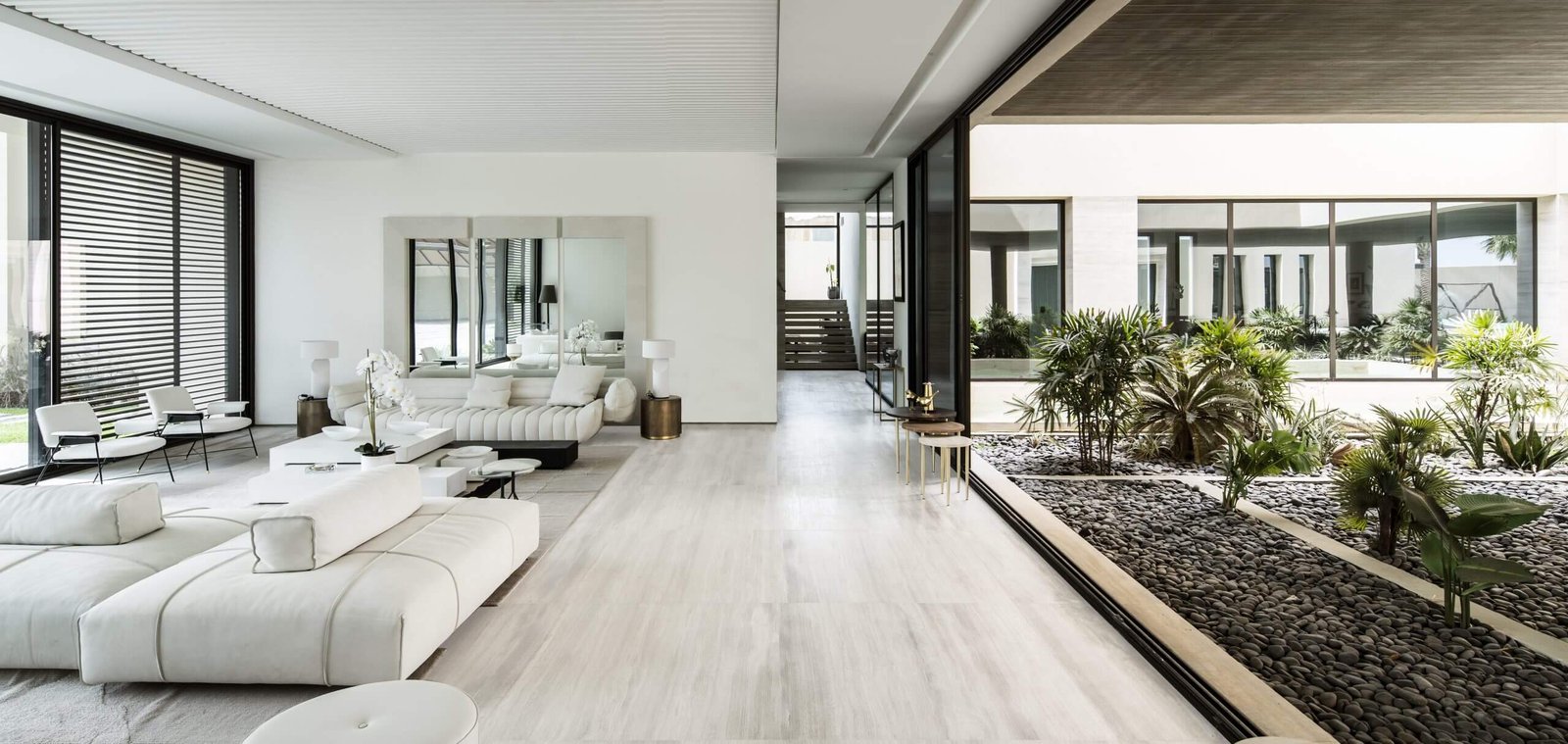
What “bespoke” actually means in stone
The word gets used loosely, so it is worth being precise. A bespoke marble piece is one designed for a specific space, a specific client, or a specific idea, from the ground up, rather than selected from an existing range and adapted at the edges. That can mean a basin carved to a dimension no catalogue offers, a table shaped around a column nobody else has to work around, or an entire bathroom conceived as one continuous gesture in a single block of stone.
It is a different proposition from customisation, which is choosing a finish, a size or a colour from a set of existing options. Customisation adjusts a product. Bespoke work starts with no product at all, only a brief, and the object that comes out the other end usually cannot be repeated, because the brief that produced it will not repeat either.
This is also why bespoke marble sits naturally with the material itself. Every block of natural stone is already unique before anyone touches it: the veining, the fragment pattern of a breccia, the exact grey of a slab are one-off facts of geology. A bespoke approach simply extends that uniqueness from the raw material into the finished piece, instead of cutting a standard shape out of a non-standard block and treating the two as unrelated.
From brief to object: how a bespoke piece gets made
The process starts with the room, not the stone. A designer or client brings a space, a use, and a set of constraints, sometimes a fixed footprint, sometimes an existing material palette, sometimes a single reference image that captures a feeling rather than a shape. Purapietra’s role at this stage is closer to listening than selling: understanding what the piece needs to do before proposing what it should be made from.
Material selection comes next, and it is rarely a simple colour choice. The right stone for a bespoke piece depends on the scale of the object, how it will be worked (a sink basin needs a stone that carves cleanly without fracturing at a thin edge; a large table top needs a block with enough consistent material to avoid a visible joint), and how it will live day to day. A stone chosen for a showpiece in a hallway can behave very differently from one chosen for a basin that gets used every morning.
Design and modelling follow, usually as sketches refined into a scale drawing or a 3D model, so that proportions, thickness and transitions can be agreed before a single cut is made into the block. This is the stage where a bespoke piece earns its cost: correcting a proportion on paper is free, correcting it in a carved slab is not.
Fabrication is where the craft becomes physical. CNC roughing gets a block close to its final form efficiently, but the character of a Purapietra piece, the rounded, sculptural edges the brand is known for, comes from hand finishing afterward: an artisan working the surface until the transitions read as continuous curves rather than machined facets. It is slower than a fully automated process, and it is also the part that cannot be substituted.
When bespoke marble is worth it, and when it isn’t
Bespoke work makes the most sense in a few recurring situations. A non-standard space, an awkward alcove, an unusual sink footprint, a specific ceiling height, is one, because a standard product either won’t fit or will fit badly. A signature moment in a project, the one piece a designer wants a client to remember, is another: a sculptural basin or a single carved table does more for a room’s identity than a matched suite of catalogue pieces ever will. And a genuinely rare material, a slab too small, too unusually patterned, or too precious to cut into standard sizes, often only makes sense as one deliberate object rather than several ordinary ones.
It is not always the right call. A guest bathroom, a rental property, or any space with a short-to-medium ownership horizon rarely justifies the cost and lead time of a bespoke piece when a well-chosen standard product will do the job at a fraction of the price and the wait. Bespoke marble rewards spaces where the piece is meant to last decades and where the extra investment compounds over that time, not spaces designed to be refreshed in five years.
Timelines and process: the practical side
A bespoke piece takes longer than a catalogue order at every stage, and it is worth planning for that rather than discovering it mid-project. Design and material selection typically run several weeks on their own, longer if the brief involves an unusual stone that needs sourcing. Fabrication, particularly the hand-finishing stage, adds real time on top of any CNC work: a rounded, sculptural edge cannot be rushed without it showing in the final surface.
Shipping and installation logistics matter more with bespoke pieces than with standard ones, because a one-off object often cannot simply be reordered if something goes wrong in transit or on site. For international projects, this usually means building extra lead time into the schedule specifically for the object’s journey, and confirming installation access, doorways, lift dimensions, stair turns, before a piece this heavy and this singular ever leaves the workshop.
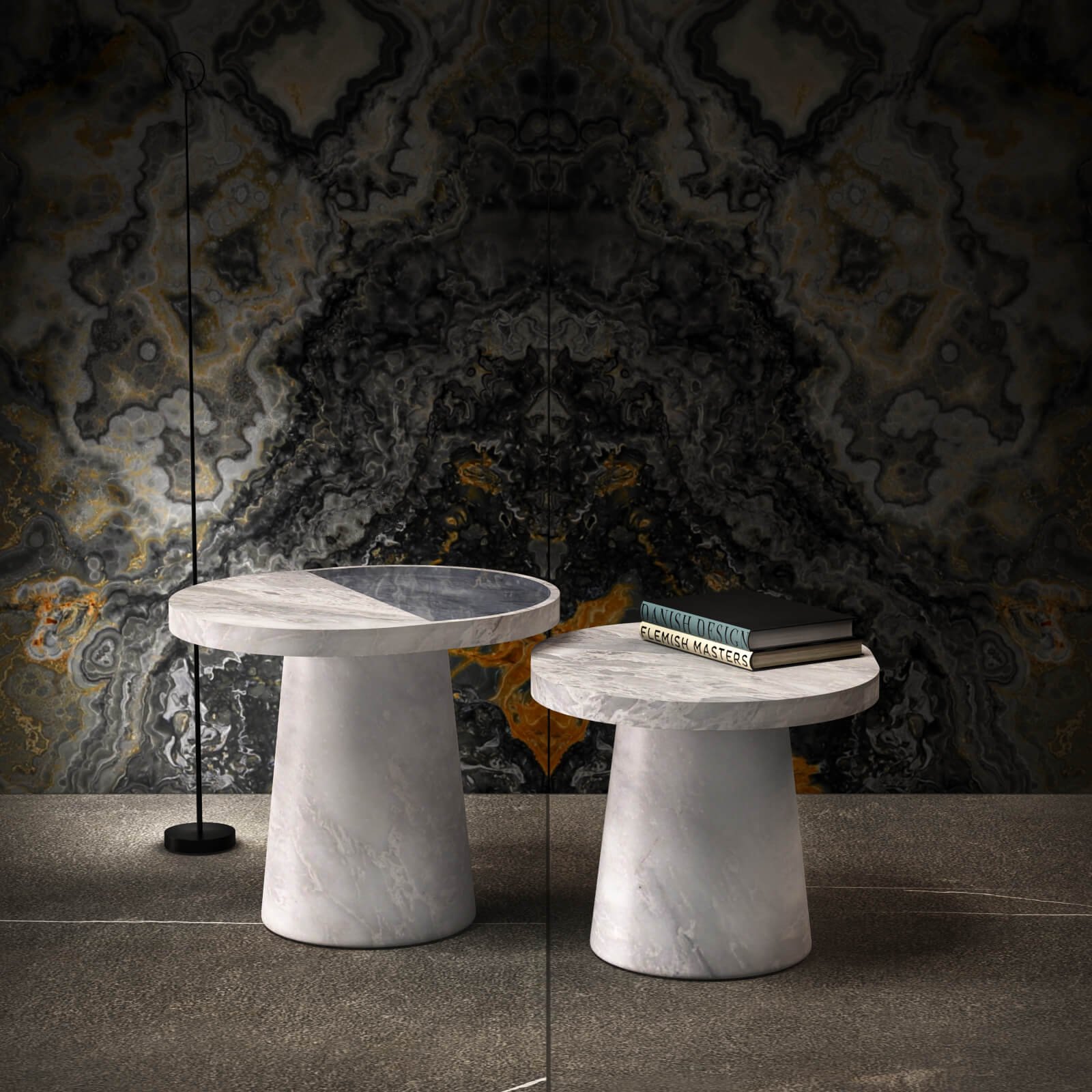
Purapietra examples: bespoke work in practice
Purapietra’s own catalogue exists partly to show what a bespoke process can produce as a repeatable idea. Pieces like the Unit freestanding basin and the Linear wall-mounted basin started as one-off design exercises before becoming part of the New Era collection, and the same sculptural language, rounded, carved from a single block, drives every genuinely custom commission that follows.
Residential projects show the same thinking at a larger scale. At Desert Chalet, Mina Abdullah Beach in Kuwait, stone was worked into the architecture itself rather than added as a finishing touch, a bespoke approach applied across an entire house rather than a single object. The full portfolio, from private villas to an Apple Store, is on our projects page, and every one of them started the same way this article describes: with a brief, not a product.
Working with a bespoke commission
A few practical points make a bespoke process go smoothly on the client side. Bring constraints early rather than late, footprint, budget, structural limits, because a design built around real constraints from day one avoids expensive revisions later. Ask to see the actual block or slab being proposed, not a generic sample, since the entire value of a bespoke piece rests on the specific stone it comes from. And build in the extra time bespoke work genuinely needs: rushing the hand-finishing stage is the single most common way a custom piece ends up looking machine-made after all.
If you are considering a bespoke piece, whether it is a single sculptural object or stonework across a whole project, we are happy to talk through the brief before anything is committed. Write to info@purapietra.it, or browse the full range of materials and finished pieces on our materials page.
Frequently asked questions about bespoke marble
What does “bespoke marble” mean?
Bespoke marble refers to a stone piece designed from a specific brief, space or idea rather than selected and adapted from an existing product range. It is different from customisation, which changes an existing product’s finish or size but starts from a template.
How long does a bespoke marble piece take to make?
Design and material selection typically take several weeks, followed by fabrication that includes hand-finishing time on top of any machine work. International projects should also plan additional time for shipping and installation logistics specific to a one-off, heavy object.
Is bespoke marble more expensive than a catalogue piece?
Yes, generally. The cost reflects design time, a dedicated block or slab selection, and hand-finishing rather than repeatable production. It tends to make financial sense for spaces meant to last many years, less so for short-term or frequently refreshed interiors.
When does a bespoke marble piece make sense over a standard product?
It makes the most sense for non-standard spaces a catalogue product won’t fit, for a signature piece meant to define a room, or when working with a rare slab too unusual or precious to cut into standard sizes.
What is the process for commissioning a bespoke marble piece?
It typically moves through a design brief, material and slab selection, a scale drawing or 3D model for approval, CNC roughing, hand-finishing by an artisan, and finally shipping and installation, with the hand-finishing and logistics stages usually taking the longest.
Can any type of marble be used for a bespoke piece?
Most can, but the right stone depends on how the piece will be worked and used. A thin carved edge needs a stone that holds its shape without fracturing, while a large tabletop needs enough consistent material from one block to avoid a visible joint, so material selection is matched to the design rather than chosen first.
Keep exploring the Purapietra magazine. See also our guides to how to identify quality marble and marble durability, or browse the full materials collection.
Breccia Cenere: Origins, Character and the Best Ways to Use It
Breccia Cenere is often filed under “white marble” and left there, which undersells it. It isn’t built like the other whites in the Purapietra range: instead of veins drifting through a single block, it is made of broken pieces of stone cemented back together, which gives it a pattern with no direction and no repeat. This guide covers what a breccia actually is, how Breccia Cenere differs from the Carrara-type whites next to it in the catalogue, the finishes that suit it, and where it earns its place in a home.
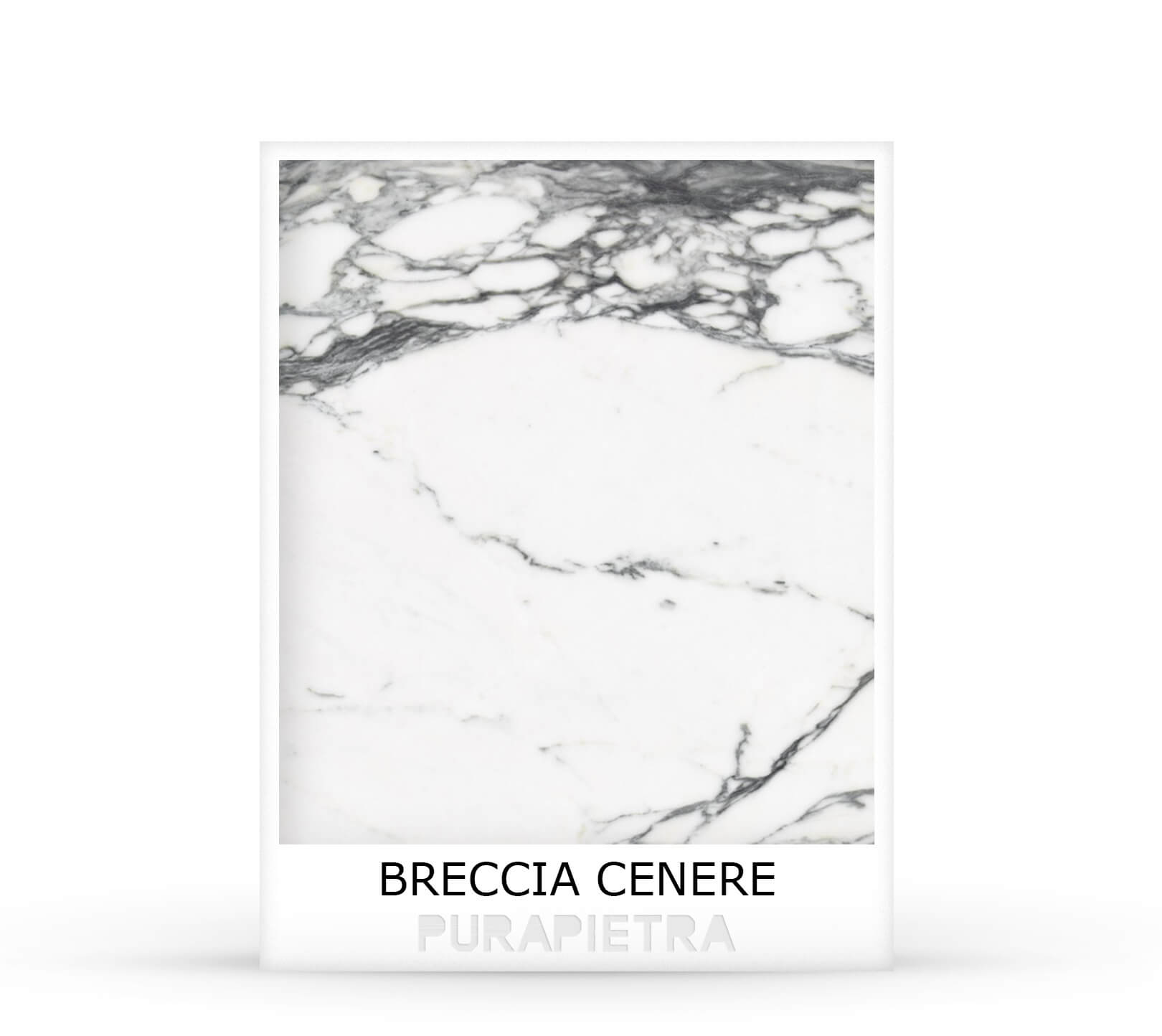
What a breccia actually is
Most of the stones we write about here are marbles in the strict sense: limestone that got buried, heated and squeezed until it recrystallised into a dense, continuous block, with veining left behind by the mineral impurities that travelled through it while it cooked. A breccia is a different kind of rock entirely. The word comes from the Italian for “gap” or “breach”, and it describes a stone made of broken fragments of older rock, re-cemented by mineral-rich fluid into a new, solid mass.
That difference in formation is the whole reason Breccia Cenere looks the way it does. There is no directional flow to the pattern, because there was never a single molten or plastic mass moving through the block. Instead you get angular, irregular pieces, sometimes a few millimetres across, sometimes the size of a hand, locked into a paler binding matrix like fragments of a broken plate glued back together and then polished flat. Every panel is genuinely different from the next, in a way a veined marble rarely is.
Brecciated stones have been prized for exactly this unpredictability since antiquity. Roman builders used them for columns and floors precisely because the fragmented pattern reads as rich and complex from any angle, and the tradition never really stopped. For the wider context on how this fits within the marble family, our guide to white marble places Breccia Cenere alongside the other varieties in the Purapietra range, and Wikipedia’s entry on breccia covers the geology in more depth.
Breccia Cenere: colour, pattern and character
The name gives away the palette. “Cenere” is Italian for ash, and that is the tone running through the fragments: cool greys, from pale smoke to a deeper charcoal, set against a lighter, often near-white ground. The effect at a distance is closer to a soft marble than a bold one, because the fragments are small and evenly distributed enough that the eye blends them into a general grey-white texture. Get closer and the structure resolves into distinct pieces, each with its own edge, its own shade, its own internal texture.
This is the detail that makes Breccia Cenere useful in a way a single strong-veined marble is not: it works at two scales at once. From across a room it behaves like a quiet neutral stone. Up close, at a basin or a tabletop where people actually look at it, it rewards attention with real complexity. Few materials do both jobs.
What to check on the actual slab, not a sample chip. Fragment size and density vary meaningfully from block to block: some cuts run finer and more uniform, others carry larger, more graphic pieces with real colour contrast between them. Both are legitimate versions of the stone, but they behave very differently on a large surface, and a 10 cm sample will not show you which one you are getting.
Breccia Cenere against the other Purapietra whites
It helps to place it next to stones people already know. Against Acqua di Carrara, which is calm, directional and almost monochrome, Breccia Cenere is busier and more textural, though never as loud as a heavily figured Calacatta. Against Bianco Statuario, the difference is structural rather than just visual: Statuario is one continuous, dramatic vein through a single block, while Breccia Cenere is many small, separate pieces with no flow between them at all. Against Bianco delle Alpi, the palest and purest of the group, Breccia Cenere reads noticeably more textured and more grey.
None of this makes one better than the others. It means Breccia Cenere is the choice when a room wants a white-family stone with genuine visual movement but not the graphic drama of a big vein, and when the idea of a pattern with no obvious repeat is itself the appeal.
Finishes: how the surface changes a fragmented stone
Honed
A smooth matt surface with no reflection. On Breccia Cenere this is often the finish we recommend first, because it softens the contrast between the ash fragments and the lighter matrix, letting the pattern read as texture rather than as a collection of separate shapes. It also hides the small surface marks of daily use far better than a polish.
Polished
A high-gloss buff that deepens the greys and sharpens the edges of every fragment, so the brecciated structure reads clearly even from across a room. This is the finish to choose if the point of the material is that visual complexity and you want it on full display. It closes the surface more, which helps with staining, but it shows every fingerprint and water mark.
Brushed
Worked with abrasive brushes to a low, satin lustre with a faint texture underfoot or underhand. A practical middle ground for a surface that gets used daily, such as a kitchen island top or a hallway floor, where a small scratch or watermark needs to disappear into the material rather than stand out against a mirror finish.
The best ways to use Breccia Cenere in interiors
Bathrooms
This is where a brecciated white stone does its best work. Run it across the floor and up a shower wall and the pattern gives the room enough visual interest to need very little else: simple fittings, a plain mirror, and the stone carries the design. A basin carved from the same block turns the material from a surface into an object, which is the idea behind pieces like our Linear wall-mounted basin and the Unit freestanding basin.
Kitchens
Like every calcium-carbonate stone in this family, Breccia Cenere will etch where an acid touches it, so treat it the way you would any marble in a kitchen: as a splashback or an island front where you want the material visible, or accept that a worktop will develop a patina over time. The fragmented pattern is, in fact, more forgiving here than a clean marble, because small marks and etches tend to disappear into the existing texture instead of standing out against it.
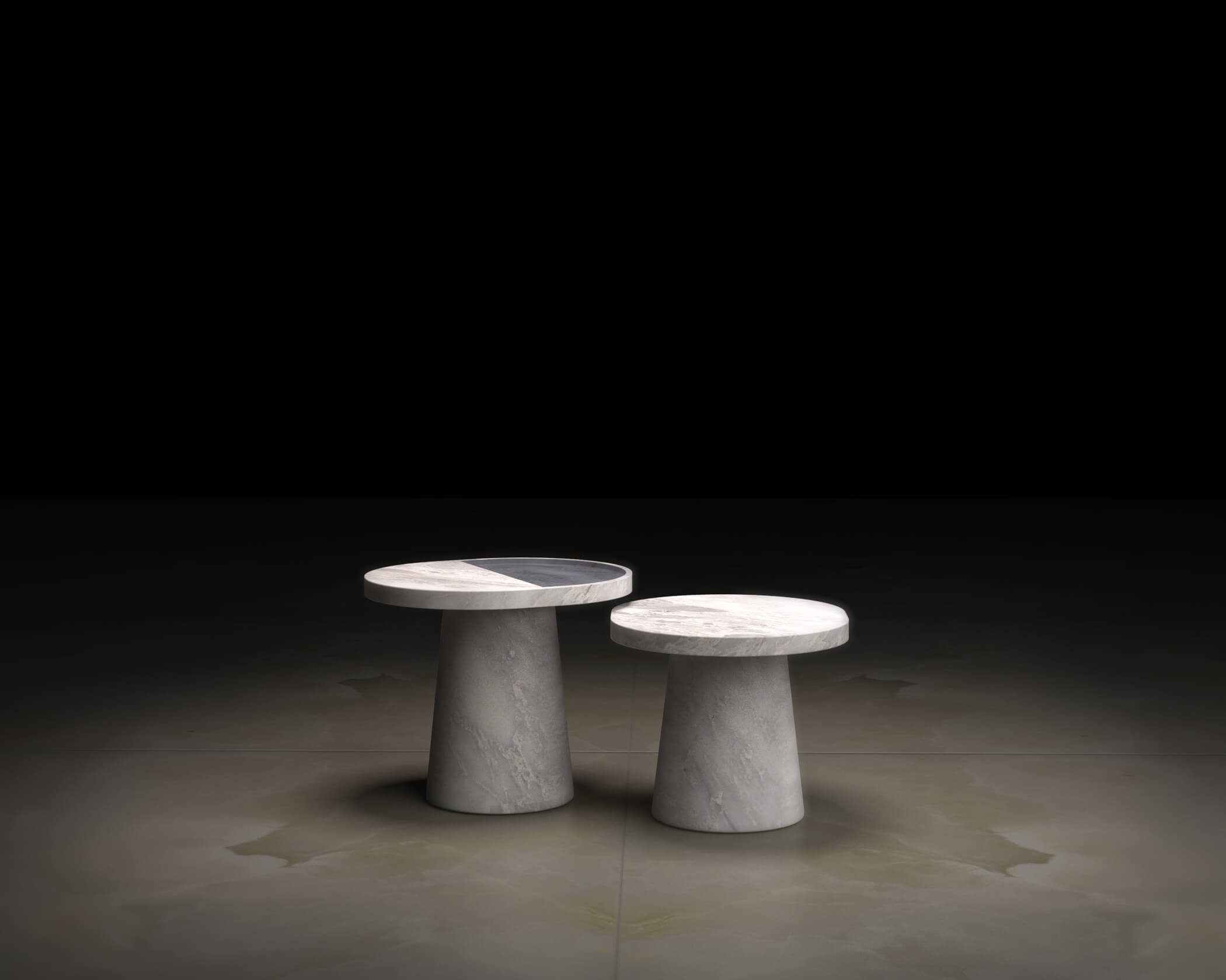
Walls, floors and objects
On walls and floors, larger formats read best, since bigger panels give the fragmented pattern room to sit without feeling chopped up by joints. At object scale, a round table or a set of trays or vases makes the most of the material’s close-up detail: you see the whole piece at once, fragments and all, which is exactly the distance at which Breccia Cenere is most persuasive.
Pairings that work
Because the stone already carries visual complexity, the materials around it are usually better kept quiet. Pale oak, unlacquered brass and matt black metal all let the breccia pattern do the work without competing for attention. A monochrome scheme of white walls and neutral fabrics is the classic setting, and it is classic for a reason: it lets the fragments read as the room’s one deliberate flourish. Where Breccia Cenere pairs less well is next to another highly patterned material in the same field of view, such as a busy encaustic tile or a strongly figured wood grain; two competing patterns rarely settle into the same room comfortably.
Formats, thickness and supply
Slabs are supplied in the standard large formats used across the Purapietra range, in 2 cm for cladding and lighter horizontal surfaces and 3 cm where a worktop or a threshold needs a more substantial edge. Because every panel of a breccia is genuinely unique, book-matching in the strict sense, mirroring the exact same pattern across a joint, is not really the point the way it is with a veined marble. What matters more is consistency of fragment size and tone across the panels used in one space, which is a conversation worth having with your fabricator before slabs are cut.
Maintenance and sealing
Breccia Cenere asks for the same routine as any natural stone in the marble family. Seal it on installation with a good impregnating sealer, and reseal every one to two years on surfaces that see water or heavy use. Clean with a pH-neutral stone cleaner only, never vinegar, lemon, or a generic bathroom spray, all of which will etch the surface over time. Wipe up spills, particularly anything acidic, as soon as they happen rather than later.
Etching shows up as a dull patch rather than a stain, and on a honed finish it is usually close to invisible given the stone’s existing texture. On a polished surface it is more noticeable and can often be restored with a marble polishing compound. As with any porous stone, mats at exterior doorways make a real difference over years of foot traffic.
Choosing a slab
Always look at the actual slab rather than a small sample, because fragment size, density and the contrast between the grey pieces and the lighter matrix genuinely vary between blocks. Decide early whether you want a finer, more uniform cut or a bolder one with larger, more graphic fragments, since both exist within the name Breccia Cenere and they behave differently at scale. Our guide to how to identify quality marble covers what to look for in any slab, brecciated or veined.
If you are considering Breccia Cenere for a specific room or a single carved piece, we are happy to talk it through before anything is committed. Write to info@purapietra.it, or browse the full range on our materials page.
Frequently asked questions about Breccia Cenere
What is Breccia Cenere?
Breccia Cenere is a natural stone from the white marble family, made of angular ash-grey fragments cemented into a paler matrix. Unlike a veined marble, it forms from broken pieces of older rock rather than a single continuous mass, which gives it a pattern with no direction or repeat.
What is the difference between a breccia and a marble?
A marble forms when limestone recrystallises under heat and pressure into a dense, continuous block, with veining left by mineral impurities. A breccia forms when existing rock is fractured and the fragments are re-cemented by mineral-rich fluid, producing a stone made of distinct angular pieces rather than a single flowing pattern.
Is Breccia Cenere suitable for a bathroom?
Yes, and it is one of its strongest uses. Choose a honed finish for grip and to keep the fragmented pattern reading as texture rather than sharp contrast, seal on installation, and clean only with pH-neutral products.
Can Breccia Cenere be used on a kitchen worktop?
It can, with the same caveats as any calcium-carbonate stone: it will etch where acids touch it. Its fragmented pattern tends to hide small marks better than a clean marble, but if you want a surface that never changes, use it as a splashback or island front and choose a harder material for the working top.
Does every slab of Breccia Cenere look the same?
No, and that is part of the appeal. Fragment size, density and colour contrast vary from block to block, so always view the actual slab rather than a small sample before committing to a project.
How does Breccia Cenere compare to Bianco Statuario or Acqua di Carrara?
Both of those are veined marbles with a directional pattern flowing through a single block. Breccia Cenere is structurally different: a fragmented stone with no flow, offering more close-up texture and less large-scale drama than Statuario, and more visual movement than the calmer Acqua di Carrara.
Keep exploring the Purapietra magazine. See also our guides to white marble and Acqua di Carrara, or browse the full materials collection.
Marble Interiors: 5 Styles and the Best Ways to Use Stone at Home
The most common mistake we see in marble interiors is not too much marble. It is marble asked to do a job it was never suited to — a polished white worktop in a house where someone actually cooks, a rare slab cut into pieces so small that the veining stops making sense. Marble is not a finish you apply. It is a material with a temperament, and rooms go right when the design is built around what the stone wants to do.
Used well, marble interiors have a quality no engineered surface reproduces: depth. That comes from the material itself — a recrystallised limestone whose calcite grains are partly translucent, as Wikipedia’s entry on marble explains. Light travels a few millimetres into the stone before it scatters, which is why a marble wall looks alive at eight in the morning and different again at six in the evening. This guide is about getting there deliberately — how marble behaves in different styles, where to be bold and where to hold back, which trends are worth following, the mistakes we are most often called in to fix, and what real projects teach that mood boards do not.
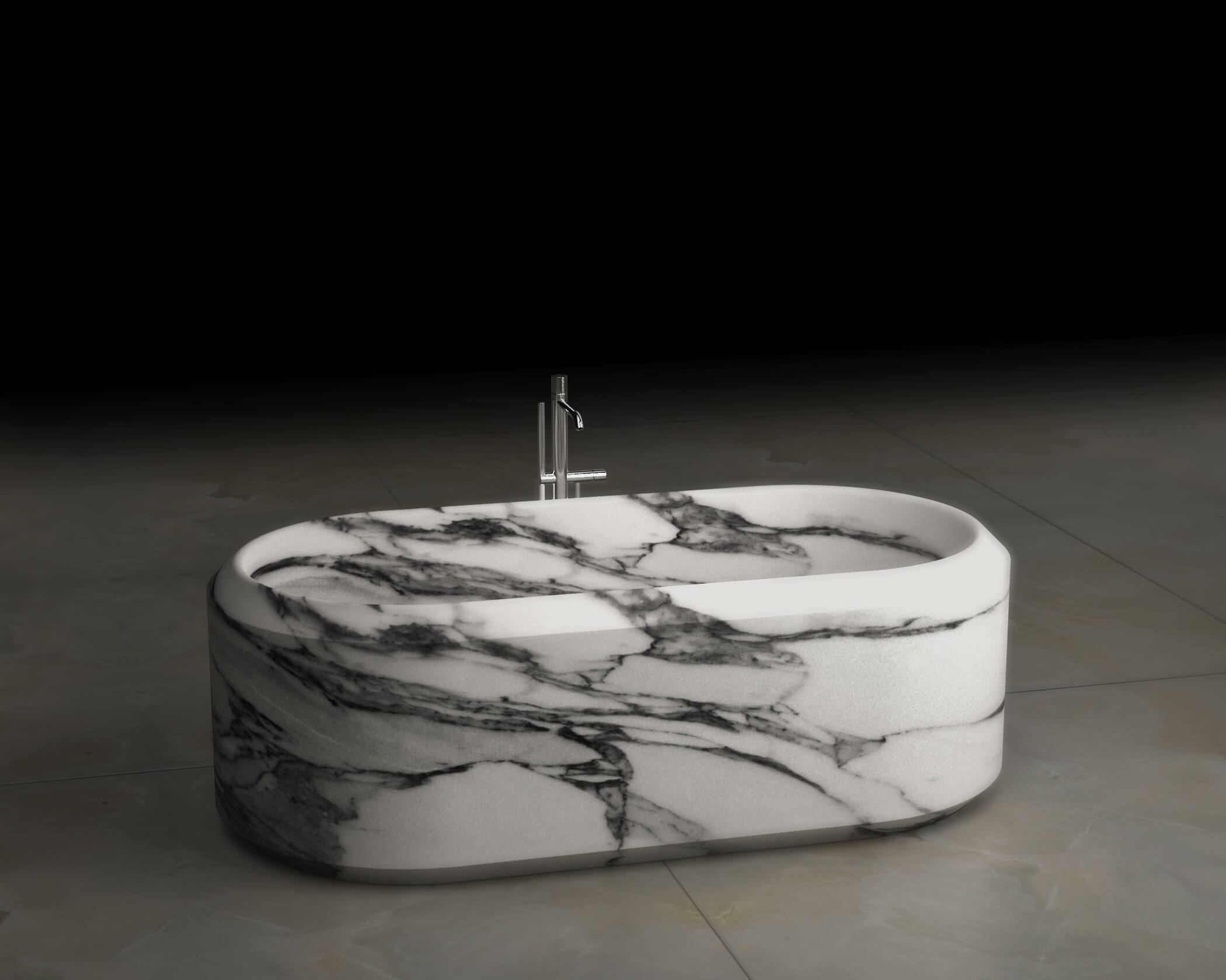
Styles compared: how marble interiors change with the language of the room
The same slab reads completely differently depending on the language of the room around it. Three broad approaches cover most of the marble interiors we are asked to work on.
Classic
In a classic interior, marble is architecture. It arrives as a chimneypiece, a threshold, a stair, a bathroom lined floor to ceiling. Veining is welcome and symmetry is the organising idea: book-matched panels, a vein that lands centrally over a fireplace opening, a floor laid in a formal pattern. Polished finishes belong here, because a classic room is built to reflect light rather than absorb it. The stones that suit this register are the Italian whites and the warm beiges — Statuario, Calacatta, Crema — where the veining has enough drawing in it to hold a formal composition.
The risk in classic schemes is accumulation. Marble floor, marble skirting, marble fireplace, marble console and marble lamp base in one room stops reading as luxury and starts reading as a showroom. Choose the two elements that carry the architecture and let plaster, timber and textile do the rest.
Modern
A modern interior treats marble as a graphic element. Here the stone is usually deployed as a single large plane — an island, a bathroom wall, a kitchen splashback run in one continuous piece — against otherwise quiet materials. Book-matching becomes a deliberate visual event rather than a period reference, and stronger stones come into play: green, black, blue, the more dramatic Calacattas. Our survey of coloured marble covers the palette that works in this register.
The technical demand in modern schemes is precision. When marble is used as a plane, every joint is visible and every mitred corner has to be exact. This is where the difference between a good fabricator and an average one becomes impossible to hide.
Minimal
Minimal interiors are the hardest place to use marble well, and the most rewarding when it works. The stone has to carry warmth and depth into a room that has deliberately removed everything else, which means quiet veining and matt surfaces rather than statement slabs. Honed whites, soft greys and travertine belong here. So do sculpted solid objects: a basin, a bench, a low table cut from one block, where the interest comes from mass and silhouette rather than pattern.
The counter-intuitive rule is that in minimal rooms you generally use less marble but thicker marble. A twenty-millimetre slab on a plywood carcass reads as a surface; a solid piece reads as an object. In a room with nothing to hide behind, that distinction is everything.
Where to be bold in marble interiors
The bathroom. This is the room that rewards commitment. It is small, it is used in soft light, and it does not take the acid abuse a kitchen does. Running a single stone from floor to ceiling and into the shower enclosure gives a bathroom a coherence that tiling never achieves. Add a sculpted basin such as our Unit Sink or the wall-mounted Linear and the room resolves into one material.
One wall, not four. A full-height marble wall behind a bed, in an entrance hall or in a lift lobby is the highest-impact and lowest-risk use of a dramatic stone. Nothing acidic touches it, the veining can be laid out properly across the whole surface, and the rest of the room stays free.
A single object. The move we recommend most often is also the cheapest: one carved piece in a room that is otherwise plain. A Groove coffee table, a set of marble trays, a group of vases. It gives a room the depth of stone without committing the architecture to it, and it can be moved when the room changes.
Where to hold back
Busy floors. Marble is soft and it scratches. In a hallway that takes shoes and grit daily, a white marble floor will dull within a couple of years. Use it in bedrooms, dressing rooms and bathrooms, or specify a honed finish and accept a light re-hone every decade or so. Our guide to marble durability goes through the wear question room by room.
Working kitchen worktops, if you are anxious. Marble etches on contact with lemon, vinegar and wine. Honed surfaces disguise this well and most owners grow to like the patina, but the conversation belongs before the order. If an unchanged worktop is a hard requirement, quartzite is the correct material and any good workshop will tell you so.
Small mosaic cuts of expensive stone. Cutting a rare slab into 10 x 10 pieces destroys the only thing you paid for. If the design calls for small formats, use a stone with uniform colour rather than one bought for its veining.
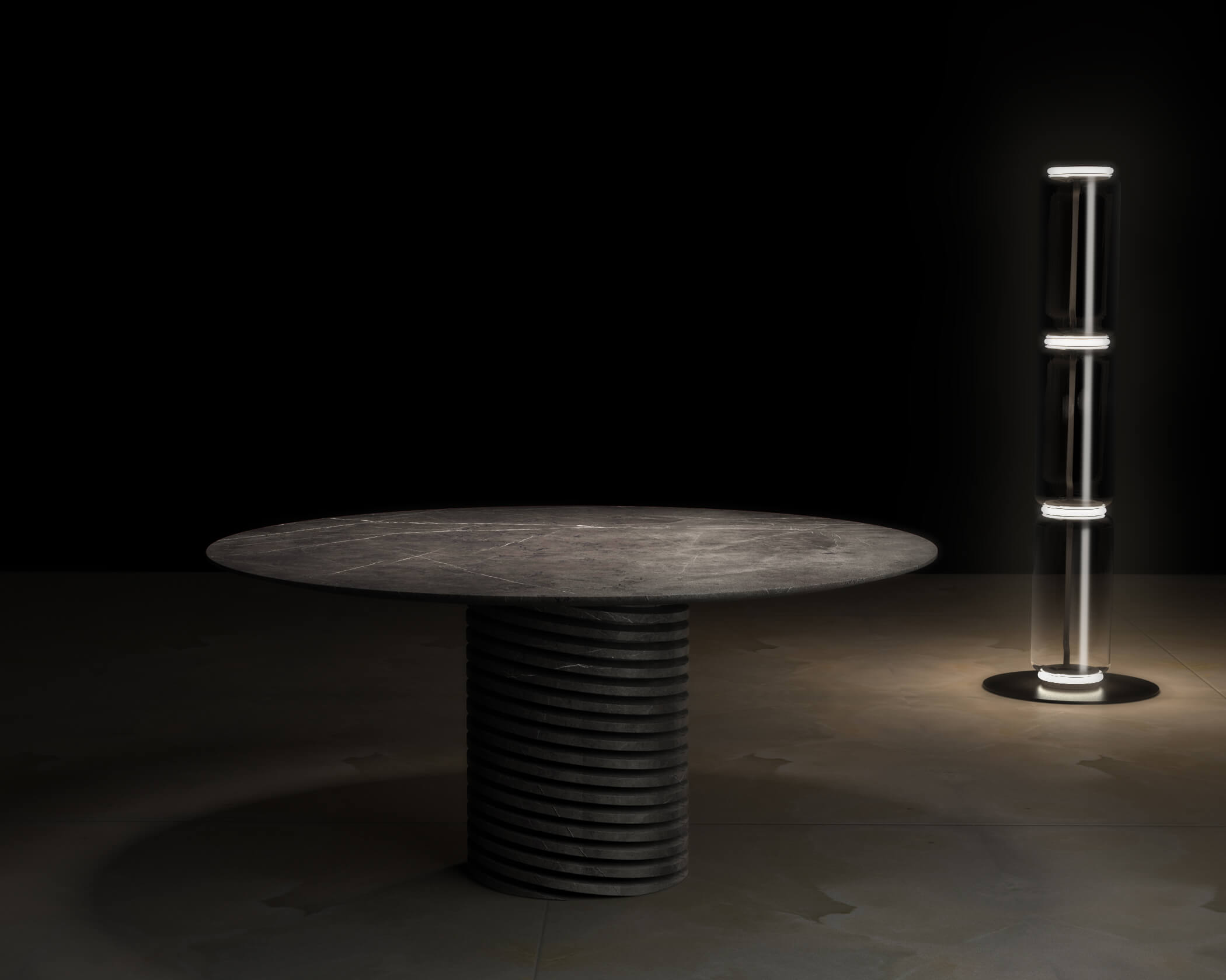
Current trends in marble interiors worth following
Colour, finally. After a decade of white and grey, the interesting work is happening in green, blue, pink and the deep browns. We are cutting more Verde Alpi, Sodalite and Rosa di Venezia than at any point in the last ten years. The pillar articles on green marble and pink marble cover what each family does in a room.
Matt over gloss. Honed, brushed and leathered finishes now outsell polished in domestic work. Partly it is fashion; mostly it is that matt surfaces are more forgiving and photograph better in the soft, indirect light people actually live in.
Solid rather than clad. Thicker, carved, monolithic pieces are replacing thin slabs on substrate. It is more expensive and considerably better, because the edge profile becomes a design decision instead of a concealment problem.
Fewer materials per room. The direction across the good projects we see is towards restraint: one stone, one metal, one timber, repeated. It is harder than it sounds and it is what separates a resolved room from a collected one.
Marble as sculpture. Stone is moving out of the kitchen and bathroom and into the living room as freestanding objects — tables, seats, vessels. It is the oldest use of the material and the one that suits contemporary interiors best, because it does not commit the building to anything.
Five mistakes to avoid in marble interiors
1. Choosing from a sample. A ten-centimetre chip cannot tell you what a three-metre slab will do. For any veined stone, select the actual slab or the block, and photograph the layout before cutting. Every disappointment we have been called to look at started here.
2. Ignoring the direction of the veining. Veins have direction. Running them one way across a room and the other way in the adjoining space is the single most common reason a finished job feels wrong without anyone being able to say why. Decide the direction at the drawing stage.
3. Specifying polished where honed belongs. Gloss on a horizontal working surface makes every etch mark legible. Almost every “the marble is ruined” call we take involves a polished worktop and an ordinary kitchen.
4. Using the wrong cleaning products. Bleach, vinegar, lemon sprays and limescale removers attack marble directly. More damage is done by cleaning than by use. pH-neutral stone soap and warm water handle almost everything.
5. Mixing too many stones. Two marbles in one room is a decision; three is an accident. If a scheme needs variety, get it from finish rather than from material — the same stone honed on the floor and polished on the wall reads as sophistication.
Room by room: a quick reference
If you want the short version, this is how we allocate stone across a house when a client asks us to plan marble interiors from scratch.
Entrance. High visual return, high wear. Use marble on the walls rather than the floor, or accept a honed floor in a hard-wearing grey or travertine. This is the one room where a dramatic slab pays for itself, because everyone sees it and nobody lingers.
Living room. Objects, not surfaces. A carved table, a bench, a fireplace surround. Polished finishes are safe here because nothing acidic reaches them, and it is the right room for a stone with real character.
Kitchen. Honed, sealed, and chosen with the etching conversation already had. If the client cooks seriously and hates change, put the marble on the splashback and a harder material on the worktop — a compromise that keeps the look and removes the risk.
Bathroom. The room to commit to. One stone, floor to ceiling, plus a solid basin or bath. Marble interiors rarely look better than in a bathroom lined in a single material.
Bedroom. A headboard wall, a windowsill, a pair of bedside tops. Low traffic, soft light, no acids: everything is permitted here, and marble floors survive well.
Lessons from real marble interiors we have built
The projects in our portfolio — private villas in Milan and the Emirates, a chalet on the Kuwaiti coast, retail work including an Apple Store — have taught a few things that mood boards never do.
Plan the block, not the room. On large jobs we start from how much usable material a block will yield and design the layout backwards from it. A scheme drawn without reference to block sizes generates joints in places nobody wanted them.
Light is a material decision. The same stone looks warm under 2700K and clinical under 4000K. We ask for the lighting specification before finalising the marble, not after, and we look at samples in the actual room whenever the site allows it.
Contrast comes from finish as much as colour. A honed field with polished detailing in the same stone gives a richer result than two different marbles, and it never dates.
The best rooms have one stone doing one job. Across every project that still looks right five years on, the marble had a defined role — the bathroom, the island, the object — and stopped there. The marble interiors that age badly are almost always the ones where the stone was asked to be everywhere at once.
If you are working with a single colour family, the pillars on white marble and black marble interiors go deeper into pairings and room-by-room use than this overview can.
Designing marble interiors with Purapietra
We work stone as a structural material rather than a finish. Pieces are cut from solid blocks, roughed on CNC for accuracy and finished by hand by Italian craftsmen, which is the stage where a sculpted edge stops looking machined. For bespoke work we help clients select the block itself and lay out the veining before anything is cut.
The full range of whites, greys, greens, blues and rare onyxes is in the materials catalogue, and the design collection is in New Era. If you want a broader grounding in the material first, our guide to the types of marble is the place to start. Write to us with a drawing, a photograph or just a room, and we will tell you honestly what the stone can and cannot do.
Frequently asked questions about marble interiors
Are marble interiors a practical choice for a family home?
Yes, with the right specification. Marble is durable but reactive: it scratches more easily than granite and etches on contact with acid. Choose honed rather than polished finishes for horizontal surfaces, seal on installation, use pH-neutral cleaners, and accept that surfaces in daily use will develop a patina. Handled that way it outlasts almost every alternative.
How much marble is too much in one room?
There is no fixed limit, but a useful rule is that marble should have a defined role rather than appear everywhere. Cladding a bathroom entirely in one stone works because the stone is the architecture. Adding a marble floor, fireplace, console and lamp base to the same living room does not, because nothing is left to give the eye a rest.
Which marble is best for a living room?
For a living room the stone usually appears as an object rather than a surface, so choose for character. Quiet whites and greys suit minimal schemes; green, blue and pink marbles work well when the piece is meant to be the focal point. Because these surfaces rarely meet acid, polished finishes are safe here.
Can marble be used on floors?
Yes, in the right rooms. Marble floors work well in bedrooms, dressing rooms and bathrooms. In busy hallways and entrances, grit and shoes will dull the surface within a few years. If you want marble in a high-traffic area, specify a honed finish, use a good doormat, and plan on periodic re-honing rather than treating wear as damage.
What are the current trends in marble interiors in 2026?
Four things are consistent across the good work being done now: a return to coloured stones after years of white and grey; matt finishes overtaking polished; solid carved pieces replacing thin slabs on substrate; and fewer materials used per room, with variety coming from finish rather than from mixing stones.
How do I stop marble from staining?
Apply a penetrating impregnating sealer on installation and refresh it every two to four years on horizontal surfaces. Blot spills quickly, particularly oil, wine and coffee. Avoid film-forming sealers, which look good briefly and then peel unevenly. Note that sealing reduces staining but does not prevent acid etching, which is a physical change to the surface.
Is marble more expensive than engineered stone?
Usually yes for the material, though the gap narrows once fabrication is included and it varies enormously by stone. Commercial Carrara and travertine are affordable; Statuario and rare onyxes are not. The more useful comparison is lifespan: a marble surface can be re-honed and returned to new condition many times over, which engineered surfaces cannot.
Bianco Statuario Marble: 6 Beautiful Ways to Use Italy’s Most Noble White
There is a moment in the workshop that never gets old. A block of Bianco Statuario comes off the saw, someone throws water across the cut face, and the grey veining surfaces out of the white like handwriting appearing on wet paper. Michelangelo went up the mountain looking for this stone. Six centuries later we are still choosing it for the same reason: no other white marble draws a line quite so deliberately.
Bianco Statuario is the most prized of the Italian white marbles, quarried in the Apuan Alps above Carrara and valued for a luminous, almost translucent white ground crossed by sparse, decisive grey veins. It is the stone people picture when they say “marble”, and it is also the most misunderstood, because the name covers a narrow band of exceptional material and a much wider band of commercial slabs sold under the same label. This guide covers where it comes from, how to read a slab, which finishes suit it, where it earns its place indoors, and what it honestly costs to work with.
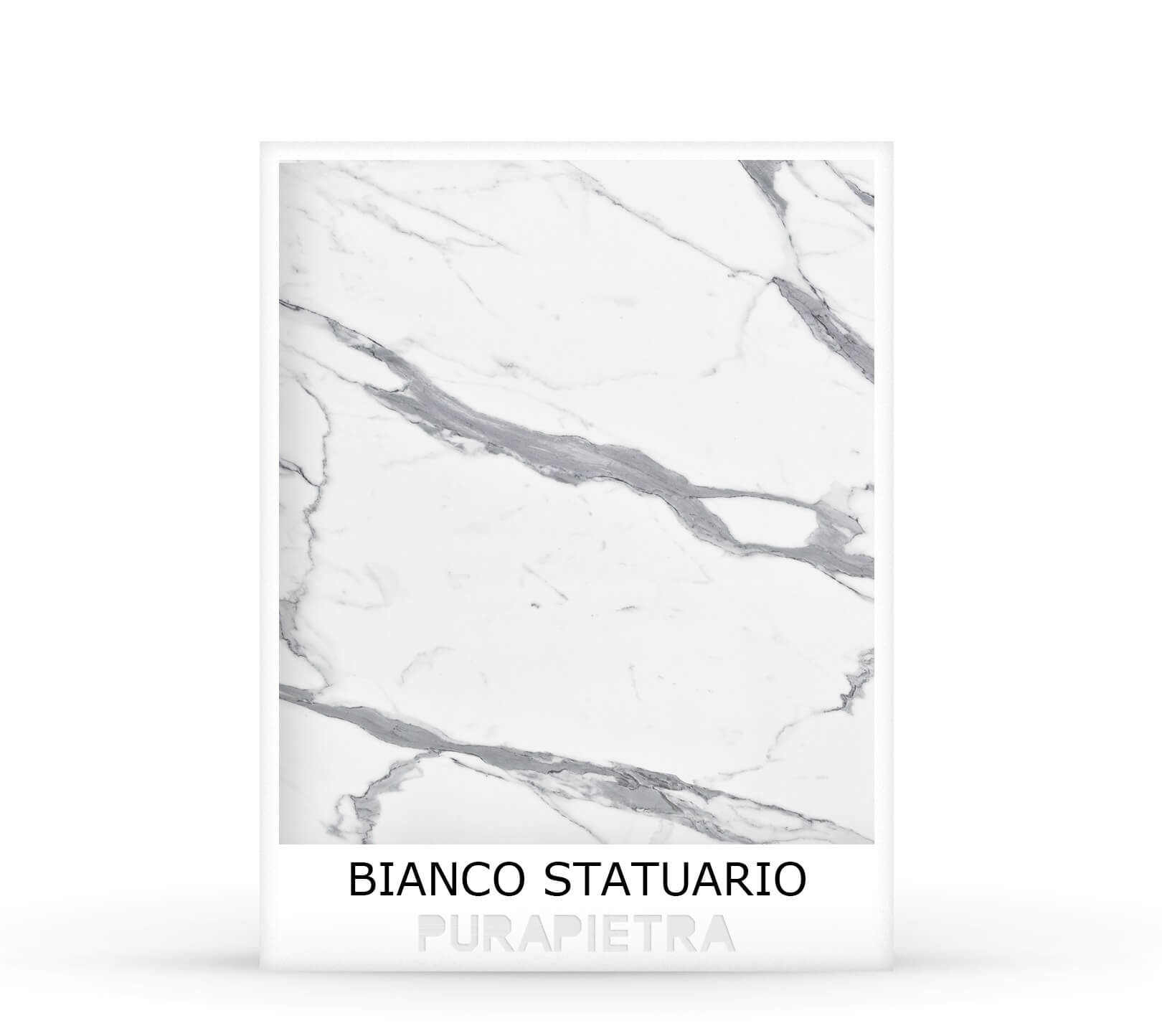
Where Bianco Statuario comes from
Statuario is extracted from a small group of quarries in the Apuan Alps, in the basins above Carrara in northern Tuscany. The geology is the same across the whole district: limestone recrystallised under heat and pressure into a dense, fine-grained calcite marble. What sets the Statuario benches apart is purity. The beds that produce it carry very little of the mineral contamination that gives most Apuan whites their faint grey cast, so the ground reads brighter and the veining stands out against it with far more contrast. The broader geological picture is set out well on Wikipedia’s entry on Carrara marble.
The practical consequence matters more than the geology. Those benches are small, they are worked slowly, and the yield of true Statuario from a given block is low. A quarry may cut a hundred blocks and classify a handful at the top grade. That scarcity is the reason the material has always been reserved for sculpture and for architecture that intends to be looked at, and it is also the reason the name gets stretched. Plenty of stone sold as “Statuario” is a good white Carrara with strong veining, which is not the same thing and should not carry the same price.
The name, and why it means something
“Statuario” means, literally, the marble for statues. The classification came from sculptors long before it came from the stone trade, and the criteria were sculptural: an even crystal structure that would take an edge in any direction, a translucency that let light travel a few millimetres into the surface before scattering, and a ground clean enough that the veining could be treated as a compositional element rather than noise. Those criteria still describe the best material today. When we are asked to define the grade for a client, we do not start with the vein pattern. We start with what the stone does to light.
If you are still deciding between the great Italian whites, our comparison of Carrara vs Statuario sets the two side by side, and the wider survey of Italian white marble covers Calacatta and the alpine whites alongside them.
Reading a Bianco Statuario slab
Four things tell you what a slab is going to do once it is on a wall.
The ground. Look at the field between the veins under indirect daylight, never under the yard lights. True Statuario holds a cold, clean white with a faint blue-grey undertone. A warm or creamy ground is not a fault, but it is not Statuario either, and it will fight a cool palette once the room is finished.
The translucency. Hold a thin offcut up to the light. Good material glows at the edge rather than blocking the light entirely. This is the property that gives a polished Statuario surface its depth, and it is the single hardest thing to judge from a photograph.
The vein. Statuario veining is sparse, grey to charcoal, and linear. On the finest blocks the veins run in a clear direction with long empty stretches between them. Dense, ropey or yellowish veining usually indicates material from an adjacent bench. It can still be beautiful, but it belongs to a different conversation about price.
The block, not the sample. Because the veining is graphic, two slabs from opposite ends of the same block can look like different stones. For any project that involves more than one slab we ask clients to come and select the block itself. A ten-centimetre sample of Bianco Statuario tells you almost nothing about what a three-metre surface will do. The habits we use to grade material are written up in more detail in our guide on how to identify quality marble.
Finishes: the same stone, three different materials
Finish changes Bianco Statuario more than any other decision you will make about it.
Polished
Polishing closes the surface and lifts the crystal, which is where the translucency becomes visible. The white gets brighter, the veins sharpen into black-grey lines, and the surface picks up light from across a room. This is the historic finish and the right one for vertical work: cladding, a fireplace surround, a stair, a reception wall. On a kitchen worktop we advise against it, because acid etching leaves dull patches that gloss makes impossible to ignore.
Honed
Honing grinds the surface smooth and stops short of gloss. The stone reads softer and slightly warmer, the veining loses a little of its edge, and the whole surface becomes far more forgiving in daily use. Etch marks still happen, but on a matt ground they are barely readable. For horizontal surfaces in a working house, honed Bianco Statuario is almost always the better specification.
Brushed and bush-hammered
Brushing runs abrasive heads across the face until it takes a fine leathery texture; bush-hammering goes further and leaves a rough, tactile surface. Both suppress the veining and both hide wear well. They are worth considering when the stone is doing textural work — a feature wall, a bench, an exterior detail — but they waste what makes Statuario expensive. If the veining is not going to be seen, there are better value whites for the job.
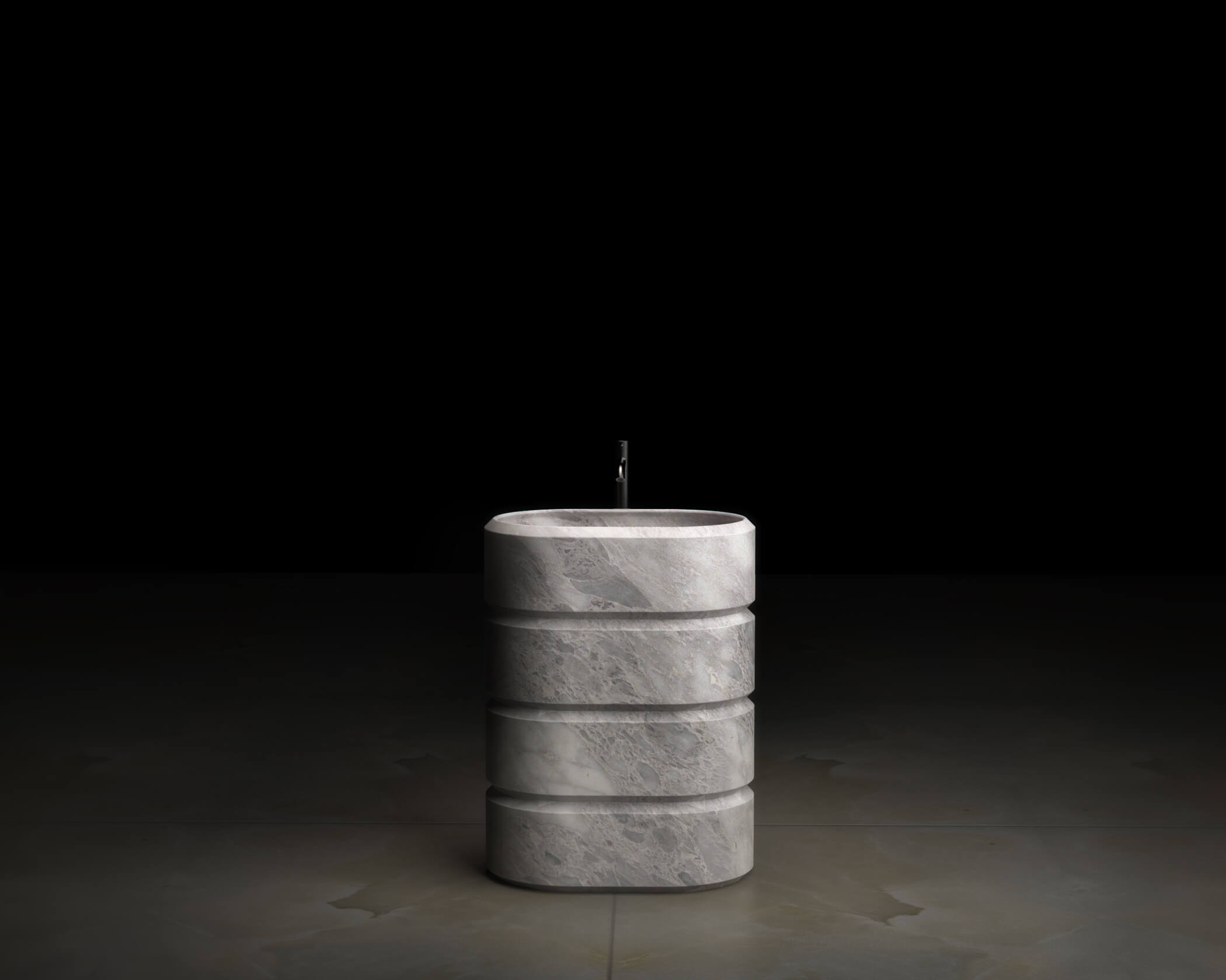
Six places Bianco Statuario earns its keep
1. Bathrooms
A bathroom is where Statuario does its most convincing work, because the room is small enough that a single material can take it over. A polished wall running floor to ceiling gives depth that no tile will reproduce, and the veining reads as composition rather than pattern when it is book-matched across a shower enclosure. Pair it with a sculpted basin such as our Unit Sink or the wall-mounted Linear, and the room resolves into one gesture. Keep descaling products away from the surface and the stone will outlive the fittings by decades.
2. Kitchen islands and worktops
Bianco Statuario makes a spectacular island, with one honest caveat that we repeat to every client. Marble is calcium carbonate and it reacts with acid: lemon juice, vinegar, wine and most limescale removers will etch it. Specify a honed finish, seal it on installation, and accept that the surface will acquire a history. If an unchanged worktop is a hard requirement, quartzite is the correct material and we will say so.
3. Cladding and full-height walls
Vertical surfaces are the safest place to use the material, because nothing acidic ever touches them. A polished Statuario wall in an entrance hall, a lift lobby or behind a bed does exactly what the stone was quarried to do. The technical work here is in the layout: matching the veining across joints, deciding where a vein is allowed to cross a corner, and planning the cutting sequence before the block is opened.
4. Fireplaces and thresholds
Statuario has been used for chimneypieces since the Renaissance for a reason. It takes carving cleanly in any direction, it holds a crisp arris, and it looks correct next to both period mouldings and a plain modern opening. On a fireplace, the heat is not a problem; the soot is, so a penetrating sealer and a soft brush are worth the small effort.
5. Sculptural and design objects
The properties that made this stone the sculptor’s default still hold. In our workshop it is the material we reach for when a piece has to survive being carved thin: a tray with a rolled edge, a vase whose wall thins towards the lip, a table with a shadow gap cut into the underside. You can see the range in our marble vases and trays, both cut from solid stone and finished by hand.
6. Floors, with conditions
Bianco Statuario can be laid as a floor and it is beautiful when it is, but it is a soft stone and a white one. In a hallway that takes shoes and grit every day it will dull and scratch. In a bedroom, a dressing room or a bathroom it holds up well. If the floor is going to be busy, use a honed finish, keep a mat at the door, and plan on a light re-hone somewhere around year fifteen rather than treating that as a failure.
Pairings that work
Aged brass and bronze. The classic answer, and still the best one. Warm unlacquered metal against a cold white ground is the pairing that carries most of the Purapietra New Era pieces, and it improves as the metal darkens.
Dark timber. Walnut, smoked oak and dark-stained ash give Statuario something to push against. The contrast is high but the materials share a grain logic — both have direction, both reward being run in one continuous piece.
Black marble. Statuario against a black marble such as Nero Marquina is a strong, formal pairing that works better in small doses than as a whole scheme. A black plinth under a white basin, or a black threshold against a white floor, gives the eye a full stop.
Plaster and lime paint. The quietest option and often the most successful. A hand-applied matt wall gives the stone somewhere to sit without competing for attention, and it is the treatment we recommend most often when the marble is already doing a lot of work.
Care, sealing and the honest limits
Seal it, then seal it again. A penetrating impregnating sealer does not coat the surface, it reduces absorption inside the pores. Apply it on installation and refresh it every two to four years on horizontal surfaces, less often on walls. Avoid film-forming products: they look good for a season and then peel unevenly.
Clean with pH-neutral products only. Warm water and a neutral stone soap handle almost everything. Bleach, vinegar, lemon-based sprays and bathroom limescale removers all attack the stone directly. Most damage we are asked to repair was caused by a cleaning product, not by use.
Deal with spills quickly. Oil and red wine stain because they are absorbed; acid etches because it dissolves. Blotting a spill within a few minutes prevents nearly all of it. A poultice will lift most absorbed stains later, but etching has to be re-honed out.
Accept the patina, or choose another stone. This is the conversation worth having before the order rather than after. A Bianco Statuario surface in daily use changes over years into something softer and slightly uneven, which most owners come to prefer. If that prospect is uncomfortable, the right answer is a different material, and no amount of sealing will change it. We wrote about the wider question in our guide to marble durability.
What Bianco Statuario costs, and why
There is no useful square-metre price for this stone, and any figure quoted without seeing the piece should be treated with suspicion. Cost is driven by four things: the grade of the block, the thickness required, the yield (how much of the block ends up in the finished piece and how much becomes offcut), and the finishing hours. A sculpted basin cut from a solid block consumes an enormous volume of material relative to its finished size, which is why solid pieces price very differently from slab work.
As a family, Statuario sits at the top of the Italian whites, above Calacatta in the finest grades and well above commercial Carrara. What you are paying for is scarcity and selection, not a difference in hardness or durability. A good Carrara will perform identically in use. It simply will not look like this.
Working with Bianco Statuario at Purapietra
We treat marble as a structural material rather than a veneer. Pieces are cut from solid blocks, roughed on CNC for accuracy and then finished by hand, which is the stage where a sculpted edge stops looking machined and starts feeling resolved. For bespoke work we ask clients to select the block, we lay out the veining on the block face before cutting, and we photograph the sequence so nothing about the finished piece is a surprise.
Bianco Statuario and the rest of our white, coloured and rare stones are shown in the materials catalogue. If Statuario turns out to be more stone than a project needs, Acqua di Carrara and Bianco delle Alpi are the two whites we most often propose instead. Write to us and we will send current block availability, finish samples and a quotation for the piece you have in mind.
Frequently asked questions about Bianco Statuario
What is Bianco Statuario marble?
It is the top classification of white marble quarried in the Apuan Alps above Carrara, in Tuscany. It is defined by a cold, luminous white ground, a fine and even crystal structure, partial translucency and sparse grey veining. The name comes from sculpture: it was historically the grade reserved for statuary.
How is Bianco Statuario different from Carrara marble?
Both come from the same district, but Carrara is the general commercial white and Statuario is a narrow top grade within it. Carrara typically has a faint grey cast and soft, cloudy veining spread across the slab. Statuario has a whiter, colder ground and fewer, sharper, more graphic veins, and it is considerably scarcer.
How much does Bianco Statuario cost?
Price depends on block grade, slab thickness, the yield of the piece and the finishing hours, so a square-metre figure is misleading for bespoke work. It is the most expensive of the Italian whites, above Calacatta at the finest grades and well above commercial Carrara. We quote per project once the piece and the finish are defined.
Can Bianco Statuario be used in a kitchen?
Yes, and it is a beautiful island material, provided you accept that marble etches on contact with acid. Specify a honed rather than polished finish, seal it on installation, and keep lemon, vinegar and descaling products off the surface. If a permanently unchanged worktop is essential, quartzite is the better specification.
Does Bianco Statuario yellow over time?
Good material does not yellow on its own. Discolouration nearly always has an external cause: an unsuitable adhesive bleeding through a thin slab, iron oxidation where the stone stays permanently wet, or a film-forming sealer breaking down. Correct installation and a penetrating sealer prevent all three.
Is Bianco Statuario suitable for a bathroom?
It is one of the best uses for it. Water alone does not harm marble; the risks are acidic cleaning products and standing limescale. Use a penetrating sealer, clean with pH-neutral products, and dry horizontal surfaces after use. A honed finish is the more forgiving choice on shower floors and vanity tops.
How thick should a Bianco Statuario worktop be?
Twenty millimetres is standard for a fully supported worktop and thirty for spans, overhangs or a heavier visual edge. Solid pieces such as basins, bathtubs and tables are cut from full blocks, so thickness there is a design decision rather than a structural minimum.
Marble Durability: How Long Marble Really Lasts and How to Care for It
Marble durability is a subject full of contradictions. Roman marble floors are still walking surfaces two thousand years after they were laid, and the same material in a modern kitchen can pick up a dull ring from a lemon in under a minute. Both facts are true, and holding them together is the only honest way to answer the question.
Marble durability is what almost every client wants to know before they commit to a piece, usually phrased as some version of “will it get ruined?”. The short answer is that marble is structurally one of the longest-lived materials available to a builder and chemically one of the more reactive ones. It does not wear out. It records what happens to it. Understanding that distinction is what separates a client who is delighted with their stone after five years from one who is disappointed after five weeks.
This guide sets out what marble durability means in practice: how hard the stone actually is, the three things that genuinely damage it, what sealing does and does not achieve, and how long a marble surface lasts in each room of a house.

Marble durability starts with hardness
Any conversation about marble durability has to begin with a number. Marble sits at roughly 3 to 5 on the Mohs scale of mineral hardness, depending on the density of the recrystallised calcite. For comparison, a fingernail is about 2.5, a steel knife blade around 5.5, quartz is 7 and granite falls between 6 and 7. You can find the full scale on Wikipedia.
Those numbers explain a lot. A dropped fork will not mark marble. A ceramic bowl dragged across it might. Grit tracked in on a shoe is the real enemy of a marble floor, because quartz sand at hardness 7 will abrade a hardness-4 surface every time someone walks across it. This is why entrance matting matters more to a marble floor than any sealer ever will.
Compressive strength is a different story and a far more flattering one. This is the side of marble durability that gets forgotten: the stone handles enormous static load, which is why it has been a structural and monumental stone since antiquity. A 3-centimetre slab supported correctly will carry anything a domestic interior asks of it, and a solid carved piece such as a bath or a table base is effectively permanent.
Density is not uniform across the family
Marble durability varies within the family itself. The tightly crystallised Italian whites tend to be denser and less absorbent than softer, more porous decorative stones, and onyx behaves differently again. When we assess a block in the workshop we are looking at crystal size and porosity as much as at pattern, and those two properties predict how the finished piece will age. Our guide on how to identify quality marble goes through what to look for.
The three threats to marble durability
Three mechanisms account for nearly all the damage we see, and only one of them is what most people expect.
Acid etching
This is the big one. Marble is calcium carbonate, and calcium carbonate dissolves on contact with acid. Lemon juice, vinegar, wine, tomato, cola, and most limescale removers will leave a dull matt spot where the polish has been chemically removed. It happens in seconds and it is not a stain: the mark is a change in surface texture, not a discolouration, so scrubbing achieves nothing.
Etching is also the single most manageable problem in the list, because it is almost invisible on a honed surface. A matt finish has no gloss to interrupt, so an etch mark blends into the surrounding surface. Specifying honed rather than polished for any horizontal working surface removes most of the anxiety in one decision.
Staining
Staining is absorption rather than reaction, and it is the threat to marble durability that a sealer genuinely addresses. Oil, coffee, red wine and rust migrate into the pore structure and darken the stone from within. Unlike etching, staining is genuinely preventable: a penetrating sealer slows absorption enough that a spill can be blotted before it travels, and most stains that do take hold can be drawn back out with a poultice.
Abrasion and impact
The third limit on marble durability is mechanical. Scratches come from harder materials moving across the surface under pressure. On floors that means grit; on worktops it means unglazed ceramic bases and, occasionally, a knife used directly on the stone. Impact damage is rarer and tends to be confined to exposed edges and corners, which is a reason to specify a slightly softened edge profile rather than a sharp arris on anything in daily circulation.
Sealing: what it does and what it does not
Sealing is the most misunderstood part of marble durability, mostly because the word suggests a protective layer that is not actually there. It is also the only part of marble durability that an owner can meaningfully control after installation.
A modern impregnating sealer is not a coating. It penetrates the pore structure and lines it, so liquids bead and sit on the surface long enough to be wiped away instead of soaking straight in. It buys time. That is its entire job, and it is a genuinely useful one.
What a sealer does not do is make marble acid-proof. Etching happens at the surface, above the level the sealer occupies, so a sealed polished worktop will etch exactly as fast as an unsealed one. Any product sold on the promise of preventing etch marks is either a film-forming coating, which will scuff and yellow, or it is overselling.
A practical schedule. Seal on installation. Re-seal working surfaces such as kitchen tops and vanity units every twelve to eighteen months. Floors need it every two to three years depending on traffic. Vertical cladding rarely needs re-sealing at all. The test is simple: drop water on the surface, wait five minutes, and if the stone darkens where the water sat, it is time.
Everyday habits that protect marble durability
Marble maintenance is less demanding than its reputation suggests, but the small habits are the ones that compound.
Clean with pH-neutral products only. Warm water and a neutral stone soap handle almost everything. Every all-purpose spray containing citrus, every bathroom cleaner marketed as descaling, and every vinegar-based recipe from the internet will slowly dull the surface.
Blot spills, do not wipe them. Wiping spreads a spill across a wider area and pushes liquid into the pores. Press with a dry cloth, lift, repeat.
Use boards and trivets in kitchens. Not because heat damages marble, which it largely does not, but because a cutting board keeps acidic food and hard ceramic off the stone.
Keep grit off floors. Matting at entrances and regular dry sweeping do more for a marble floor over twenty years than any treatment applied to it.
Do not reach for abrasives. Scouring pads and cream cleaners will remove a polish permanently and unevenly. A deep etch or scratch is a job for a stone restorer, who can re-hone or re-polish the affected area and return it to a uniform surface.
Marble durability room by room
Lifespan is not a single number, because marble durability depends entirely on what the surface is asked to do.
Cladding and vertical surfaces. Effectively permanent. Nothing touches it, nothing spills on it, and a polished finish applied on installation will still be intact in fifty years. This is where marble is at its most reliable and its most luminous. It is also the reason we so often steer a client who loves polished stone towards a wall instead of a worktop.
Bathrooms. Decades, with the caveat that limescale and the products used to remove it are the main risk. Water alone is harmless. Descaler is not. Keeping a bathroom marble surface dry and using neutral cleaners is enough.
Kitchens. A honed marble worktop will last as long as the kitchen, but it will not look untouched. Expect a slow accumulation of faint marks that eventually read as a uniform patina rather than as individual defects. Most people stop noticing them within a year. Those who cannot accept the process should not specify marble, and we tell them so before the quotation stage.
Floors. Centuries in principle, and this is where the historic evidence is strongest. In practice a domestic marble floor will need re-honing once or twice in a lifetime to remove accumulated traffic wear. That is a restoration of the surface, not a replacement of the material.
Solid objects and furniture. This is marble durability at its best. Carved pieces such as vases, trays and freestanding basins are the most durable format of all, because the mass is uniform through the full thickness. There is no substrate to fail and no thin edge to chip. A solid marble piece is a generational object.
How marble durability compares to the alternatives
It is worth being clear about where marble sits, because the honest comparison usually helps rather than hurts.
Granite is harder and acid-resistant, so it etches far less and takes abrasion better. It also looks like granite, with a granular speckled field rather than veining, which is a different aesthetic proposition entirely.
Quartzite is the closest thing to marble that resists acid, because it is silica-based rather than carbonate-based. Some quartzites carry veining that reads convincingly marble-like. It is the material we recommend when a client wants the look and will not accept any change over time.
Engineered quartz is consistent, non-porous and requires no sealing. It is also visually flat, since the pattern is printed or scattered rather than geological, and it will not take a re-polish when it eventually scratches.
Marble’s argument against all three rests on a particular reading of durability: it is the only one of the four that improves rather than degrades. A resin surface at year fifteen looks tired. A marble surface at year fifteen looks lived in, and it can be brought back to new with a mechanical re-finish that no engineered material accepts.
Choosing a stone with marble durability in mind
Marble durability starts at selection. A denser block with a tighter crystal structure will absorb less, hold an edge better and take a re-polish more evenly than a soft, porous one, and that difference is visible in the slab long before it is visible in the finished piece.
In our workshop, pieces are cut from solid blocks, shaped on CNC and finished by hand by Italian craftsmen, which means the surface quality is controlled at the point where it matters most. Our full range of marbles, onyxes and rare stones, with notes on the character of each, is in the materials catalogue. If you are choosing between whites, the white marble guide covers the family in detail, and travertine is worth reading if you want a warmer stone with a different wear profile. For the geology behind all of it, Wikipedia’s marble entry is a reasonable starting point.
Frequently asked questions about marble durability
How long does marble last?
Structurally, indefinitely, which is why marble durability is usually a question about finish rather than about material. Roman and Renaissance marble surfaces are still in use today. What changes over time is the finish rather than the material, and a worn or etched surface can be re-honed or re-polished back to a uniform appearance, which is not possible with engineered alternatives.
Does marble stain easily?
Unsealed marble absorbs oil, wine and coffee fairly readily because it is porous. A penetrating sealer slows absorption enough that most spills can be blotted before they take hold, and stains that do set can usually be drawn out with a poultice rather than removed mechanically.
Does marble scratch?
Yes, from anything harder than about 4 on the Mohs scale. In practice that means quartz grit on floors and unglazed ceramic on worktops rather than cutlery or glassware. Honed surfaces disguise light scratching considerably better than polished ones.
Can etch marks be removed from marble?
Yes. An etch is a change in surface texture rather than a stain, so it is corrected by re-finishing the surface, not by cleaning it. Light etching on a honed surface can often be buffed out with a fine abrasive pad; deeper marks on polished stone need a stone restorer.
Is sealing marble really necessary?
For any horizontal surface in use, yes. Sealing does not prevent acid etching, but it substantially reduces staining, which is the damage most likely to be permanent. Vertical cladding that never gets touched can generally be left after the initial application.
Is marble a good choice for a family kitchen?
The answer depends on tolerance rather than on marble durability itself. Honed marble in a busy kitchen will develop a patina within the first year and then change very little afterwards. Households that want a surface to look identical in ten years are better served by quartzite or engineered quartz.
Does heat damage marble?
Marble is not combustible and tolerates normal cooking temperatures without discolouring. The risk from a very hot pan placed directly on stone is thermal shock cracking rather than scorching, which is rare but not impossible. A trivet removes the question entirely.
How often should marble be resealed?
Kitchen worktops and vanity tops every twelve to eighteen months, floors every two to three years, cladding rarely. Test by leaving a few drops of water on the surface for five minutes: if the stone darkens underneath, the sealer has stopped working.
Bianco delle Alpi Marble: 5 Beautiful Ways to Use Italy’s Purest White
Some white marbles announce themselves. Bianco delle Alpi does the opposite: it waits until the light moves across a room before it shows you anything at all. Of every white stone we cut in the workshop, this is the one that clients come back to when they want calm rather than drama, and it rewards a designer who knows how to leave a surface alone.
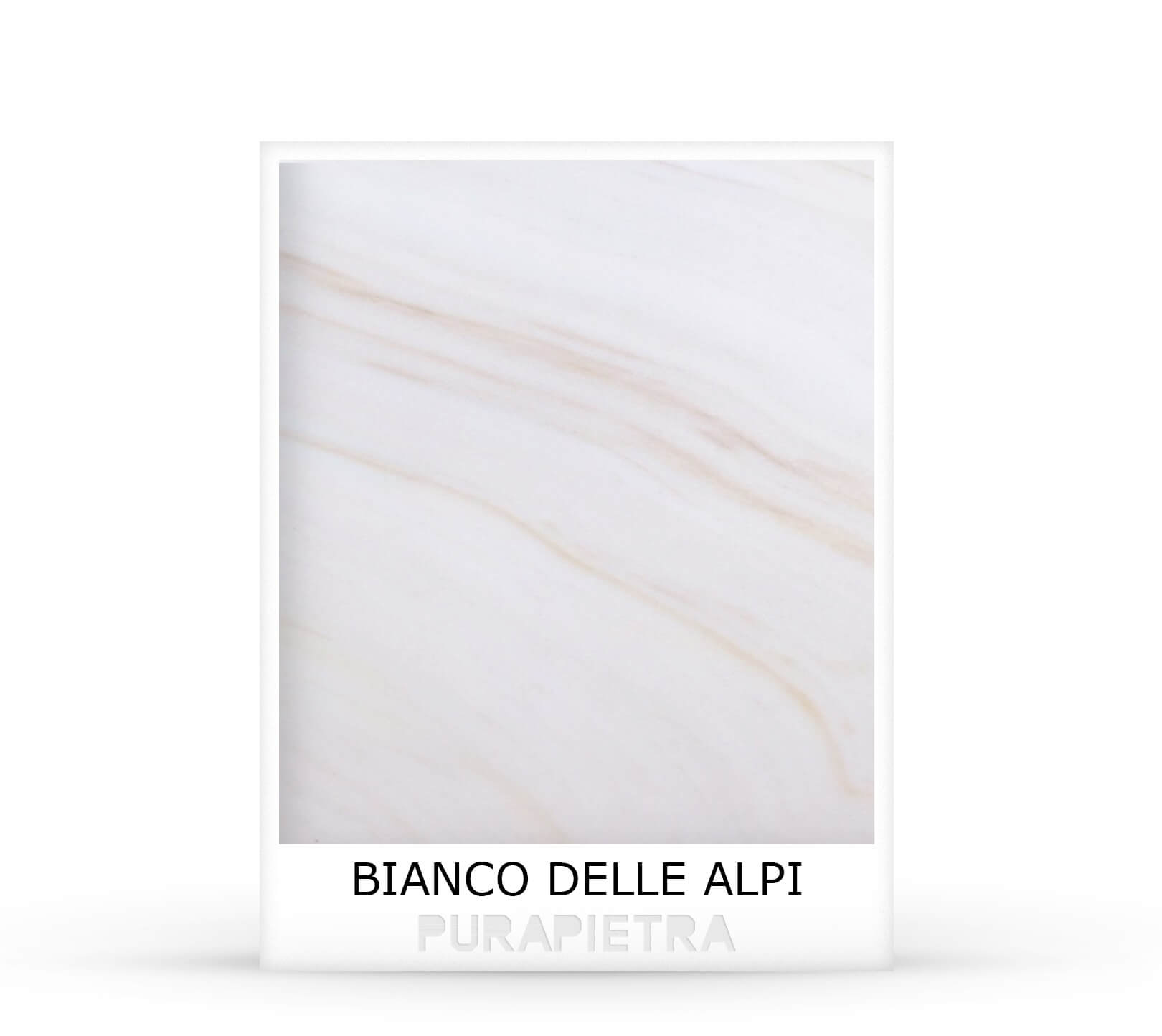
Bianco delle Alpi is an Italian white marble quarried in the alpine arc of northern Italy, prized for a background that reads almost snow-white and for veining so restrained it can disappear at three metres. It sits at the quiet end of the white family, a long way from the theatrical golds of Calacatta and a step cleaner than most Carrara grades. This guide covers where it comes from, how to read a slab, which finishes suit it, and where it earns its place indoors.
Where Bianco delle Alpi comes from
The name is geographic rather than commercial. Bianco delle Alpi is extracted from metamorphic deposits along the Italian alpine belt, in basins where limestone was recrystallised under pressure over millions of years. That process is the same one that produced the more famous Apuan whites further south, and it explains why the two families look related without being interchangeable. You can read the general geology on Wikipedia’s entry on marble, but the practical consequence is simpler: a tighter, more uniform crystal structure than a decorative breccia, and therefore fewer surprises when the block is opened.
Alpine quarrying has its own rhythm. Blocks come out in smaller volumes than the industrial basins of Carrara, and extraction is seasonal in the higher sites. For a workshop like ours that means availability moves in waves rather than a steady supply, and it is worth reserving material early when a project needs several matching slabs. It also means each batch has a character of its own. Two blocks from the same quarry, cut a year apart, will not be twins.
How it differs from Carrara and Statuario
Designers often ask us to line up the Italian whites side by side, and the differences become obvious the moment you do. Classic Carrara carries a faint grey cast and a soft cloudy veining that reads as texture across a large surface. Bianco Statuario is brighter and colder, with more decisive grey veins that make a statement piece. Bianco delle Alpi lands between them but closer to the quiet side: whiter than Carrara in the ground, less graphic than Statuario in the vein.
If you already know the family, our guide to Italian white marble sets out the whole group, and the broader white marble pillar covers how these stones behave as a category.
Reading the slab: ground, vein and movement
Three things tell you what a Bianco delle Alpi slab will do in a room.
The ground. Look at the field between the veins under indirect daylight. A good slab holds a clean, cool white with no yellow drift. Warm patches are not a defect, but they will fight a cool palette and become obvious once the surface is polished.
The vein. Alpine white veining tends to be fine, grey to grey-green, and irregular. On the best blocks it behaves like pencil shading rather than a drawn line. Heavy, dark or ropey veining usually signals material from a different bench and should be judged on its own merits rather than dismissed.
The movement. Because the veining is soft, book-matching is less dramatic here than it is with a Calacatta. That is often the point. On a long kitchen island or a full-height shower wall, the eye reads a continuous field rather than a mirrored pattern, which is exactly what you want when the stone is meant to hold the room together rather than dominate it.
The habits we use to grade a slab apply to any white stone, and we have written them up in more detail in our guide on how to identify quality marble.
Finishes: how the surface changes the stone
Finish does more to a white marble than colour ever will. The same block can look like three different materials depending on how it is treated.
Honed
A honed surface is ground smooth and left matt. On Bianco delle Alpi this is our default recommendation for anything horizontal. Matt white reads soft rather than clinical, etch marks from acids are far less visible because there is no gloss to interrupt, and fingerprints stay invisible. The trade-off is a slightly more absorbent surface, so sealing matters more.
Polished
Polishing closes the surface and lifts the crystal, which makes the white brighter and the veins sharper. It is the right choice for vertical cladding, for a fireplace surround, or for a piece meant to catch light across a hallway. On a kitchen worktop we advise against it. Lemon juice, vinegar and wine leave dull patches on a gloss white that no amount of care will fully prevent.
Brushed and bush-hammered
Brushing runs abrasive heads over the surface until it takes on a fine, leathery texture. It hides wear well and gives Bianco delle Alpi an unexpected warmth. Bush-hammering goes further and produces a rougher, tactile face suited to feature walls and exterior work. Both finishes suppress the veining, so choose them when the material is doing textural work rather than decorative work.
Five places Bianco delle Alpi earns its keep
1. Bathrooms
This is the stone’s natural home. A honed Bianco delle Alpi wall running from floor to ceiling gives a bathroom depth without pattern, and because the veining is faint you can turn corners and run into niches without the joints becoming visible seams. Pair it with a sculpted basin such as our Unit Sink or the wall-mounted Linear, and the room resolves into one material rather than a collection of surfaces.
2. Kitchens
Bianco delle Alpi makes a beautiful island top, with one honest caveat. Marble is calcium carbonate and it reacts to acid. If a client wants a white stone worktop and will not tolerate any change over time, we steer them towards quartzite. If they accept that a kitchen surface acquires a history, honed Bianco delle Alpi is one of the most forgiving whites we work with, because matt hides etching far better than gloss.
3. Cladding and full-height walls
Polished slabs on a vertical plane are where this marble becomes luminous. Cladding takes no wear, so the polish stays perfect, and the fine veining scales well: it reads as texture from across a room and as detail from a metre away. This is the application we recommend when a client falls in love with the polished sample but has an active household.
4. Furniture and monolithic pieces
Solid marble furniture asks a lot of the stone. A tabletop or a carved bath is a single mass with no substrate behind it, so the material has to be structurally sound and visually consistent through its full thickness. The tight alpine crystal structure suits this well, and the restrained veining means a curved edge does not slice through a pattern in an awkward place.
5. Small objects
At the scale of a tray or a vase, a quiet white is worth more than a dramatic one. Heavy veining on a small object turns into visual noise. Bianco delle Alpi keeps its calm even at 20 centimetres, which is why it turns up so often in our trays and vases.
What to pair it with
A quiet white is generous. It sits under almost anything, which makes the pairing decision a question of intention rather than compatibility.
With brass and bronze. Unlacquered brass that is allowed to patinate gives a cool white marble the warmth it lacks. This is the pairing we return to most often for bathrooms.
With dark stone. Setting Bianco delle Alpi against a Nero Marquina or a Nero di Milano produces a contrast that feels architectural rather than decorative. Our notes on black marble interiors cover how to balance the two without the scheme tipping into a chessboard.
With pale timber. Oak, ash and larch bring grain to a room that has very little of it. The combination reads alpine in the best sense, and it stops a white-on-white scheme from feeling like a showroom.
With plaster and lime. Matt mineral wall finishes share the same family of surface as honed marble. Used together they make the stone feel native to the building rather than applied to it.
Care and sealing
Bianco delle Alpi is not difficult to live with, but it does have preferences.
Seal it, then seal it again. A penetrating impregnating sealer sits inside the pores rather than forming a film on top. Apply it on installation and reapply roughly every twelve to eighteen months on working surfaces, less often on cladding. A sealer slows absorption; it does not make the stone acid-proof.
Use pH-neutral cleaners only. Anything containing citrus, vinegar or descaler will dull the surface. Warm water and a neutral stone soap handle almost everything.
Deal with spills quickly. Red wine, oil and coffee are the usual culprits. Blot rather than wipe, so the liquid is not spread across a wider area. Persistent stains can be drawn out with a poultice, which is worth doing before anyone reaches for an abrasive.
Accept a patina. Marble in daily use changes. On a honed surface those changes accumulate into something closer to a leather finish than to damage, and most of the clients who were nervous about it at the start end up preferring the stone at year five.
Working with Bianco delle Alpi at Purapietra
We treat white marble as a structural material, not a veneer. Pieces are cut from solid blocks, shaped on CNC for accuracy and then finished by hand, which is where a sculpted edge stops looking machined and starts feeling resolved. For bespoke work we ask clients to select the actual block rather than a sample, because a 5-centimetre chip cannot tell you what a 3-metre slab is going to do.
Bianco delle Alpi and the rest of our white and coloured stones are shown in the materials catalogue. If you are weighing it against the other Italian whites, Acqua di Carrara is the closest alternative in feel, with a slightly softer, more atmospheric ground. Write to us and we will send current availability, finish samples and a quotation for the piece you have in mind.
Frequently asked questions about Bianco delle Alpi
Is Bianco delle Alpi a real Italian marble or a trade name?
It is a genuine Italian marble, quarried in the alpine districts of northern Italy. The name describes the geographic origin rather than a processing treatment, though as with most stone names it covers a range of grades rather than a single fixed appearance.
How much does Bianco delle Alpi cost?
Price depends on block quality, slab thickness and how much of the material a piece consumes, so a square-metre figure is misleading for bespoke work. As a family it sits below Statuario and Calacatta and roughly alongside good commercial Carrara. We quote per project once the piece and the finish are defined.
Can I use Bianco delle Alpi on a kitchen worktop?
Yes, provided you accept that marble etches on contact with acid. Specify a honed finish rather than polished, seal it on installation, and keep lemon, vinegar and descaling products away from the surface. If a permanently unchanged worktop is the requirement, quartzite is the better material.
Does Bianco delle Alpi turn yellow over time?
Good-quality material does not yellow on its own. Discolouration almost always comes from something else: an unsuitable adhesive bleeding through a thin slab, iron oxidation where the stone stays permanently damp, or a film-forming sealer degrading. Correct installation and a penetrating sealer prevent all three.
Is it suitable for outdoor use?
In mild climates and in a brushed or bush-hammered finish, yes. In locations with hard freeze-thaw cycles or heavy acid rain, exposed marble will lose definition over decades. Granite and some quartzites are the safer specification for fully exposed exterior work.
What is the difference between Bianco delle Alpi and Carrara?
They come from different Italian basins. Carrara is quarried in the Apuan Alps in Tuscany and typically shows a faint grey cast with cloudy veining. Bianco delle Alpi comes from further north and generally reads whiter in the ground with finer, more scattered veins.
How thick should a Bianco delle Alpi worktop be?
Twenty millimetres is standard for a supported worktop and thirty for spans, overhangs or a heavier visual edge. Solid pieces such as basins and tables are cut from full blocks, so thickness there is a design decision rather than a structural minimum.
Coloured Marble: 4 Colours and the Best Ways to Use Them Indoors
Coloured marble is back in serious projects, and the interesting part is not that people are using green or yellow again but how differently they are using it. For twenty years the safe answer in stone was white. That consensus is loosening. This is a guide to the coloured marble worth knowing, how much of it a room can actually take, and the pairings that hold together once the mood board is off the wall.
Why coloured marble came back
The all-white interior was a reaction to the heavy, dark, over-decorated rooms of the decades before it, and like most reactions it went further than it needed to. What replaced the excess was a period of restraint that eventually became its own kind of default: white marble, white walls, pale oak, everywhere, in every price bracket.
Two things pushed colour back into the conversation. The first is that natural stone is one of the only materials in a modern interior that has colour built into it rather than applied to it. A green marble is green all the way through, and it got that way through millions of years of mineral chemistry. That is a different proposition from a painted surface or a printed ceramic, and once you have seen the two next to each other the difference is hard to unsee.
The second is scale. Contemporary projects tend to use coloured marble in small, deliberate quantities: an inset, a single wall, a bath, an object, rather than the wall-to-wall applications that gave the material its dated reputation in the first place. Small doses changed everything.
Green: the coloured marble that behaves
Green is the easiest coloured marble to live with, because green already exists in most interiors in the form of plants and daylight through leaves. The eye does not experience it as a departure.
The range is wide. Verde Alpi is the deep, almost black-green with white fracture veining that most people picture, an Italian serpentinite quarried in the Aosta valley. Verde Mediterraneo and Verde Positano run lighter and more mottled, closer to the colour of shallow water over rock. Malachite is the theatrical one, banded in concentric rings like the mineral it takes its name from, and it is a stone to use once in a room and no more.
Green pairs unusually well with brass and with warm woods, and it is the coloured marble that most reliably survives being put next to a white one. A green inset in a white bathroom, a green plinth under a white basin, a green shelf in a white kitchen: all of these work. Our guide to green marble goes further into the varieties and their uses.
Yellow: warmth without weight
Yellow coloured marble does something no other colour does, which is raise the temperature of a room without darkening it. Giallo di Bolgheri, quarried in the Tuscan Maremma, is honey to amber with soft cloudy movement rather than hard veining. Crema Amalfi and Avorio Striato sit at the pale end, closer to a warm neutral than a colour, and are useful when you want warmth but not a statement.
The risk with yellow is that under warm artificial light it can tip from honey to something closer to nicotine. It is worth seeing a yellow slab under the actual lighting temperature the room will have, and worth avoiding it altogether in a space lit only by low-Kelvin bulbs. Under daylight, or under neutral 3500K to 4000K light, it is a beautiful stone. There is more on the varieties and where they sit in our yellow marble guide.
Pink: the least obvious success
Pink carries more baggage than any other coloured marble and rewards you for ignoring it. The stones themselves are subtle: Rosa di Venezia is a soft dusty rose with grey drifting through it, Flora is paler and more clouded, and Pink Onix is translucent enough to be lit from behind. None of them are the saturated bubblegum that the word suggests.
Pink works best where you would otherwise have used a warm white, and it works particularly well in bathrooms, because it is the one colour that flatters skin under artificial light. Used as a full-height cladding in a small windowless room it turns what would have been a cold box into something enveloping. Paired with grey, with unpolished brass or with a deep green it stops reading as pink at all and starts reading as a warm neutral with more going on than usual. Our pink marble guide covers the varieties in more detail.
Blue: the rarest and the most demanding
Genuine blue in stone is uncommon, because the minerals that produce it are uncommon. Sodalite Lapis is the deepest of them, a dense royal blue shot through with white calcite. Sky Onix is pale and translucent, closer to a winter sky than to a pigment. Stormo Blue and Mare d’Inverno sit in the grey-blue middle where the colour reads as atmosphere rather than as a decision.
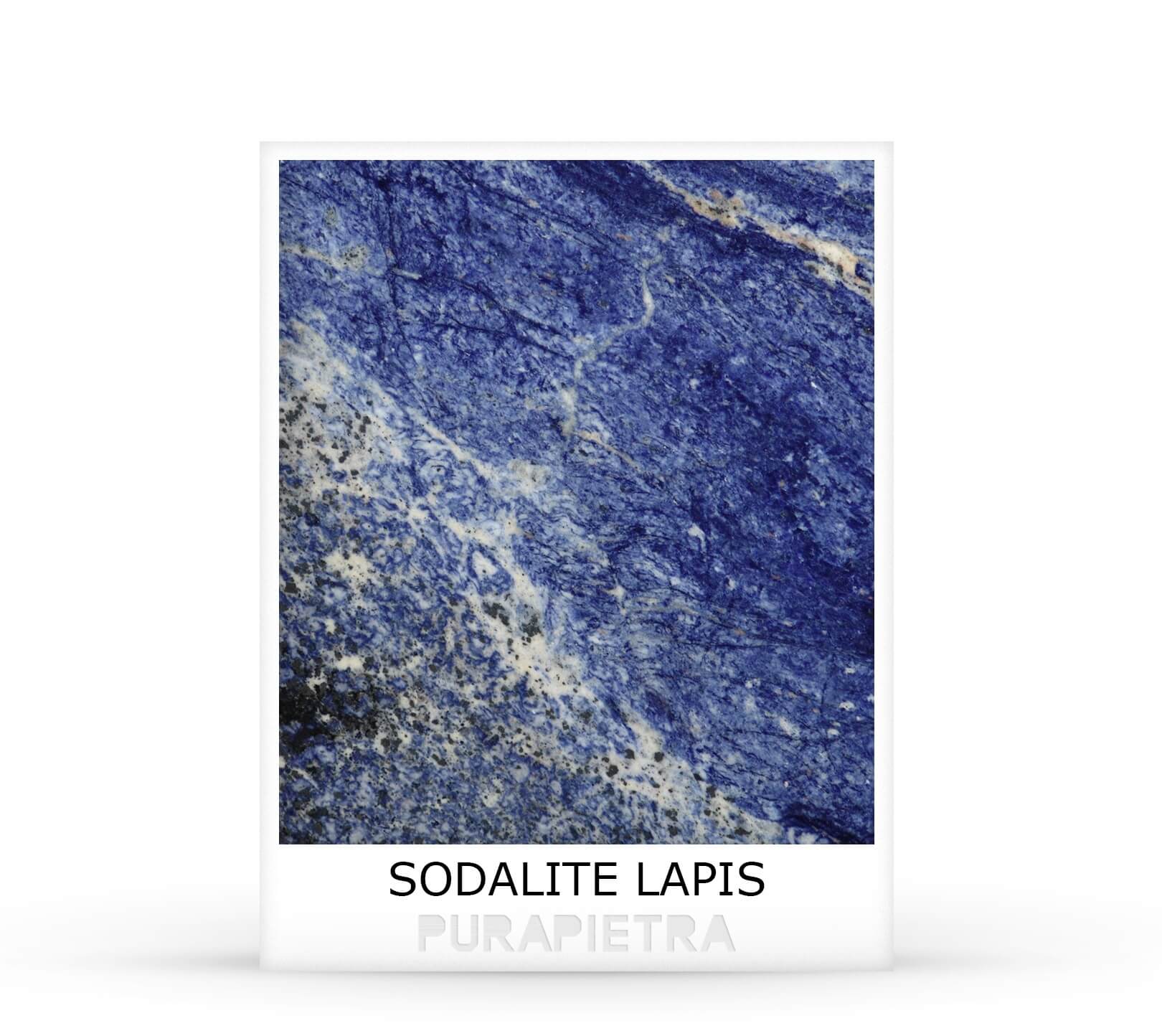
Blue is the hardest coloured marble to place, for a simple reason: it is a cool colour, and most of the materials people put around stone are warm. Blue against oak, blue against brass and blue against terracotta all fight. Blue against white, against grey, against blackened steel or against another blue works immediately. The other constraint is supply. Sodalite and the deep blues come in limited block sizes, so a continuous run of any length is often not possible and a small, framed application is the honest way to use them.
How much coloured marble a room can take
This is where most coloured stone projects succeed or fail, and the answer is usually “less than the mood board suggests”.
One coloured marble per room. Two of them in the same space almost always end up in competition, because both are strongly figured and neither will yield. If you want a second material with presence, make it a metal or a wood.
Keep the proportions unequal. A coloured stone occupying somewhere between five and twenty per cent of the visible surface reads as intentional. At fifty per cent it reads as indecision. A green inset in a white floor, a yellow band at splashback height, a pink alcove in a grey bathroom: all of these are the right size.
Put it where the eye already goes. Behind a basin, around a fireplace, on the front of an island, on a single wall at the end of a sightline. Colour in a place the eye passes over is wasted, and colour everywhere is noise.
Let quiet stone carry the volume. A calm white or grey does the structural work and the coloured marble does the accent. Our guides to white marble and grey marble cover the backgrounds that coloured stone sits best against.
Finishes: how the surface changes a coloured marble
Finish matters more with colour than it does with white, because the surface decides how saturated the stone looks.
Polished pulls the colour up to its maximum. A polished Verde Alpi is almost black-green and reflective; the same slab honed is noticeably lighter and softer. If the colour is the reason you chose the stone, polishing is how you get all of it, at the cost of showing every fingerprint and every etch mark.
Honed takes roughly a shade out of the colour and gives it a chalky, matt quality. On floors it is the safer choice for grip, and on a strong colour it stops the surface becoming a mirror in a room that did not need one.
Brushed and leathered finishes sit between the two and are the most forgiving for horizontal surfaces that get used. On a deep coloured marble the faint texture catches light unevenly, which reads as depth rather than as wear.
The practical point is that a sample is only meaningful in the finish you are actually going to specify. Comparing a polished sample of one stone against a honed sample of another tells you almost nothing about how they would look side by side.
Lighting: the part most schemes get wrong
Colour in stone is entirely at the mercy of the light falling on it, and a coloured marble chosen in a daylit warehouse is a different material under warm downlights at night.
Warm light at 2700K deepens reds, pinks and yellows and pushes greens towards olive. It flatters Rosa di Venezia and Giallo di Bolgheri and does no favours at all to blue. Neutral light at 3500K to 4000K is the most honest across the whole range and the safest default when a room contains more than one stone. Daylight varies with orientation: a north-facing room cools every colour by a noticeable degree, which is worth knowing before choosing a blue for one.
Backlighting is a separate technique and it only applies to the translucent stones. Onyxes such as Pink Onix and Sky Onix, cut thin and lit from behind, stop reading as surfaces and start reading as light sources. It is a beautiful effect and an unforgiving one: the panel has to be evenly lit or every variation in thickness shows.
Coloured marble at object scale
The lowest-risk way into coloured stone is not a wall. It is an object.
A bowl in green marble, a tray in a warm yellow, a vase in something deep and figured: at that scale you get the whole colour and none of the commitment, and if the room changes around it, the piece moves. It is also the scale at which the material is most legible, because you are seeing the stone as a solid rather than as a surface, with the edges and the thickness visible.
Several pieces in our trays and vases collections exist for exactly this reason, and a single object is often what convinces someone that a coloured marble belongs in the house at all. The larger applications tend to follow later.
Pairings that hold together
A few combinations come up repeatedly in projects because they work rather than because they are fashionable. Green with brass and pale oak, which is warm without being heavy. Yellow with off-white and blackened steel, where the metal stops the yellow becoming sweet. Pink with mid grey and unlacquered bronze, which keeps the pink honest. Blue with white and chrome, cool throughout and deliberately so. And any coloured marble against a large plain field of the same stone’s palest relative, which is the most reliable trick there is.
The pairing to avoid is coloured stone against a patterned non-stone surface. A green marble next to a patterned tile, a printed wallpaper or a strongly grained veneer produces two competing rhythms, and the stone always loses, because the other material is cheaper to replace and therefore usually wins the argument later.
Practical notes before you specify
Coloured marbles are not all the same material underneath. Serpentinites such as Verde Alpi are harder than calcitic marbles but more prone to fracture along their veins, which is why green slabs are often resin-backed and net-reinforced. Onyxes, including the pink and blue translucent stones, are softer, more brittle and best used vertically or backlit rather than as a working horizontal surface. The saturated colours also show etching and wear more visibly than a white does, because there is more contrast to lose.
Sealing follows the same rules as it does for any calcium carbonate stone: an impregnating sealer on installation, pH-neutral cleaners only, and no acids anywhere near the surface. The one difference is that on a dark coloured marble an unsuitable sealer can leave a visible sheen where it pools, so it is worth testing on an offcut first.
Two rules cover most of the rest. See the actual slab, not a photograph, because colour reproduction on a screen is unreliable and colour is the entire point here. And view it under light close to the light in the room it is going into. Our full range is on the materials page, organised by colour family, and there is a broader introduction to the material itself on Wikipedia’s marble entry.
If you are working on something specific and want to talk the material through before committing, write to info@purapietra.it.
Frequently asked questions about coloured marble
What is coloured marble?
Coloured marble is natural stone whose colour comes from minerals present when the rock formed, rather than from any surface treatment. Iron oxides give reds, pinks and yellows, serpentine and chlorite give greens, and rarer minerals such as sodalite give blue. The colour runs through the whole thickness of the stone.
Which coloured marble is easiest to use in a home?
Green, in most cases. It sits comfortably alongside wood, brass and white stone, and the eye accepts it readily because green already appears in most interiors through plants and daylight. Pale yellows and dusty pinks are almost as forgiving. Deep blue is the most demanding, both to pair and to source.
Is coloured marble more expensive than white marble?
It varies more than it does with the whites. Common greens and warm creams can cost less than premium Italian white marble, while rare blues, translucent onyxes and strongly figured stones such as Malachite cost considerably more. Block size limits are often the real constraint rather than the price per square metre.
Can coloured marble be used in a bathroom?
Yes, and small bathrooms are one of its best applications, since the surface area is limited and the impact is high. Choose a honed finish for floors, seal on installation, and use only pH-neutral cleaners. Translucent onyxes are better on walls and backlit panels than on floors or worktops.
Does coloured marble fade over time?
Not indoors. The colour is mineral and stable. What changes is the surface: a polished finish will dull where acids touch it, and heavy traffic will wear a sheen down over years. Both are surface conditions and both can be restored by a stone specialist without the colour being affected.
How much coloured marble should a room have?
As a working rule, somewhere between five and twenty per cent of the visible surface, concentrated in one place the eye already goes. One coloured stone per room, with a quiet white or grey doing the rest of the work.
Which finish is best for coloured marble?
Polished gives the deepest, most saturated colour but shows every mark. Honed takes about a shade out of the colour and is the safer choice on floors and in bathrooms. Brushed sits between the two and hides daily wear best on horizontal surfaces.
Keep exploring the Purapietra magazine. See also our guides to green marble, yellow marble and pink marble, or browse the full materials collection.
Acqua di Carrara Marble: 4 Finishes and the Best Ways to Use It
Acqua di Carrara is the quietest stone in the Carrara family. It has the white ground everyone recognises and almost none of the drama, which is exactly why designers keep coming back to it. This guide covers where Acqua di Carrara is quarried, how to read its veining, the four finishes that change it completely, the best ways to use it in a house, and what it asks of you once it is installed.
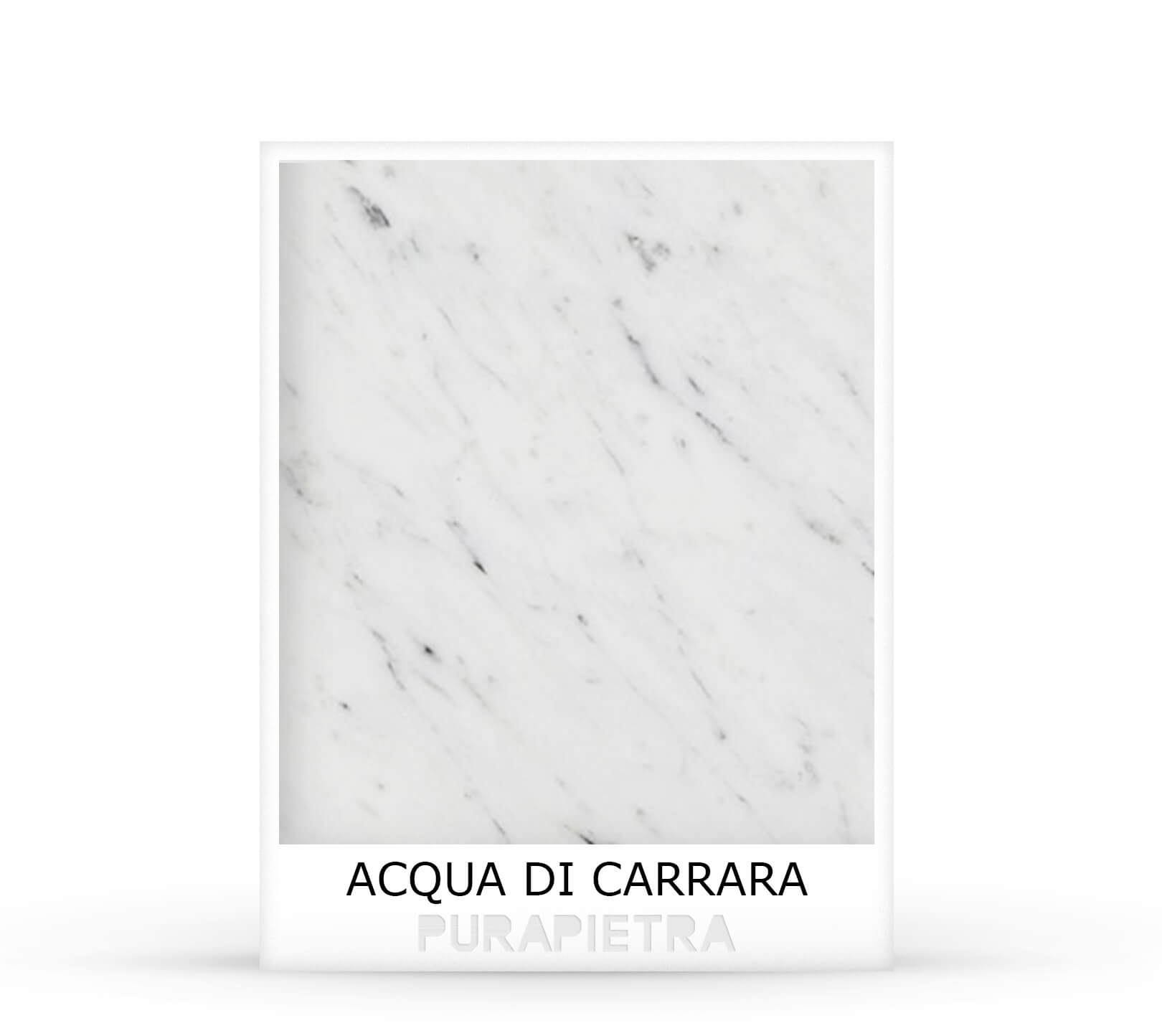
Where Acqua di Carrara comes from
Acqua di Carrara is quarried in the Apuan Alps above Carrara, in northern Tuscany, from the same basin that has supplied sculptors and architects since Roman times. Geologically it is a metamorphic marble: limestone laid down on an ancient seabed, then buried, heated and compressed until the calcite recrystallised into the dense, close-grained white the area is known for.
The Apuan basin runs to more than a hundred active and historic quarries. The commercial names attached to the stone that comes out of them describe the character of a particular seam rather than a different mineral. Statuario, Calacatta, Bianco Carrara and Acqua di Carrara are all the same rock with different personalities.
This one sits at the calm end of that spectrum. The name translates roughly as “water of Carrara”, and it is a good description of the effect: the veining moves through the slab the way sediment moves through still water, in soft grey drifts rather than the sharp black lines of a Bardiglio or the gold-brown branching of a Calacatta. Where Statuario is the stone you choose when you want the marble to be the event in the room, Acqua di Carrara is the one you choose when you want the room to be the event and the marble to hold it together.
That distinction matters commercially as well as visually. Statuario blocks are rare and priced accordingly. Acqua di Carrara comes out of the mountain in usable volume, which means larger continuous surfaces are realistic, and it means the price sits in a more workable range for a whole bathroom or a full run of cladding. If you want the wider context on the Tuscan whites, our guide to Italian white marble sets them side by side, and there is background on the quarrying district itself on Wikipedia’s Carrara marble entry.
Reading the stone: ground, veining and colour
Three things are worth learning to look at before you commit to a slab.
The ground. The base is a cool white with a faint grey cast, not the warm ivory of a Crema or the optical, almost blue-white of a top-grade Statuario. Under warm artificial light it reads as soft white. Under north daylight it can look faintly silver. Neither is a fault, but it does mean Acqua di Carrara behaves differently in a north-facing bathroom than it does in a south-facing kitchen, and it is the reason we always ask where a slab is going before recommending a finish.
The veining. Fine, diffuse and directional. It tends to run as a soft grey wash with occasional darker threads, and it holds the same rhythm across the block, which is what makes bookmatching straightforward. There is no sudden change of key from one metre to the next.
The uniformity. This is the practical advantage. Because the pattern is consistent, offcuts still look like the main surface, joints are easier to plan, and a mistake at the fabrication stage is easier to recover from. On a heavily figured marble, a badly placed cut ruins the panel. On Acqua di Carrara it rarely does.
Acqua di Carrara compared with the other Carrara whites
Most of the confusion around Tuscan white marble comes from the names, so it is worth putting them side by side. All four stones below come out of the same mountains, and the differences are of degree rather than of kind.
Against Bianco Carrara
Bianco Carrara is the commercial workhorse, and it comes in graded qualities: C, CD, Venato and so on. The lower grades carry a greyer ground and a busier, more scattered veining that can read as noisy over a large surface. Acqua di Carrara is cleaner and more directional, so it holds together better when the surface gets big. If you have seen a Bianco Carrara bathroom that felt slightly restless, this is usually why.
Against Statuario
Statuario is the trophy stone: a brighter, more optical white with bold, well-separated grey veining, quarried in limited volume and priced for it. It is a feature material and behaves like one. Acqua di Carrara does the opposite job. It is a background, and on a project where the joinery, the metalwork or a single sculptural piece is meant to lead, that is the more useful behaviour.
Against Calacatta
Calacatta has a warmer ground and thicker veining that often carries gold or ochre. It is beautiful and it is emphatically not neutral, which means everything else in the room has to agree with it. Choosing Acqua di Carrara instead is usually a decision about how much of the room you want the stone to decide.
Against Bardiglio and the greys
Bardiglio is the grey of the same district, and it makes a natural companion rather than a competitor. A Bardiglio floor under Acqua di Carrara walls, or a Bardiglio inset in a white surface, keeps everything within one geological family while giving the eye a change of tone. Our grey marble guide covers those varieties in more depth.
The 4 finishes: how the surface changes the stone
Honed
Ground to a smooth matt surface with no reflection. This is what we specify most often for Acqua di Carrara, because the softness of the veining suits a soft surface. Honed marble diffuses light instead of bouncing it, hides water marks and fingerprints far better than a polish, and gives the stone a chalky, almost fabric-like quality up close. The trade-off is that a honed surface is slightly more open and wants sealing more attentively.
Polished
Buffed to a reflective sheen. Polishing deepens the grey of the veins and pulls up whatever contrast the slab has, so it is the finish to choose if you want the pattern to read from across the room. It also closes the surface, which helps with staining. On floors it is the least forgiving option underfoot when wet.
Brushed and leathered
Worked with abrasive brushes until the surface has a faint texture and a low satin lustre. It is a good middle ground for horizontal surfaces that get used, because the slight irregularity disguises the small marks that daily life leaves on stone. On a kitchen island in particular, brushed Acqua di Carrara ages better than polished.
Sandblasted and split
Heavier textures, mostly kept for exterior cladding, steps and thresholds where grip matters. Worth knowing that changing the finish between two adjoining surfaces of the same stone is often a better move than changing material altogether.
The best ways to use Acqua di Carrara in interiors
Bathrooms
This is the stone’s natural home. A bathroom clad in a strongly veined marble can feel busy the moment you put a mirror, a tap and a towel rail in front of it. Acqua di Carrara absorbs all of that. Run it from the floor up through the shower, stop it at a clean horizontal line, and let the fittings do the talking. A carved basin in the same stone turns a functional object into something closer to sculpture, which is the thinking behind our Linear wall-mounted basin and the Unit freestanding basin.
Kitchens
Marble in a kitchen is a decision, not a default. Acqua di Carrara is a calcium carbonate stone, so it will etch where an acid touches it: lemon, wine, tomato, vinegar, most descalers. What people find, though, is that a lightly veined white takes a patina better than a dramatic one, because the dull marks that build up over years read as part of the surface rather than as damage to a pattern.
If you want stone in the kitchen but not the maintenance conversation, use it as a splashback or an island front and put a harder material on the worktop. That combination gives you the material where you see it and something more forgiving where you work.
Walls, floors and stairs
On walls Acqua di Carrara behaves as a warm-cool neutral: it gives a room a base tone and then stops asking for attention. On floors, large formats with tight joints keep the surface calm, and a honed finish is the sensible choice for grip. On stairs, the directional veining can be run continuously up the flight, which is one of those details nobody consciously notices and everybody feels.
Objects
At object scale, a quiet white marble is at its most persuasive, because you are seeing the whole piece at once and there is nothing to compete with the form. Our marble vases and trays exist for that reason: they bring the material into a room with no building work involved.
Pairings that work
Acqua di Carrara is generous with other materials, which is part of its appeal. With pale oak or walnut it warms up and reads domestic. With brushed brass or unlacquered bronze the grey in the veins picks up the metal and the whole scheme settles. With blackened steel it goes graphic and architectural. And with another stone, the contrast can be very effective if you keep the proportions unequal: a dark green or black inset against a field of white works, while a fifty-fifty split usually does not. Our guides to green marble and black marble cover the counterparts if you are planning that kind of pairing.
The pairing to be careful with is a warm white. Acqua di Carrara next to an ivory or cream stone tends to make both look slightly wrong, because the eye reads the temperature difference as a mismatch rather than a choice. Either commit to the cool family or put enough distance between the two.
Formats, thickness and how the stone is supplied
Slabs arrive from the Apuan district at roughly 300 by 160 centimetres, though the usable area is always smaller once edges and any fractured zones are taken out. Two thicknesses cover most interior work: 2 cm for cladding, shower walls and lighter horizontal surfaces, and 3 cm for worktops, thresholds and anywhere an exposed edge has to look substantial.
Where a thicker edge is wanted without the weight of a solid 6 cm slab, a mitred build-up is the standard solution: two pieces cut at 45 degrees and joined so the veining continues around the corner. Done well the joint is invisible and the surface reads as a solid block. Done badly it is the first thing anyone notices, which is why it is worth asking to see a fabricator’s mitres before committing a project to them.
One more supply note. Because Acqua di Carrara is quarried in volume, matching slabs from the same block is realistic in a way it is not with the rarer whites. If a project needs continuity across several rooms, reserve the block rather than the square metres. It costs nothing extra to ask and it is the difference between a scheme that looks planned and one that looks assembled.
Maintenance and sealing
Less demanding than its reputation suggests, but it does want a routine. Seal on installation with a good impregnating sealer, and again every one to two years on surfaces that get wet or used, less often on walls. Clean with a pH-neutral stone cleaner and nothing else: no vinegar, no lemon, no generic bathroom or kitchen spray, no abrasive cream. Wipe spills when they happen rather than when you notice them.
Etching, the dull matt mark left where an acid has touched a polished surface, is the thing people mistake for staining. It is not a stain, it is a change in the surface, and on a honed finish it is often invisible. On a polished finish a marble polishing powder will usually bring it back. Deep staining is the harder problem, and sealing is what prevents it. Put mats at external doors if the stone is on a floor, because grit underfoot does more damage over ten years than any spill will.
Choosing a slab
Three things are worth insisting on. See the actual slab rather than a sample chip, because the grey cast and the density of the veining vary from block to block and a 10 cm sample tells you almost nothing. Look at it in light similar to where it is going, or at least know which way the room faces. And ask where the stone will be worked, because with a quiet marble the craft is all in the edges and the joints.
A clean edge profile, veining that runs continuously from one panel to the next, a mitred corner that reads as a solid block: that is what separates a considered surface from a bought one. It is also the part of the process that no photograph will show you, and the part worth spending on. Our guide to how to identify quality marble goes through what to look for in the slab itself.
If you are working towards something specific, a bathroom, a single carved piece or a whole interior, we are happy to talk the material through before anything is committed. Write to info@purapietra.it, or browse the full range on our materials page.
Frequently asked questions about Acqua di Carrara
What is Acqua di Carrara marble?
Acqua di Carrara is a white marble quarried in the Apuan Alps above Carrara, in Tuscany. It has a cool white ground and fine, diffuse grey veining that drifts through the slab rather than cutting across it, which makes it the calmest of the well-known Carrara whites.
What is the difference between Acqua di Carrara and Statuario?
Both come from the same quarrying basin. Statuario has a brighter, more optical white ground and bold grey veining that makes it a feature material, and it is considerably rarer and more expensive. Acqua di Carrara has softer, more diffuse veining and a slightly greyer ground, so it works as a background rather than a focal point.
Is Acqua di Carrara suitable for a bathroom?
Yes, and it is one of its best uses. Choose a honed finish for grip and to keep water marks invisible, seal on installation, and use only pH-neutral cleaning products. Avoid acidic descalers and limescale removers on the stone itself.
Can Acqua di Carrara be used as a kitchen worktop?
It can, provided you accept that it will etch where acids touch it and develop a patina over time. Many people like that. If you want a surface that stays exactly as installed, use the marble on the splashback or island front and choose a harder material for the working top.
How much does Acqua di Carrara cost?
It sits in the mid range for Italian white marble, below Statuario and Calacatta and above the most common commercial Bianco Carrara grades. The final figure depends on slab thickness, finish, block selection and fabrication far more than on the stone name, so it is best quoted against a specific project.
What is the difference between Acqua di Carrara and Bianco Carrara?
They come from the same district, but Bianco Carrara is a graded commercial category whose lower grades have a greyer ground and busier, more scattered veining. Acqua di Carrara has a cleaner ground and more directional veining, which holds together better across large surfaces.
Does Acqua di Carrara yellow over time?
Not on its own. Yellowing in white marble is almost always caused by an unsuitable sealer, an oil-based product, iron in the water reaching the stone through an open surface, or a cementitious adhesive bleeding through a thin slab. Correct sealing and the right installation method prevent it.
Keep exploring the Purapietra magazine. See also our guides to white marble, Italian white marble and travertine, or browse the full materials collection.
Black Marble Interiors: Varieties, Pairings and Design Ideas
Black marble interiors have a reputation for being severe. In practice the opposite is true: black is the most flattering background a room can have, as long as you know how much of it to use and what to put next to it. This is a guide to the varieties worth knowing, the pairings that work, the rooms that suit the stone, and the small habits that keep a black surface looking right.
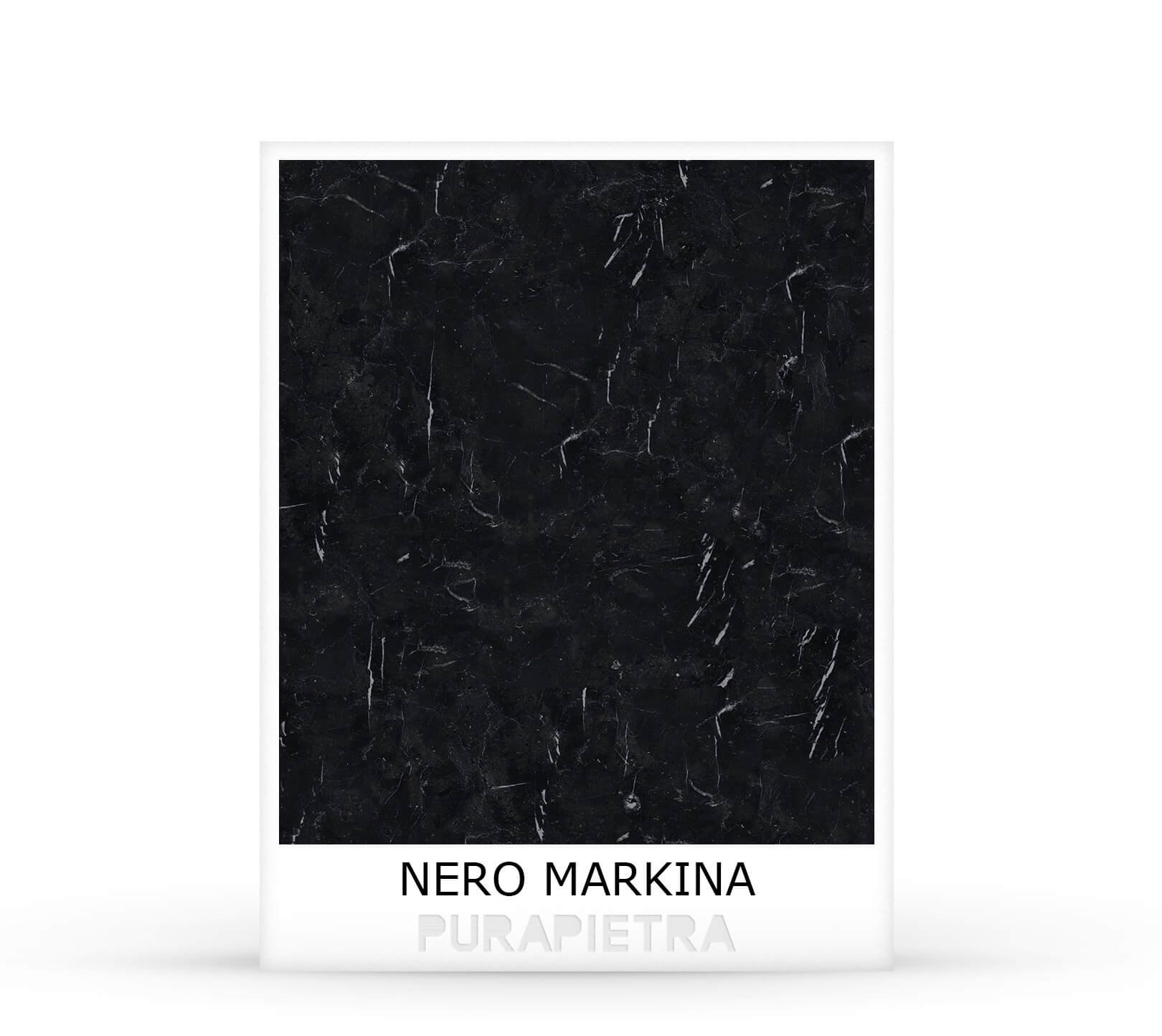
Why black works in a room
Black absorbs light instead of returning it, and that single property does most of the work. A black surface recedes, so the objects in front of it come forward. Put a pale ceramic bowl on a black marble table and the bowl looks better than it did on oak. Set brass taps against a black wall and the metal reads as warm rather than yellow. This is the whole argument for black marble interiors, and designers reach for the stone for the same reason galleries paint walls a flat neutral: it makes everything else legible.
The second thing black does is give a room a floor, in the compositional sense. Interiors built entirely from mid-tones tend to feel unresolved, as though nothing has been decided. One black element anchors the whole arrangement. It does not need to be large. A single carved object, a threshold, a plinth, a table top is enough to settle a room that was not quite working.
Where black marble interiors go wrong is quantity. Black takes light out of a space, and a small room clad floor to ceiling in a dark stone will feel like a vault regardless of how good the marble is. The rule most of our clients arrive at, usually after some persuasion, is that black should be the accent that everything else is measured against, not the field.
The varieties worth knowing for black marble interiors
Not all black marble behaves the same way, and the difference between them is mostly about how loud the veining is.
Nero Marquina
The one most people picture. A dense, near-uniform black from the Basque Country, crossed by white veins that can be fine and scattered or thick and dramatic depending on the block. It is graphic, high contrast and photographs beautifully, which is why it turns up in so many hotel bathrooms. In a home it wants a calm setting: the stone is doing enough on its own.
Nero Tempesta
Softer and more atmospheric. The black is less absolute and the veining reads as movement rather than as line, closer to weather than to graphics. Where Nero Marquina is a statement, Nero Tempesta is a texture, and it is often the better choice for larger surfaces because the eye does not tire of it.
Nero di Francia and Nero di Milano
Deeper, quieter blacks with restrained veining. These are the ones to specify when you want darkness itself rather than pattern, and they work particularly well for carved pieces where the form should be doing the talking, not the surface.
Kenya Black
A black with a direction. Bands of charcoal and near-black fold and ripple through the slab, picked out by thin white veins, closer to wood grain than to a flat black. Polished, the bands turn glassy and the veining sharpens. Honed, the same stone goes from glossy to velvet and the pattern softens.
All of these sit in the Purapietra catalogue alongside the other colour families, and they are worth comparing side by side on the materials page before deciding. For the geology and the fuller technical picture, our pillar guide to black marble goes deeper into where the colour comes from and how the stone behaves.
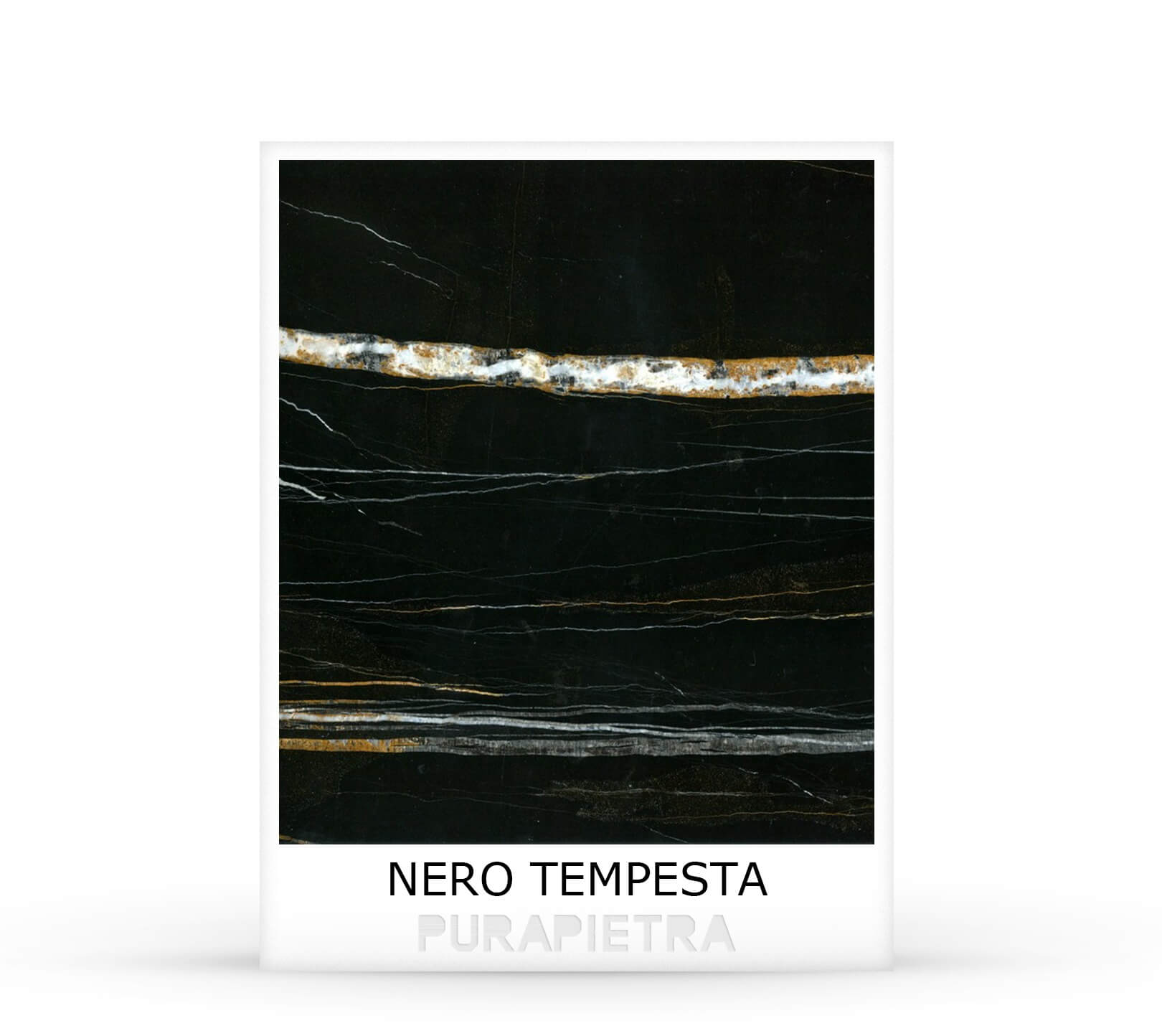
Pairings: what makes black marble interiors work
Black and gold, or better, black and brass
The classic, and the one most at risk of tipping into pastiche. Gold against black is undeniably rich, but polished gold on polished marble in a small room reads as a hotel lobby. Unlacquered brass, which dulls and warms as it ages, gives the same warmth with none of the glare. Keep the metal to the small things: taps, handles, an edge detail, the rim of a tray.
Black and wood
The most forgiving pairing there is, and the one we specify most. Mid and dark woods, walnut and oiled oak in particular, share black marble’s warmth without competing with it. Wood also brings grain, which stops a dark scheme from going flat. A black marble top on a walnut base is a combination that has never really dated.
Black and white
Maximum contrast, so it needs a light hand. Rather than splitting a room in half, let one material dominate and use the other as a line: a black threshold in a pale floor, a white basin on a black surround. The pillar guide to white marble is useful here if you are trying to match the two families in a single scheme.
Black and green
Less obvious and quietly excellent. Deep greens, whether in a stone such as Verde Alpi, in textiles or in planting, sit naturally against black because both are dark and neither is neutral. Our guide to green marble covers the tones that pair best.
Black and warm neutrals
Plaster, linen, travertine, unglazed terracotta. This is the softest way to use black marble and the one that suits a home best. The black stops being dramatic and starts being grounding, which is usually what you actually want to live with.
The rooms that suit black marble
Bathrooms
The room where black marble interiors are most tempting and most often overdone. The version that works: one black surface, generous natural or well-placed artificial light, and everything else pale. A black vanity top against plaster walls, or a black-clad shower enclosure in an otherwise light room. A sculpted basin in a dark stone becomes the object the room is built around, which is the thinking behind pieces such as the Unit freestanding basin and the wall-mounted Linear.
Kitchens
Black marble is beautiful on an island and demanding on a worktop. Polished black shows water marks, dust and every fingerprint, so if the stone is going somewhere that gets used, specify a honed finish. It hides marks better and it looks more contemporary. Reserve the polish for a vertical surface where nothing touches it.
Living rooms
This is where black marble interiors are at their easiest, because the stone is not being asked to work. A low table, a fireplace surround, a plinth. The material gets to be sculpture, and the room gets its anchor.
Objects, at any scale
The lowest-commitment way into black marble interiors, and the one we would suggest to anyone unsure. A tray, a bowl, a vase in a dark stone gives a room the same weight a large surface would, on a shelf instead of a wall. A good number of our trays and vases were designed with exactly this in mind, turned and hollowed from a single block and finished by hand in Italy.
Living with a black surface
Black marble interiors are not more fragile than any other stone. It is simply more honest about what happens to it. Dust reads on a dark polish. A ring left by a glass shows immediately. Limescale is visible in a way it never is on white. None of this is damage, and most of it disappears with a wipe, but it does mean black rewards a honed finish in any room where life happens.
The care itself is standard. Seal on installation and periodically after that. Clean with a pH-neutral stone product, never with vinegar, lemon, bleach or an abrasive cream. Wipe spills promptly, particularly anything acidic, because black marble etches like every other calcite marble and a dull patch is more visible against black than against grey. Coasters under glasses, and a cloth rather than a scourer.
One habit worth adopting: keep a soft dry microfibre cloth near any black marble surface you use daily. Most of what shows on black is dust and water, and both come off dry in seconds. It is a smaller commitment than people imagine before they own the stone.
Starting a project
Black marble interiors repay being decided early rather than added at the end, because the whole palette of a room ends up arranged around it. If you are weighing it for a bathroom, a piece of furniture or a single carved object, we are glad to talk it through before anything is committed. Write to info@purapietra.it.
Black is one register among several. If you are working out how marble should behave across a whole house rather than in a single dramatic room, our guide to marble interiors covers the styles, the rooms worth committing to and the mistakes most worth avoiding.
Frequently asked questions about black marble interiors
Does black marble make a room look smaller?
It can if it covers large surfaces, because black absorbs light rather than reflecting it. Used as an accent, on a worktop, a table, a threshold or a single clad wall, it does the opposite: it gives the room a visual anchor and makes lighter materials read more clearly against it.
Which is the best black marble for interiors?
It depends on how much pattern you want. Nero Marquina gives high contrast with sharp white veining and suits smaller statement surfaces. Nero Tempesta is softer and more atmospheric, better across large areas. Nero di Francia and Nero di Milano are quieter, near-uniform blacks that suit carved pieces where the form should lead. Kenya Black is the exception: a patterned black with flowing charcoal bands and white veining.
What colours go with black marble?
Unlacquered brass, walnut and oiled oak, warm neutrals such as plaster and linen, and deep greens. Crisp white works too but needs restraint, since maximum contrast in a small room can feel harsh. Polished gold and cool chrome are the two to use most sparingly.
Should black marble be polished or honed?
Honed in any room that gets used. A honed finish hides dust, water marks and fingerprints far better and reads as more contemporary. Keep polished black for vertical surfaces and feature areas where nothing touches the stone.
Is black marble hard to maintain?
No harder than other marbles, but less forgiving visually, because dust, water rings and limescale all show against a dark surface. Seal it, clean it with a pH-neutral product, wipe spills promptly and keep a dry microfibre cloth to hand. That is most of it.
Can black marble be used in a small bathroom?
Yes, with one condition: keep it to a single surface and make sure the room is well lit. A black vanity top or a black-clad shower wall in an otherwise pale bathroom gives depth. Cladding every surface in a small room is what makes the space feel closed in.
Keep exploring the Purapietra magazine. See also our pillar guide to black marble, our guides to white marble and green marble, or browse the full materials collection.
Travertine: Characteristics, Finishes and Contemporary Uses
Travertine is the warm one. Where marble can feel cool and formal, travertine brings the temperature of a room up, and it does it with a surface that shows how it was made. This guide covers what the stone actually is, how the finish changes its character completely, where it belongs in a contemporary interior, how it compares with marble, and what looking after it really involves.
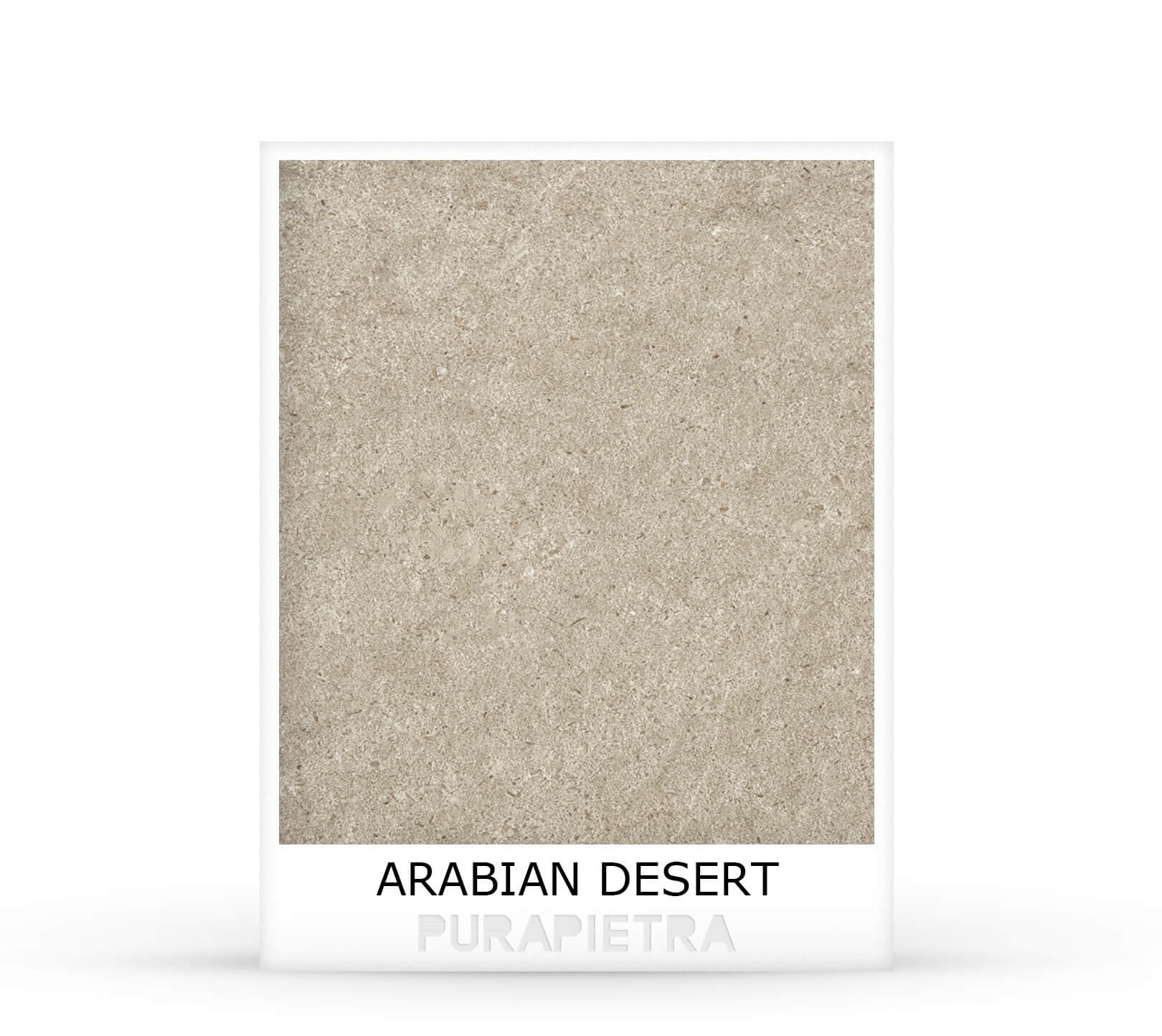
What travertine is and how it forms
Travertine is a form of limestone, but it is born in a way that sets it apart from every other stone we work with. It precipitates out of mineral springs, usually hot ones, where water saturated with dissolved calcium carbonate reaches the surface, loses pressure and carbon dioxide, and drops its mineral load layer by layer. The process is slow and it is atmospheric: gas escaping through the depositing calcite leaves behind the small open cavities that give the stone its signature. Those pores are not a defect. They are the fossil record of bubbles rising through water thousands of years ago.
The layering matters as much as the porosity. Because the stone builds up in seasonal bands, it has a clear grain, and the direction you cut it changes what you see. Cut across the bands, in what the trade calls a vein cut, and you get long linear striping that reads as calm and architectural. Cut with the bedding, a cross cut, and the same block gives clouded, flowery patterning with a much softer rhythm. Two surfaces from one block, two entirely different moods. It is one of the few materials where the fabricator’s decision is as visible as the quarry’s.
Colour comes from iron and other trace minerals in the source water, which is why it runs from near-white ivory through cream and honey to walnut and, less commonly, a silvery grey. The classic Roman travertine, quarried around Tivoli east of Rome, is the warm ivory most people picture. It has been quarried continuously for more than two thousand years, which tells you something about how the material wears.
Colours and finishes: the same stone, four different characters
More than with almost any other natural stone, the finish decides what the stone looks like in a room. Choosing the stone is only half the decision.
Filled and polished
The pores are filled with a matching resin or cement, then the surface is polished to a reflective sheen. This is the stone at its most formal. It reads closest to marble, catches light, and suits lobbies, feature walls and anywhere you want the stone to look deliberate and dressed. The trade-off is that polishing flattens some of the texture that makes travertine interesting in the first place.
Filled and honed
Filled, then ground to a smooth matt surface. For contemporary interiors this is the one we specify most often. It keeps the banding and the warmth, loses the glare, and does not show water marks or fingerprints the way a polish does. On floors it is also far less slippery, which is not a small point in a bathroom.
Brushed and unfilled
Left open, with the pores visible, and worked with abrasive brushes until the surface has a soft, slightly undulating touch. This is the most tactile version of the stone and the most rustic, though used with restraint it looks anything but. A brushed, unfilled wall in a room of otherwise flat surfaces gives the eye something to rest on.
Bush-hammered and split
Heavier textures, usually kept for exteriors, thresholds and cladding where grip and shadow matter more than smoothness. Worth knowing about even if the project is indoors, because a change of finish between two adjoining surfaces is often a better move than a change of material.
Where to use travertine in contemporary interiors
The reputation travertine carries from the 1970s, endless beige floors in endless beige rooms, is the main thing standing between the material and the credit it deserves. Used with a lighter hand, it is one of the most liveable stones there is.
Bathrooms
Travertine and water have an old relationship, and a honed travertine bathroom feels warmer underfoot and softer in the light than the same room in a cool white marble. Clad one wall rather than four, or run the stone from the floor up into the shower and stop it at a clean horizontal line. A rounded, hand-finished basin in a warm stone reads as sculpture rather than sanitaryware, which is the thinking behind pieces such as our Linear wall-mounted basin and the Unit freestanding basin.
Kitchens
Travertine is softer and more porous than granite, so a full run of worktop in a busy family kitchen asks for commitment and good sealing. Where it works beautifully is everywhere else in the room: a splashback, an island front, a shelf, a wall. The stone takes the hardness out of contemporary cabinetry without any of the noise a strongly veined marble would bring.
Walls, floors and objects
On walls, travertine behaves as a warm neutral. It gives a room a base temperature and then gets out of the way, which makes it unusually forgiving to live with. On floors, a filled and honed finish in a large format keeps the joints quiet and the surface calm. And at the scale of an object, warm stone is at its most persuasive: a bowl, a tray or a vase carries the material into a room with no building work at all. Several of our marble trays and vases exist for exactly that reason.
Travertine vs marble: which one for which job
Both are calcium carbonate, both come out of the same broad geological story, and both etch if you leave lemon juice on them overnight. The differences are real, though, and they are practical rather than aesthetic snobbery.
Structure. Marble is metamorphic. Heat and pressure recrystallised the original limestone into a dense, closed mass. Travertine skipped that step, so it stays porous and slightly softer. In numbers, travertine sits around 3 to 4 on the Mohs scale against marble’s 3 to 5, but the porosity matters more day to day than the hardness does.
Look. Marble’s drama comes from veining that cuts across the stone. Travertine’s comes from banding that runs with it, plus the texture of the pores. Marble asks for attention; travertine gives a room a mood. If you want a comparison in the flesh, the white marble guide is a useful counterpoint on exactly this.
Care. Both want sealing and a pH-neutral cleaner. It wants the sealant more, and more often, particularly in wet areas and particularly if it is unfilled. Neither will forgive an acidic bathroom product.
Cost. Travertine is generally the more accessible of the two, which is part of why it appears so often in large-format flooring. Rarer varieties, silver and walnut among them, close that gap quickly.
For the wider picture on how stones compare across colour families, the full range is laid out on our materials page, and there is more background on the material itself on Wikipedia’s travertine entry.
Maintenance: what looking after travertine really means
Less than people fear, but not nothing. Seal on installation, and again every one to three years depending on traffic and whether the surface gets wet. Wipe spills when they happen rather than when you notice them, because the porosity that gives the stone its character also gives a spill somewhere to go. Clean with a pH-neutral stone cleaner and nothing else: no vinegar, no lemon, no generic bathroom spray, no abrasive cream. Put mats at external doors, because grit underfoot does more damage to a stone floor over ten years than any spill will.
If a filled travertine loses a plug of filler, it is a small repair rather than a problem, and a good fabricator will re-fill and re-hone the patch invisibly. Etching, the dull mark left where an acid has touched the surface, can usually be polished back on a honed finish. Deep staining is the one to avoid, and sealing is what avoids it.
Choosing a travertine slab
Three things are worth insisting on. See the actual slab, not a sample chip, because banding and colour vary enormously across a single block. Decide the cut direction and the finish before you fall in love with a photograph, since both change the material more than the choice of quarry does. And ask where the stone is going to be worked. It rewards careful fabrication: clean edge profiles, well-matched filling, joints planned so the banding runs continuously from one panel to the next. That last part is craft, not supply, and it is where a project either looks considered or looks bought.
If you are working towards something specific, whether it is a bathroom, a single carved piece or a full interior, we are happy to talk through the material before anything is committed. Write to info@purapietra.it and we will take it from there.
Frequently asked questions about travertine
Is travertine a type of marble?
No. Both are calcium carbonate stones, but marble is metamorphic, formed when limestone recrystallises under heat and pressure. Travertine is a sedimentary limestone that precipitates from mineral springs and never goes through that transformation, which is why it stays more porous and slightly softer.
Is travertine suitable for bathrooms?
Yes, and it is one of its best uses. Choose a filled and honed finish for grip and easy cleaning, seal it on installation, and use only pH-neutral products. Travertine feels warmer underfoot than marble and diffuses light softly, which suits a bathroom well.
What is the difference between filled and unfilled travertine?
Filled travertine has its natural pores filled with resin or cement before finishing, giving a smooth, closed surface that is easier to clean and better for worktops and floors. Unfilled travertine leaves the pores open for a more textured, tactile look, usually reserved for walls and feature surfaces.
Does travertine stain easily?
It can if it is unsealed, because the porosity gives liquids somewhere to go. Sealed on installation and resealed every one to three years, and with spills wiped promptly, travertine holds up well in daily use.
What is Roman travertine?
Roman travertine is the classic warm ivory stone quarried around Tivoli, near Rome, and used continuously since antiquity in buildings including the Colosseum. It is the reference point most people have in mind when they picture travertine.
Is travertine more expensive than marble?
Usually less, which is one reason it is widely used for large-format flooring and cladding. Rarer varieties such as silver and walnut travertine cost considerably more, and the final figure always depends as much on fabrication and finish as on the stone itself.
Keep exploring the Purapietra magazine. See also our guides to white marble, black marble and green marble, or browse the full materials collection.