
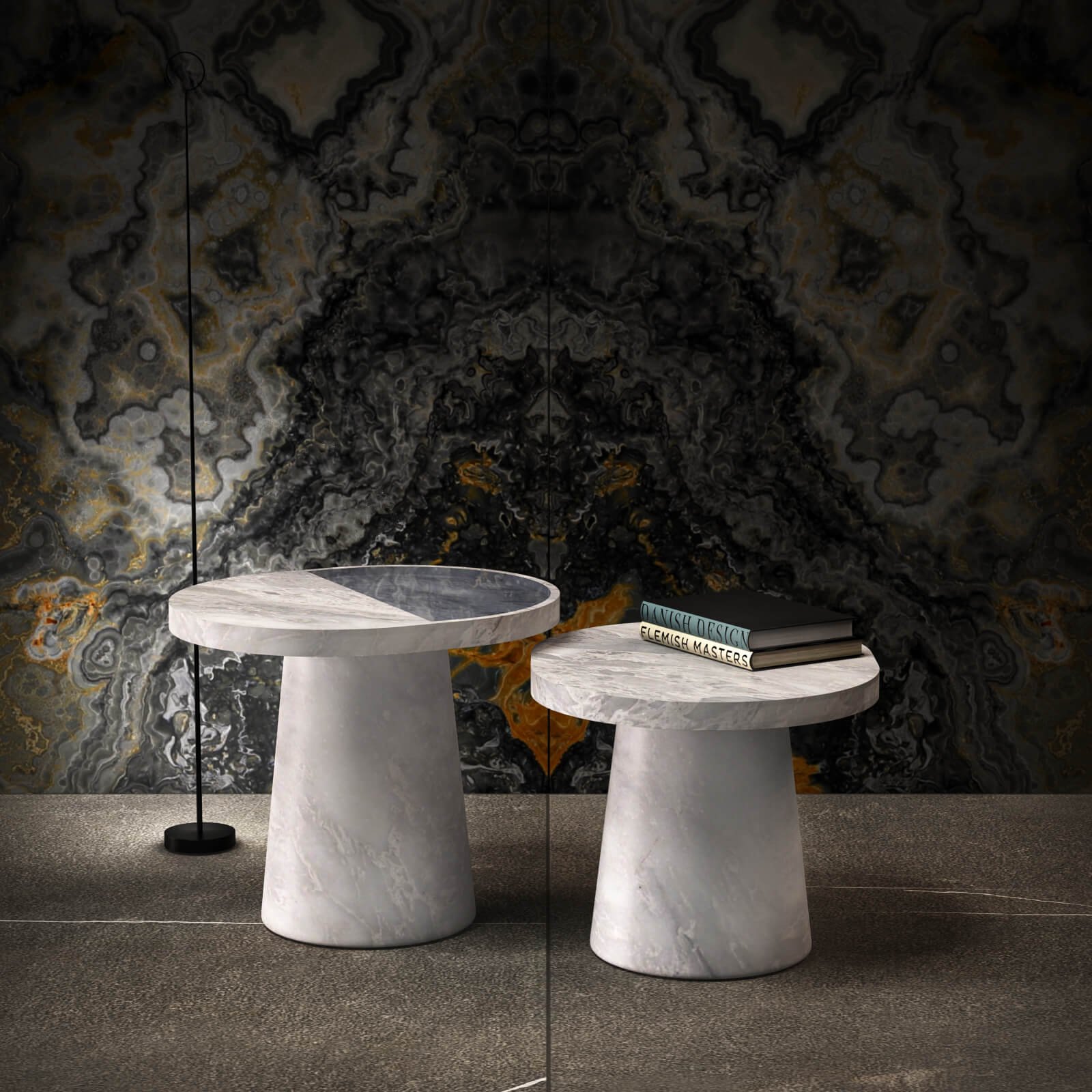
How many types of marble really exist? A map of the main Italian marbles by colour and origin, with technical traits, interior uses and price bands to help you get your bearings.
Say the word “marble” and the mind runs straight to the white of Carrara, to statues, to churches.
But marble is a far wider world: hundreds of different varieties exist, each with its own colour, drawing and character. Understanding the main types of marble helps you choose with real knowledge, whether it is for a floor, a kitchen worktop or a design object.
Italy, in this, plays in a league of its own. The quarries of the Apuan Alps and other regions have supplied some of the most sought-after marbles in the world for centuries, and even today “Italian marble” is a phrase that works like a guarantee.
This guide lines up the types of marble that matter, with what you need to know to find your way.
What marble is and how it is classified
Geologically, marble is a metamorphic rock: it is born from limestone, a marine sediment, which transforms under the pressure and heat of the earth’s crust. The calcite crystals dissolve and reassemble into a compact, translucent mass. From this process, called metamorphism, come the faintly sugary surface and the stone’s ability to hold the light.
In the trade, though, the word “marble” has a broader sense: stones that are not geologically marble (some travertines, onyxes and limestones) are called marble too, because they are worked and polished in the same way.
In the end the most useful way to navigate the many marble varieties stays the aesthetic one: the background colour and the drawing of the veins. That is how the market, and designers, group them.
Italian marbles by colour
The most practical way to map the types of marble is to start from colour. Each family has its champions.
White marbles
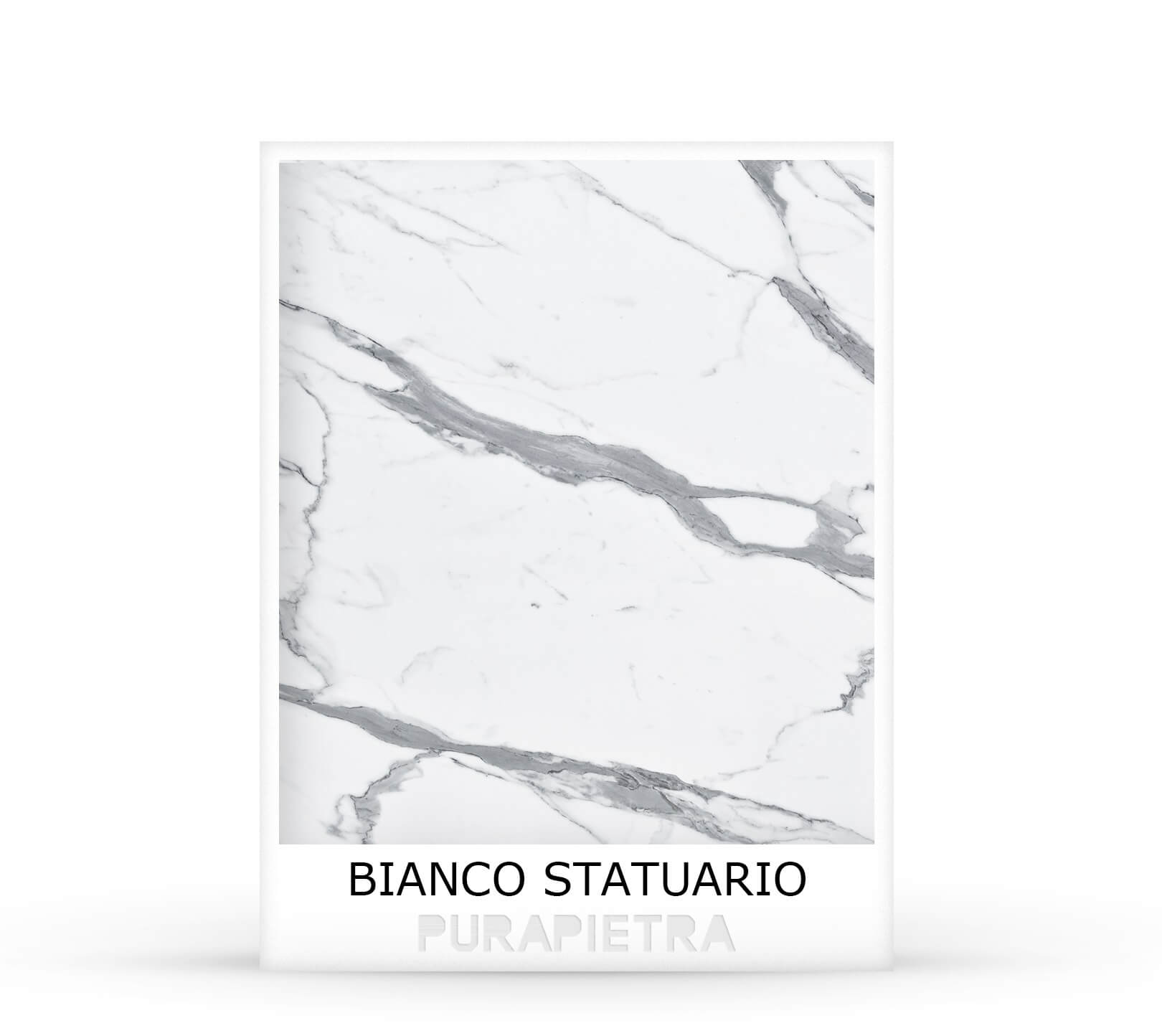
These are the most famous. Bianco Carrara, with its light background and thin grey veins, is the most common; Bianco Statuario, purer and more compact, is the sculptors’ choice; Calacatta, with its broad, dramatic veins, is among the most coveted today. We covered them in detail in the pillar on white marble.
Black marbles
From Spanish Nero Marquina, with its white veins, to Ligurian Portoro laced with gold, black marbles bring intensity and theatre. They are the choice for those who want a strong presence. The full story is in the pillar on black marble.
Grey marbles
The greys (Grigio Agata, Grigio di Vagli, Wolf Grey, Zebrato di Londra) are the most versatile: neutral, elegant, able to sit well with almost anything. Increasingly requested in contemporary interiors.
Green, yellow, pink and other families
Beyond the classics there are the coloured marbles: deep greens like Verde Alpi, warm yellows like Giallo di Bolgheri, delicate pinks, rare and precious blues. These are more scenic stones, often used as a detail to add an accent of colour. You will find them all, sorted by colour, in the Materials section of the catalogue.
Technical traits: hardness and porosity
Beyond colour, all marbles share a few technical traits worth knowing before you choose.
Hardness. Marble is relatively soft compared with granite: on the Mohs scale it sits around 3. That makes it wonderful to work and to polish, but also more sensitive to scratches. On a heavily used worktop it is something to factor in.
Porosity. Being porous, marble absorbs liquids if it is not protected. An impregnating treatment reduces absorption and should be renewed now and then, especially in kitchens and bathrooms.
Sensitivity to acids. Marble is calcium carbonate, so it reacts to acidic substances such as lemon, vinegar and some cleaners, which can leave dull marks. That is why neutral, specific products are always recommended. These are manageable limits: with the right care, a marble lasts generations.
The finish changes everything. The very same type of marble can wear quite different faces depending on how the surface is worked.
A polished finish brings out colour and veining and makes the stone reflective; a honed (or satin) finish makes it matte and velvety, more discreet and less slippery; an antiqued or brushed finish gives a textured, lived-in look. Choosing the right finish matters as much as choosing the variety.
Uses of marble in interiors
Every type of marble has its vocations, but in general the stone enters spaces in many ways. In cladding and floors it brings continuity and elegance; for these large surfaces more uniform varieties are often preferred.
In bathrooms it becomes a basin top, a wall cladding, a tub carved from the solid, with that spa-like atmosphere no other material can give. In kitchens it serves as a worktop and splashback, provided it is treated and used with awareness of its limits.
Then there is the chapter of design: here marble stops being a surface and becomes an object. Tables, freestanding basins, vases, trays. It is the direction Purapietra has chosen with collections like Linear, Unit Sink and the hand-worked accessories, where the stone becomes an everyday gesture.
Italian marble price bands
How much does marble cost? The honest answer is: it depends. The price of Italian marble varies widely with the variety, the rarity, the thickness, the finish and the work required. Rather than precise numbers, which change constantly, it is better to think in bands.
Accessible band. The most common marbles, such as Bianco Carrara in commercial grades, stay relatively affordable precisely because of their availability.
Mid band. Many greys, the greens and yellows, and the better grades of the whites, sit in an intermediate band.
High band. Rare and highly sought marbles, such as first-choice Calacatta, Portoro or spectacularly drawn stones, reach the highest values, helped by the difficulty of extraction.
To this you add the workmanship (a tub carved from the solid needs far more material and time than a simple slab) and the finish. The advice is always to ask for a quote on the specific project: only then does the price become a real number rather than a stab in the dark.
How to choose the right types of marble
With so many varieties available, the choice can feel dizzying. In truth a few questions are enough to narrow it down.
Where will the marble go, and how hard will it be used? What atmosphere are you after: calm and neutral, luminous, dramatic? How much does the uniqueness of the drawing matter to you against continuity? And, of course, which budget band do you have in mind?
Answering these questions almost always leads to two or three candidates, not a hundred. At that point the only test that really counts comes into play: looking at the stone in person, in the light of the space it will live in. No spec sheet can replace that moment.
Questions that come up often
How many types of marble are there?
There are hundreds of types of marble worldwide, between true marbles and stones commercially called marble. The most practical way to navigate them is to group them by background colour: whites, blacks, greys, greens, yellows, pinks and so on.
Which Italian marble is the most prized?
Among the most sought-after are Bianco Statuario and first-choice Calacatta among the whites, and Portoro among the blacks. Prestige depends on purity, rarity and the drawing of the veins.
How much does Italian marble cost?
The price varies widely with variety, thickness, finish and workmanship. It ranges from more accessible marbles like commercial Bianco Carrara up to rare stones in the high band. For a real figure a project quote is always best.
What is the difference between marble and granite?
Marble is a softer, acid-sensitive limestone rock, luminous and veined; granite is harder and more resistant but with a more speckled look. The choice depends on the use and the aesthetic result you want.
From quarry to object
Knowing the types of marble is the first step to choosing well: understanding where a stone comes from, how it behaves and which band it belongs to avoids costly mistakes and leads to a result that lasts.
But marble, in the end, is meant to be lived with more than studied. If you have a project in mind, the best way is to start from the materials: explore the varieties in the Materials section and see how stone becomes object in the Purapietra magazine.
Each colour deserves its own chapter. We wrote them: white, black, grey, beige and blue marble, plus a close reading of the two most famous Apuan whites in Carrara vs Statuario. See also our guide to green marble and the comparison of Italian vs imported marble.