
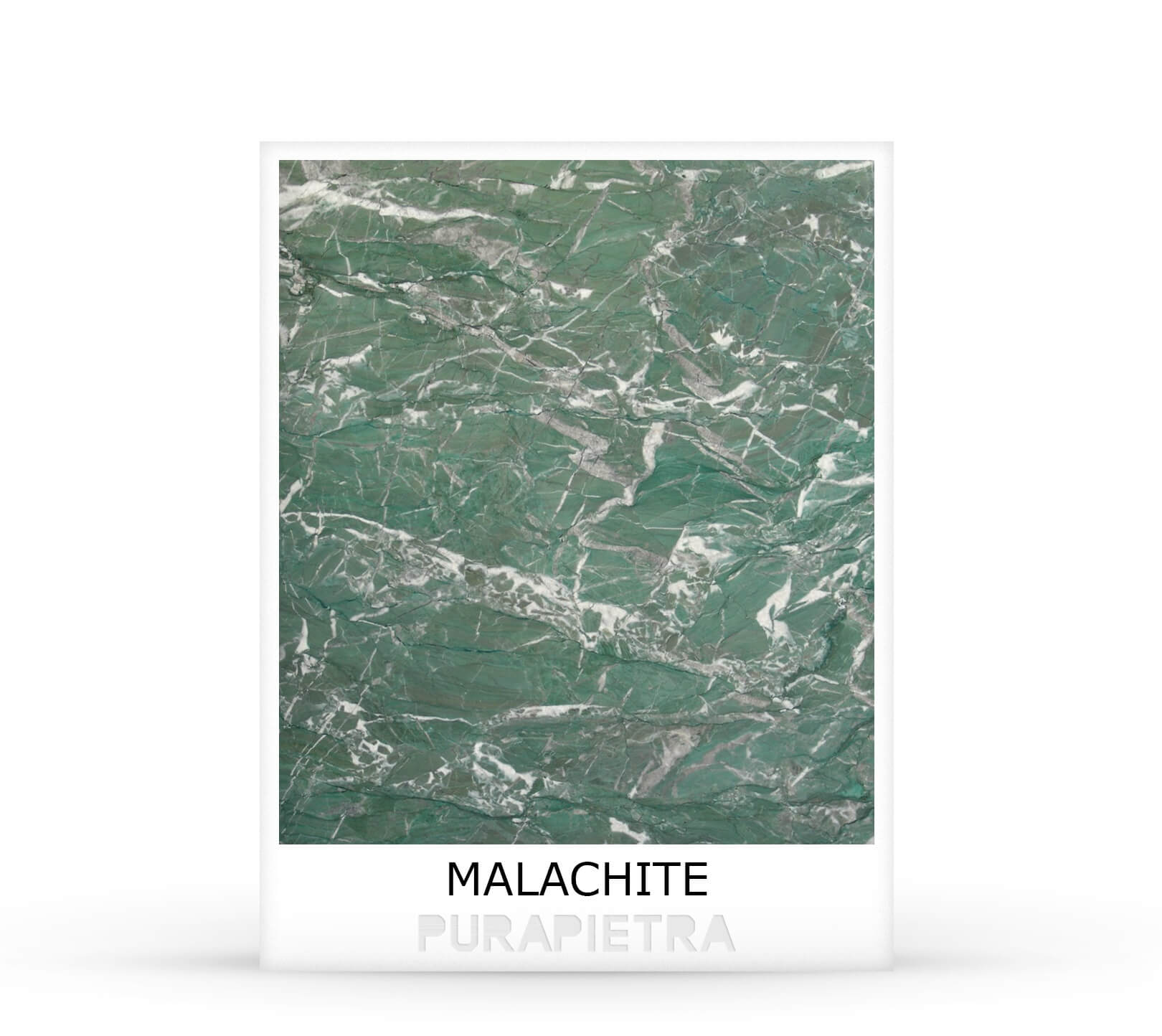
Malachite is the green marble that does not try to be quiet. The ground is a clear, mid green, and across it run white veins that are wide, irregular and impossible to ignore. On a slab it looks like a map of rivers seen from above. On a made object it looks like a stone that has been cracked and healed in white.
Malachite is one of the green stones in the Purapietra catalogue, and one we use on several pieces of our own design collection. This guide covers what it looks like, how to read a slab, which finish suits which job, where it works best, what to put next to it, how to care for it and what moves the cost. We also say where it is the wrong stone.
What Malachite marble looks like
The first thing you notice is contrast. The green is not dark and not pale: it sits in the middle, cool and slightly grey in places, which lets the veins read at full strength. They are white, sometimes close to silver, and they do not follow a pattern. Some are hairlines that fork into a net. Others are broad strokes that cut across a whole piece and stop. Where the veins crowd together, the green breaks up into small plates, like crazed ice.
That makes Malachite a stone with a lot of movement. If you have read our guide to Verde Alpi, the difference is easy to put in one line: Verde Alpi is a dark field with a fine web on it, Malachite is a green field with loud white lines through it. The first one calms a room, the second one starts a conversation. Our pillar guide to green marble puts the main greens next to each other, and the guide to coloured marble explains how to choose a colour for a whole room.
The name, and what it does not mean
Malachite is also the name of a green copper mineral, which people have carved and polished for centuries. The marble that carries the name is a different material: it borrows the colour and the banded, flowing look, not the chemistry. If you are searching for the mineral, this is not it. If you are searching for a green stone to build with, this is a good place to start. For a plain definition of the rock family, marble has a clear overview.
Malachite in a slab and in a made object
A slab shows the whole range of the stone. You see the green, the big veins and the places where the pattern thins out. A made piece shows only what the maker chose to keep. That matters with Malachite, because the veins are so strong that every cut decides what the object looks like.

On the ribbed piece above, the horizontal grooves cut the stone into bands, and the veins travel across them without lining up. That is the honest behaviour of a natural pattern: it is not matched, it is found. We use Malachite on several pieces of our collection, including Unit Bath, Unit Sink, Linear, Tato and Groove, and each one shows the stone in a different way: a large freestanding volume in the bath, a wall-hung basin in Linear, a low table in Groove.
How to read a Malachite slab
Because the pattern is so strong, two slabs from the same stone can feel like two different stones. Before you order, look at four things.
How wide the veins run
A slab with broad veins reads as bold and graphic. A slab with a finer net reads as calmer, closer to a classic green. Neither is a defect. The question is which one suits the surface you are covering.
Where the green is clear
Look for the areas of uninterrupted green. They give the eye somewhere to rest and make the veins stand out. A slab that is all veins and almost no ground can feel busy on a large wall.
Grey and darker tones
Some slabs carry grey or darker shadows beside the white veins. They are part of the stone, and in the right light they add depth. If you want a very clean green and white, say so when you choose the slab.
The edge of the pattern
The pattern changes across a slab. Ask to see the whole piece, not a cropped photo, and plan where the strongest veins fall. On a kitchen island or a bath surround, that decides where the eye lands.
Finishes for Malachite
The finish changes both the look and the way the stone ages.
Polished. It gives the deepest green and the whitest veins, and it is the finish that shows the stone at its most dramatic. It is also the finish that shows an etch mark most clearly, and a saturated green shows it more than a pale one. We suggest it for walls, panels and pieces that are admired more than used.
Honed. The surface is matte and soft, the green is a little quieter and the veins are less sharp. It hides marks, it is kinder to wet hands and it is the finish we recommend for anything touched every day: a basin, a vanity top, a coffee table.
Our guide to marble durability explains why a polished surface shows wear first and what sealing does and does not do.
Best uses for Malachite in interior design
A statement piece
Malachite is at its best when it is the one strong thing in the room: a bath, a basin, a low table. A single large piece in this stone gives a room a centre without a second material trying to compete. That is the logic behind our Unit Bath and Unit Sink.
Feature walls and bathrooms
A single wall in Malachite, behind a bath or a vanity, can carry a bathroom. Keep the other surfaces quiet. If you want more on how to treat a vertical surface in stone, see our guide to marble wall cladding.
Furniture and objects
At the scale of a table or a vessel, the veins read like drawing. Groove and Tato are the examples on our site. For a floor or a full kitchen, a stone this loud is a bigger decision, and we would look at a calmer green first. Our guides to marble flooring and the marble kitchen cover the practical side of those surfaces.
What to pair with Malachite
Metal. Brushed brass and aged gold warm the green and push the room toward the classical and decorative. Blackened steel and dark bronze keep it moody and architectural. Nickel and chrome cool it down. Our guide to marble and metal goes through the options.
Wood. Pale oak softens the contrast, and a warm walnut makes the green look deeper. The guide to marble and wood shows how to balance the grain against a busy stone.
Other stones. Because Malachite already has a lot of pattern, the safest neighbour is a calm one: a plain cream or a quiet white. Our guide to pairing marble with other materials explains the rule of one loud stone per room.
Caring for Malachite
Treat it like any fine marble. Ask for sealing at installation, wipe spills quickly, and use a pH neutral cleaner. Avoid lemon, vinegar, wine and limescale removers, which can leave a dull mark on a polished surface. A saturated green shows that dull mark more than a pale one, so on a surface that is used every day we choose honed.
We do not publish hardness or porosity figures for Malachite, because we would rather give you the technical sheet of the slab you are buying than a general number. Ask for it when you choose the slab, and our guide on how to identify quality marble lists what to check in front of the stone.
What sets the price of Malachite
There is no fixed price per square metre. Green stones with strong, well-drawn veining get expensive quickly, because the good blocks are rare and the slabs are chosen for their pattern. The final figure depends on the block, how strong and well placed the veining is, the thickness, how much of the slab you can use and the hours of finishing. We quote each project once the slab and the finish are chosen. Our page on Italian marble versus imported stone explains what origin changes in a quote.
When Malachite is the wrong choice
Malachite is not the stone for a room that should stay calm: the veins are loud by design, and a large floor in it will dominate everything. It is also not the right pick for someone who wants a surface that never changes, because a polished green shows every etch mark. And it is not a good match for a design that needs a precise, repeatable pattern, since the veins cannot be matched from slab to slab. If any of this describes your project, a quieter green or a lighter stone is the better answer, and we will tell you before you order.
Why choose Malachite with Purapietra
We treat stone as a building material, not a skin. Every piece is roughed on CNC for accuracy and finished by hand, which is where an edge stops looking machined. With a stone this graphic, we ask clients to choose the slab, and we plan where the veins fall, where the joints go and how the lighting will sit before the first cut. If you need something made to your own drawing, our page on bespoke marble explains how we work.
You can see Malachite next to our other stones in the materials catalogue, and our guide to marble interiors covers how to build a room around a stone. Send us a plan, a sketch or a photo of the room, and we will tell you what the stone can do there and roughly what it will cost.
Frequently asked questions about Malachite marble
What is Malachite marble?
Malachite is a green stone with a mid green ground and bold white veins, sold by Purapietra as a green marble. It takes its name from the green mineral, but it is a different material.
Is Malachite marble the same as the malachite mineral?
No. The mineral is a copper compound that is carved into small objects. Malachite marble is a building stone that shares the colour and the flowing look.
Is Malachite a good choice for a bathroom?
Yes, as a statement piece or a single wall. Choose a honed finish for surfaces that get wet or touched every day, and seal the stone at installation.
Polished or honed Malachite?
Polished shows the deepest green and the sharpest white veins and suits walls and panels. Honed is softer, shows fewer marks and suits anything in daily use.
How much does Malachite cost?
There is no fixed price per square metre. The figure depends on the block, how strong the veining is, the thickness, the yield and the finishing. We quote each project once the slab and finish are chosen.
What goes with Malachite?
Brushed brass or aged gold for a classical mood, blackened steel for a darker one, pale oak or walnut for warmth, and a calm cream or white stone as a neighbour.
Can I see Malachite on a finished piece?
Yes. Malachite is used on Unit Bath, Unit Sink, Linear, Tato and Groove, all in our design collection.