
Italian White Marble: The Great Varieties Compared
White marble is the material most people picture when they hear the word marble, and Italy has produced the finest examples for two thousand years. But “white marble” is not one stone. Carrara, Calacatta and Statuario look alike at a glance and behave very differently in a room. This guide compares the great Italian white marbles so you can tell them apart and choose the right one for your project.
Why Italian white marble sits at the top
The prestige is not marketing. The Apuan Alps above Carrara hold one of the largest and purest deposits of white marble on earth, quarried since Roman times and used by Michelangelo for the David. Centuries of quarrying and carving built a level of craft around these stones that is hard to find anywhere else, and the names have become a shorthand for quality that architects and designers trust worldwide.
White also flatters almost any scheme. It reflects light, makes small rooms feel larger, and works as easily in a minimalist space as in a classical one. That versatility is why it remains the most requested colour we work with. If you want the wider context on the colour as a whole, our pillar guide to white marble is the place to start; this article goes deeper on how the individual Italian varieties differ.
The varieties compared
The differences between the great whites come down to two things: the background colour of the stone and the character of the veining. Once you learn to read those, telling them apart becomes straightforward.
Carrara
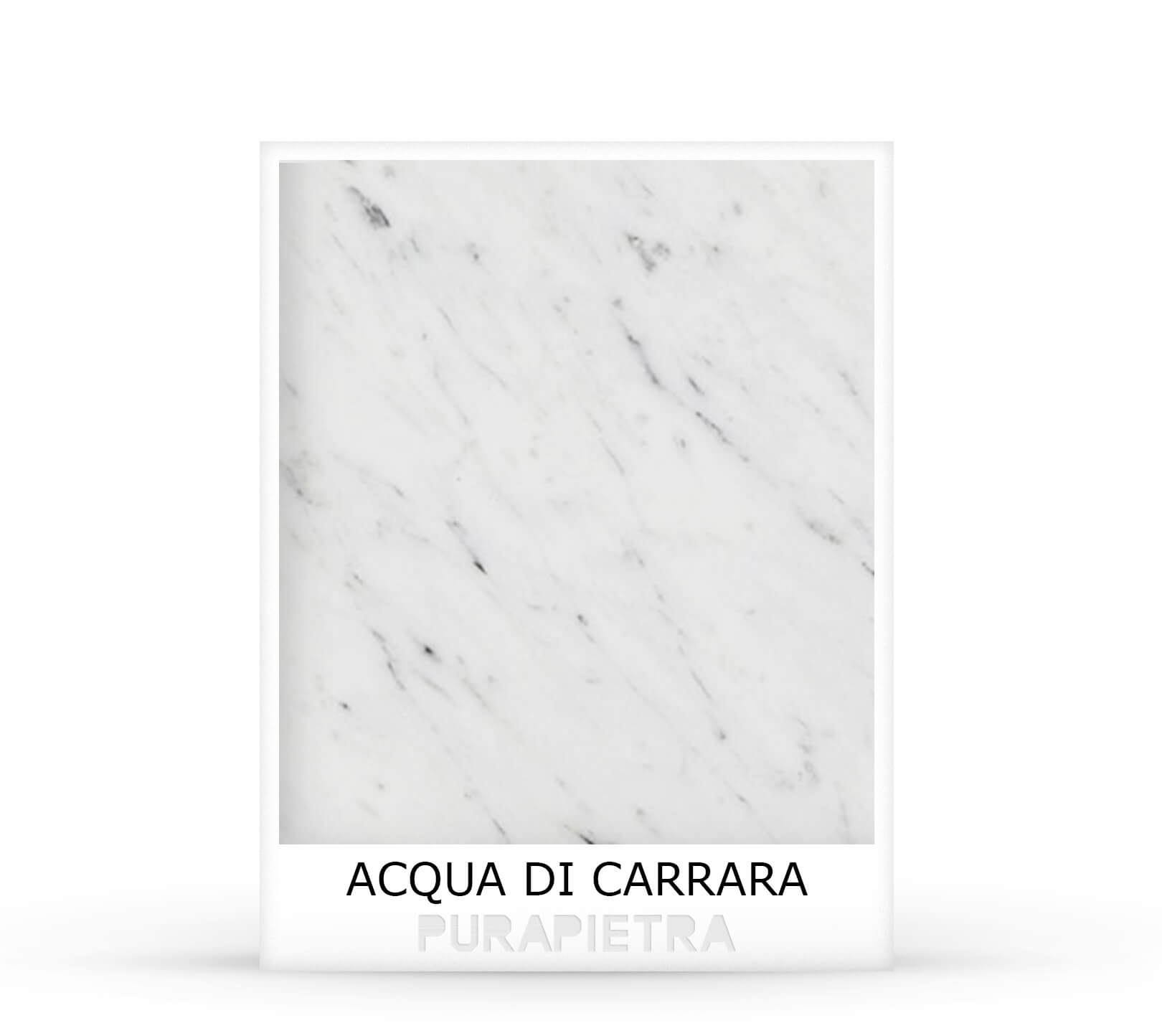
Carrara is the classic and the most widely available. Its background is a cool, slightly grey-white, and its veining is soft and feathery, often described as cloudy rather than linear. Because the pattern is gentle, Carrara reads as calm and understated, which makes it forgiving across large areas and a natural choice when you want the stone to be a quiet backdrop rather than the star. It is also the most accessible of the Italian whites, which adds to its popularity.
Calacatta
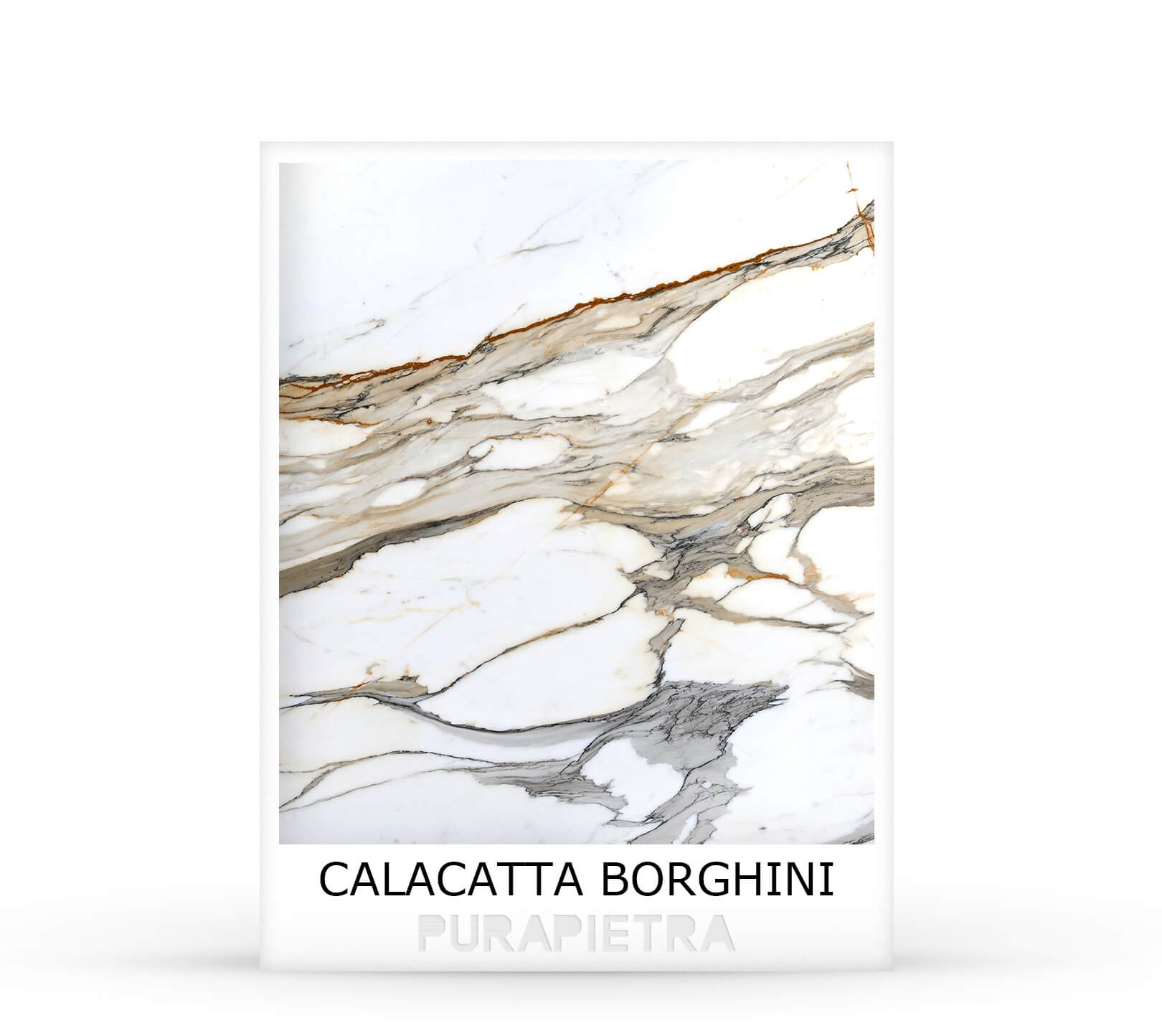
Calacatta is the dramatic one. Its background is a warmer, brighter white, and its veins are bolder, thicker and more defined, often in grey with hints of gold or beige. Where Carrara whispers, Calacatta makes a statement. It is rarer than Carrara and priced accordingly, and it rewards being used where the veining can be seen and enjoyed: a single feature panel, an island top, a sculptural object. Calacatta Borghini, shown above, is one of the most prized examples, with strong, confident movement across a clean white field.
Statuario
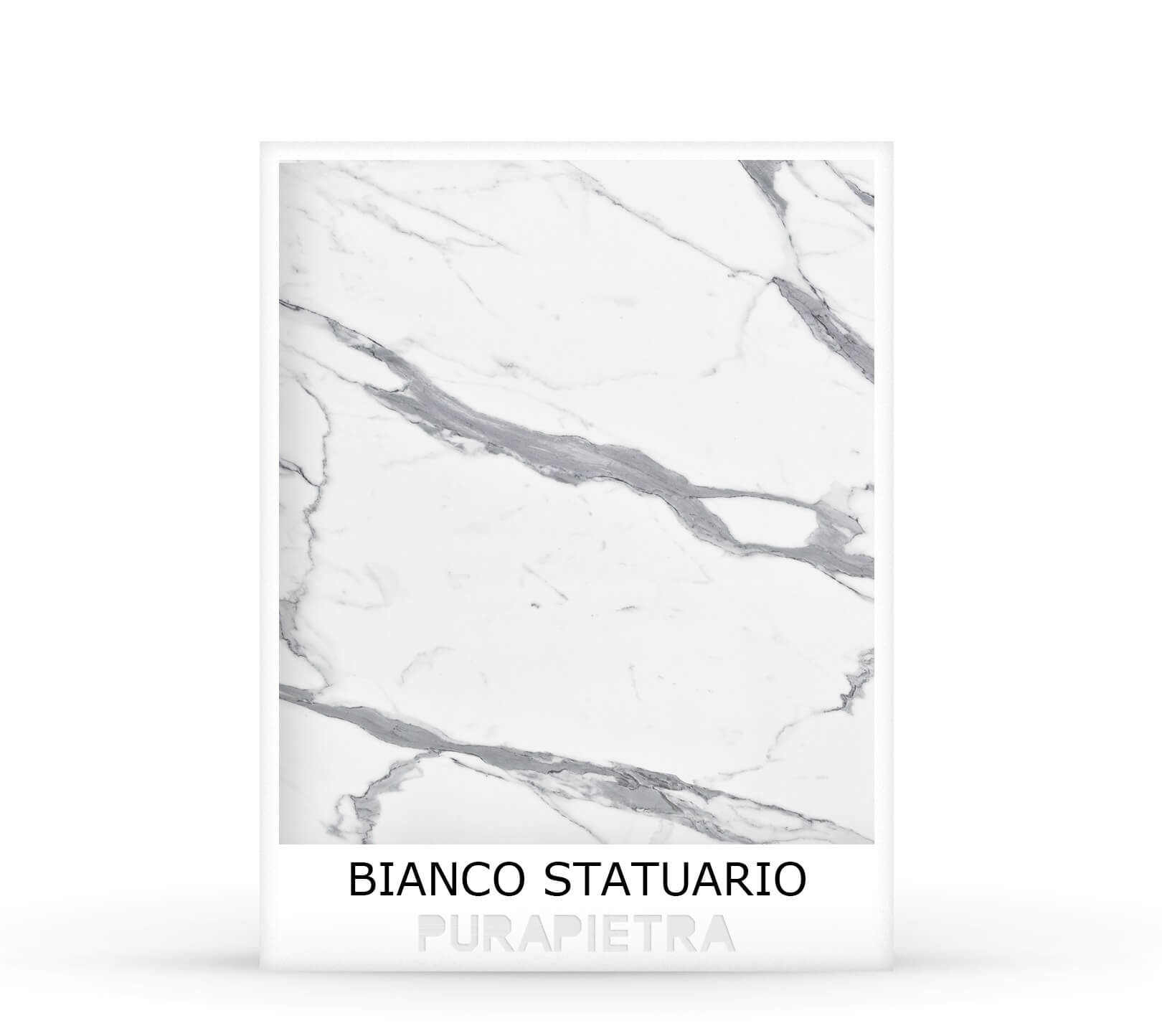
Statuario is the sculptor’s marble, the one Michelangelo favoured. It combines the brightest, most luminous white ground with fine, elegant grey veining, striking a balance between the calm of Carrara and the drama of Calacatta. Its purity and even structure make it ideal for carving, which is why it has always been the choice for statuary. It is the rarest and most expensive of the three, and a slab of good Statuario is treated almost as a work of art in its own right.
Veining and tone: how to read a slab
Beyond the named variety, every slab is individual, and learning to read one is the real skill. Look first at the base colour. Hold a sheet of white paper against the stone: a cool marble will look faintly grey next to it, a warm one faintly cream. That tells you which fixtures and finishes will sit comfortably alongside it.
Then look at the veins. Are they fine and diffuse like Carrara, or bold and linear like Calacatta? Do they run in one direction, which lets a fabricator “book-match” two slabs into a mirror image, or are they random? For a large surface, ask to see the whole slab and to mark where the cuts will fall, so the best movement lands where the eye goes first. If you want a fuller checklist, our guide on how to identify quality marble walks through what separates a good block from a poor one.
Choosing white marble by room
The right variety depends as much on where it is going as on personal taste.
For a large kitchen worktop or a whole bathroom, a calmer marble like Carrara often works best, because bold veining repeated across many square metres can become busy. Save the dramatic Calacatta for the island top or the splashback where it becomes a feature. If you want colour as well as drama, Calacatta Viola adds violet and burgundy veining to a warm white ground. For a statement object such as a basin, a table or a vase, the drama of Calacatta or the luminous purity of Statuario is exactly what you want, since the piece is meant to be looked at.
This is the thinking behind our own design objects: a rounded white marble basin or side table uses a small quantity of a special stone at the scale where its veining can be fully enjoyed. You can see the whole white family, and how each variety reads next to the others, on the materials page.
Living with white marble
All of these stones are calcite marbles, so the care is the same regardless of variety. White marble is durable but reactive to acid, which means lemon, wine and vinegar can leave a dull etch on an unsealed surface. Seal the stone on installation, refresh the sealant periodically, wipe spills quickly and clean with a pH-neutral product. Etching and patina are also, for some owners, part of the appeal: a white marble worktop that develops a soft, used surface over years is doing what natural stone has always done.
One honest note on colour. White marble is not pure white and was never meant to be. The grey and gold in the veins, and the faint warmth or coolness of the ground, are what give each variety its character. If you want a flawless, uniform white with no movement, an engineered surface will do that; what you give up is the depth, the light and the individuality that only a natural block carries.
How to choose between them
If you want a safe, timeless white that recedes into the background, choose Carrara. If you want a bold, luxurious statement and have the budget for it, choose Calacatta. If you want the brightest, purest white for a piece that will be carved or admired up close, choose Statuario. And whichever name you settle on, see the actual slab before you commit, because the block in front of you matters more than the label on it.
For a deeper look at the geology and history behind these stones, the Wikipedia entry on Carrara marble is a reliable starting point.
Frequently asked questions
What is the difference between Carrara and Calacatta marble?
Carrara has a cool grey-white background with soft, feathery veining, so it reads as calm and understated. Calacatta has a warmer, brighter white background with bolder, more defined grey and gold veins, so it makes a statement. Calacatta is also rarer and more expensive than Carrara.
Which Italian white marble is the most valuable?
Statuario is generally the rarest and most expensive of the classic whites, prized for its bright, luminous ground and fine veining. Top-grade Calacatta, such as Calacatta Borghini, also commands very high prices, while Carrara is the most accessible.
Is Italian white marble suitable for kitchen worktops?
Yes, though it needs care. White marble is durable but etches if acids are left on an unsealed surface, so seal it on installation, wipe spills quickly and clean with a pH-neutral product. Many owners also accept a soft patina over time as part of the character of natural stone.
Why is white marble not perfectly white?
Because the colour is natural. The grey and gold veins and the faint warmth or coolness of the ground come from minerals in the original stone. That movement is exactly what gives each variety its identity; a flawless, uniform white is only possible with an engineered surface.
How do I choose the right white marble for my project?
Match the drama of the stone to how much of it you are using and where. Use a calmer Carrara across large areas, a bold Calacatta for a feature, and a pure Statuario for objects meant to be admired up close. Always view the full slab, not a small sample, before deciding.
Keep exploring the Purapietra magazine. See also our pillar guide to white marble, our note on how to identify quality marble, and the full materials collection.
Yellow Marble: Varieties, Uses and How to Choose It
Yellow marble carries warmth the way few natural stones can. It reads as sunlight held inside rock, and in the right room it turns a cold surface into something that feels almost lived-in. This guide looks at what gives yellow marble its personality, the varieties we work with at Purapietra, where the stone belongs in an interior, and how to choose a slab you will still love in ten years.
The character of yellow marble
Yellow is the rarest of the warm marbles, and that rarity shows in the price of a good slab. The colour comes mostly from iron oxides and clay minerals trapped in the original limestone before it recrystallised, which is why the tone shifts from pale straw to deep amber depending on the quarry and even the block. No two slabs are identical, so a yellow surface always looks made rather than manufactured.
What people respond to is the feeling. Grey and white marbles are cool and architectural; yellow is domestic and generous. It bounces warm light around a room, softens hard corners, and pairs beautifully with brass, walnut and bronze. Because the colour is already saturated, a little yellow marble goes a long way. A single panel or a carved object can carry a whole room without the space tipping into pastiche.
The Purapietra yellow: Giallo di Bolgheri
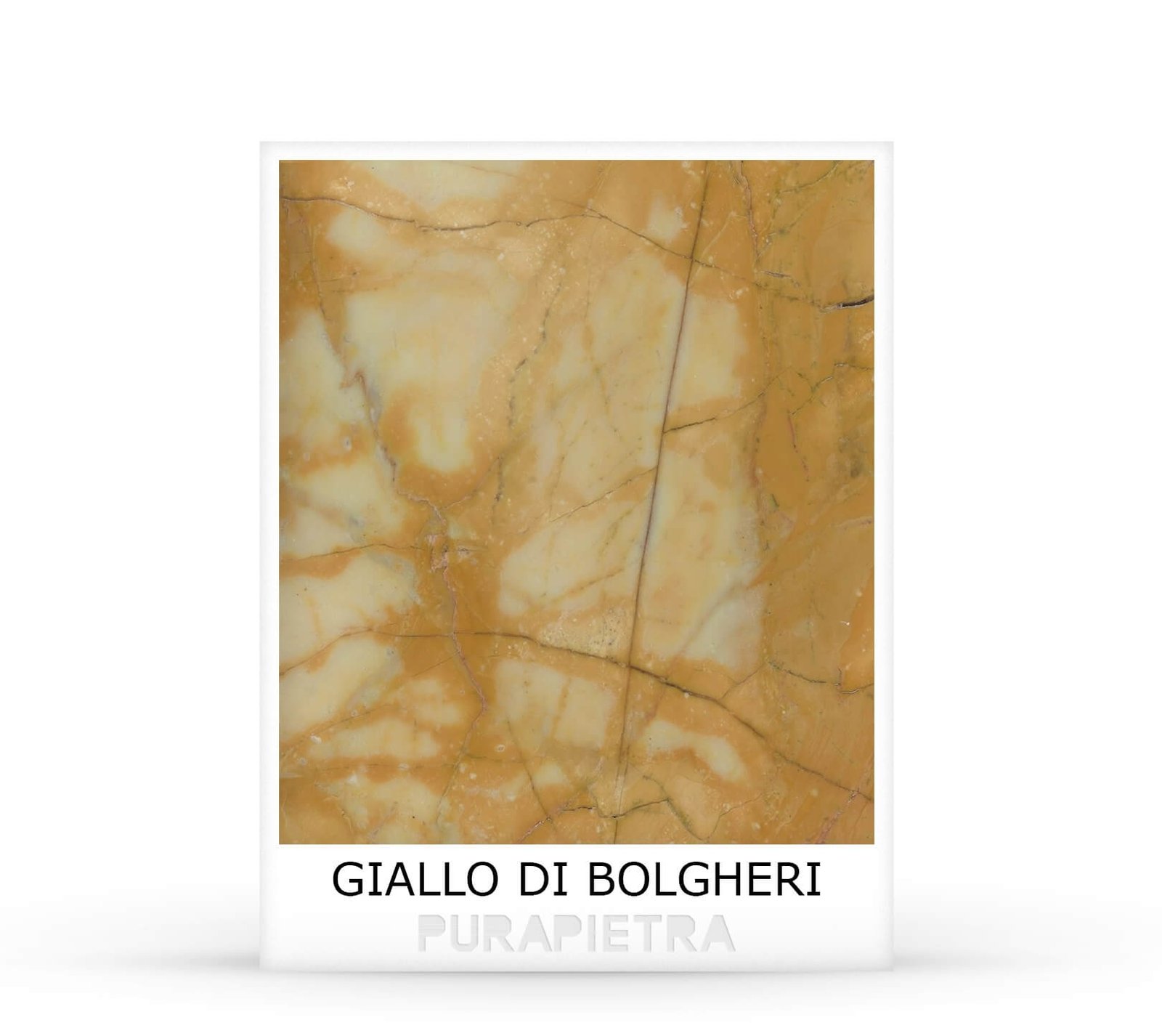
The stone we return to most often is Giallo di Bolgheri, named after the Tuscan coast it comes from. It has a honeyed base crossed by finer ochre and ivory movement, warm without being loud. Under natural light it glows; under a spotlight it deepens. It behaves well under the tools, which matters when a piece is going to be turned, hollowed or given a rounded, sculptural edge in the way our work tends to.
Yellow marble sits at the warm end of a catalogue that runs across every colour family. If you want to see how it reads next to the cool whites, greys and greens, the full range is laid out on our materials page, where you can compare tones side by side before committing to a direction.
Where to use yellow marble in interiors
Yellow marble works best where you want a room to feel warm and quietly expensive rather than sterile. A few places it earns its keep:
Bathrooms
A bathroom is where yellow marble tends to surprise people. Cladding a wall or a vanity in a warm stone turns a functional room into somewhere you actually want to spend time, especially in morning light. A rounded freestanding basin in yellow marble becomes the piece the whole room is arranged around. If you are weighing yellow against a cooler option, our guide to white marble is a useful counterpoint on tone and mood.
Kitchens
Yellow works as an accent in the kitchen more than as a full run of worktop. An island top, a splashback or a shelf in yellow marble warms up the hard lines of contemporary cabinetry. As with any marble in a kitchen, it wants sealing and a little care around acids, which we cover further down.
Cladding, floors and objects
On walls and floors, yellow marble reads as a warm neutral rather than a bold colour, which makes it easier to live with than clients expect. It is also lovely at the scale of an object. Many of our marble vases and trays are made to bring exactly this kind of warmth into a room without any building work at all.
Colour and material pairings
Because yellow marble is already warm and saturated, the surfaces around it should mostly support rather than compete. A few combinations we keep coming back to:
Warm metals are the natural partners. Brass, bronze and aged gold pick up the ochre notes and make the whole scheme feel intentional. Cool chrome, by contrast, tends to fight the stone.
For wood, walnut and oiled oak sit comfortably beside yellow; their grain echoes the movement in the stone. Very pale woods can look washed out next to it.
If you want to keep the room calm, ground the yellow with soft greens or deep charcoals rather than more warm colour. Our green marble pieces, for example, make a considered companion to a yellow surface, one warm and one cool, both natural.
Care, maintenance and durability
Yellow marble is a calcite-based stone, so it behaves like other marbles: hard-wearing but reactive to acid. Lemon, wine and vinegar can etch a dull mark if they sit on an unsealed surface. The fixes are simple. Seal the stone on installation and refresh the sealant periodically, wipe spills quickly, and clean with a pH-neutral product rather than anything acidic or abrasive.
Used this way, yellow marble lasts for generations. The warm tone is stable and does not fade in daylight the way some pigments do, because the colour is mineral, not a coating. A surface installed today will read the same decades from now, which is part of why natural stone rewards the initial investment.
How to choose the right yellow marble
Choosing yellow marble is less about the name on the slab and more about the specific block in front of you. A few things worth doing before you decide:
See the actual slab, not a sample. Yellow varies more than most colours from block to block, and a small chip cannot show you how the veining will run across a finished top or panel. Ask to view the full slab and, ideally, to mark the section that will be used.
Match the finish to the room. A polished finish deepens the yellow and adds shine, which suits a formal bathroom or a statement object. A honed, matte finish reads softer and more contemporary and hides everyday marks better in a kitchen.
Think about quantity. A little yellow reads as luxury; a lot can read as heavy. If in doubt, use it where the eye lands first and let calmer materials do the rest of the work.
If you are still comparing colour families, it helps to read across the range before narrowing down. Our overview of the black marble collection sits at the opposite end of the spectrum and is a good way to test how bold you actually want the room to feel.
A warm surface, made to last
Yellow marble is not the safe choice, and that is exactly its appeal. It brings warmth, rarity and a made-by-hand quality that a manufactured surface cannot fake. Chosen well and cared for simply, a yellow slab becomes the quiet centre of a room. If you would like to see Giallo di Bolgheri in person or talk through a bespoke piece, a sample request is the easiest place to start.
For background on how these stones form and why colour varies so much between quarries, the Wikipedia entry on marble is a solid primer.
Frequently asked questions
What gives yellow marble its colour?
The warm tone comes from iron oxides and clay minerals that were present in the original limestone before it recrystallised into marble. The exact shade, from pale straw to deep amber, depends on the concentration of those minerals and varies from quarry to quarry and even block to block.
Is yellow marble suitable for bathrooms?
Yes. Yellow marble is a favourite for bathrooms because it turns a cool, functional room into a warm one, especially in natural light. It should be sealed on installation and cleaned with a pH-neutral product, since like all calcite marbles it can etch if acids are left on the surface.
What colours go well with yellow marble?
Warm metals such as brass and bronze, mid-to-dark woods like walnut and oiled oak, and grounding tones such as soft green or deep charcoal. Cool chrome and very pale woods tend to fight the warmth of the stone rather than support it.
Which yellow marble does Purapietra work with?
Our signature yellow is Giallo di Bolgheri, a honeyed Tuscan marble with fine ochre and ivory veining. It carves and turns well, which suits the rounded, sculptural pieces we make. You can see it alongside the rest of the collection on the materials page.
How do I care for a yellow marble surface?
Seal it on installation and refresh the sealant periodically, wipe spills promptly, and use only a pH-neutral cleaner. Avoid acidic or abrasive products. Treated this way, the surface stays warm and unmarked for generations.
Keep exploring the Purapietra magazine. See also our guides to white marble, green marble and black marble, or browse the full materials collection.
How to Identify Quality Marble: A Guide for Non-Experts
You do not need to be a geologist to buy good stone. A little knowledge of what to look for, what to touch and what to ask goes a long way, and it is usually the difference between a surface you love for decades and one you regret within a year. This is a practical guide to judging quality marble for people who are choosing it for the first time.
Marble is one of the few materials most people buy once in their lives and expect to keep forever. That makes it worth a little patience at the point of choice. The good news is that the signs of a quality slab are visible to anyone willing to slow down and look properly. You are not being asked to trust a certificate or a salesperson; you are being asked to use your eyes, your hands and a few honest questions. Here is how to read a slab the way we do.
Veining, compactness and colour
The first thing to judge in a piece of quality marble is the veining, because it tells you both how beautiful the slab is and how it was chosen. Good veining looks intentional. It has flow and balance, the lines run with a rhythm rather than scattering, and on a well-selected block the pattern reads almost like a drawing. Poor slabs often show veining that is muddy, broken or crowded into one corner, which is a sign the block was cut for yield rather than for beauty. Hold the slab upright, step back, and ask whether the pattern would look right on the wall or table you have in mind. If it fights the eye now, it will fight the room later.
Compactness is the quality you cannot see from across the room but can feel up close. Dense, well-formed marble has a tight, even grain with no visible pitting, and it feels solid and cool under the hand. Run your palm across a polished surface: it should be smooth and continuous, without small holes, soft patches or areas that seem to absorb rather than reflect light. Loose or porous stone will have been filled and resined in places to hold it together, and while filling is normal in some varieties, heavy filling across a whole slab points to a weaker block that will stain and chip more easily in use.
Colour is the third test, and the one people misread most often. Quality marble has a clean, consistent ground. A white should be a true white or a warm cream, not a dirty grey; a coloured marble should hold its tone across the whole slab rather than fading or blotching. Look for clarity rather than brightness: the best stones have depth, a sense that the colour goes into the surface rather than sitting on top of it. Beware slabs where the colour looks patchy, cloudy in the wrong places, or oddly uniform, since perfect uniformity can be a sign of an engineered material rather than natural stone. If you want to see how colour defines the natural families, our guide to the types of marble is a useful starting point.
Natural marble versus engineered stone
The single most useful skill for a buyer is telling real marble from a manufactured lookalike. Engineered or reconstituted stone, sometimes sold as marble-effect, is made from crushed stone bound in resin, and while it has its uses, it is not the same material and should not be sold or priced as though it were. The tells are learnable. Natural marble has irregular veining that never repeats, since no two parts of a slab are identical and no two slabs from the same block match exactly. If you see the same vein pattern echoed across several tiles or panels, you are almost certainly looking at a print or a cast, not stone.
Temperature and weight are the next clues. Natural marble stays cool to the touch and feels dense and heavy for its size, because it is solid rock. Many engineered surfaces warm quickly under the hand and can feel lighter or slightly plastic. Look at the edge and the underside too: real marble shows the same stone all the way through, while some composites reveal a different core or a suspiciously perfect, poreless back. A discreet test, with the supplier’s permission, is a drop of water on an unsealed offcut. Natural marble will slowly darken as it absorbs, because it is porous; a fully resin-bound surface will not. The geology of marble explains why the real material behaves this way, and it is worth a read before you buy.
None of this makes engineered stone bad. It makes honesty essential. If you want the qualities that only natural marble offers, the depth, the individuality, the way it ages, then you need to be sure you are buying it. Ask directly whether a material is natural stone or a composite, and expect a straight answer. A reputable supplier will tell you exactly what you are looking at and why.
Reading flaws: which matter and which do not
Every natural marble has flaws, and learning which ones matter is most of the skill. Some marks are simply the stone being itself. Fine veining, small colour shifts and the odd natural inclusion are not defects; they are the reason people choose natural material over a flawless print. A slab with a little character is often more beautiful than a sterile one, and a good fabricator will use those features rather than hide them.
Other marks are genuine weaknesses. Cracks, or fissures that go right through the slab, are the serious ones, because they threaten the structure of a finished piece. Tap gently along a slab and listen: a clear, ringing note suggests a sound stone, while a dull thud can indicate a hidden fracture. Look for stun marks, the pale bruised patches that appear where a slab has been knocked, and for large areas of resin fill that has been colour-matched to disguise a break. Small stable fissures can be perfectly acceptable in the right position and are common in many prized marbles, but they should be disclosed and placed deliberately, never hidden in a spot that will bear weight or take an edge.
The judgement, then, is not flaw versus no flaw, since that comparison does not exist in natural stone. It is whether the flaws are honest and well-placed or hidden and structural. A quality marble slab will have its character on show and its weaknesses either absent or openly pointed out. If a supplier is reluctant to let you see the whole slab in good light, that reluctance is itself the answer.
Finish and thickness
Finish is where quality becomes tactile. A well-finished polished surface is even and mirror-clear across the whole slab, with no dull patches, swirl marks or waves when you look along it at a low angle. A honed finish should be uniformly matte, smooth and consistent, without shiny spots where the machine lingered. Run your fingertips over the surface and along the edges: quality fabrication feels crisp and clean, with edges that are true and profiles that are sharp. Rough, chipped or uneven edges are a sign of hurried work, and hurried work rarely stops at the edges.
Thickness matters more than most first-time buyers realise. Slabs are commonly supplied at around two centimetres or three centimetres, and thicker stone is generally stronger and less prone to flexing or cracking, especially over spans such as an island or a long vanity. Thin material can be perfectly sound in the right application, but it needs proper support underneath and skilled handling. Ask what thickness you are being quoted, check that it suits the use, and be wary of unusually thin stone offered at a tempting price, since the saving often reappears later as a crack. The way a stone is finished and worked is exactly where craft shows; our own design collection and pieces such as the carved stone basins exist to show what careful fabrication can do with a good block.
The questions to ask any supplier
Once you know what to look for, the right questions do the rest. Ask where the stone comes from, since a supplier who knows the quarry and the block usually knows the material. Ask whether it is natural marble or an engineered composite, and expect a clear, unhesitating answer. Ask to see the actual slab you will be buying, not a small sample or a photograph, because marble is sold slab by slab and the piece in the yard is the piece you will live with.
Ask about finish and thickness, and whether the stone has been sealed or resined and what maintenance it will need. Ask to see it in daylight rather than under showroom spotlights, which flatter every surface. Ask whether the slab has any fissures or repairs and where they sit. And ask for a written quotation tied to the specific slab, so that what you inspect is what arrives. A good supplier welcomes these questions, because they are the questions of someone who takes the material seriously, and they are exactly the conversation we have with every client. If you are weighing natural stone against the alternatives more broadly, our comparison of white marble and the wider materials collection shows what the real thing looks like across colours.
A quick checklist before you buy
When you are standing in front of a slab and trying to decide, run through the same short list every time. Look at the veining for flow and balance. Feel the surface for a tight, cool, even grain with no pitting. Check the colour for clarity and consistency across the whole slab. Confirm it is natural stone, not a resin composite, using weight, temperature and the individuality of the pattern. Inspect for cracks and disguised repairs by looking in raking light and tapping for a clear ring. Judge the finish for evenness and the edges for crispness. Confirm the thickness suits the use. And ask the questions above until you have honest answers to all of them.
Quality marble is not about perfection, and chasing a flawless slab usually means chasing an engineered one. It is about a sound, well-chosen, honestly finished piece of natural stone whose character is on show rather than hidden. Take your time, trust your hands as much as your eyes, and choose the slab you keep coming back to. The best slab is rarely the most flawless one. It is the one you cannot stop looking at.
Related reading
Keep exploring the Purapietra magazine: the complete guide to the types of Italian marble and our pillar guides to white marble, black marble and grey marble. Browse every stone on the materials page, or see how a well-chosen block becomes an object in our design collection.
Frequently asked questions
How can I tell if marble is good quality?
Look at the veining for flow and balance, feel the surface for a tight, cool, even grain with no pitting, and check that the colour is clean and consistent across the whole slab. Inspect it in daylight for cracks and disguised repairs, tap it for a clear ring, and confirm the finish is even and the edges are crisp. Quality marble shows honest character rather than perfect uniformity.
How do I tell real marble from fake?
Natural marble has irregular veining that never repeats, stays cool to the touch and feels heavy and dense, while engineered or marble-effect surfaces often show a repeating pattern, warm up quickly and can feel lighter. A drop of water on an unsealed offcut will slowly darken on natural marble because it is porous, but not on a fully resin-bound composite. Always ask the supplier directly whether it is natural stone.
Are cracks and marks in marble always a defect?
No. Fine veining, small colour shifts and natural inclusions are part of the material and often make a slab more beautiful. The marks that matter are cracks and fissures that run through the slab, stun bruises and large areas of disguised resin fill. Small stable fissures can be acceptable if they are disclosed and placed deliberately, but structural cracks and hidden repairs are genuine faults.
What thickness of marble should I choose?
Slabs are commonly supplied at around two or three centimetres. Thicker stone is generally stronger and less likely to flex or crack, especially over spans such as an island or a long vanity, while thinner material can work with proper support and skilled handling. Confirm the thickness suits the application and be cautious of unusually thin stone offered at a low price.
What should I ask a marble supplier before buying?
Ask where the stone comes from, whether it is natural marble or an engineered composite, and to see the actual slab in daylight rather than a sample. Ask about finish, thickness, sealing and any fissures or repairs and where they sit, and request a written quotation tied to the specific slab so that what you inspect is what arrives.
Pink Marble: Varieties, Uses and How to Choose
Pink marble is the warmest stone in the room. It carries the colour of dawn, of skin, of coral and old plaster, and it softens a space in a way no white or grey ever manages. This is a guide to the pink marbles we work with at Purapietra: where the colour comes from, what each stone does in an interior, and how to choose the one that belongs in yours.
Most people meet pink marble and assume it will be loud. It rarely is. Pink is a quiet colour in stone, closer to a blush than a statement, and it reads as warmth long before it reads as pink. A pink marble vanity does not shout across a bathroom; it makes the whole room feel a few degrees warmer and a little more human. That is the reason designers keep returning to it, and the reason it is worth understanding properly before you choose.
The character of pink marble
Pink marble gets its colour the same way every marble does, from the minerals that were present when the stone recrystallised. Marble is limestone that has been reworked by heat and pressure, and its tone comes from whatever was trapped in the rock during that process. Iron oxides and manganese are the usual source of pink and rose, sometimes with traces of hematite giving a deeper, redder blush. The result is a family of stones that run from the palest grey-pink through warm rose to an apricot that verges on peach. Wikipedia has a clear primer on how marble forms if you want the geology in full.
What sets pink apart from the neutral marbles is temperature. White and grey are cool by default and need warm metals or wood to soften them. Pink arrives warm, which changes how you build a scheme around it. It flatters skin and softens light, so it suits the rooms where people slow down: bedrooms, bathrooms, dressing rooms, quiet corners. It is also more forgiving of the eye than a stark white, since a small mark or a shift in tone reads as character rather than a flaw. If you want to see how it sits among the other Italian stones we work with, our guide to the types of marble maps the whole range.
The pink marble varieties at Purapietra
Our pink selection is small and chosen slab by slab. Four stones, each with a different temperature and a different job, picked for grain and for the way the colour holds under a hand finish.
Rosa di Venezia
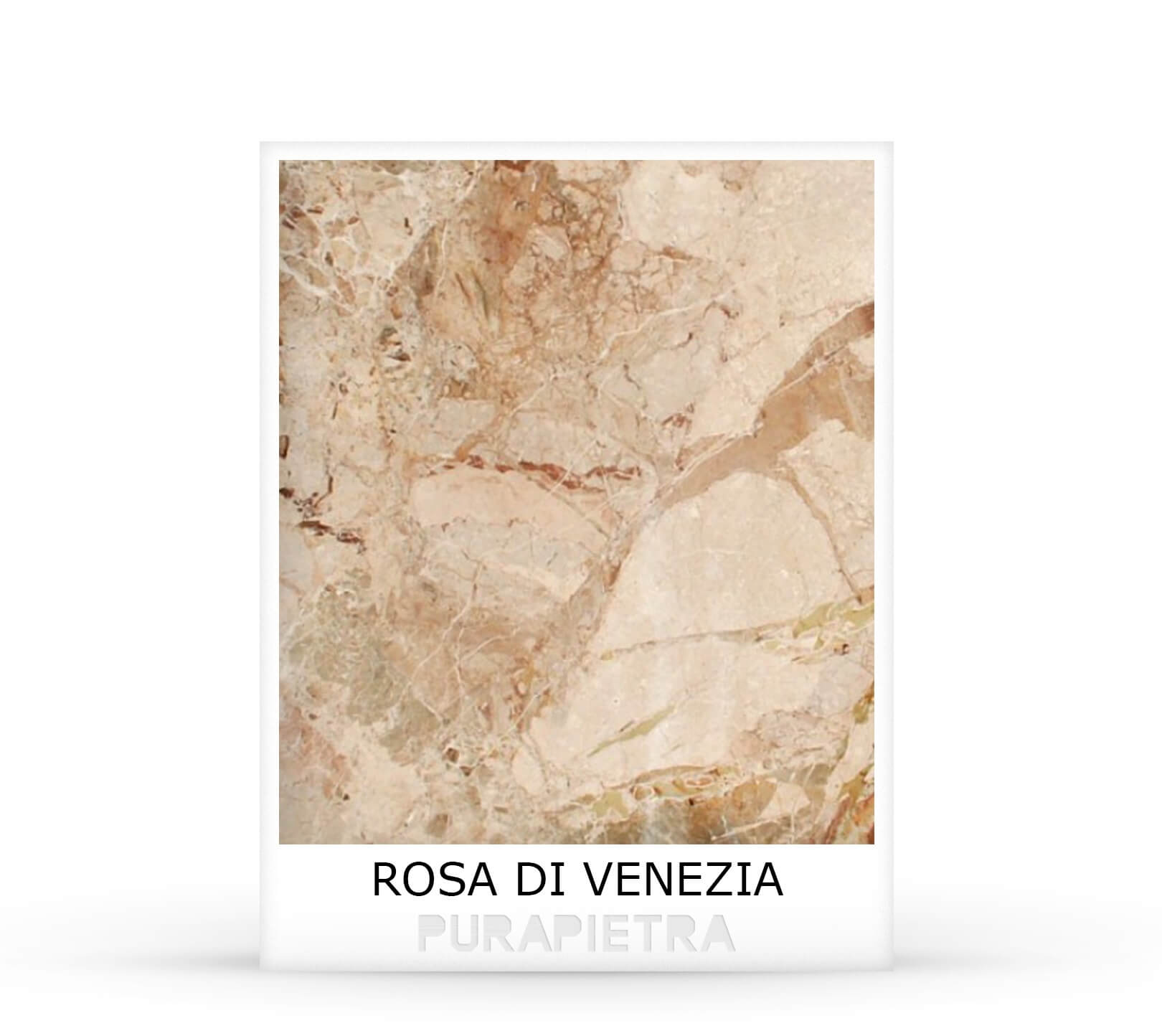
The most classically pink of the four. Rosa di Venezia has a warm rose ground crossed by soft, cloudy veining that keeps the surface gentle rather than busy. It is the stone to reach for when you want the room to read as unmistakably pink but still calm, since the colour is even and the movement is quiet. It behaves beautifully across a larger surface, which makes it a good choice for a vanity top, a bath surround or a run of cladding where the warmth can spread out and settle.
Acquasanta
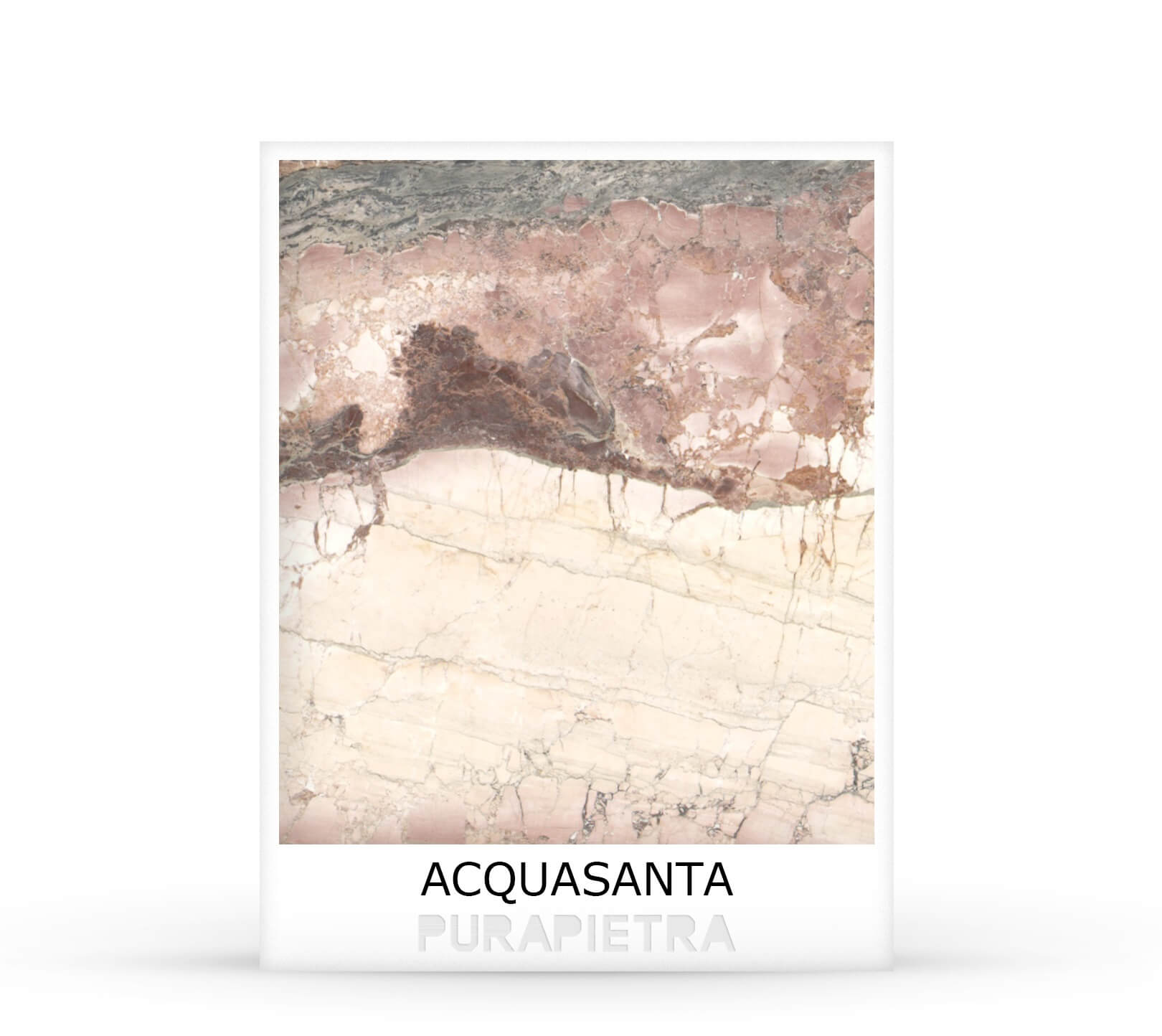
A greyer, more restrained pink, and the one that reads as a neutral more than a colour. Acquasanta sits between rose and dove grey, with fine darker veining that gives it structure, and it is the pink you can use almost anywhere without committing the room to a single mood. It works where you want warmth without declaration: a kitchen surface, a fireplace surround, a floor that lifts a cool room by a degree. We know this stone well enough to have named one of our limited-edition pieces after it.
Flora
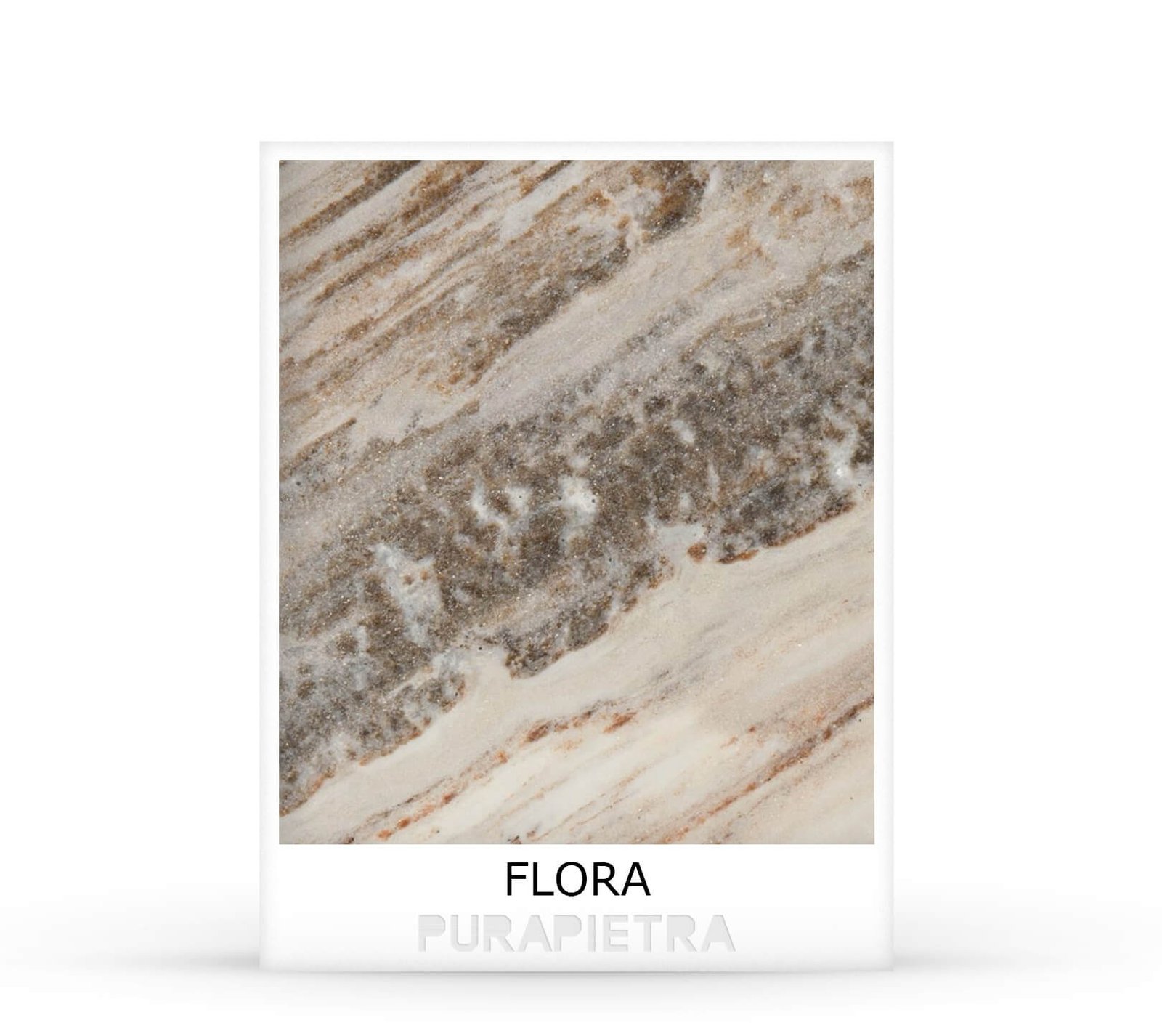
The most decorative of the pinks. Flora carries more movement and a livelier pattern, with pink threaded through warmer and cooler tones so the slab is as much pattern as colour. It is a stone to use where you want one surface to be the event: a bookmatched panel, a single tabletop, a feature wall behind a bed. Give it room to be seen and keep everything around it plain, because a busy pink next to another pattern quickly turns into noise.
Pink Onix
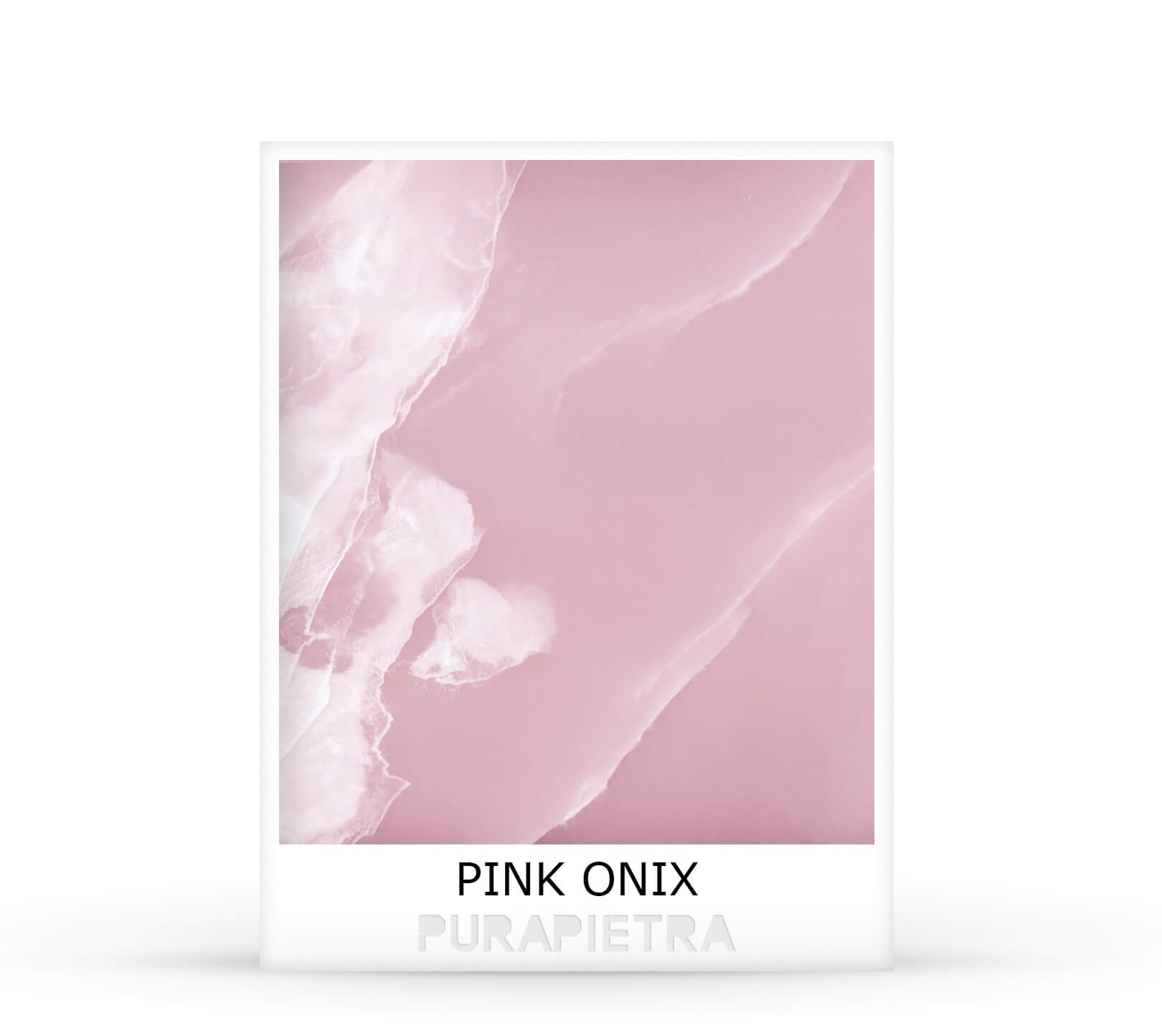
Not a marble in the strict sense but an onyx, and the jewel of the group. Pink Onix is translucent, banded in bands of rose and honey, and it does something no marble can: it glows when light passes through it. Backlit as a panel, a bar front or a basin, it turns from stone into something closer to amber. It is a precious material and best used like one, in a single dramatic place rather than spread across a room. Treat it as the centrepiece and let it earn the attention.
Where to use pink marble in interiors
Pink is the colour that makes a room feel warm and lived-in, which is why it belongs in the private, restful parts of a home. Bathrooms take it especially well. A Rosa di Venezia vanity with a carved freestanding stone basin gives you something soft and flattering without the coldness of a white bathroom, and pink light is the most forgiving light to see yourself in. Use a honed finish in wet areas and pink turns almost powdery and matte, which reads contemporary rather than dated.
In the kitchen, pink is a gentler alternative to the marble-and-brass default. An Acquasanta island looks like a warm neutral against pale timber, while a Flora splashback brings colour to a run of plain cabinetry without any need for a bold paint. The greyer pinks hold up better than a soft white under daily use, and because pink hides the faint marks of a working surface more kindly than a stark white does, it is a sensible choice as well as a beautiful one.
In living spaces, pink does its best work in furniture and objects. A coffee table in Flora, a console in Acquasanta, a shelf of vases and trays in a warm rose: small pieces carry a soft colour further than square metres of it ever could, and they let you test whether pink is right for a room before you commit a wall to it. Our design collection exists partly for this, to put remarkable stone into a room at a scale that makes sense.

Pairing pink marble
Pink is easier to pair than people fear, as long as you decide early whether you want it warm or cool. Brass, aged gold and copper push it toward the romantic and the classical, deepening the rose and making the room feel richer. Blackened steel, bronze and nickel cool it down and keep it architectural, which stops a pink bathroom from tipping into sweetness. Chrome is the most neutral choice and lets the stone speak for itself. The metal you choose matters more with pink than with almost any other colour, because it decides whether the room feels tender or sharp.
For woods, pink is happiest with pale and mid-toned timbers. Oak, ash and light walnut keep the mood fresh, while very dark woods can make pink look faded by contrast. If you are combining stones, pink wants a calm partner. It sits beautifully beside white marble for a soft, layered scheme, and it holds its own against the cool restraint of grey marble, which shares Acquasanta’s temperament. Pink against a strong second colour usually reads as busy, so let the neutrals do the supporting work.
Care and durability
Pink marble needs the same basic care as any marble. It is a calcite stone, which means it is softer than granite and sensitive to acid. Lemon, vinegar, wine and most limescale removers will etch a polished surface and leave a dull mark, and this is true of pink exactly as it is of white. Seal the stone on installation, reseal every year or two depending on use, wipe spills promptly, and clean with pH-neutral products only. Pink Onix, being an onyx, is softer still and wants the same gentle treatment with a little extra caution around impact.
Pink has one quiet advantage over white in daily life. Because the colour already carries warmth and a little tone, the small etches and watermarks that show starkly on a bright white surface are far less obvious on a rose or grey-pink stone. A honed finish makes them almost invisible, which is why we recommend honing any pink surface that will be used rather than admired. Keep polish for vertical panels, tabletops and objects, where the wear will never reach and the colour can shine.
Finishes: how the surface changes the colour
Finish changes pink more than it changes a neutral stone. Polished, the pink deepens and gains a soft sheen that makes the rose look saturated and almost luminous, which is how Flora and Pink Onix look in the images that make people want them. Honed, the same slab lightens and turns matte and powdery, closer to plaster than to stone, which reads calm and contemporary and hides wear far better. Leathered or brushed adds a fine texture that catches light unevenly and gives the surface a hand-worked, tactile character.
The consequence is that variety and finish cannot be chosen separately. A honed Rosa di Venezia and a polished Rosa di Venezia are, for design purposes, two different materials, one soft and matte, the other warm and glowing. Ask to see the same stone in both before you decide, and look at it in the light of the room where it will live rather than under a showroom’s spotlights. Pink shifts more between daylight and lamplight than most colours, which is part of its charm and part of the reason to test it properly.
How to choose the right pink marble
Start with how much colour you actually want. If the pink should sit in a scheme as a warm neutral without dominating it, Acquasanta is the answer, since it reads almost grey until the light warms it. If you want the room to be unmistakably and calmly pink, Rosa di Venezia gives you the colour with a quiet surface. If you want one surface people remember, Flora will do it, and if you want something precious and luminous, Pink Onix, used like the jewel it is.
Then check the practical constraints early. Confirm block availability before you commit to a design, because the more decorative pinks and the onyx come out of the ground in limited numbers. Confirm the slab dimensions against your layout, since figured stones are chosen for pattern and are not endlessly repeatable. And confirm the finish on a physical sample, in your own light, at the time of day the room is actually used.
The whole family is on our materials page. Once you have narrowed it to one or two, ask for a sample. Pink changes more between the photograph and the room than most people expect, and no screen has ever reproduced the way a honed Rosa di Venezia warms a bathroom at the end of the day.
How much does pink marble cost?
Pink marble sits across a wide price range, and the variety matters far more than the colour itself. The calmer pinks such as Acquasanta and Rosa di Venezia are quarried in reasonable quantities and priced in line with a mid-range Italian marble, while a heavily figured Flora climbs higher because the good blocks are chosen for pattern. Pink Onix is a different category again: as a translucent onyx selected for its banding, it is priced as a precious material and is best budgeted for a single feature rather than a whole room. As a rule, expect calm pink marble to cost around the level of a good white, with figured slabs and onyx rising sharply from there.
The honest way to budget is to treat pink marble as a feature material and price the surface rather than the square metre. A single Flora tabletop or a Rosa di Venezia vanity delivers most of the impact for a fraction of the cost of cladding a whole room, which is exactly how we tend to use it. Ask for a quotation against a specific slab rather than a generic rate, because two blocks of the same pink marble can differ in price as much as they differ in beauty. Fabrication adds to the total as well, since bookmatching, curved edges and carved basins all take time.
A short history of pink marble
Pink marble has a long and grand history in Italian building. Rose and salmon-toned stones lined the great cathedrals of the north, most famously the pink Veronese marble that gives Verona’s monuments their warm glow, and Renaissance architects used pink alongside white and green to bring warmth into churches and palaces. The colour signalled wealth and softness at once, a way to make a monumental space feel welcoming rather than cold. When you specify pink marble today you draw on that same instinct, the oldest trick in Italian design for warming stone.
Pink has never really been a trend. It has drifted in and out of fashion over the centuries but never disappeared, and a pink surface brings something indoors the cooler stones cannot: warmth, and a softness that makes a room easier to be in. In a house full of grey and white, it also tends to look like a choice about comfort rather than fashion, which is rarer than it should be. One piece of advice before you commit: sit with a sample for a few days. Pink changes more than any other colour between daylight and a lit lamp, and that change usually tells you more than a showroom ever will.
Related reading
Keep exploring the Purapietra magazine: our pillar guides to white marble, black marble, grey marble and green marble, plus the complete guide to the types of Italian marble. Browse every stone on the materials page, or bring the material home through our design collection.
Frequently asked questions
What is pink marble?
Pink marble is natural stone whose colour ranges from pale grey-pink through warm rose to apricot. The tone comes from iron oxides and manganese present when the stone formed. Some stones sold as pink marble, such as Pink Onix, are technically onyx rather than true calcite marble, which is why they can be translucent and glow when backlit.
Is pink marble suitable for a bathroom?
Yes, and bathrooms are one of its best uses. Pink is warm and flattering, it softens light, and it hides watermarks and etching more kindly than a stark white. Use a honed finish in wet areas, seal the stone on installation and reseal periodically, and clean only with pH-neutral products.
Which pink marble is best for a kitchen?
The calmer, greyer pinks such as Acquasanta work best on a working surface, since they read as a warm neutral and hide the marks of daily use. Choose a honed finish over polished for worktops, seal the stone, and keep acids such as lemon and vinegar off the surface to avoid etching.
What is the difference between pink marble and Pink Onix?
Rosa di Venezia, Acquasanta and Flora are calcite marbles, opaque stones coloured by iron and manganese. Pink Onix is an onyx: a softer, translucent stone banded in rose and honey that glows when light passes through it. Marble suits surfaces and cladding; onyx is best treated as a precious feature material and often backlit.
What colours go with pink marble?
Warm metals such as brass and copper deepen it for a romantic, classical mood, while blackened steel and nickel cool it and keep it architectural. Pale woods such as oak and ash suit it best, and among stones it sits beautifully next to white marble and grey marble. Avoid pairing pink with another strong colour unless the contrast is the whole point.
The 10 Most Prized Italian Marbles and Why They Are Unique
Italy has given the world its most celebrated stone. The most prized Italian marble is not simply beautiful; it is the product of specific mountains, specific veins, and centuries of knowing exactly where to cut. This is a guide to ten of them, the famous and the rare, and to what actually makes one Italian marble worth more than the slab beside it.
Ask anyone to picture marble and they will picture something Italian, whether they know it or not. The white of a Renaissance sculpture, the veined tops of a grand hotel, the floors of a cathedral: nearly all of it came out of a handful of Italian mountains. But not all Italian marble is prized, and the price gap between an ordinary slab and a rare one can be enormous.
Understanding why is the difference between buying stone and buying the right stone. This guide to the most prized Italian marble is here to make that choice clearer, one variety at a time.
What makes an Italian marble ‘prized’
A prized Italian marble earns its status for a short list of reasons, and it usually needs several of them at once. The first is scarcity: the finest stones come from small, nearly exhausted parts of a quarry, and once that seam is gone it does not come back.
The second is the quality of the white or the ground colour, its brightness, its warmth, its evenness. The third is the veining, which is where the real value lives; a clean, graphic, well-balanced vein pattern is rare, and slabs are selected one by one for it.
The fourth is workability, since the best Italian marble cuts, carves and polishes cleanly. And the fifth, quietly, is history: a stone that Michelangelo used, or that has floored churches for four hundred years, carries a value no new quarry can invent.
The most prized Italian marbles almost always tick several of these boxes at once, which is why a truly great slab commands the price it does. All of the stones below are drawn from the Purapietra catalogue, and every one is genuinely Italian. If you want to see how they sit alongside the rest of the range, our guide to the types of marble maps the whole family by colour and origin.
The ten most prized Italian marbles
1. Bianco Statuario
The most famous white Italian marble in the world, and the one the word “statuary” is named for. Quarried above Carrara in the Apuan Alps, Statuario is prized for a warm, luminous white ground and soft, sparing grey veining. It is the stone of classical sculpture because it carves cleanly and holds fine detail, and the finest grades are now rare enough that a good slab is treated as a small event. Used flat and polished, it is the quiet definition of luxury.
2. Calacatta Borghini
If Statuario is the quiet white, Calacatta is the loud one, and Borghini is among its most sought-after grades. This Italian marble has a brilliant white ground crossed by bold, generous veining in warm gold and grey. The contrast is what people pay for: dramatic, graphic, and beautifully suited to bookmatching, where two slabs mirror into a single symmetrical pattern. It belongs where a surface is meant to be seen, a kitchen island, a feature wall, a fireplace.
3. Calacatta Viola
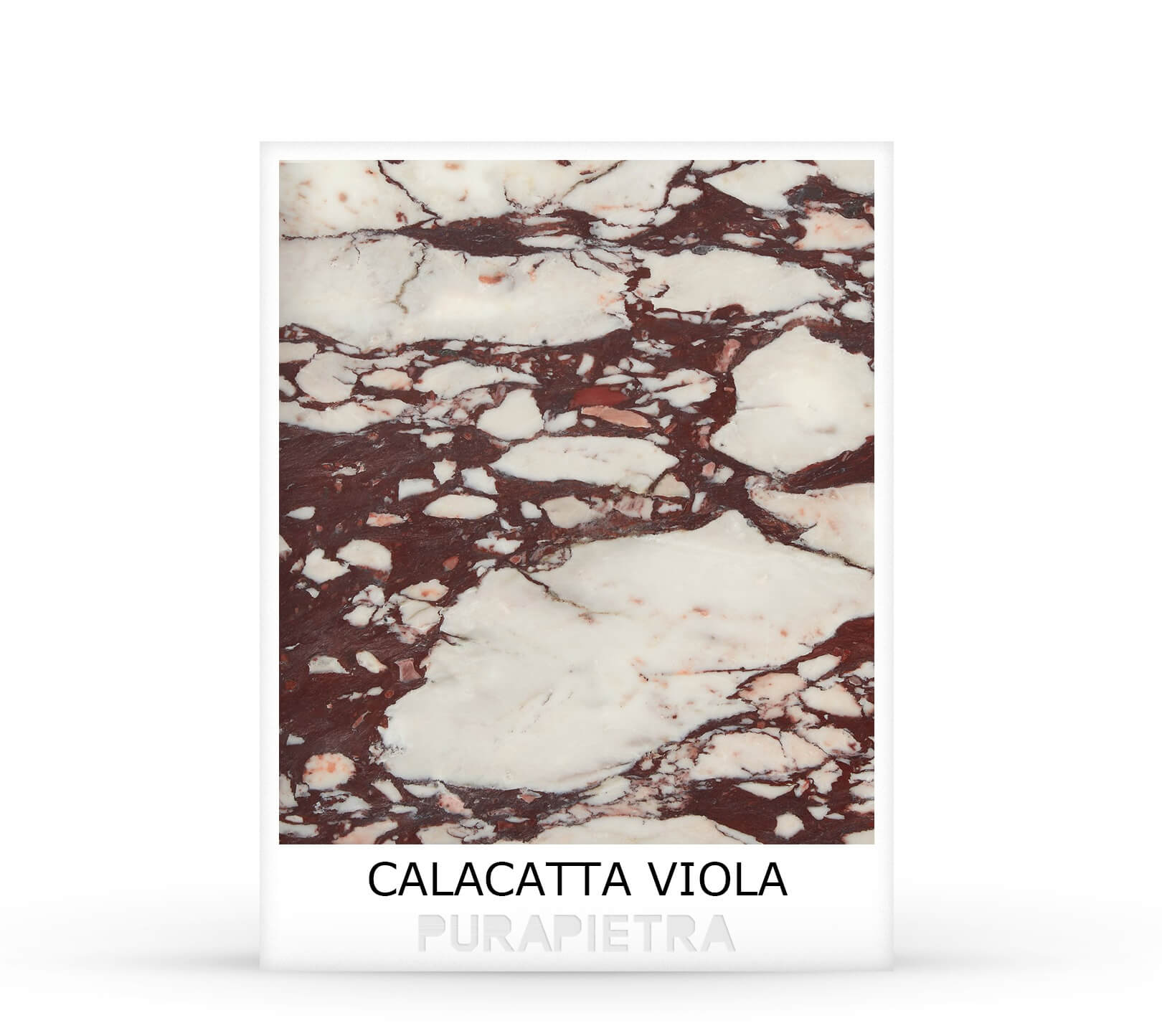
One of the rarest and most theatrical types of Italian marble. Calacatta Viola carries dramatic veining in violet, burgundy and grey across a warm white ground, a colour combination that occurs in very few places on earth. It reads as art rather than architecture, and it is best used sparingly and precisely: a single tabletop, a bookmatched panel, a bathroom that is meant to stop people. Scarcity and colour together make it one of the most valuable stones on this list.
4. Acqua di Carrara
A softer, cooler white from the same Apuan mountains, Acqua di Carrara has a fresh, clear ground and delicate, watery grey veining, hence the name. It is less dramatic than Calacatta and less warm than Statuario, which makes it the versatile choice: an Italian marble that works across large areas without shouting. For interiors that want brightness and calm rather than spectacle, it is one of the most useful prestige whites Italy offers.
5. Breccia Cenere
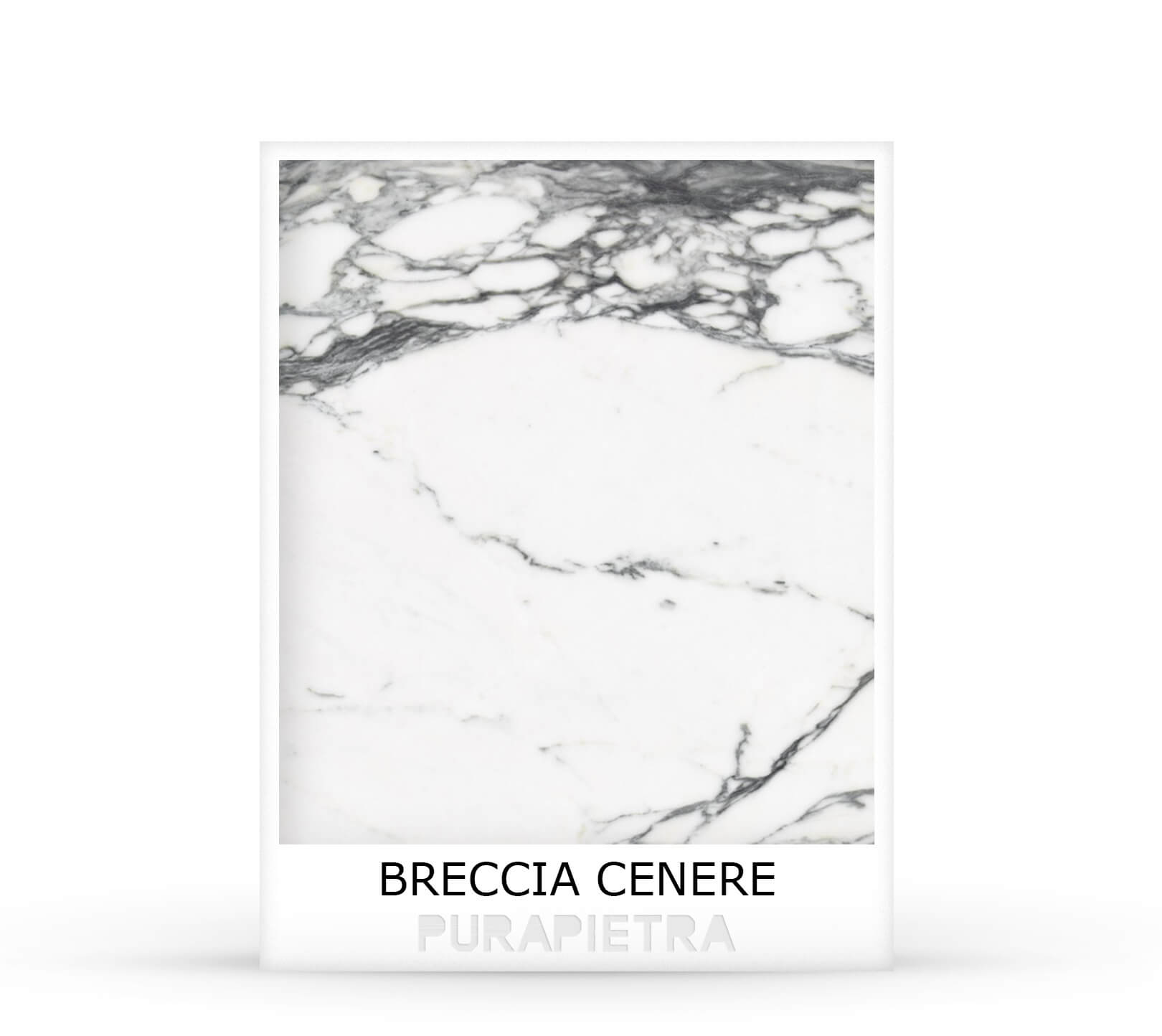
A breccia is a marble made of fragments, angular pieces of older stone cemented back together over geological time, and the good ones are spectacular. Breccia Cenere sets grey and ash-toned fragments in a paler matrix, giving a slab that looks like a mosaic made by the earth. This Italian marble brings pattern and movement without strong colour, which makes it a sophisticated choice for floors, cladding and large surfaces where a plain stone would feel flat.
6. Verde Alpi
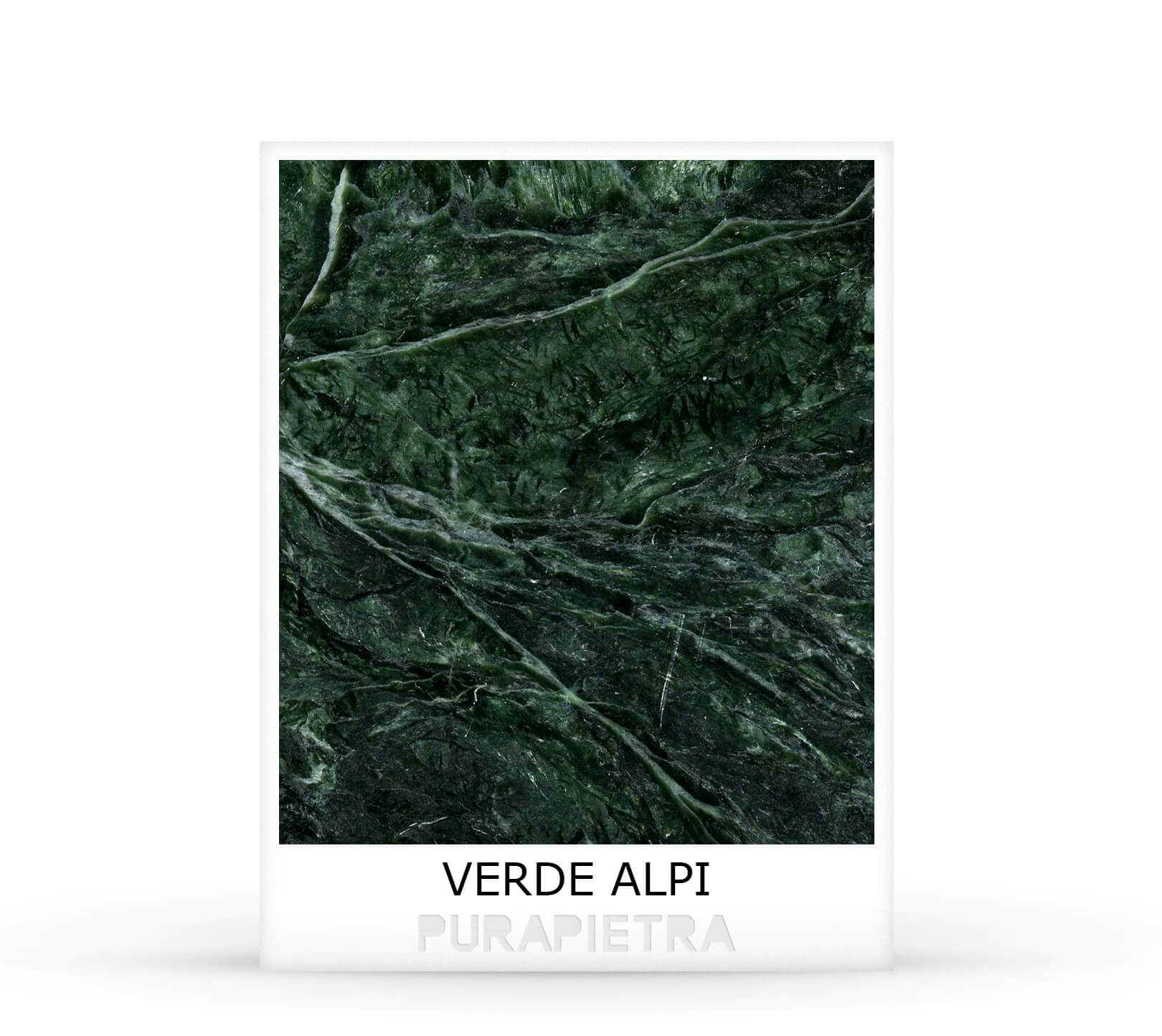
The classic green Italian marble, quarried in the Alpine north-west and used in Italian architecture for centuries. Verde Alpi is a deep bottle green threaded with a fine white network of veins, and because it is a serpentinite it is harder and more durable than most marbles. It has floored churches and lined the lobbies of grand mid-century buildings, and it remains one of the few strong colours that reads as timeless rather than fashionable. See our full guide to green marble for the rest of the family.
7. Grigio di Vagli
A refined grey Italian marble from Vagli in the Tuscan Apuan Alps, less famous than its white neighbours but prized by designers who know it. Grigio di Vagli has a soft, even grey ground with gentle, smoky veining, the kind of stone that gives a room depth without demanding attention. It is the sophisticated alternative to a plain grey: quiet, warm-cool in temperature, and quietly Italian in origin. Our grey marble guide places it among its relatives.
8. Giallo di Bolgheri
Yellow and gold marbles are among the rarest natural stones, and Italy’s Tuscan coast produces one of the finest. Giallo di Bolgheri carries a warm honey-to-amber ground with soft veining, a colour that turns a room golden in evening light. Because saturated yellow is so uncommon, this Italian marble is treated as a feature material: a vanity, a tabletop, an inlay, something small and warm at the centre of a cooler scheme.
9. Rosa di Venezia
Pink is another colour marble rarely delivers cleanly, which is why a good rose-toned Italian marble is prized. Rosa di Venezia has a soft, warm pink ground with delicate veining, romantic without being sweet. It flatters brass and warm timber, and it brings a gentle blush to a bathroom or a bedroom that no paint colour can match. Like all the pale, saturated stones it is best kept to the surfaces where its colour can be appreciated up close.
10. Bianco delle Alpi
A luminous white from the Italian Alps, Bianco delle Alpi closes the list where it started, on the colour Italy is most famous for. It has a bright, clean ground with fine, restrained veining, a white that feels crisp and contemporary rather than classical. For projects that want the prestige of white Italian marble in a cooler, more modern key, it is one of the most elegant choices available.
Where the prized marbles belong in design
The rarest stones reward restraint. A Calacatta Viola or a Giallo di Bolgheri does its best work as a single, deliberate gesture: one tabletop, one vanity, one bookmatched panel that the rest of the room is arranged around. Spread a spectacular Italian marble too thin and it stops feeling special; concentrate it, and a small area of extraordinary stone lifts everything near it.
Our design collection exists partly for this reason, to put remarkable material into a room at the scale of an object rather than a floor. The more even stones, Acqua di Carrara, Bianco delle Alpi, Breccia Cenere and Grigio di Vagli, can carry larger areas without becoming exhausting, which makes them the right choice for floors, cladding and worktops.
Small pieces are the most democratic way into a prized Italian marble: a set of vases or trays in Calacatta or Verde Alpi puts genuine luxury stone into a home without the cost of a full surface. It is the easiest way to live with a great material before committing to it on a larger scale.
Rarity, value and how to buy well
With a prized Italian marble, the practical advice is the same across every stone on this list. Buy the actual slab, not the name, because two blocks of Calacatta can differ enormously in the quality of their veining. Reserve the whole quantity you need at once, since a rare seam can be exhausted between one order and the next.
Check the slab dimensions against your design early, because the finest Italian marble does not always come in the largest formats. And always view a physical sample in the light of the room where it will live, at the time of day the space is actually used. A photograph flattens colour and depth that only the stone itself will show you.
The complete Purapietra collection is on our materials page, organised by colour so you can move from a family, white, black, green, grey, to the individual stone. When you have narrowed the field, ask for a sample. A photograph will tell you the pattern; only the stone in your hand will tell you the value.
Caring for a prized Italian marble
A prized stone deserves prized care, and the good news is that Italian marble is far more forgiving than its reputation suggests. Almost all of these stones are calcite based, which means acids etch them: lemon, vinegar, wine and many household cleaners will leave a dull mark on a polished surface.
The fix is simple. Seal the stone on installation, reseal it every year or two depending on use, wipe spills quickly, and clean only with pH-neutral products. Treated this way, an Italian marble surface will outlast almost everything else in the room.
Finish is part of care as much as looks. On worktops and other working surfaces, a honed finish hides etching and daily wear far better than a polish, which is why we usually recommend it for kitchens and bathrooms. Save the mirror polish for vertical panels, tabletops and objects, where the stone is admired rather than used.
Etching, when it does happen, is not damage in the structural sense: it is a surface change that a professional can often re-hone away, and that many owners come to see as part of the living patina of the material. Remember that the most prized Italian marbles were cut from mountains that have stood for millions of years. A little routine attention is a small price for a surface that will still look extraordinary long after the trends around it have gone.
From quarry to slab: how Italian marble is made
Part of what you pay for in a prized Italian marble is the sheer difficulty of getting it out of the mountain. In the Apuan Alps above Carrara, blocks are still cut from quarry faces that Michelangelo would recognise, using diamond wire and careful reading of the stone’s natural fractures. A single block can weigh twenty tonnes, and only a fraction of what comes out of the ground meets the grade for a prestige slab.
Once a block reaches the workshop, it is sawn into slabs a few centimetres thick, and this is where the character of an Italian marble is decided. The direction of the cut sets the pattern: cut one way, a stone reads as soft cloud; cut another, the same block becomes bold, directional veining. Bookmatched pairs are cut from consecutive slices so their patterns mirror, which is why bookmatching is reserved for the most dramatic stones.
Finishing is the last act. Polishing brings the colour and veining to their fullest depth; honing leaves a soft matte surface that wears better; brushing and leathering add texture. The same Italian marble can look like three different materials depending on the finish, which is why we always show a stone in the finish you intend to use rather than the one that photographs best.
Understanding this journey, from quarry face to finished surface, is the quickest way to understand why the finest stone costs what it does. It also explains why no two orders are ever quite identical: every block carries the record of the exact place and moment it was cut, and that individuality is precisely what makes a great Italian marble worth owning.
Related reading
Keep exploring the Purapietra magazine: our pillar guides to white marble, black marble, green marble and grey marble, plus the complete guide to the types of Italian marble. Browse every stone on the materials page, or bring the material home through our design collection.
Frequently asked questions
What is the most prized Italian marble?
Bianco Statuario from Carrara is usually considered the most prized Italian marble, valued for its warm luminous white and its history as the stone of classical sculpture. For colour and rarity, Calacatta Viola is among the most valuable, because its violet veining occurs in very few places on earth.
Why is some Italian marble so expensive?
Several factors combine: scarcity, since the finest grades come from small and nearly exhausted seams; the quality of the ground colour and the veining, which are selected slab by slab; workability; and history. When an Italian marble is both rare and beautifully patterned, its value rises sharply because no two slabs are the same.
What is the difference between Statuario and Calacatta?
Both are white Italian marble from the Carrara area. Statuario has a warmer white ground with soft, sparing grey veining and a restrained, classical look. Calacatta has a brighter white ground with bolder, more dramatic gold and grey veining, so it reads as a statement stone rather than a quiet one.
Are green and coloured stones also prized Italian marble?
Yes. Colour is rare in natural stone, so a fine coloured Italian marble can be as prized as a white one. Verde Alpi has centuries of use in Italian architecture, while genuinely yellow, pink and violet stones such as Giallo di Bolgheri, Rosa di Venezia and Calacatta Viola are valued precisely because those colours occur so rarely.
How do I choose a prized Italian marble for my project?
Decide first whether the stone should be a feature or a background. Rare, dramatic Italian marble works best concentrated on a single surface, while more even stones can cover larger areas. Then buy the specific slab rather than the name, reserve the full quantity at once, and view a physical sample in the light of your own room before committing.
Green Marble: Varieties, Uses and How to Choose
Green marble is the colour that walks the line between nature and jewellery. It carries the green of moss, malachite and deep water, and it changes a room the way a plant does, by bringing something living into it. This is a guide to the green marbles we work with at Purapietra: where the colour comes from, what each stone does in a space, and how to choose the one that belongs in yours.
Most marble colours read as background. Green does not. It is a real colour with a mood, and it shifts a room the moment it arrives, from cool sage through bottle green to the near-black depth of a Verde Positano. Some green slabs are quiet and cloudy, closer to a painted wall than a stone. Others carry veining so vivid you would frame them. Knowing which is which is most of the choice.
The character of green marble
Green marble owes its colour to a small group of minerals that were present when the rock formed. Marble is recrystallised limestone, and its tone comes from whatever was trapped in the stone during that process. Iron gives reds and yellows, graphite gives black, and green comes mainly from serpentine, chlorite and related silicates. Several of the stones sold as green marble are, strictly speaking, serpentinites or ophicalcites rather than pure calcite marbles, which is part of why their colour runs so deep and their veining so dramatic. Wikipedia has a clear primer on how marble forms if you want the geology in full.
That mixed origin has a practical side worth knowing. The serpentine-based greens are often harder and less porous than a classic white marble, which makes them more forgiving on surfaces that get used. The trade-off is that green rarely comes in the calm, uniform sheets you get from a Carrara. It is a stone with movement, so it belongs where that movement can be seen: a vanity top, a bookmatched panel, a fireplace, a table, an island. If you want to see how it sits among the other Italian stones we work with, our guide to the types of marble maps the whole range.
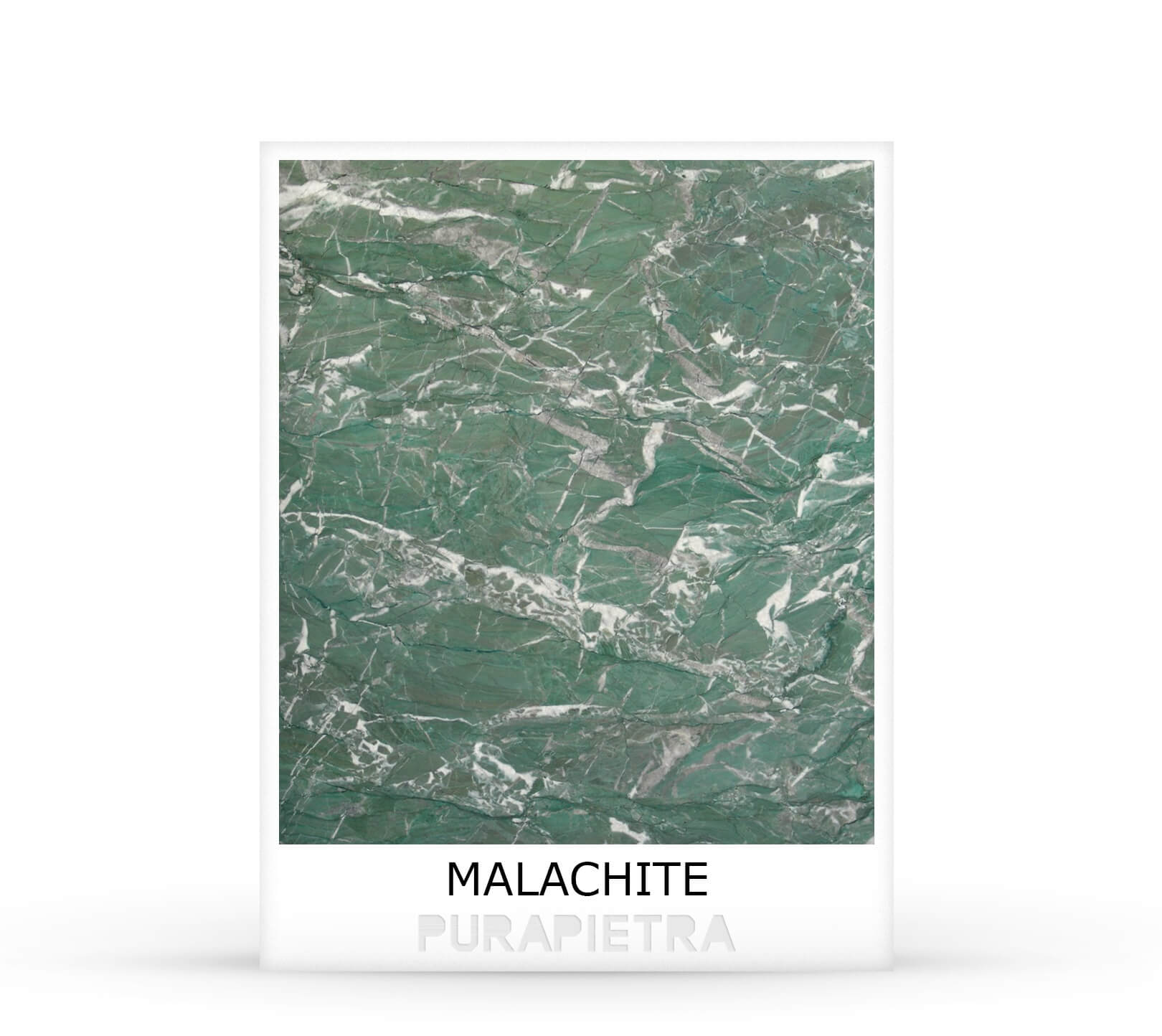
The green marble varieties at Purapietra
Our green selection is small and chosen slab by slab. Four stones, each with a different temperature and a different job, picked for grain and for the way the colour holds under a hand finish.
Malachite
Named for the mineral it echoes, Malachite is the most jewel-like green we offer. A saturated deep green ground is crossed by white and pale-green veining that swirls rather than runs straight, so the slab reads as pattern as much as colour. It behaves like a precious material rather than a building one, and it is best used that way: a single tabletop, an inlay, a small vanity, a run of objects. Give it one place to be extraordinary and everything around it can stay quiet.
Verde Alpi
The classic Italian green, quarried in the Alpine valleys of the north-west. Verde Alpi is a dark bottle green threaded with a fine white network of veins, and it has a long history in Italian architecture, from church floors to the lobbies of mid-century palazzi. It is harder and denser than most marbles because it is a serpentinite, which makes it one of the more practical greens for surfaces that see daily life. Bookmatched, its white veining opens into a symmetrical pattern that carries a whole wall.
Verde Mediterraneo
The most relaxed of the four. Verde Mediterraneo is a softer, greyer green, closer to sage and olive than to bottle, with gentle veining and a calmer overall movement. Because it sits so near a neutral, it is the green you can use across a larger area without the room becoming loud: a stretch of bathroom cladding, a kitchen island, a fireplace surround that reveals itself slowly. This is the stone for people who want the colour without the declaration.
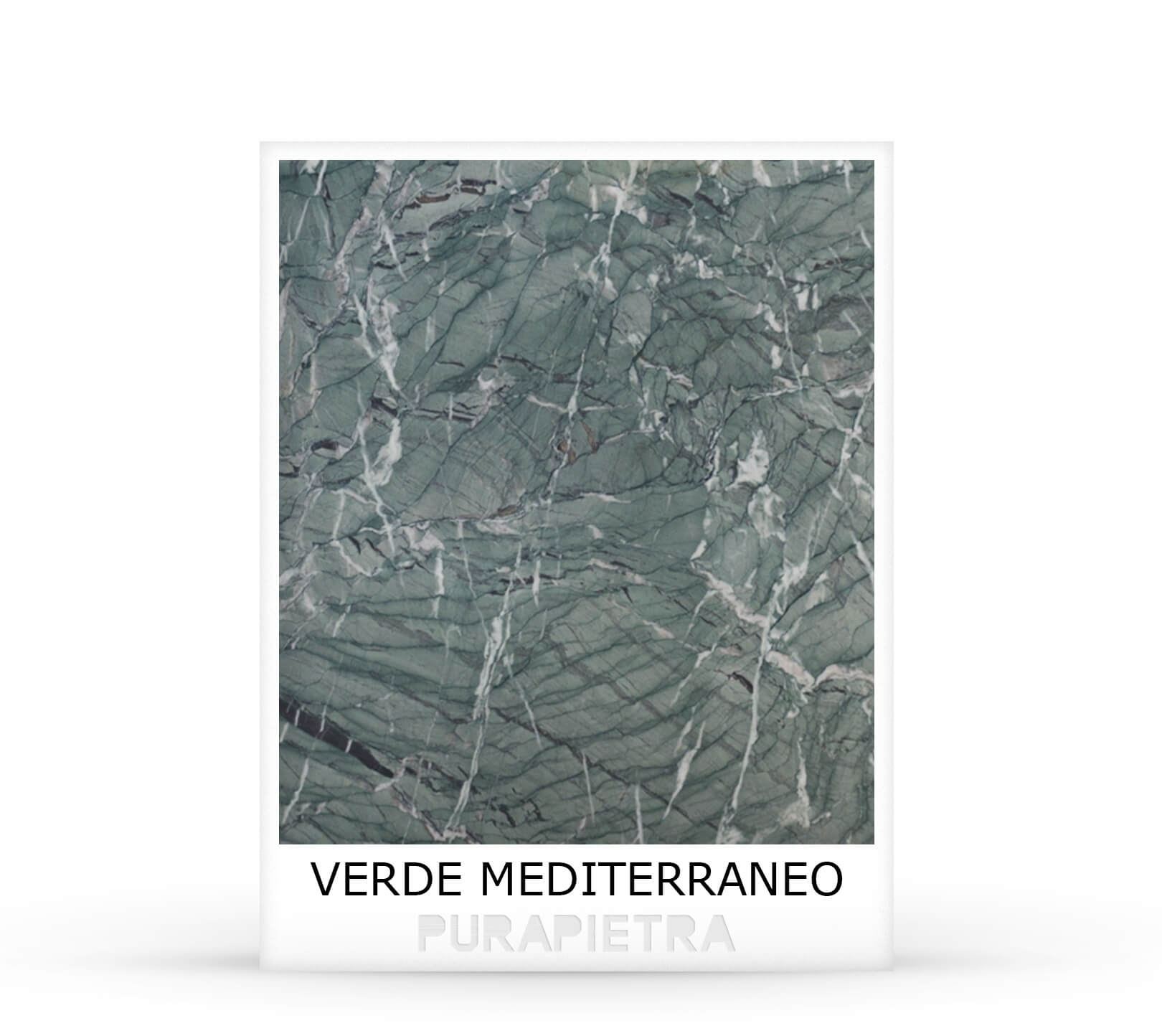
Verde Positano
The darkest and most dramatic green in the collection. Verde Positano has an almost black-green ground broken by bold veining, and it has the same effect as a very deep stone in any colour: it makes a surface feel weighty and expensive. It works best where you want one element of a project to anchor everything else, a console, a bar front, a bathroom feature wall. Pair it with light and it comes alive; sink it into a dark room and it turns quietly luxurious.
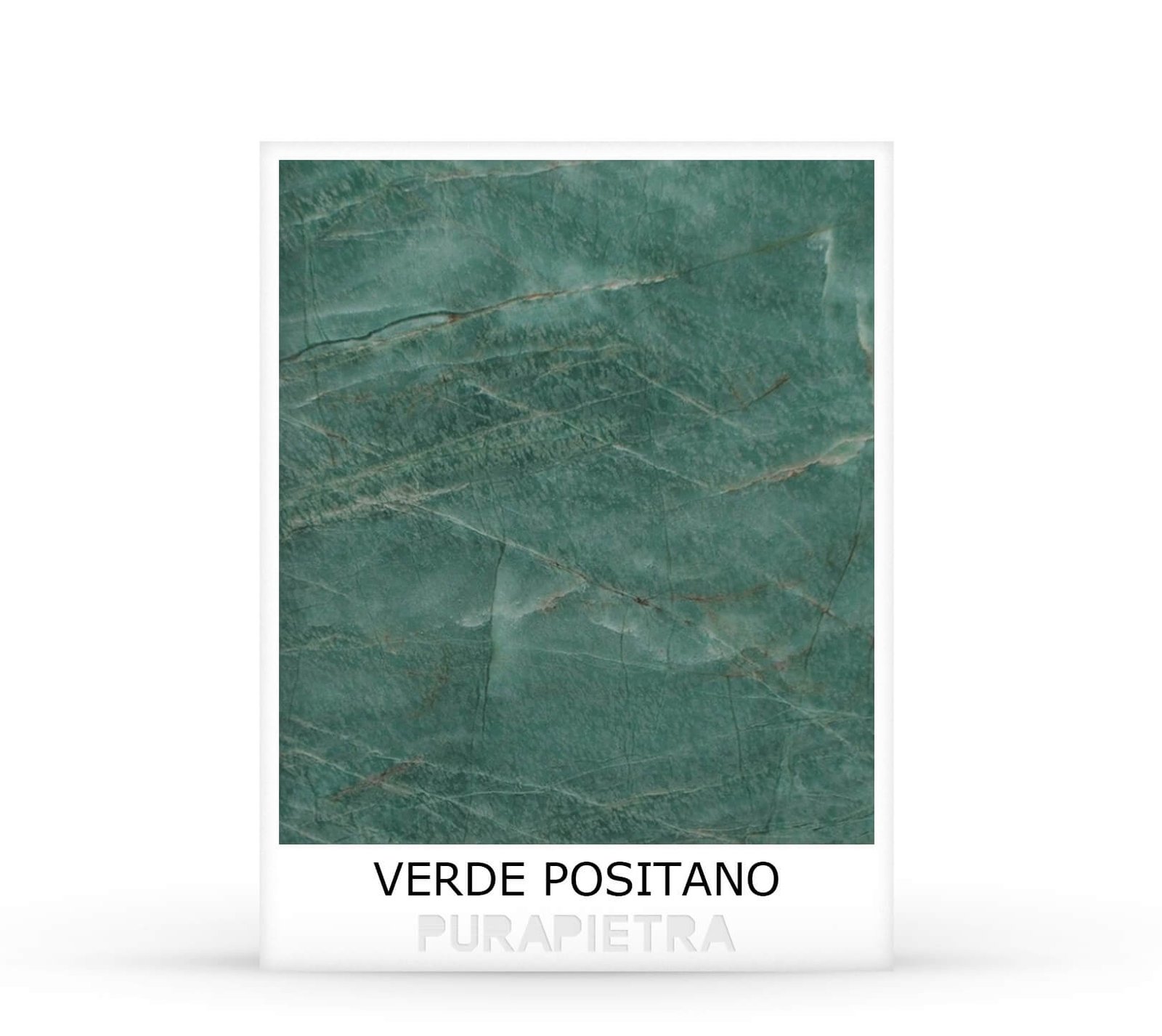
Where to use green marble in interiors
Green is the colour that connects an interior to the natural world, which is why it feels so at home in rooms meant to be restful. Bathrooms take it beautifully. A Verde Mediterraneo vanity with a carved freestanding stone basin gives you something calm and slightly botanical without the usual beige, and a Verde Alpi shower wall reads as timeless rather than trend-led. Green also flatters brass and warm timber, so it slots into both classical and contemporary bathrooms without a fight.
In the kitchen, green is the natural counterpoint to wood and to warm metals. A Verde Alpi island against pale oak, or a Malachite splashback behind a run of walnut, is a richer and more considered pairing than the marble-and-brass default. The denser serpentine greens hold up better than a soft white under daily use, which makes them a sensible choice for a surface that will actually be cooked on. Keep the perimeter simple and let the green be the event.
In living spaces, green does its best work in furniture and objects. A coffee table in Malachite, a console in Verde Positano, a shelf of vases and trays in the same stone: small pieces carry a strong colour further than square metres of it ever could. Our design collection exists partly for this, to put remarkable stone into a room at a scale that makes sense.
Pairing green marble
Green takes metal well, and the metal sets the mood. Brushed brass and aged gold warm it and push the scheme toward the classical and the decorative, which suits Malachite and Verde Alpi. Blackened steel and dark bronze keep it moody and architectural, which is where Verde Positano wants to be. Nickel and chrome cool the whole thing down and read more contemporary, a good match for Verde Mediterraneo. Copper is the one to test rather than assume; against the right green it is gorgeous, against the wrong one it turns muddy.
For woods, warm species are the reliable contrast. Oak, walnut and teak give the green something to sit against and echo its natural feeling. If you are combining stones, green is happiest next to a calm neutral. A green island in a room of white marble reads as deliberate and fresh, while green against another strong colour usually reads as noise. Deep greens such as Verde Positano also sit well beside our black marble for a darker, more enveloping scheme, and the greyer grey marble family shares Verde Mediterraneo’s cool temperament.
Care and durability
Green marble needs the same basic care as any marble, with one useful difference. The serpentine-based greens like Verde Alpi are harder and less porous than a soft white, so they resist scratching and staining better. But they are still calcite and silicate stones, which means acids can still etch a polished surface: lemon, vinegar, wine and most limescale removers will leave a dull mark. Seal the stone on installation, reseal every year or two depending on use, wipe spills promptly, and clean with pH-neutral products only.
Finish matters here as much as material. Dark and saturated greens show etching more clearly than pale ones, so a dull ring is more visible on Verde Positano or Malachite than on Verde Mediterraneo. For any green surface that will be used rather than admired, a honed finish is the smart choice: it removes the reflective layer that makes etch marks obvious and gives the stone a matte, almost velvet depth. Save the polish for vertical panels and objects, where the colour can shine without the wear.
Finishes: how the surface changes the colour
Finish changes green marble more than it changes a neutral stone. Polished, the green deepens and gains a wet, saturated intensity, which is how Malachite and Verde Positano look in the photographs that make people want them. Honed, the same slab lightens by a visible degree and turns matte and soft, which reads more contemporary and hides wear far better. Leathered or brushed adds a fine texture that catches light unevenly and gives the stone a hand-worked, less industrial character.
The consequence is that variety and finish cannot be chosen separately. A honed Verde Alpi and a polished Verde Alpi are, for design purposes, two different materials. Ask to see the same stone in both before you decide, and look at it in the light of the room where it will live rather than under a showroom’s spotlights.
How to choose the right green marble
Start with how loud you want the room to be. If the stone should sit in a scheme without dominating it, Verde Mediterraneo is the answer, since it behaves almost like a sage-toned neutral. If you want one surface people remember, Verde Positano or a bookmatched Verde Alpi will do it. If the point is luxury at a small scale, Malachite, used like the jewel it resembles.
Then check the practical constraints early. Confirm block availability before you commit to a design, because the more dramatic greens come out of the ground in limited numbers. Confirm the slab dimensions against your layout, since heavily veined stones are chosen for pattern and are not endlessly repeatable. And confirm the finish on a physical sample, in your own light, at the time of day the room is actually used.
The whole family is on our materials page. Once you have narrowed it to one or two, ask for a sample. Green changes more between the photograph and the room than most people expect, and no screen has ever reproduced the depth of a polished Malachite in daylight.
How much does green marble cost?
Green marble sits across a wide price range, and the variety matters more than the colour itself. The serpentine greens such as Verde Alpi are quarried in reasonable quantities and priced in line with a mid-range Italian marble, while a heavily figured Malachite or a deep Verde Positano climbs quickly because the good blocks are rare and the slabs are chosen for pattern. As a rule, expect green marble to cost more than a standard white and less than a semi-precious blue, with the exact figure driven by block availability, slab size and finish. Fabrication adds to the total: bookmatching, curved edges and carved basins all take time, and green’s natural movement means more slabs are set aside during selection.
The honest way to budget is to treat green marble as a feature material and price the surface rather than the square metre. A single Malachite tabletop or a Verde Alpi vanity delivers most of the impact for a fraction of the cost of cladding a whole room, which is exactly how we tend to use it. Ask for a quotation against a specific slab rather than a generic rate, because two blocks of the same green marble can differ in price as much as they differ in beauty.
A short history of green marble
Green marble has decorated important buildings for two thousand years. The Romans prized a green serpentine they called Verde Antico, cut from Greek and Alpine quarries and set into the floors of temples and palaces. Renaissance and Baroque architects returned to it for altars, columns and inlays, and the deep greens of the Italian Alps lined the grand interiors of the nineteenth and twentieth centuries. When you specify green marble today you join a long line of builders who reached for the same colour to signal permanence and craft.
That history is part of why green still reads as considered rather than trendy. It has never really left use, only moved in and out of fashion, and a green marble surface carries a little of that association indoors: the colour of nature, growth and calm. In a world of grey kitchens and beige bathrooms, choosing green marble is a quiet signal that the room was designed by someone with a point of view. It is a colour that rewards patience: live with a sample for a few days, watch how the green shifts from morning light to lamplight, and the right stone will make itself obvious long before you have finished deciding.
Related reading
Keep exploring the Purapietra magazine: our pillar guides to white marble, black marble, grey marble and blue marble, plus the complete guide to the types of Italian marble. Browse every stone on the materials page, or bring the material home through our design collection. See also the comparison of Italian vs imported marble.
Frequently asked questions
What is green marble?
Green marble is natural stone whose colour ranges from soft sage through bottle green to near-black. The tone comes from minerals present when the stone formed, mainly serpentine, chlorite and related silicates. Several stones sold as green marble are serpentinites or ophicalcites rather than pure calcite marbles, which is why their colour runs so deep.
Is green marble durable enough for a kitchen?
Often yes. The serpentine-based greens such as Verde Alpi are harder and less porous than a soft white marble, which makes them more resistant to scratching and staining on worktops and islands. They should still be sealed and cleaned with pH-neutral products, and a honed finish is preferable to polished for surfaces in daily use.
Can green marble be used in a bathroom?
Yes, and bathrooms are one of its best uses. Green feels calm and slightly botanical, and it flatters both brass and warm timber. Use a honed finish in wet areas because it hides etching and watermarks, seal the stone on installation, and reseal periodically.
What is the difference between Verde Alpi and Malachite?
Verde Alpi is a classic Italian serpentinite: a dark bottle green with a fine white network of veins, hard and practical enough for surfaces. Malachite is a deeper, more jewel-like green with swirling white veining, best treated as a feature material for tabletops, inlays and objects rather than large worked surfaces.
What colours go with green marble?
Warm woods such as oak and walnut, warm metals such as brass for a classical mood, or blackened steel and nickel for a cooler, more contemporary one. Green also sits well against calm neutrals, especially white and grey marble. Avoid pairing it with another saturated colour unless the contrast is the whole idea.
Italian Marble vs Imported Marble: The Real Difference in Quality
“Italian marble” is the most repeated phrase in the stone trade and one of the least examined. It is used as a synonym for quality, which is convenient for anyone selling it and unhelpful for anyone buying. So here is the honest version of Italian marble vs imported marble: what actually differs, where the difference is real, where it is marketing, and when the imported slab is the better answer.
Marble comes out of the ground in more than fifty countries. Turkey, Greece, Spain, India, Brazil, China and Iran all export it in volume, and several of them ship more tonnage than Italy does. Italy has not been the largest producer for years. What it still has is something narrower and harder to replicate: a handful of geologically exceptional deposits, and roughly seven hundred years of accumulated knowledge about how to get stone out of them and work it.
Italian marble vs imported marble: what “Italian marble” actually means
The phrase is not a legal designation and not a quality grade. It is an origin claim, and a loose one. Strictly, it means the block was quarried in Italy: most often from the Apuan Alps above Carrara, but also from Vagli, Bolgheri, the Alps and a scattering of smaller Italian sites. Loosely, and this is where buyers get caught, it sometimes means only that the stone was finished in Italy while the block arrived from somewhere else entirely.
Both statements can be true at once, and only one of them tells you about the stone. A slab quarried in Turkey and polished near Verona is a good slab, possibly an excellent one, but it is Turkish marble with Italian fabrication. There is nothing wrong with that as long as it is described accurately and priced accordingly. The problem is when “Italian” is used to mean “expensive and good” rather than “from Italy”, because at that point the word has stopped carrying information.
The names help, if you know them. Carrara, Statuario, Calacatta, Arabescato and Bardiglio are Apuan stones with genuine geographic meaning. Names constructed to sound Italian without being tied to a place are worth a second question. If you want the map of the real ones, our guide to the types of Italian marble lays them out.
Geological quality: where the difference is real
Some of the Italian advantage is not narrative. It is in the rock.
The Apuan deposits produce marble with an unusually fine and even crystal structure. Practically, that means a denser stone, lower porosity, a surface that takes a mirror polish without micro-pitting, and better behaviour under carving. It is why Renaissance sculptors went to Carrara rather than anywhere closer, and why Statuario still commands prices that look irrational on a spreadsheet. A coarse-grained marble can be perfectly good as a floor and still fall apart under a chisel.
The second real difference is consistency within the deposit. A well-run Apuan quarry produces blocks whose colour and veining stay recognisable across a large order. That matters enormously when you are cladding a lobby or bookmatching a wall, and it is the reason a specifier will pay a premium for a stone they have used before. Some imported deposits are equally consistent; many are not, and the variance shows up as waste on site.
What is not a real difference: hardness, strength and durability as generic categories. A good Turkish or Greek marble will outperform a mediocre Italian one on every technical test that matters. Marble is calcite wherever it comes from, and it etches with acid in Carrara exactly as it does in Rajasthan. Anyone telling you Italian marble does not stain is selling, not explaining.
Quarrying and fabrication: the part nobody photographs
The stone is half the story. What happens to it afterwards decides how it looks in your house.
Italian quarries have largely moved to diamond wire cutting, which extracts squarer blocks with fewer internal fractures and less waste than blasting or older mechanical methods. Fewer fractures means fewer slabs that crack during processing, and fewer slabs that develop a hairline a year after installation.
In fabrication, the Apuan district has an unusual concentration of workshops running current CNC alongside hand finishing, with technicians who have seen enough stone to know when a block should be cut against its natural direction and when it should not.
That judgement is the genuinely scarce resource, and it is why we work the way we do. Every piece in our New Era collection is CNC-shaped and then finished by hand in Italy, because a machine can hold a tolerance but it cannot decide how a curve should feel. The same applies to our vases and trays: small objects where every square centimetre is visible and there is nowhere for a rushed finish to hide.
None of this is exclusive to Italy, and it is where the Italian marble vs imported marble question gets genuinely interesting. There are excellent fabricators in Turkey, Spain and increasingly in India. But the density of them per square kilometre around Carrara is genuinely unusual, and it shortens the distance between a block and a finished piece.
Traceability, quarries and what you can actually verify
The most useful practical difference between Italian and imported marble has little to do with the stone and a lot to do with paperwork.
Italian quarries are documented, regulated and, in the Apuan case, watched closely by everyone from the regional government to environmental groups. That scrutiny is inconvenient for operators and excellent for buyers, because it means a block can usually be traced to a named quarry, with an extraction date and a batch. If you need to match material in two years for a phase two, that record is what makes it possible.
Traceability also covers the questions that increasingly appear in specifications: working conditions, environmental compliance, the carbon cost of transport. A block from Carrara arriving in Northern Europe has a shorter and better-documented journey than one crossing an ocean. If a project is being certified, that documentation is not a nicety, it is a requirement.
What to ask, regardless of origin: which quarry, which block number, what date, can I see the other slabs from the same block. A serious supplier answers all four without hesitating. A supplier who answers “it’s Italian” has told you nothing. Every stone on our materials page is selected slab by slab for exactly this reason.
When imported marble is the right choice
There are good reasons to buy imported stone, and pretending otherwise would be dishonest.
Some colours simply do not exist in Italy. The deepest blues come from Brazilian and Bolivian sodalite. Several greens come from India and Greece. The most saturated onyxes come from Iran, Turkey and Pakistan. If the design needs that colour, origin is not a choice you get to make. Our own blue marble and black marble families both include stones from outside Italy for precisely this reason, and they are in the collection because they are the best available, not because they are the cheapest.
Budget is the second honest reason. A Turkish white in place of Statuario can halve a material cost with a difference most people would not identify in a finished room. On a large project, that gap can be the difference between marble and a printed porcelain imitation, and real stone from Turkey beats fake stone from anywhere.
Scale is the third. Some imported deposits produce very large, very uniform blocks in quantities the Apuan quarries cannot match. For a big commercial floor where consistency across a thousand square metres matters more than the pedigree of the name, imported is often the technically better answer.
The value of made in Italy
So what is left, once the marketing is stripped out?
A few deposits whose crystal structure is measurably superior for carving and polishing. A supply chain you can audit. A fabrication culture that still has enough hand skill to make decisions a machine cannot. And a body of reference, seven centuries of buildings and sculpture, that tells you exactly how these stones age, because we have watched them do it.
That is a real premium, and it is worth paying when the piece is going to be looked at closely and kept for a long time: a sculpted basin, a bookmatched wall, an object someone will inherit. It is worth less when the stone is a service floor in a building that will be refitted in fifteen years. Knowing which situation you are in is the actual skill, and it is a more useful question than the usual Italian marble vs imported marble debate.
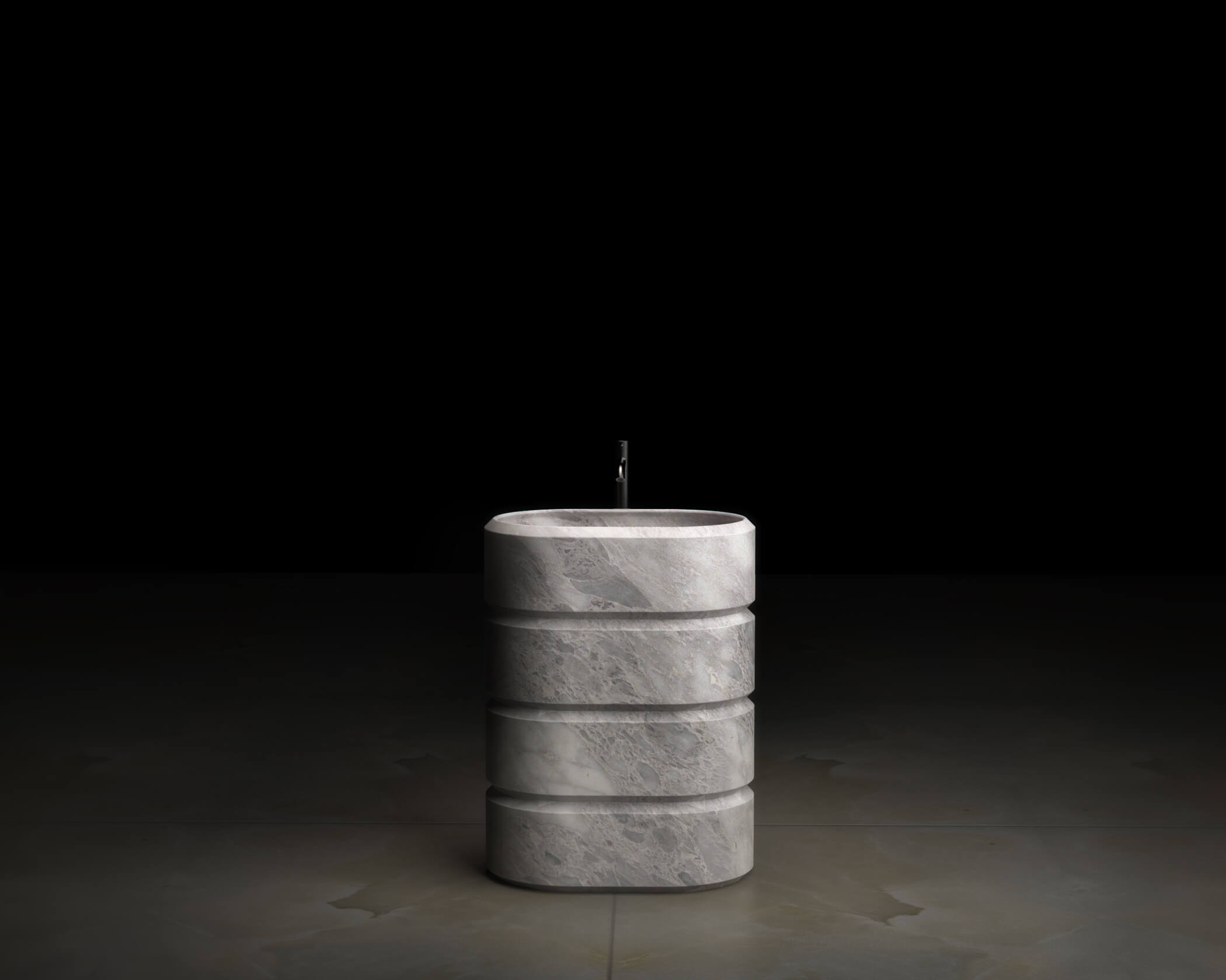
Related reading
Keep exploring the Purapietra magazine: the complete guide to the types of Italian marble, our pillar guides to white marble, black marble, grey marble and beige marble, and the head-to-head on Carrara vs Statuario. Browse every stone we select on the materials page. See also our guide to green marble.
Frequently asked questions
Is Italian marble really better than imported marble?
For specific deposits and specific uses, yes. The Apuan marbles have a finer, more even crystal structure that polishes and carves better than most alternatives, and Italian supply chains are more traceable. But “Italian” is an origin, not a quality grade: a good Turkish or Greek marble easily outperforms a mediocre Italian one. Judge the individual stone, not the flag.
How can I tell if marble is genuinely Italian?
Ask for the quarry name, the block number and the extraction date, and ask to see other slabs from the same block. Legitimate Italian material carries that documentation. Be careful with the distinction between quarried in Italy and finished in Italy, since both are sometimes described as Italian marble.
Why is Italian marble more expensive?
Limited deposits, higher extraction and labour costs, stricter environmental regulation, and higher selection standards that reject more material. You are also paying for consistency and traceability, which reduce risk and waste on site.
Does imported marble stain more easily than Italian marble?
Not because of origin. All marble is calcite based and reacts to acids wherever it was quarried. Porosity varies between deposits rather than between countries, and some imported marbles are denser than some Italian ones. Sealing and pH-neutral cleaning matter far more than the passport.
When should I choose imported marble instead?
When the colour does not exist in Italy, such as deep blues, many greens and the most saturated onyxes; when the budget will otherwise force a switch to imitation materials; and when a very large project needs uniform blocks in quantities the Italian quarries cannot supply.
Blue Marble: Varieties, Uses and How to Choose
Blue marble is the rarest thing in a stone yard. Whites and greys arrive by the container; blue turns up occasionally, in small quantities, and never twice the same. That scarcity is exactly why designers keep asking for it. This is a guide to the blue marbles we work with at Purapietra: where the colour comes from, what each stone does in a room, and how to choose the one that suits yours.
Almost every other marble colour is a variation on neutrality. Blue is not. It is a real colour, with an opinion, and it changes a room the moment it goes in. The tones run from a stormy grey-blue through petrol and teal to the deep ultramarine of lapis. Some slabs are quiet and cloudy; others have veining so dramatic you would hang them on a wall like a painting. Understanding which is which is most of the work.
The character of blue marble
Blue marble is uncommon because the chemistry that produces it is uncommon. Marble is recrystallised limestone, and its colour comes from whatever minerals were trapped in the rock as it formed. Iron gives you reds and yellows, graphite gives you black, and the blues come from rarer sources: lazurite and sodalite in the deepest stones, chlorite and other silicates in the greyer, stormier ones. Wikipedia has a good primer on how marble forms if you want the geology in full. What matters commercially is simpler: the deposits are small, extraction is slow, and blocks come out in limited numbers. Nobody quarries blue marble at scale.
That rarity has a practical consequence worth knowing before you fall in love with a slab. Blue is rarely available in the quantities you would need for a whole floor or a full house of cladding. It belongs on the surfaces where a small area does a lot of work: a vanity top, a bookmatched panel, a bar front, a coffee table, a lit shower niche. Treat it as a feature stone from the start and you will design with it rather than around it. If you want to see how it sits among the other Italian stones we work with, our guide to the types of marble maps the whole range.
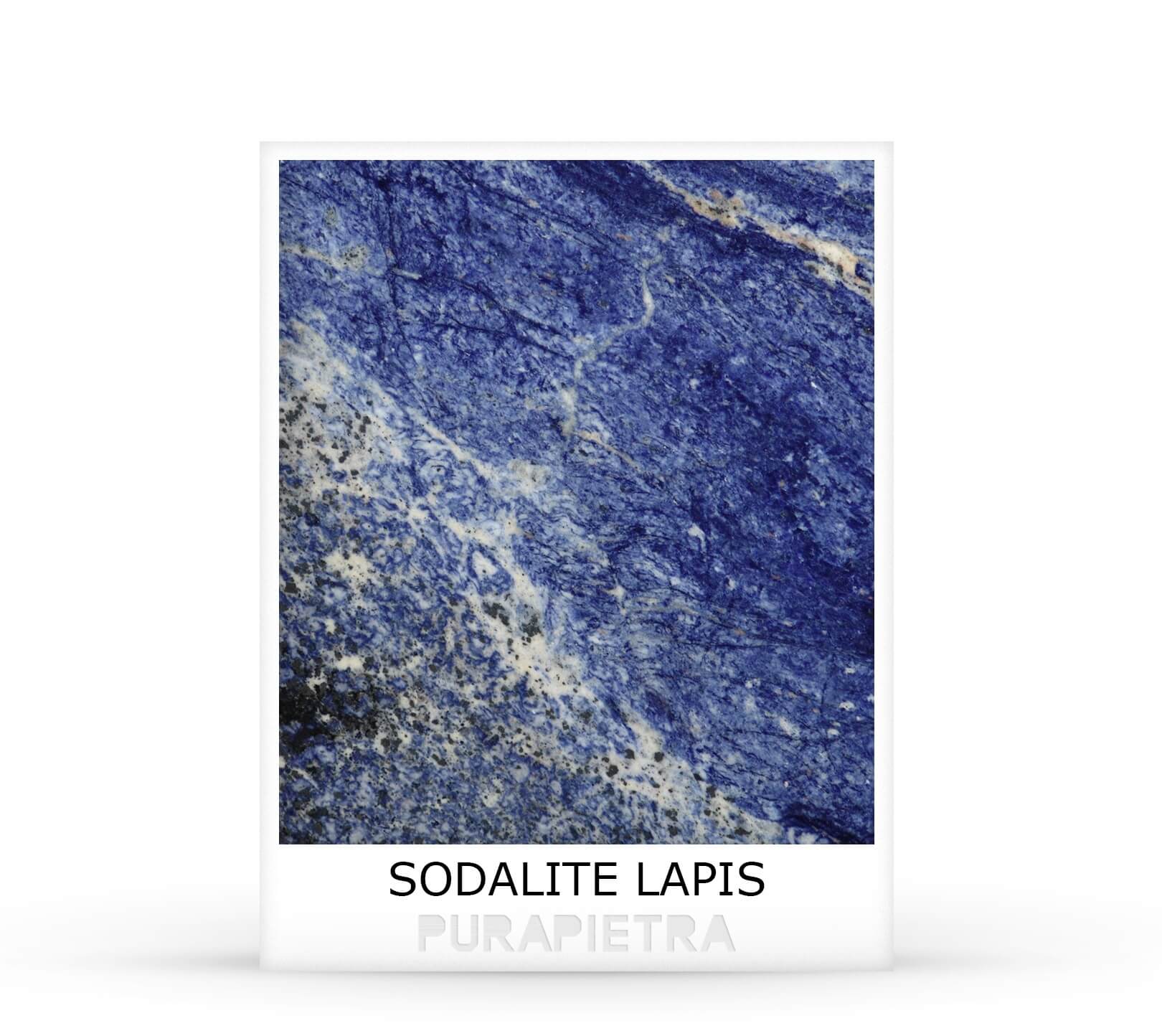
The blue marble varieties at Purapietra
Our blue selection is small on purpose. Four stones, each with a different temperature and a different job, chosen slab by slab for grain and for the way the colour holds under a hand finish.
Mare d’Inverno
The name means winter sea, and the stone earns it. Mare d’Inverno is a cool grey-blue crossed by pale veining that moves like water under a flat sky. It is the most restrained of the four, close enough to grey that it behaves like a neutral in a scheme, but with enough blue in it to keep the room from going cold and generic. This is the blue for people who want the colour without the declaration: a kitchen island, a run of bathroom cladding, a fireplace surround that reveals itself slowly.
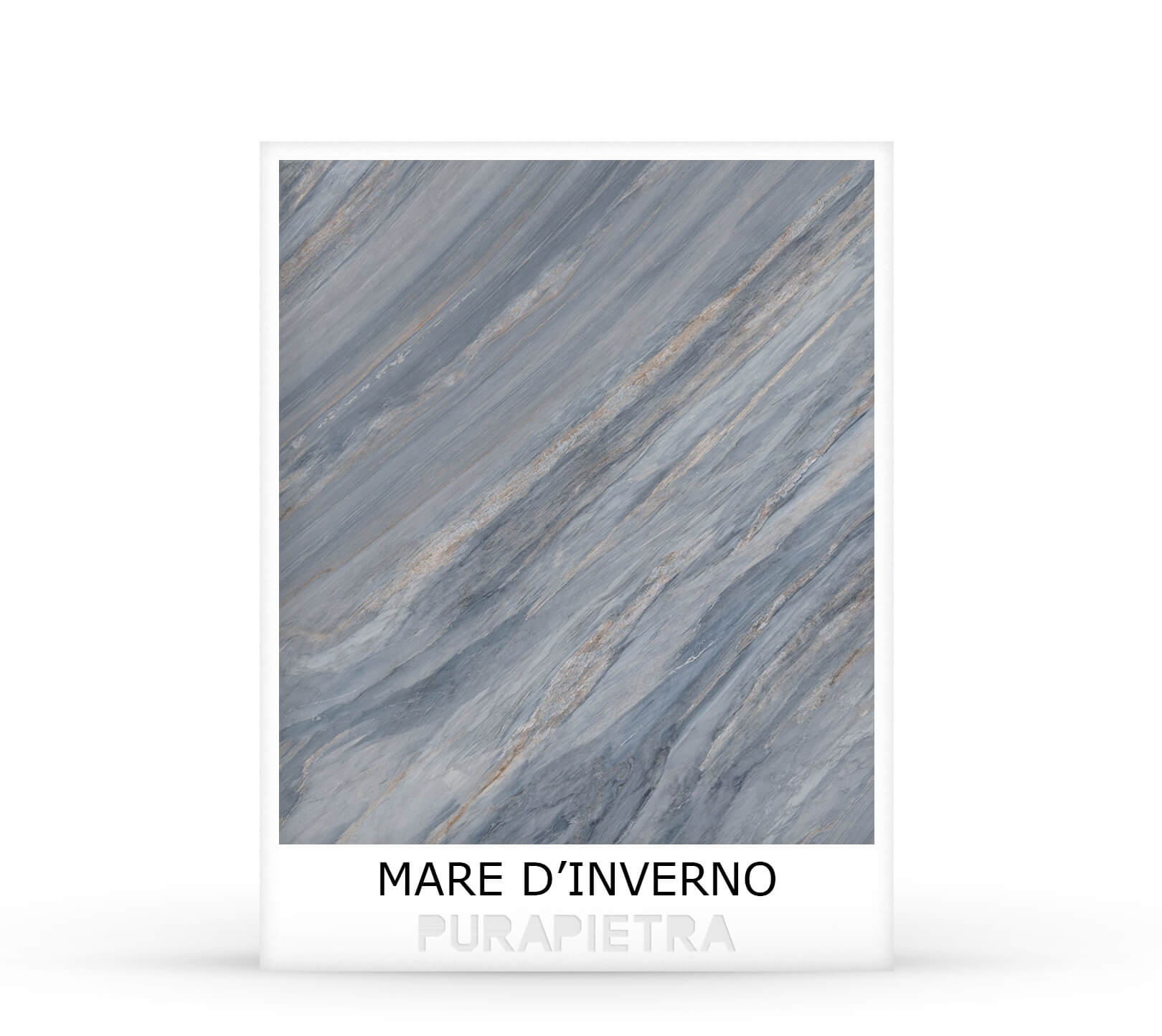
Sky Onix
Not a marble in the strict geological sense but an onyx, and the difference is the point. Sky Onix is translucent. Backlight it and the pale blue banding lifts off the surface and glows, which is why it ends up in the places where light matters: a lit bar front, a floating vanity, a headboard panel, a shower wall with LEDs behind it. Onyx is softer and more fragile than marble, so it wants vertical, low-traffic positions rather than worktops. Handled properly it does something no other stone in the collection can do.
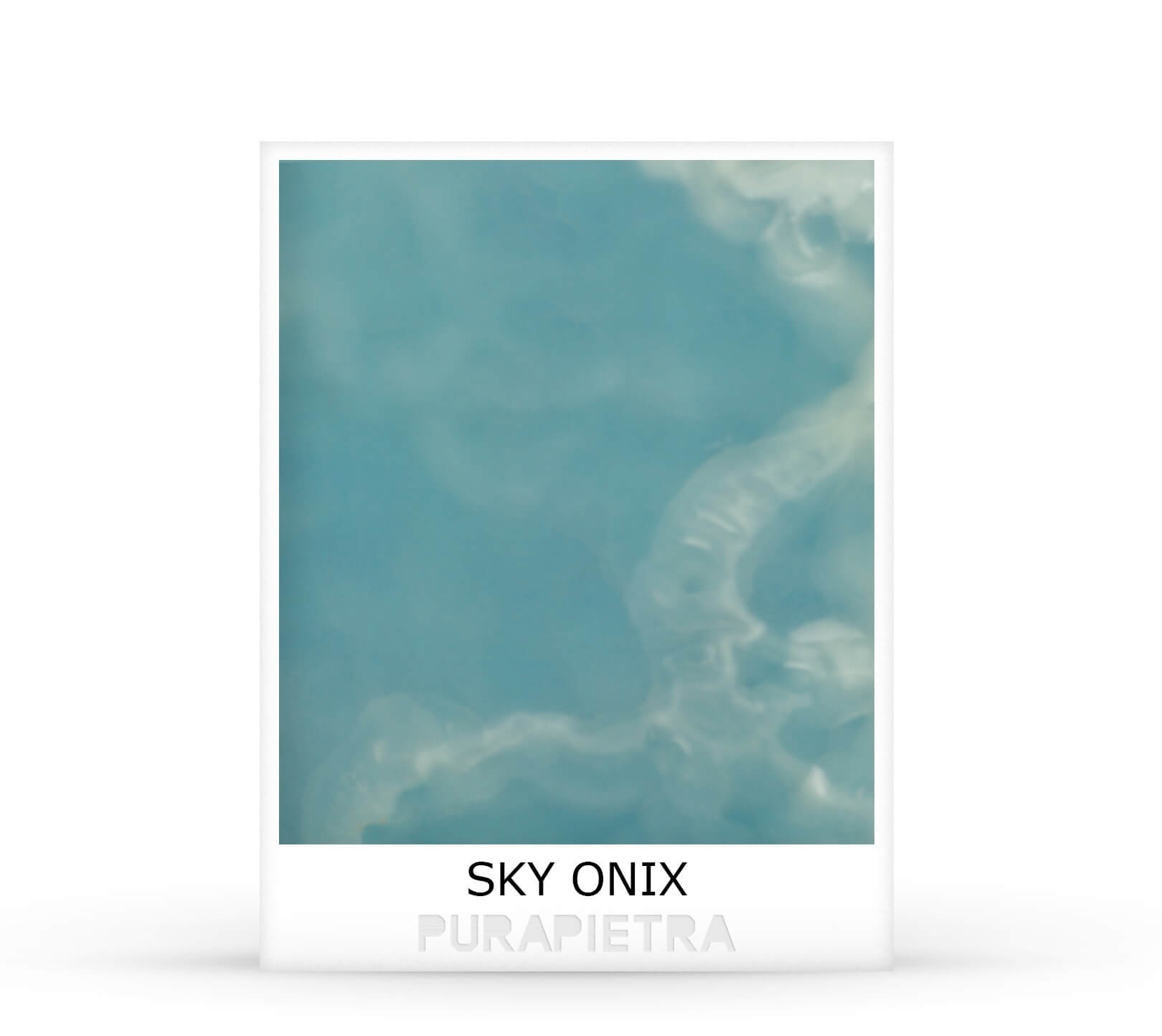
Sodalite Lapis
The deepest blue we offer, and the most valuable. Sodalite Lapis carries the saturated ultramarine of lapis lazuli, broken by white calcite and occasional flecks of gold-toned pyrite. It reads as jewellery rather than building material, and it should be used that way: a single tabletop, an inlay, a small vanity, a set of objects. Give it one place to be extraordinary and everything around it can stay quiet.
Stormo Blue
Darker and more dramatic than Mare d’Inverno, Stormo Blue has the look of a sky just before weather arrives. Deep blue-grey ground, bold pale veining, a lot of movement across the slab. Bookmatched, it becomes an event: two slabs opened like a book turn into a symmetrical pattern that carries a whole wall. It is the choice when you want one surface in the project to be genuinely memorable.
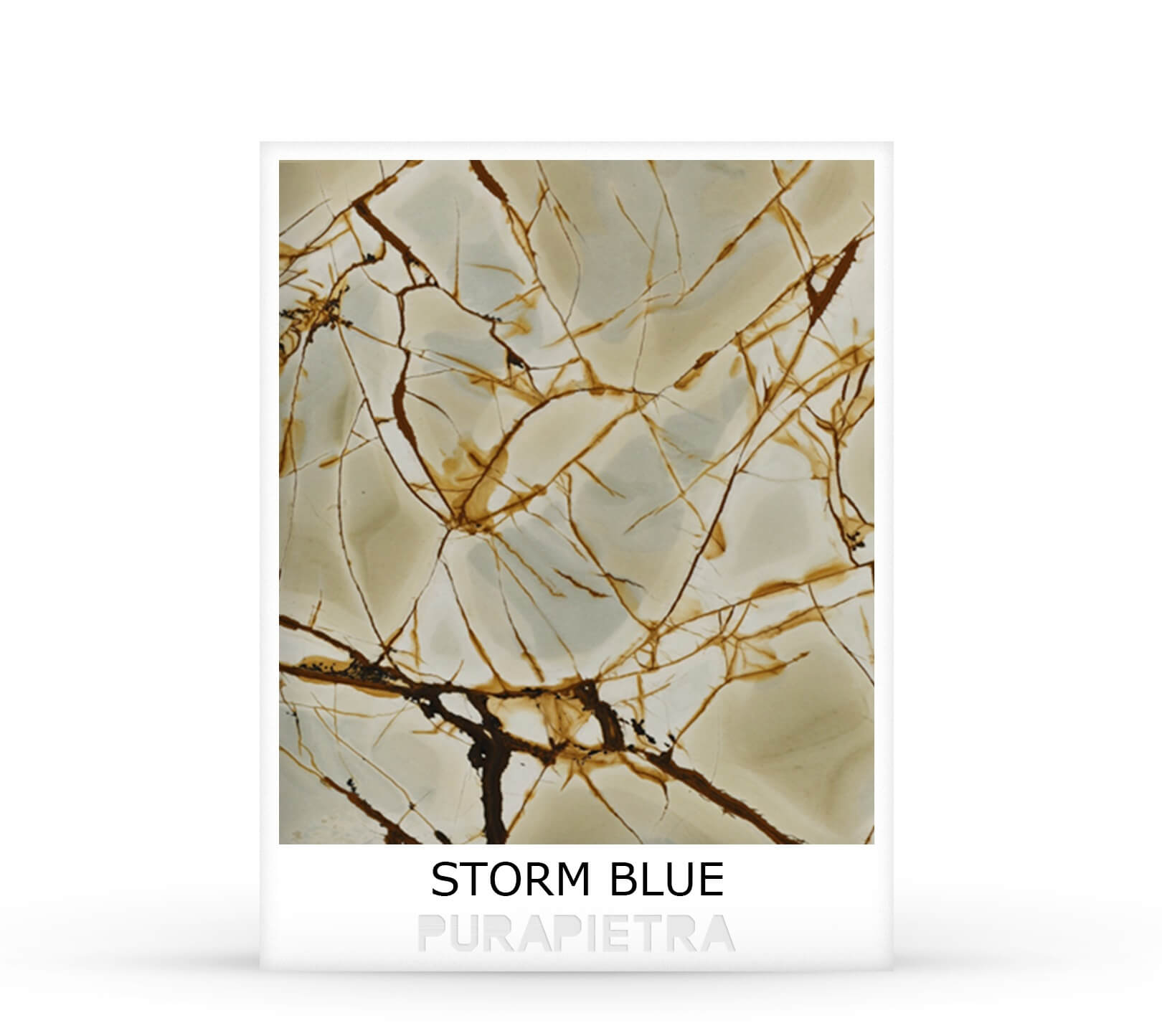
Where to use blue marble in interiors
Blue is a cool colour, and cool colours read as calm, clean and slightly formal. That makes bathrooms the obvious home for it. A Mare d’Inverno vanity with a carved freestanding stone basin gives you something restful without the hotel-beige cliché, and a backlit Sky Onix panel behind the mirror turns an ordinary wall into the reason the room exists. Blue also happens to flatter water and chrome, which is a convenient accident.
In the kitchen, blue is the counterpoint to warm timber. A Stormo Blue island against pale oak or walnut is a stronger, more contemporary pairing than the marble-and-brass default, and the darker ground is more forgiving of daily marks than a white top. Keep the perimeter surfaces simple and let the island be the event.
In living spaces, blue works best in furniture and objects. A coffee table in Sodalite Lapis, a console in Stormo Blue, a shelf of vases and trays in the same stone: small pieces carry a rare material further than square metres of it ever could. Our design collection exists partly for this reason, to put remarkable stone into a room at a scale that makes sense.
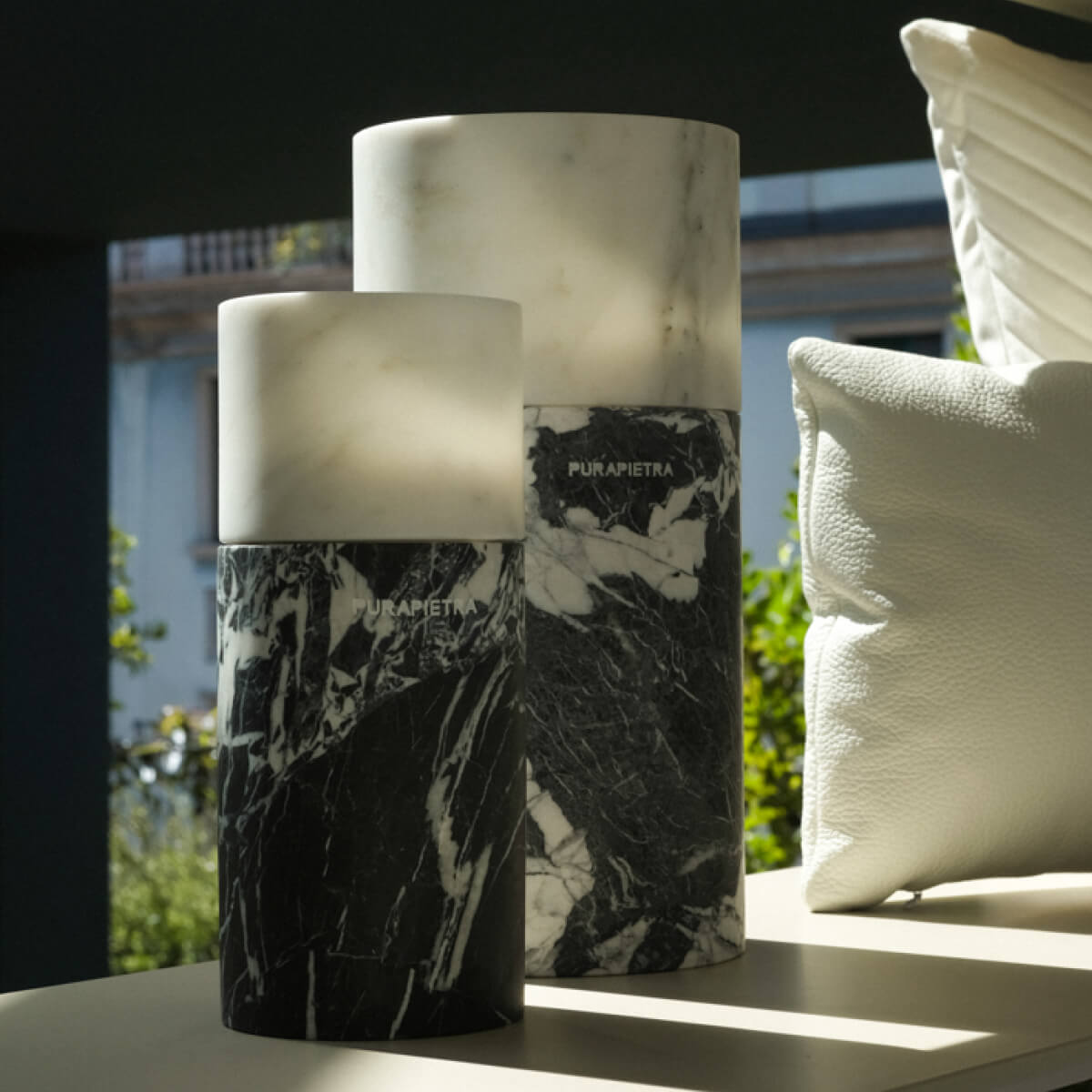
Pairing blue marble
Blue takes metal well, but the metal decides the mood. Brushed brass and aged gold warm it and push the whole scheme toward the decorative and the classical, which is the pairing you want with Sodalite Lapis. Polished nickel, chrome and blackened steel keep it cool and architectural, which suits Stormo Blue and Mare d’Inverno better. Copper is the risky one; it can turn beautiful or muddy depending on the exact tone of the slab, so test it against the actual stone rather than a sample chip.
For woods, warm species are the safer contrast. Oak, walnut and teak give the blue something to sit against; pale grey-toned timbers can leave the room feeling flat and chilly. And if you are combining stones, blue is at its best next to a calm neutral. A blue island in a room of white marble reads as deliberate, while blue against another strong colour usually reads as an argument. Our grey marble family is the most natural companion of all, since the greyer blues share its temperature.
Care and durability
Blue marble needs the same care as any other marble, with one addition. Like all marble it is calcite based, so acids etch it: lemon, vinegar, wine and most limescale removers will leave a dull mark on a polished surface. Seal the stone on installation, reseal every year or two depending on use, wipe spills promptly, and clean with pH-neutral products only.
The addition is that dark and saturated stones show etching more clearly than pale ones. A dull ring on white marble is barely visible; the same ring on Sodalite Lapis or Stormo Blue catches the eye. This is a strong argument for a honed finish on any blue surface that will be used rather than looked at. Honing removes the reflective layer that makes etch marks obvious, and it suits the colour anyway, giving the stone a matte, almost velvet depth. Save the polish for vertical panels and objects.
Onyx deserves its own note. Sky Onix is softer, more porous and more brittle than marble, and its translucency means backing and lighting have to be engineered rather than improvised. Keep it vertical, keep it out of wet, high-traffic zones, and have it installed by someone who has done it before.
Finishes: how the surface changes the colour
Finish changes blue marble more than it changes any other colour. Polished, the blue deepens and gains a wet, saturated intensity; this is how the stone looks in the photographs that made you want it. Honed, the same slab lightens by a visible degree and turns matte and soft, which reads more contemporary and hides wear far better. Leathered or brushed adds a fine texture that catches light unevenly and gives the stone a hand-worked, less industrial feel.
The practical consequence is that you cannot choose the variety and the finish separately. A honed Stormo Blue and a polished Stormo Blue are, for design purposes, two different materials. Ask to see the same stone in both before you decide, and look at it in the light of the room where it will live rather than under the showroom’s spotlights.
How to choose the right blue marble
Start with how loud you want the room to be. If the stone should sit in a scheme without dominating it, Mare d’Inverno is the answer; it behaves almost like a grey. If you want one surface people remember, Stormo Blue bookmatched will do it. If the point is luxury at a small scale, Sodalite Lapis. And if light is the idea, Sky Onix backlit.
Then check the practical constraints early, because with blue they bite harder than with other colours. Confirm block availability before you commit to a design, since a stone that exists in the yard today may not exist in three months. Confirm the slab dimensions against your layout, because blue rarely comes in the very large formats. And confirm the finish on a physical sample, in your own light, at the time of day the room is actually used.
The whole family is on our materials page. Once you have narrowed it to one or two, ask for a sample. Blue changes more between the photograph and the room than any other stone we sell, and no screen has ever reproduced the moment a lit onyx panel comes on.
Related reading
Keep exploring the Purapietra magazine: our pillar guides to white marble, black marble, grey marble and beige marble, plus the complete guide to the types of Italian marble. Browse every stone on the materials page, or bring the material home through our design collection. See also our guide to green marble and the comparison of Italian vs imported marble.
Frequently asked questions
What is blue marble?
Blue marble is natural marble whose colour ranges from grey-blue and petrol through to deep ultramarine. The tone comes from rare minerals present when the stone formed, mainly lazurite, sodalite, chlorite and related silicates. Because those deposits are small, blue is the least common colour family in natural stone.
Why is blue marble so expensive?
Scarcity, mostly. The deposits are limited, blocks come out in small numbers, and the most saturated stones such as Sodalite Lapis are semi-precious rather than architectural materials. Wastage during cutting is higher too, because slabs are selected for veining and bookmatching.
Can blue marble be used in a bathroom?
Yes, and bathrooms are one of its best uses. A honed finish is preferable to polished in wet areas because it hides etching and watermarks, and the stone should be sealed on installation and resealed periodically. Onyx such as Sky Onix should be kept to vertical panels rather than worktops or floors.
What is the difference between blue marble and blue onyx?
Marble is recrystallised limestone; onyx is a banded calcite deposit formed in caves, which makes it translucent. Sky Onix will glow when backlit, where a marble will not. Onyx is also softer and more fragile, so it belongs on vertical, low-traffic surfaces.
What colours go with blue marble?
Warm woods such as oak and walnut, warm metals such as brass for a classical mood, or nickel and blackened steel for a cooler architectural one. Blue also sits well against calm neutrals, particularly white and grey marble. Avoid pairing it with another saturated colour unless the contrast is the whole idea.
Carrara vs Statuario Marble: Differences, Value and How to Choose
Carrara vs Statuario is one of the oldest questions in Italian design, and one people get wrong all the time. The two stones come out of the same mountains and share the same white heart, yet you cannot simply swap one for the other. One is the everyday poetry of Tuscan marble. The other is its rarest, most wanted version. Here is how to tell them apart, why one gets so much reverence, and how to choose between them for your project.
Both are quarried in the Apuan Alps above the town of Carrara, in northern Tuscany. It is the same range that has fed sculptors and architects since Roman times, and where Michelangelo picked his blocks. That shared origin is why a small sample can fool you. Put a full slab in front of you and the difference is obvious.
There is more on the geology on Wikipedia’s Carrara marble page. What follows is the practical version. For the wider family, see our guide to the types of Italian marble.
Common origin, different souls
“Carrara” is a place and, loosely, a category. When people say Carrara marble, they usually mean the classic greyish white stone with soft, feathery veining that has become shorthand for Italian marble everywhere. Purapietra’s Acqua di Carrara is a refined example: a cool, luminous white with a delicate, watery grey movement, which is where the name comes from.
Statuario comes from specific, much scarcer veins in the same district. Bianco Statuario, literally the sculptor’s white, was prized because its ground is whiter and its veining more defined, giving carvers a cleaner canvas.
Carrara whispers; Statuario speaks up. That is the heart of the Carrara vs Statuario question, and that scarcity and that clarity explain everything that follows.
Appearance and veining compared
The quickest way to read the difference is background against vein.
Carrara has a soft, slightly cooler greyish white background. Its veins are fine and feathery, often described as cloudy or watery. The effect is gentle and even, a stone that fills a room with quiet light rather than asking for attention. Because the pattern is fairly regular, Carrara is forgiving over long runs and easy to match from slab to slab.
Statuario reads brighter and cleaner. The background is a purer white, and the veining stands against it with real confidence: bolder, more linear, sometimes carrying a warm gold or grey undertone. You notice Statuario. Bookmatched across a wall or a big island, its veins make the kind of sculptural surface that ends up in magazines and stays in people’s memory.
Prestige and rarity
Statuario has always been the more wanted of the two, and the reason is simply supply. The whitest, cleanest blocks that count as true Statuario are a small share of what the quarries produce, and that purity is what made them the choice of sculptors from Michelangelo onward. Carrara comes out in far greater volume, which keeps it easy to find without taking anything away from how it looks.
It helps to be clear about what that rarity means. Statuario’s prestige comes from scarcity and drama, not from being tougher. Both are calcite marbles with similar hardness and the same care. If your surface is a background rather than a hero, the everyday elegance of Carrara is usually the smarter call. If the surface is the whole point of the room, Statuario earns its reputation.
Where to use each one
Think of it as a question of role. Carrara is the natural pick for surfaces that should feel calm and consistent: bathroom floors and walls, a full run of cladding, a kitchen you want to read as timeless rather than theatrical. Its even pattern also makes it the easier option when you need several slabs to match.
Statuario belongs on the one surface you want to become the focal point: a bookmatched feature wall, a single block of an island, a fireplace surround, a vanity that carries the whole bathroom. Used sparingly and lit well, it does more for a room than any amount of decoration.
A common and elegant move is to use both, with Carrara across the quiet surfaces and one Statuario gesture where the eye should land.
Both stones sit at the heart of our white marble family, and you can see them next to the full range, from Calacatta to Ivory Onix, on our materials page. If a sculptural white object appeals more than a surface, the same marbles are carved into our design collection and hand finished vases, or shaped into a freestanding basin that becomes the centrepiece of a bathroom.
Carrara vs Statuario: the short version
If you only remember one thing about Carrara vs Statuario: Carrara is the calm, cooler, evenly veined white that suits large everyday surfaces and matches easily from slab to slab. Statuario is the brighter, rarer white with bolder veining, best saved for the one surface you want people to look at.
Care: the same discipline for both
Whichever you choose, the upkeep is the same. Both are calcite marbles, so both etch when they meet acid. Lemon, vinegar, wine and plenty of household cleaners will dull a surface that has not been sealed. Seal it on installation, seal it again from time to time, wipe up spills quickly, and use a gentle cleaner rather than an acidic one.
On a bright white like Statuario, etching and patina show a little more readily than on grey veined Carrara, so a honed finish and a careful hand pay off. Cared for properly, both stones do what marble has always done. They get more beautiful, and more personal, with time.
A note on finishes and light
Because Statuario is all about that bright, clean ground, the finish matters even more than it does with Carrara. Polished, a Statuario surface pushes the contrast between white field and dark vein and throws light around the room.
It looks spectacular on a feature wall, though it will also show fingerprints and etching sooner. Honed, the drama softens a little and the stone is far more forgiving day to day, which is why we tend to suggest it for surfaces that get used rather than only admired.
Carrara, with its softer grey ground, hides wear well either way. Whichever you land on, look at the slab under the actual light of your room. White marble moves more than any other colour between the cool of a north facing room and the warmth of afternoon sun, and a stone that looked grey in the showroom can read almost cream at home.
So, which should you choose?
Choose Carrara if you want quiet, timeless elegance, a consistent look across large areas, or the comfort of a stone that matches easily from slab to slab. Choose Statuario if you want a rare, luminous white with dramatic veining for a surface meant to be admired, and the project calls for a real moment of drama. And there is no rule against having both. The most considered interiors often let Carrara set the calm and let Statuario provide the crescendo.
The real decision, as always with natural stone, happens in front of the slab. See both in the light of your own space before you commit. You can explore them on our materials page, and ask for a sample once you have narrowed the choice.
Related reading
Continue through the Purapietra magazine: the family-wide white marble pillar, our guide to the types of Italian marble, and the warmer beige marble, characterful grey marble and dramatic black marble families. See every slab on the materials page, or bring the stone home through our design collection and hand finished vases. See also our guide to green marble and the comparison of Italian vs imported marble.
Frequently asked questions
What is the difference between Carrara and Statuario marble?
Both are white marbles from the Carrara district of Tuscany. Carrara has a softer greyish white background with fine, feathery veining. Statuario has a brighter, purer white background with bolder, more defined veins. Statuario is rarer and more sought after; Carrara is easier to find and more understated.
Why is Statuario marble considered so precious?
Statuario comes from limited veins that yield very white, clean blocks, and that scarcity, together with centuries of admiration from sculptors and architects, makes it the most sought after of the Carrara whites. Its prestige comes from rarity and appearance, not from being more durable.
Is Statuario stronger than Carrara?
No. Both are calcite marbles with similar hardness, porosity and care needs. Statuario’s prestige is about its rarer, whiter, more dramatic look, not extra strength. Both should be sealed and cleaned with gentle, non acidic products.
Can I use Carrara and Statuario together?
Yes, and it is a classic approach. Carrara across large, calm surfaces and Statuario on a single feature, like a bookmatched wall or island, lets you enjoy the drama of Statuario while keeping the whole scheme calm and balanced.
Which is better for a bathroom, Carrara or Statuario?
Carrara is the more practical everyday choice for bathroom floors and walls thanks to its even pattern and easy matching. Statuario is the one to pick when you want the bathroom to feel like a showpiece, say on a feature wall or a striking vanity. Both need sealing and gentle, non acidic cleaning.
Beige Marble: Varieties, Uses and How to Choose
Not many materials feel as warm as beige marble. It never shouts, and it never chills a room. Instead it settles everything into a soft, sunlit calm, which is why we keep coming back to it. This is a guide to the beige marbles we work with at Purapietra: what each one looks like, where it belongs, and how to pick the right stone for your space.
White marble can feel crisp, even a little clinical. Beige reads warmer and more lived in. The colours run through ivory, sand, honey and a soft greige, usually with gentle veining or a cloudy movement across the slab. That variety is the appeal. One family of stone can carry a calm bathroom, a big kitchen island or a whole wall of cladding without ever looking samey.
The character of beige marble
Geologically, beige marble is the same crystalline limestone as its whiter cousins, recrystallised over millions of years under heat and pressure. The colour shifts toward beige when clay and iron minerals are present as the stone forms. There is a fuller primer on how marble forms on Wikipedia’s marble page. For interiors the point is simpler: beige carries warmth into a room and copes with daily life more gracefully than pure white. If you want to see where it sits among the other Italian stones, we cover the whole range in our guide to the types of marble.
The family splits into a few personalities. Some slabs are almost uniform and calm, the kind you want when the marble should stay in the background and let the furniture talk. Others have big veining or fossil movement and become the thing you look at. Knowing which is which is the first real decision, and that is where the individual stones come in.
The beige marble varieties at Purapietra
Our beige selection runs from restrained to expressive. We choose each slab for its grain, its consistency and the way it takes a hand finish.
Avorio Striato
An ivory ground with fine, linear striations. Avorio Striato is the quietest of the group and the most architectural. Set it vertically and it adds height and rhythm to a wall; lay it flat and it reads almost like raw silk. A good choice when you want structure without any noise.
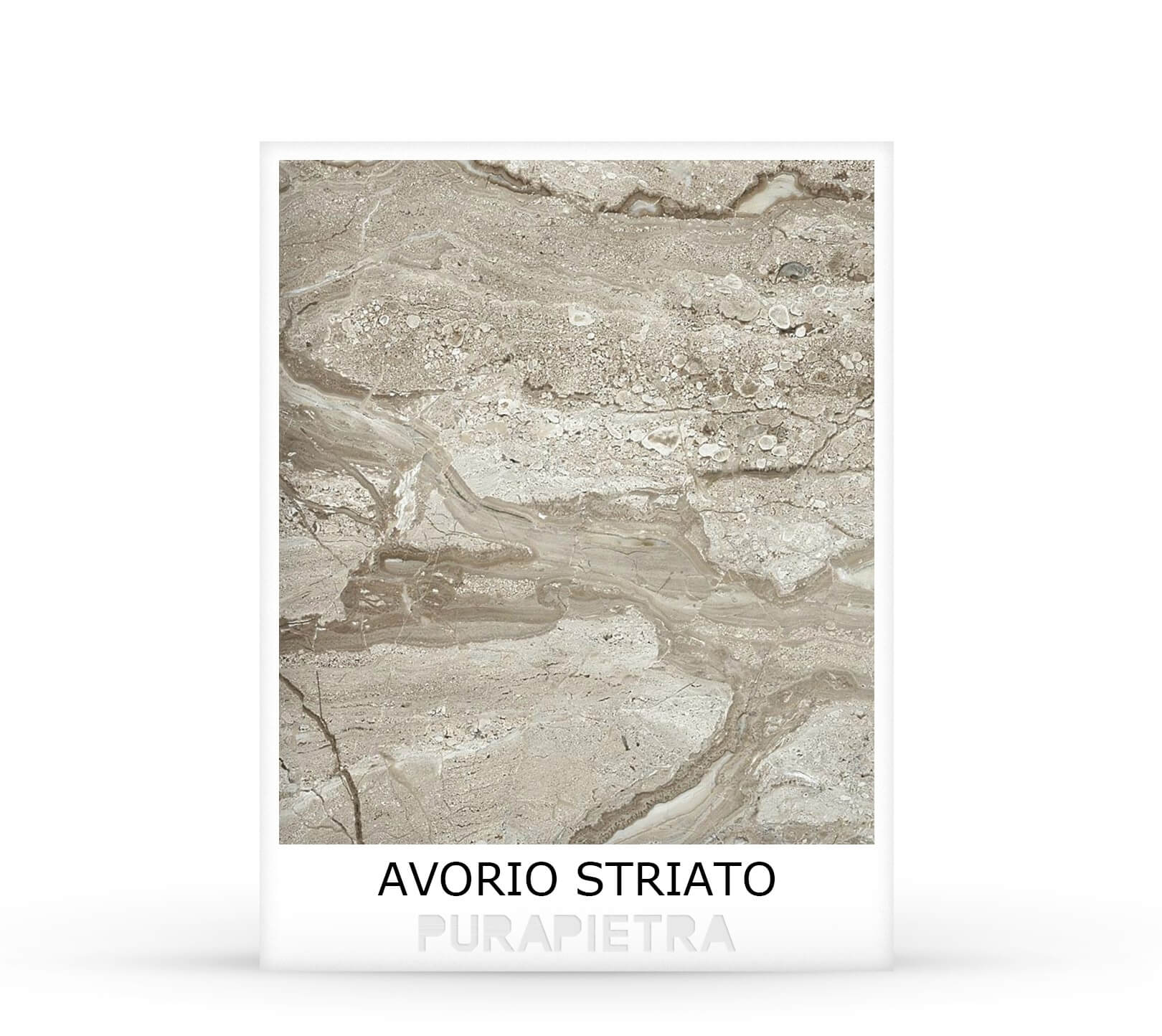
Arabian Desert
Warmer and sandier, Arabian Desert looks the way it sounds, like dunes in low light. The tone shifts softly across the slab instead of breaking into sharp veins, so it holds up well over big surfaces like floors and tall cladding.
Crema Amalfi
A classic Italian cream with a subtle, cloudy movement. Crema Amalfi gets along with almost everything, from brass to warm woods to matte plaster, and it has been a steady favourite for bathroom vanities and wet rooms that should feel like a spa.
Crema Palladio
A little deeper in tone than Crema Amalfi, with a fine mineral fleck that gives it depth up close. Crema Palladio sits between beige and greige, which makes it easy to place in rooms that mix warm and cool notes.

Patagonia
The statement stone of the family. Patagonia has bold, organic veining and pockets of translucency that light up when it is backlit. This is the beige you reach for when you want a single dramatic surface: a bookmatched wall, a sculptural island, or a lit shower panel that ends up defining the whole room.
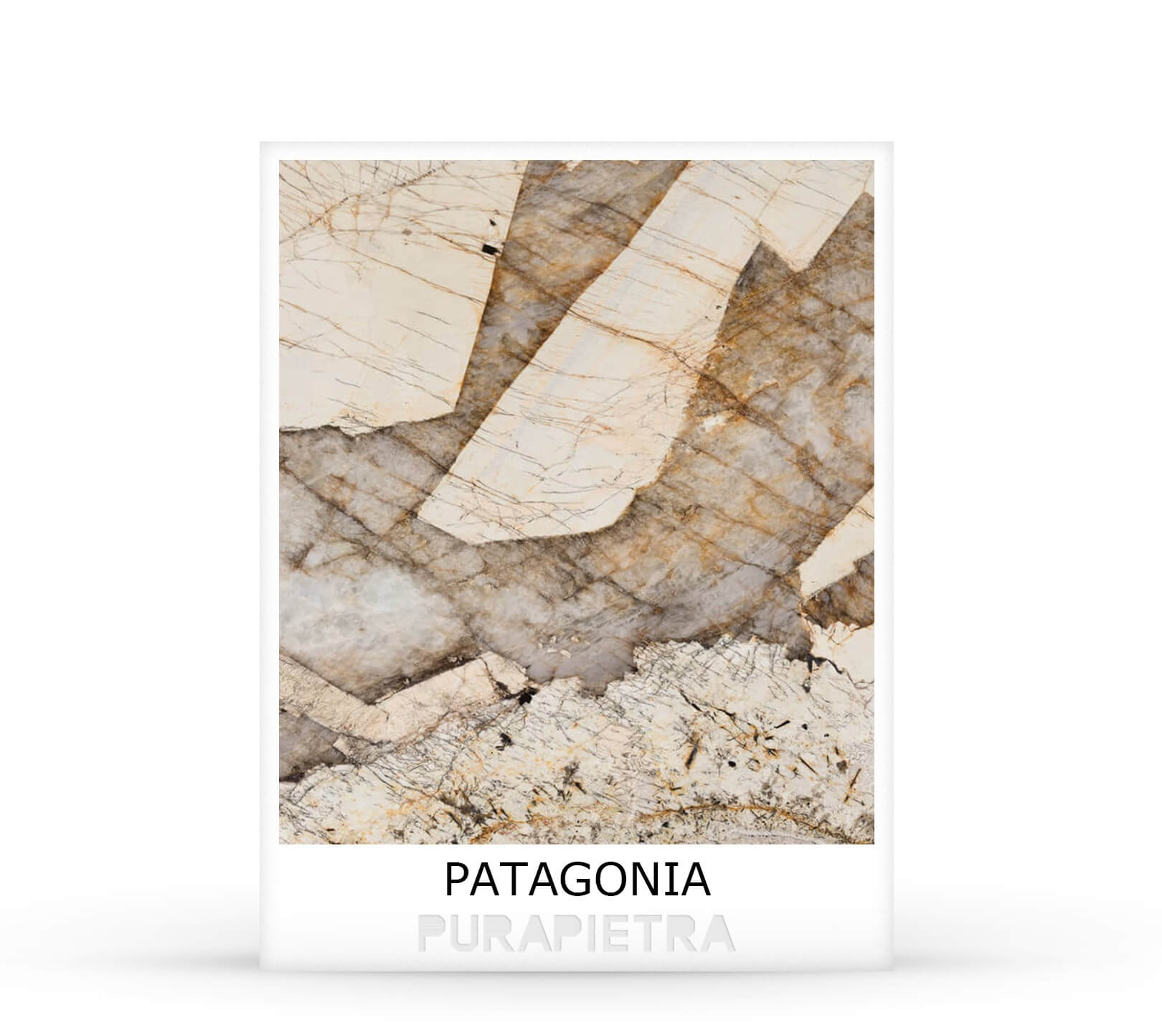
White Moon
The lightest of our beiges, White Moon floats between soft ivory and pale sand. It gives you the calm of white marble with a touch more warmth, which makes it the answer for clients who love the idea of white but find it too cold.

Where to use beige marble in interiors
Beige marble flatters warm light and skin tones, so it works almost everywhere in the home.
In the bathroom, beige gives you that enveloping, hotel feeling people ask for more than anything else. Crema Amalfi or White Moon on the walls, with a carved stone basin, turns an ordinary room into somewhere you want to linger. If you would rather the room felt soft than shiny, a honed matte finish takes the glare off the light.
In the kitchen, beige works hard and hides more. Sealed properly, a beige worktop swallows the everyday marks that would jump out on stark white. The warmth also sits naturally next to timber cabinets and unlacquered brass.
For cladding and floors, the calmer stones like Arabian Desert and Avorio Striato hold large areas together without tiring the eye. Save the dramatic ones, Patagonia especially, for the single surface you actually want people to notice.
Beige marble also becomes design objects. Our vases and trays bring the same stone into a room at a smaller, more personal scale, and a freestanding basin can carry a whole bathroom on its own.
Pairing beige marble
Beige is a connector colour, which is what makes a palette easy to build around it. Warm metals like brass, bronze and aged gold look almost inevitable against it. Natural woods, from pale oak to dark walnut, share the same warmth. And when you want contrast, beige is the perfect base for something darker: a beige bathroom picks up real drama from one wall or vanity in a deep stone. If that contrast is where you are heading, our guide to black marble is a good companion, and the wider white marble pillar shows how the lighter end behaves.
Care and durability
Like every marble, beige is calcite based, so it reacts to acids. Citrus, wine and some cleaning products can etch a surface that has not been sealed. The upside is that beige hides etching and everyday patina far better than white, which is exactly why it ages so well. Seal it when it goes in, seal it again now and then, wipe up spills quickly, and clean it with something gentle rather than acidic. Looked after this way, beige marble ages beautifully and takes on the soft, lived in character that made natural stone worth choosing.
Finishes: how the surface changes the colour
The same beige slab can feel like two different stones depending on the finish. Polished, the colour deepens and gains a reflective shine, which suits a feature wall you want to catch the light. Honed, or matte, the shine drops away and the stone reads softer and more modern. That is the finish we usually suggest for beige bathrooms and floors, because it hides etching and feels warmer underfoot. A leathered or brushed finish adds a light texture that works well in kitchens, giving a bit of grip and a more hand worked look. Decide the finish alongside the variety, not after it. The two together, not the colour on its own, decide how the marble actually behaves in your room.
How to choose the right beige marble
Start with the job the stone has to do. If it is a background, a floor, a big wall, a run of cladding, pick a calm variety like Avorio Striato, Arabian Desert or Crema Amalfi and let the veining stay quiet. If the stone is meant to be the star, Patagonia earns the attention. Match the tone to your light too. Rooms that face north take the warmest beiges well, while a room full of sun can carry the cooler, greige end.
Then go and see it. A slab on a screen is never the slab in your hands, and beige in particular changes with the light of the room it will live in. You can look through the whole family on our materials page, and once you have narrowed it down, ask for a sample so you can live with the colour before you commit.
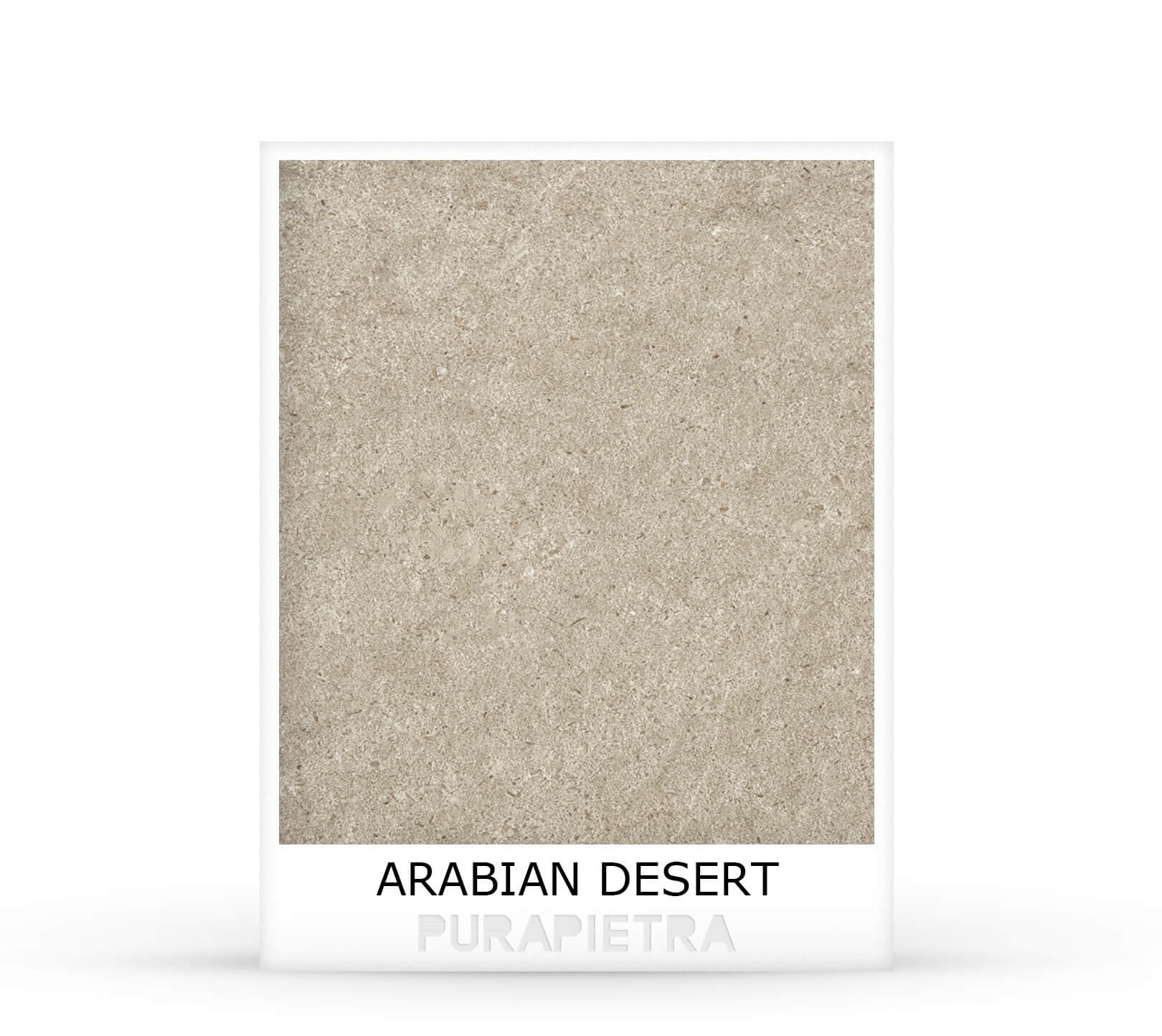
Related reading
Keep exploring the Purapietra magazine: our pillar guide to white marble, the moody world of black marble, the versatile grey marble family, and the complete guide to the types of Italian marble. For the two most famous whites compared side by side, see Carrara vs Statuario. Browse every stone on the materials page, or bring the material home through our design collection. See also our guide to green marble and the comparison of Italian vs imported marble.
Frequently asked questions
What is beige marble?
Beige marble is natural crystalline marble that reads cream, sand or a warm greige rather than pure white. The colour comes from clay and iron minerals that were present when the stone formed. You get the elegance of marble with more warmth and a surface that forgives more.
Is beige marble good for bathrooms?
Yes. Beige is one of the most popular choices for bathrooms because the warm tone feels calm, like a spa, and it hides watermarks and etching better than white. Seal it on installation, use a honed finish if you want softer light, and clean it with gentle, non acidic products.
Which beige marble is the most hard wearing?
The calmer, denser varieties like Avorio Striato and Arabian Desert handle busy surfaces such as floors and cladding well, and their quiet pattern disguises wear. Any beige marble needs proper sealing and correct cleaning to perform at its best.
How do I choose between beige and white marble?
Choose beige if you want warmth, a cosier feel and a surface that copes better with daily use. Choose white if you want something crisper, cooler and more classical. Beige is often the answer for people who love the idea of white marble but find it too cold in their light.
Does beige marble stain easily?
Marble is porous and can stain or etch if it is left unsealed, but beige tones camouflage marks far better than white. With sealing and quick cleaning of spills, staining is rarely a real problem.