
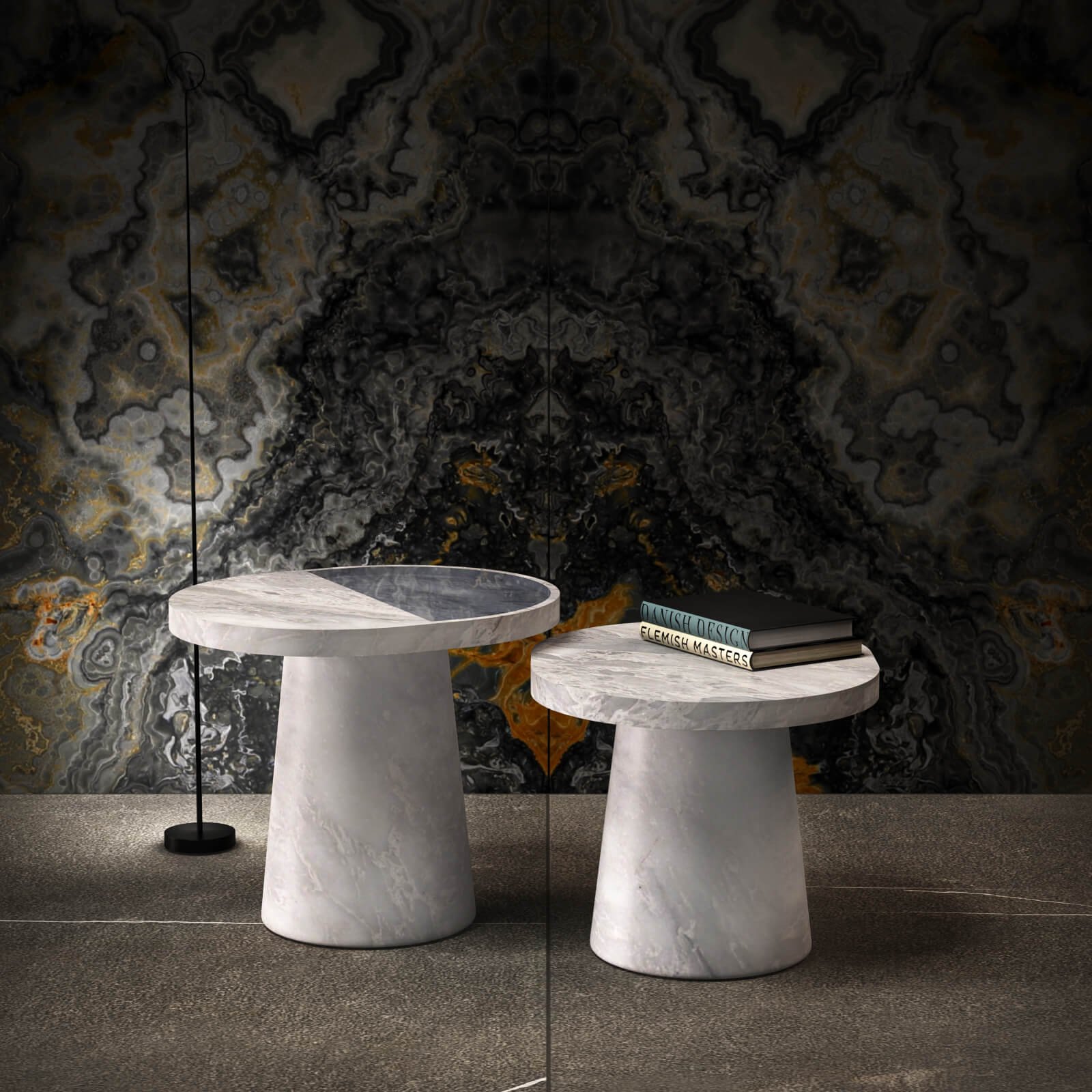
Blue marble is the rarest thing in a stone yard. Whites and greys arrive by the container; blue turns up occasionally, in small quantities, and never twice the same. That scarcity is exactly why designers keep asking for it. This is a guide to the blue marbles we work with at Purapietra: where the colour comes from, what each stone does in a room, and how to choose the one that suits yours.
Almost every other marble colour is a variation on neutrality. Blue is not. It is a real colour, with an opinion, and it changes a room the moment it goes in. The tones run from a stormy grey-blue through petrol and teal to the deep ultramarine of lapis. Some slabs are quiet and cloudy; others have veining so dramatic you would hang them on a wall like a painting. Understanding which is which is most of the work.
The character of blue marble
Blue marble is uncommon because the chemistry that produces it is uncommon. Marble is recrystallised limestone, and its colour comes from whatever minerals were trapped in the rock as it formed. Iron gives you reds and yellows, graphite gives you black, and the blues come from rarer sources: lazurite and sodalite in the deepest stones, chlorite and other silicates in the greyer, stormier ones. Wikipedia has a good primer on how marble forms if you want the geology in full. What matters commercially is simpler: the deposits are small, extraction is slow, and blocks come out in limited numbers. Nobody quarries blue marble at scale.
That rarity has a practical consequence worth knowing before you fall in love with a slab. Blue is rarely available in the quantities you would need for a whole floor or a full house of cladding. It belongs on the surfaces where a small area does a lot of work: a vanity top, a bookmatched panel, a bar front, a coffee table, a lit shower niche. Treat it as a feature stone from the start and you will design with it rather than around it. If you want to see how it sits among the other Italian stones we work with, our guide to the types of marble maps the whole range.
The blue marble varieties at Purapietra
Our blue selection is small on purpose. Four stones, each with a different temperature and a different job, chosen slab by slab for grain and for the way the colour holds under a hand finish.
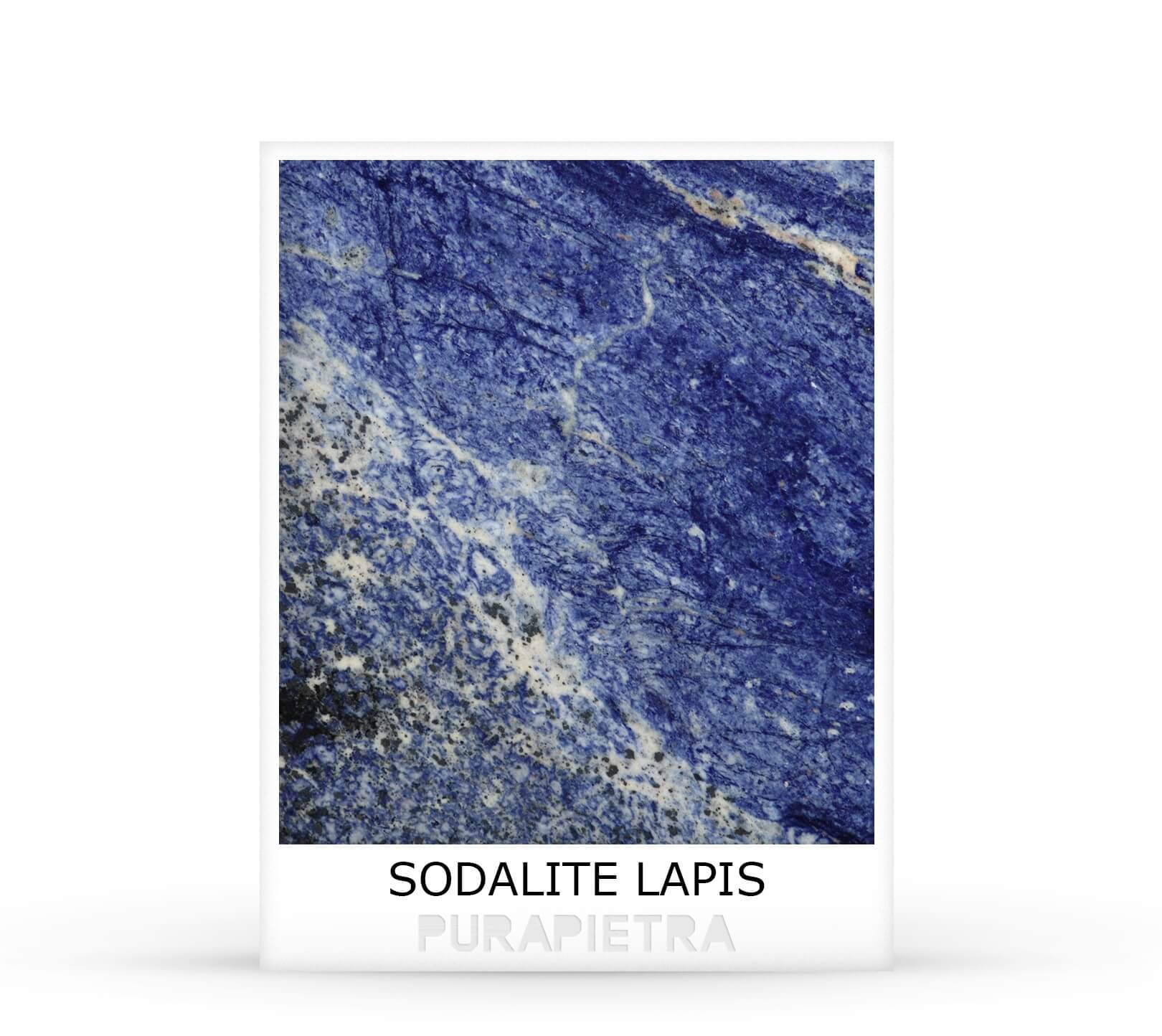
Mare d’Inverno
The name means winter sea, and the stone earns it. Mare d’Inverno is a cool grey-blue crossed by pale veining that moves like water under a flat sky. It is the most restrained of the four, close enough to grey that it behaves like a neutral in a scheme, but with enough blue in it to keep the room from going cold and generic. This is the blue for people who want the colour without the declaration: a kitchen island, a run of bathroom cladding, a fireplace surround that reveals itself slowly.
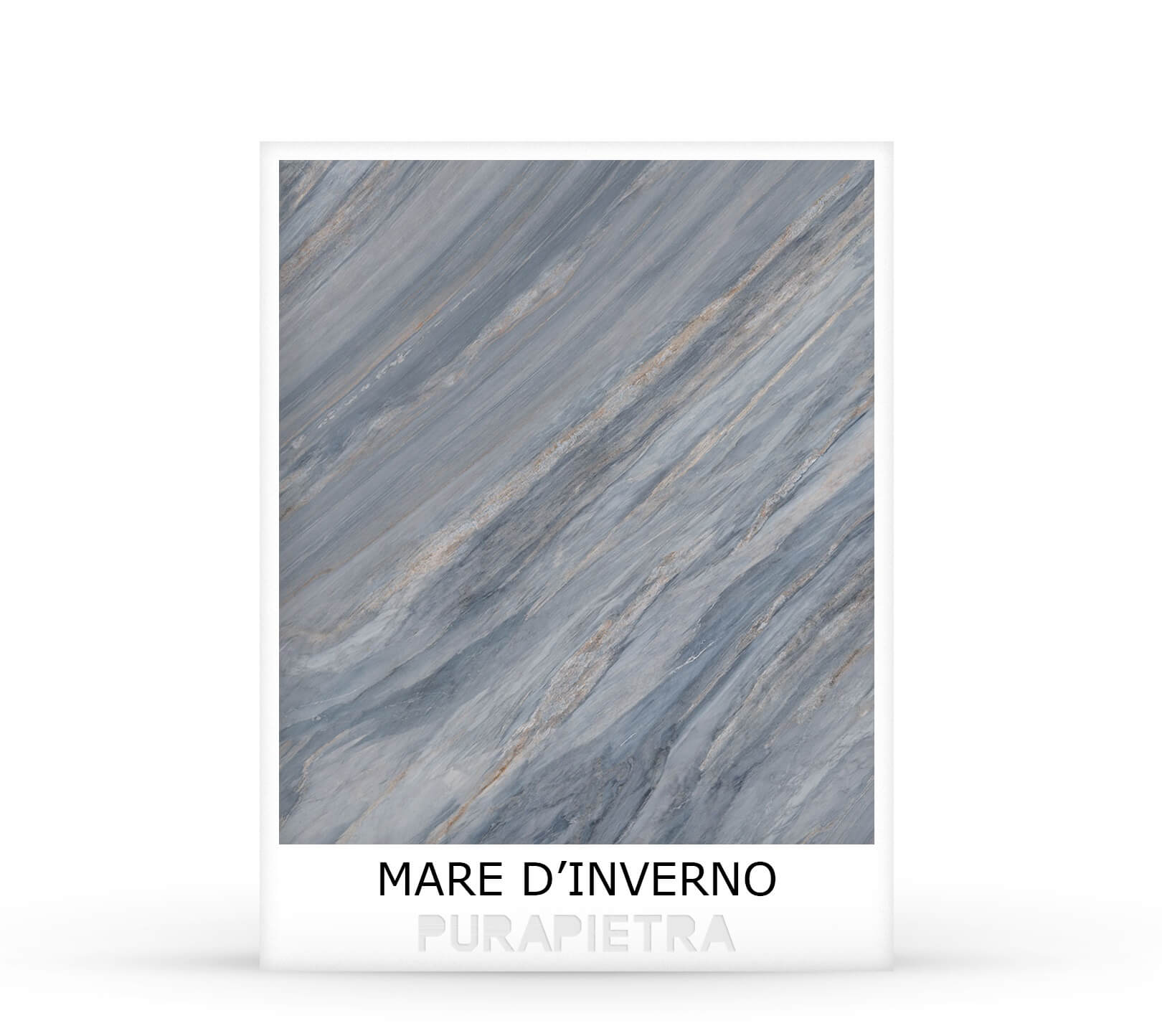
Sky Onix
Not a marble in the strict geological sense but an onyx, and the difference is the point. Sky Onix is translucent. Backlight it and the pale blue banding lifts off the surface and glows, which is why it ends up in the places where light matters: a lit bar front, a floating vanity, a headboard panel, a shower wall with LEDs behind it. Onyx is softer and more fragile than marble, so it wants vertical, low-traffic positions rather than worktops. Handled properly it does something no other stone in the collection can do.
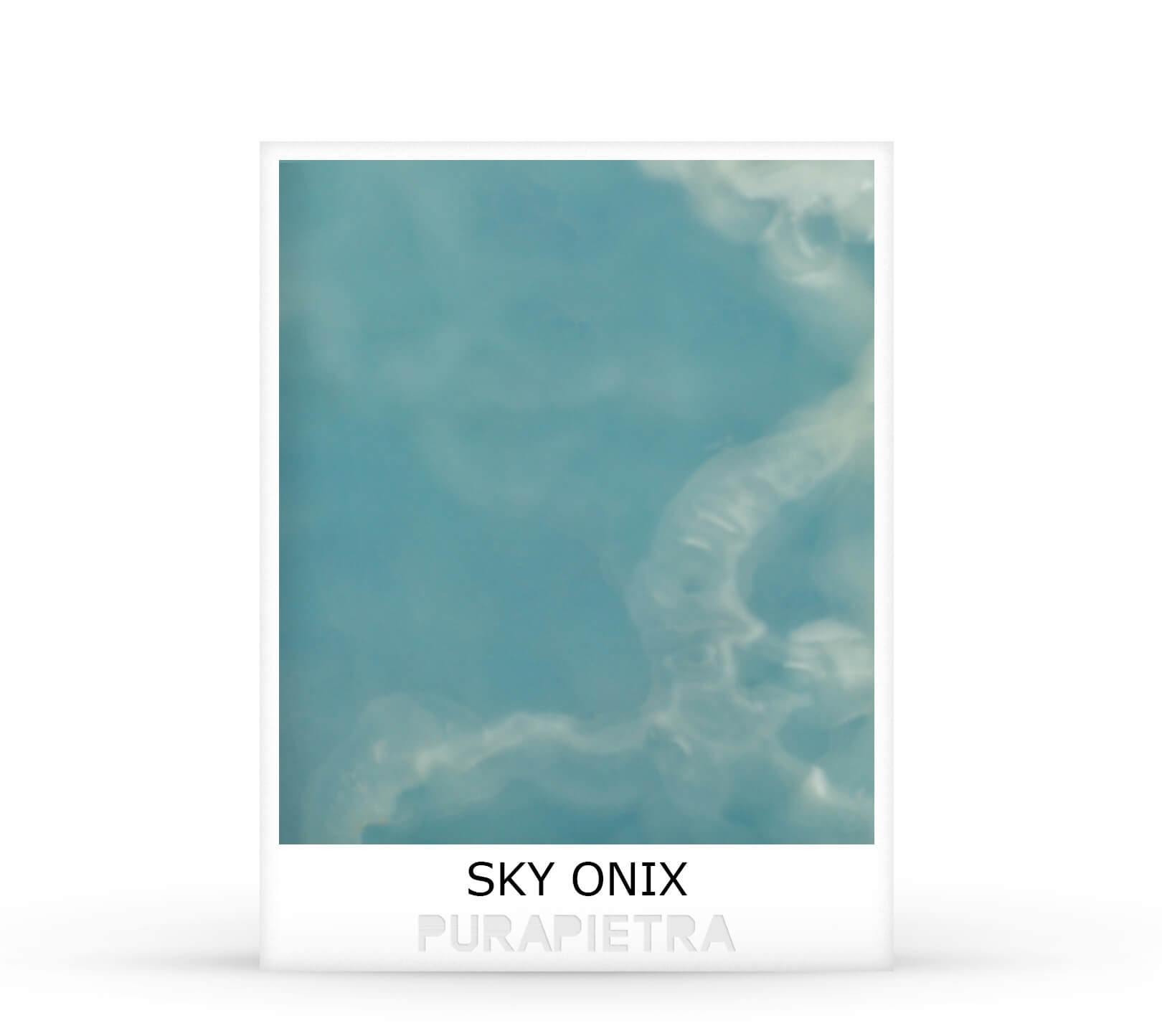
Sodalite Lapis
The deepest blue we offer, and the most valuable. Sodalite Lapis carries the saturated ultramarine of lapis lazuli, broken by white calcite and occasional flecks of gold-toned pyrite. It reads as jewellery rather than building material, and it should be used that way: a single tabletop, an inlay, a small vanity, a set of objects. Give it one place to be extraordinary and everything around it can stay quiet.
Stormo Blue
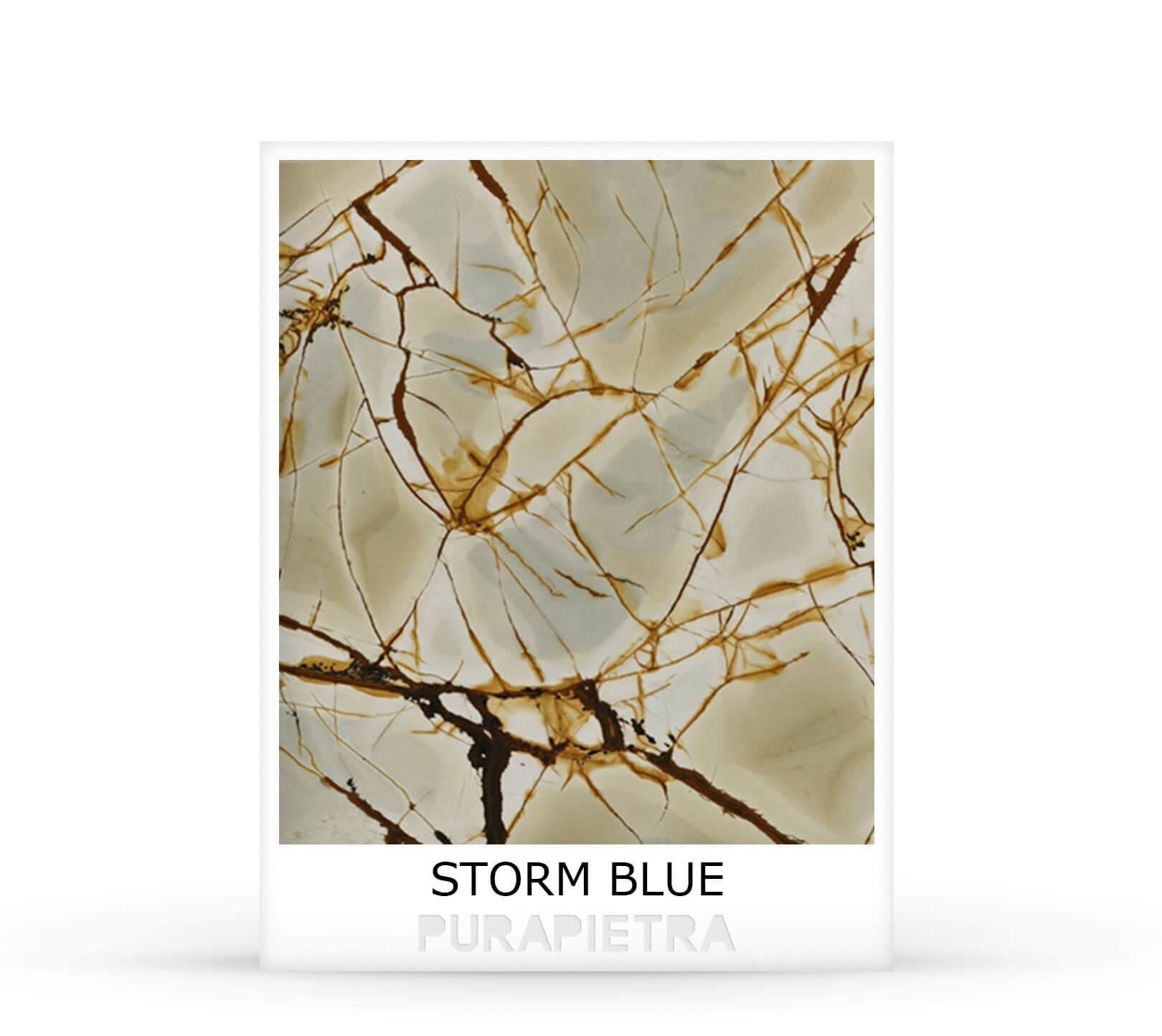
Darker and more dramatic than Mare d’Inverno, Stormo Blue has the look of a sky just before weather arrives. Deep blue-grey ground, bold pale veining, a lot of movement across the slab. Bookmatched, it becomes an event: two slabs opened like a book turn into a symmetrical pattern that carries a whole wall. It is the choice when you want one surface in the project to be genuinely memorable.
Where to use blue marble in interiors
Blue is a cool colour, and cool colours read as calm, clean and slightly formal. That makes bathrooms the obvious home for it. A Mare d’Inverno vanity with a carved freestanding stone basin gives you something restful without the hotel-beige cliché, and a backlit Sky Onix panel behind the mirror turns an ordinary wall into the reason the room exists. Blue also happens to flatter water and chrome, which is a convenient accident.
In the kitchen, blue is the counterpoint to warm timber. A Stormo Blue island against pale oak or walnut is a stronger, more contemporary pairing than the marble-and-brass default, and the darker ground is more forgiving of daily marks than a white top. Keep the perimeter surfaces simple and let the island be the event.
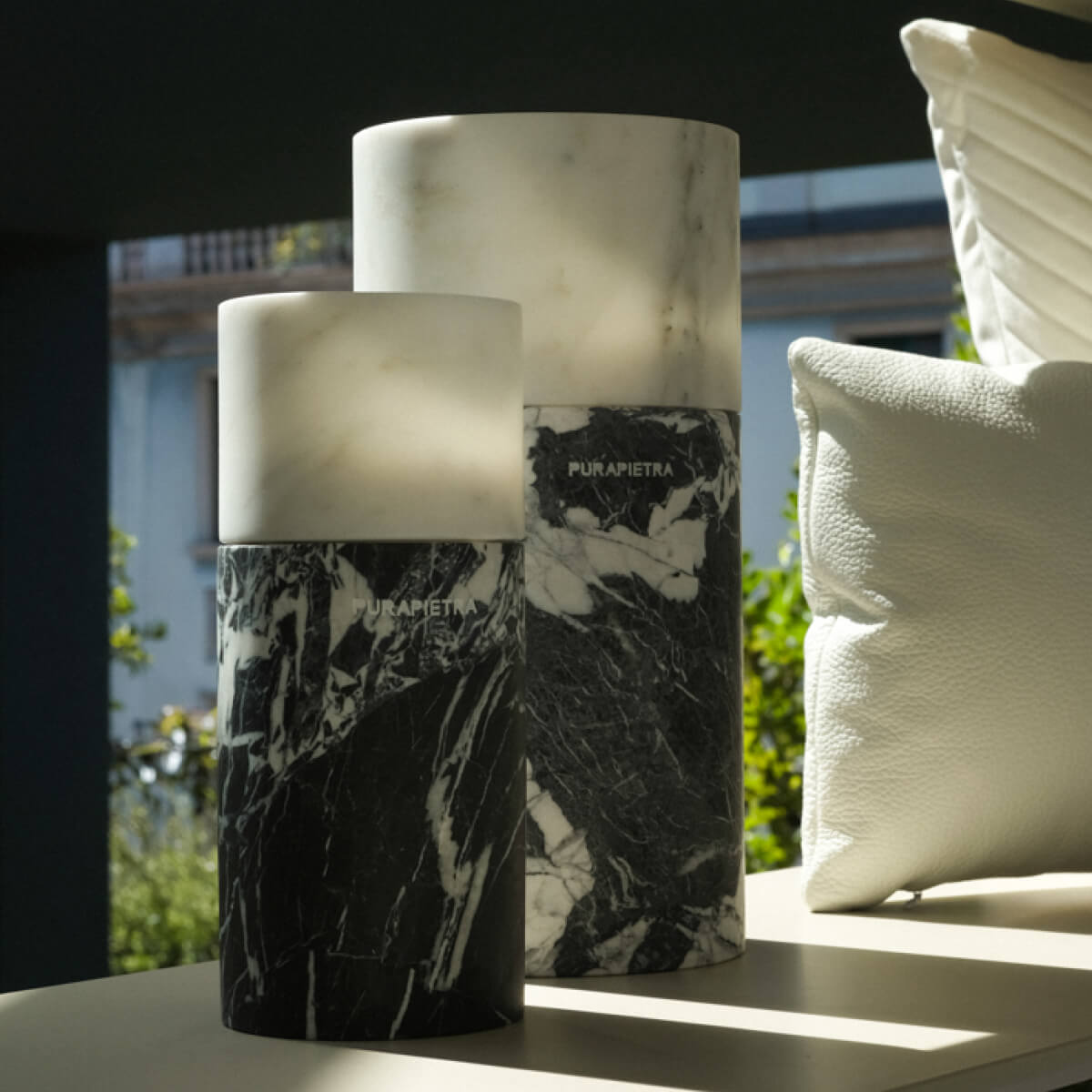
In living spaces, blue works best in furniture and objects. A coffee table in Sodalite Lapis, a console in Stormo Blue, a shelf of vases and trays in the same stone: small pieces carry a rare material further than square metres of it ever could. Our design collection exists partly for this reason, to put remarkable stone into a room at a scale that makes sense.
Pairing blue marble
Blue takes metal well, but the metal decides the mood. Brushed brass and aged gold warm it and push the whole scheme toward the decorative and the classical, which is the pairing you want with Sodalite Lapis. Polished nickel, chrome and blackened steel keep it cool and architectural, which suits Stormo Blue and Mare d’Inverno better. Copper is the risky one; it can turn beautiful or muddy depending on the exact tone of the slab, so test it against the actual stone rather than a sample chip.
For woods, warm species are the safer contrast. Oak, walnut and teak give the blue something to sit against; pale grey-toned timbers can leave the room feeling flat and chilly. And if you are combining stones, blue is at its best next to a calm neutral. A blue island in a room of white marble reads as deliberate, while blue against another strong colour usually reads as an argument. Our grey marble family is the most natural companion of all, since the greyer blues share its temperature.
Care and durability
Blue marble needs the same care as any other marble, with one addition. Like all marble it is calcite based, so acids etch it: lemon, vinegar, wine and most limescale removers will leave a dull mark on a polished surface. Seal the stone on installation, reseal every year or two depending on use, wipe spills promptly, and clean with pH-neutral products only.
The addition is that dark and saturated stones show etching more clearly than pale ones. A dull ring on white marble is barely visible; the same ring on Sodalite Lapis or Stormo Blue catches the eye. This is a strong argument for a honed finish on any blue surface that will be used rather than looked at. Honing removes the reflective layer that makes etch marks obvious, and it suits the colour anyway, giving the stone a matte, almost velvet depth. Save the polish for vertical panels and objects.
Onyx deserves its own note. Sky Onix is softer, more porous and more brittle than marble, and its translucency means backing and lighting have to be engineered rather than improvised. Keep it vertical, keep it out of wet, high-traffic zones, and have it installed by someone who has done it before.
Finishes: how the surface changes the colour
Finish changes blue marble more than it changes any other colour. Polished, the blue deepens and gains a wet, saturated intensity; this is how the stone looks in the photographs that made you want it. Honed, the same slab lightens by a visible degree and turns matte and soft, which reads more contemporary and hides wear far better. Leathered or brushed adds a fine texture that catches light unevenly and gives the stone a hand-worked, less industrial feel.
The practical consequence is that you cannot choose the variety and the finish separately. A honed Stormo Blue and a polished Stormo Blue are, for design purposes, two different materials. Ask to see the same stone in both before you decide, and look at it in the light of the room where it will live rather than under the showroom’s spotlights.
How to choose the right blue marble
Start with how loud you want the room to be. If the stone should sit in a scheme without dominating it, Mare d’Inverno is the answer; it behaves almost like a grey. If you want one surface people remember, Stormo Blue bookmatched will do it. If the point is luxury at a small scale, Sodalite Lapis. And if light is the idea, Sky Onix backlit.
Then check the practical constraints early, because with blue they bite harder than with other colours. Confirm block availability before you commit to a design, since a stone that exists in the yard today may not exist in three months. Confirm the slab dimensions against your layout, because blue rarely comes in the very large formats. And confirm the finish on a physical sample, in your own light, at the time of day the room is actually used.
The whole family is on our materials page. Once you have narrowed it to one or two, ask for a sample. Blue changes more between the photograph and the room than any other stone we sell, and no screen has ever reproduced the moment a lit onyx panel comes on.

Related reading
Keep exploring the Purapietra magazine: our pillar guides to white marble, black marble, grey marble and beige marble, plus the complete guide to the types of Italian marble. Browse every stone on the materials page, or bring the material home through our design collection. See also our guide to green marble and the comparison of Italian vs imported marble.
Frequently asked questions
What is blue marble?
Blue marble is natural marble whose colour ranges from grey-blue and petrol through to deep ultramarine. The tone comes from rare minerals present when the stone formed, mainly lazurite, sodalite, chlorite and related silicates. Because those deposits are small, blue is the least common colour family in natural stone.
Why is blue marble so expensive?
Scarcity, mostly. The deposits are limited, blocks come out in small numbers, and the most saturated stones such as Sodalite Lapis are semi-precious rather than architectural materials. Wastage during cutting is higher too, because slabs are selected for veining and bookmatching.
Can blue marble be used in a bathroom?
Yes, and bathrooms are one of its best uses. A honed finish is preferable to polished in wet areas because it hides etching and watermarks, and the stone should be sealed on installation and resealed periodically. Onyx such as Sky Onix should be kept to vertical panels rather than worktops or floors.
What is the difference between blue marble and blue onyx?
Marble is recrystallised limestone; onyx is a banded calcite deposit formed in caves, which makes it translucent. Sky Onix will glow when backlit, where a marble will not. Onyx is also softer and more fragile, so it belongs on vertical, low-traffic surfaces.
What colours go with blue marble?
Warm woods such as oak and walnut, warm metals such as brass for a classical mood, or nickel and blackened steel for a cooler architectural one. Blue also sits well against calm neutrals, particularly white and grey marble. Avoid pairing it with another saturated colour unless the contrast is the whole idea.