
A staircase is the one piece of stone in a house that people use with their whole body weight, in every season, often in a hurry and sometimes in wet shoes. That makes it a different job from a floor or a wall. The stone matters, but the finish, the edge and the way the stair is built matter more.
This guide is for anyone planning a marble staircase: a new stair, a stone cladding over an existing one, or a single landing. It covers how to choose the stone, which finish keeps the steps safe, how the edge and the balustrade change the look, what to settle with the installer before anything is cut, how to look after the stone and when marble is the wrong material for a stair. It does not give dimensions, because those depend on the building and on the rules where it stands, and we would rather say that plainly than quote numbers that do not apply to your stair.
Why marble works on a stair, and where it does not
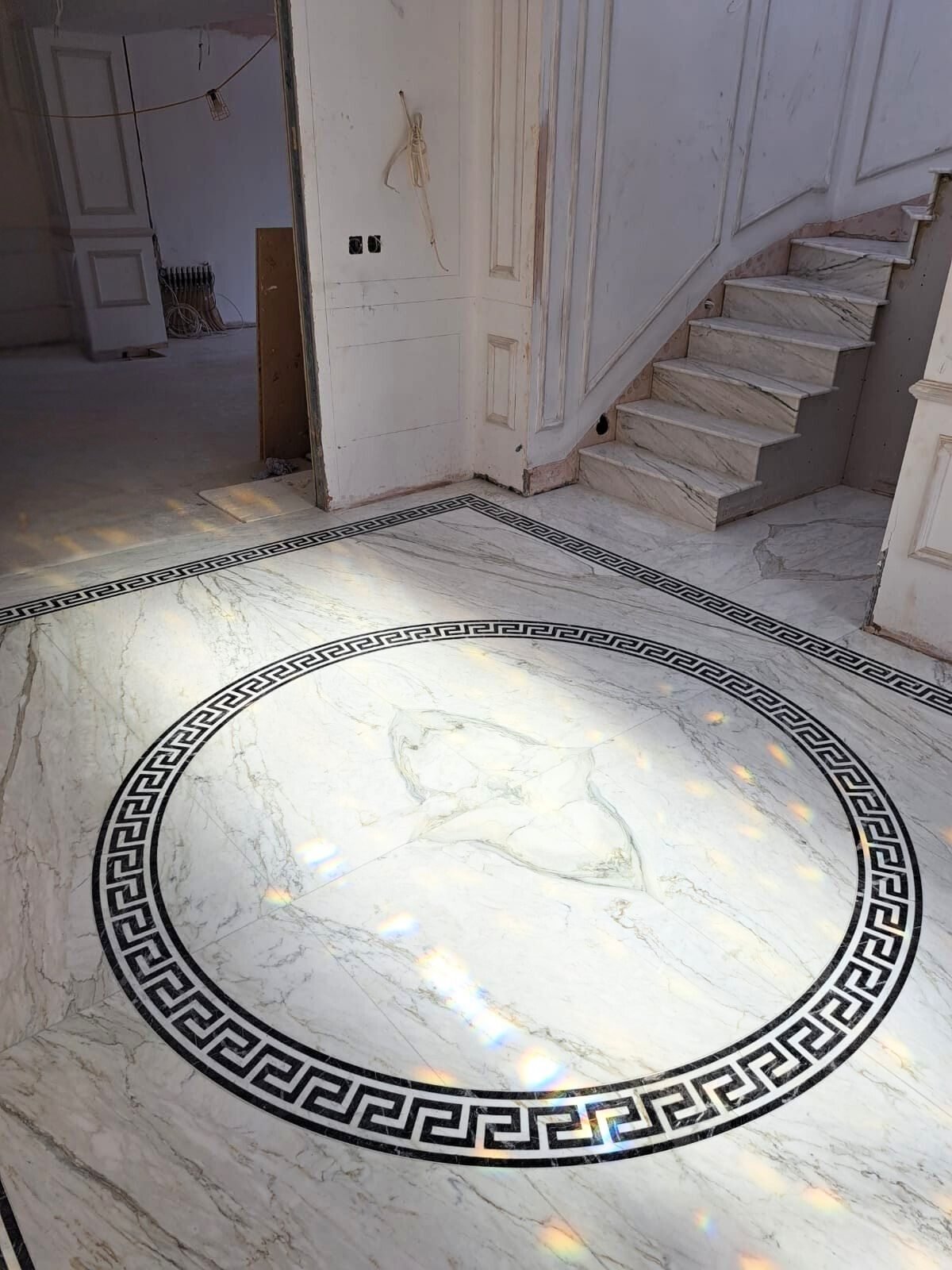
Stone has been used for stairs for as long as there have been grand buildings, and for a good reason: it is dense, it does not move, and it looks as if it was always part of the house. A staircase in one stone, from the entrance floor to the landing, reads as a single object. At Moscow Private Residence, for example, the monumental staircase was made in the same marble as the flooring, and that continuity is what makes the hall look composed and not assembled.
There are costs, and they are practical. Marble is heavy, and a stair carries the weight of the stone as well as the people on it. It can be slippery if the finish is wrong. It is a calcite stone, so acid spills etch it, although a stair sees fewer of those than a worktop. And a staircase is built once: if a step is chipped or cut wrong, it cannot be altered as easily as a painted wall. None of this rules marble out. It means that the stair should be planned with the installer from the start, not added at the end.
Choosing the stone for a staircase
The same rule applies as for a floor: choose the stone by what it will go through, and then by what it looks like. Three questions help.
Does the pattern suit a small surface? A stair is cut into narrow pieces, treads and risers, and a strong, wide vein can be chopped into fragments that no longer read as a vein. A calmer, finer pattern usually looks better on a stair than a dramatic one. If you love a dramatic stone, ask whether the treads and risers can be cut from the same slab, in sequence, so the pattern carries up the stair. This is the same idea as bookmatching on a wall, and it takes selection and planning, as we explain in our guide to how to identify quality stone.
Do you want it to match the floor? Using the same stone on the floor and the stair is the classic choice. A different stone can also work, usually a darker one for the steps so that they read as a separate object. Whichever you choose, decide early, because the floor and the stair are often cut and finished together.
How much daily wear will it see? A stair in the main hall of a family house is walked on many times a day. A stair to a guest suite is not. For the first, choose a stone and a finish that hide marks. For the second, you have more freedom. Our guide to how long marble lasts explains what to expect over the years, and our list of the most prized Italian marbles is a good place to start looking at stones.
The finish decides whether the stair is safe
A polished marble surface is slippery when wet, and a stair is the place where that matters most. This is the single most important decision on the whole project, so it is worth reading our guide to marble flooring, which explains finishes and the slip tests that exist. In short:
Polished. The finish that shows the stone at its best, and the one we would be most careful with on a stair. In a dry interior, with a rug or a runner, or on a landing, it can be fine. On steps that people use in wet shoes, or that are near an outside door, it is a risk.
Honed. Matt and calm, with more grip than polished, and it hides marks better. It is the finish we recommend as the starting point for an interior stair that sees daily use.
Brushed, sandblasted or bush-hammered. Textured finishes that give real grip. Brushed suits steps where grip matters, and is the finish to ask about for a stair that is wet or near the outside. Sandblasted and bush-hammered are rougher and belong on outdoor steps. Our stone guides make the same point: a textured finish is what we advise for steps where grip matters more than showing the veins off.
One honest point: a textured finish changes the colour and mutes the pattern, so a stair in brushed stone will not look like the polished swatch. Ask to see the stone in the finish you will use, and look at it in the light of the room where it will be installed. Slip ratings and the dimensions of the stair are set by the rules where the building stands, and the installer or the engineer must confirm them. We do not quote them here.
Treat the nosing as a separate decision
The front edge of a step, the nosing, is the part people look at and the part that wears first. It can be left square, rounded softly or given a more detailed profile, and the choice changes the look of the whole stair: a fine, square edge looks architectural, a soft round looks gentler and is kinder to a chipped corner. Decide this with the drawing in front of you, and ask to see a sample of the edge, not only of the face of the stone.
Straight, curved or sculptural
The shape of the stair changes how much it costs, how long it takes and how many people have to agree on the drawing.
A straight stair is the simplest to make and to fix, and it gives the clearest view of the stone. It is the right answer for most houses, and a good one for showing a pattern.
A curved stair asks more of the stone. Each tread has a different shape, and the veins have to be planned so they do not look cut at random. As we say in our guide to bespoke marble, a curved or turning stair also affects how the stone reaches the site, because heavy pieces have to pass doors, lifts and stair turns before they are installed. Confirm these with the installer before the first cut, not after.
A sculptural stair, in which the stone itself becomes the main feature of the room, is a project in its own right. We have made them, for instance in Dubai at Iconic Villa, and they are always planned with the architect, the engineer and the lighting designer from the first sketch.
The balustrade, the wall and the light
The stone is only part of what you see. Three things around it change the result.
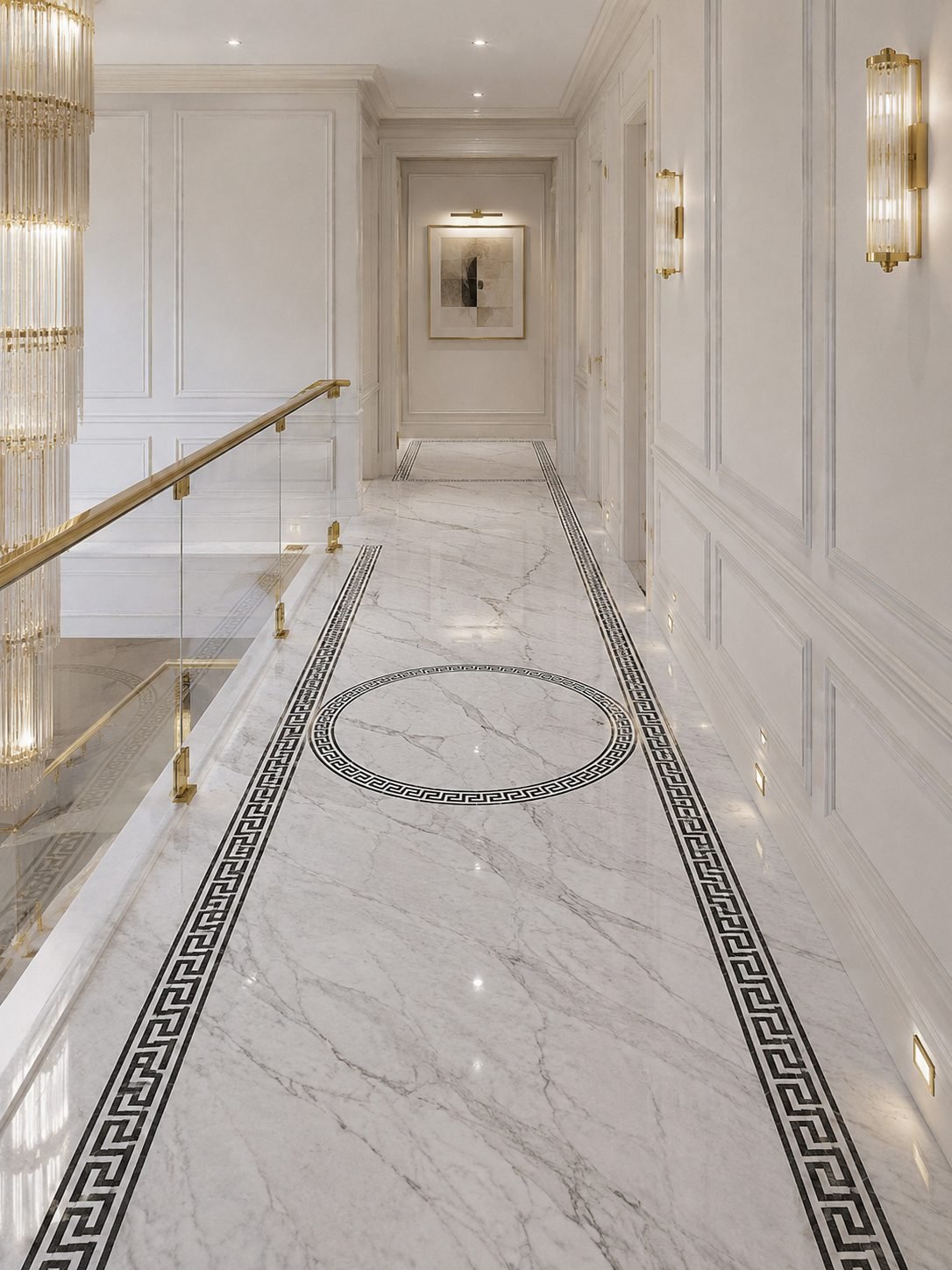
The balustrade. Stone, glass, metal and timber all work, and the choice sets the character. In the landing above, a clear glass balustrade with a brass handrail leaves the stone floor and the steps in full view. A solid stone balustrade is heavier and more monumental. Our guide to marble and metal explains how to match the tone and the finish of the metal to the stone.
The wall beside the stair. A stair wall is touched all the time, because people hold it, brush past it and lean against it. If you clad it in stone, a textured finish is a better choice than a mirror polish. Our guide to marble wall cladding covers the options.
The light. People need to see the edge of every step. Small wall lights, lights set into the wall at a low level or a light under the nosing make a stair safer and show the stone at night. Plan the cables before the stone is fixed, because cutting a channel afterwards is a much bigger job.
What to settle with the installer before anything is cut
A stair is a structural element, and the stone adds to its load. These are the points we ask clients to settle first.
The structure. Whoever is responsible for the structure should confirm that it can carry the stone, and what the stone has to be fixed to. This is a calculation for the engineer on the project, and we do not give weights or loads here.
The access. Heavy pieces have to reach the stair. Check the doors, the lift, the stair turns and the route from the street before the pieces are cut, not after. It is the most common reason for delay on a stair.
The drawing. Give us the measured drawing or a survey of the stair. Stairs are rarely perfectly regular, and the stone is cut to the actual opening, not the one on the original plan.
The order. The floor, the stair, the wall and the balustrade depend on each other. Agree who fixes what, in what order, so that nothing is cut or fixed twice.
The local rules. The dimensions of a stair, the grip of the surface and the height of a balustrade are set by the building rules where you are. The installer or the architect will know them.
Caring for a marble staircase
A stair is easier to look after than a worktop and harder than a wall. Seal the stone at installation, and reseal it as the stone needs: floors are usually resealed every two to three years, and a busy stair is closer to a floor than to a wall. Clean with a pH-neutral stone product and a soft cloth. Avoid vinegar, lemon, bleach, limescale removers and abrasive creams, and wipe wet shoes and spills quickly. Grit is the real enemy of a stair, because it scratches polished stone underfoot, so a mat at the door and regular sweeping do more than any treatment. The front edge of each step is the part that wears first, so check it from time to time and ask a stone restorer to look at it if it chips.
What a marble staircase costs
There is no fixed price, and we would rather say so than give a number that means nothing without your drawing. Four things set the cost: the stone and the quality of the blocks, the shape of the stair, the amount of cutting, finishing and fitting, and the structural work and access that the site needs. A curved or sculptural stair costs more than a straight one, a textured finish costs more than a honed one, and a stair in a stone with a strong pattern that you want matched across the treads costs more than one in a calm stone cut in any order. We quote each project once we have the drawing, the stone and the finish.
When marble is the wrong choice for a stair
Marble is not the right answer for every stair. It is a poor choice where the structure cannot take the extra load and cannot be reinforced, where the stair is outside and wet and you want a polished look, and where the household would be unhappy about a surface that can chip at the edge or etch from a spill. It is also not the one to choose if you want to change the stair in five years. If any of these apply, a stone cladding on part of the stair, such as a landing or a single step, gives you the material without the whole commitment.
Marble stairs with Purapietra
We treat stone as a building material, not a skin. Every piece is roughed on CNC for accuracy and finished by hand, which is where an edge stops looking machined. For a stair, we plan the pattern across the steps, the finish, the edge and the route of every piece before the first cut. You can see staircases in our projects, among them Moscow Private Residence, Private Villa Milan and Al J House, and our page on bespoke marble explains how we work on a custom piece.
If you are still choosing a stone, the materials catalogue shows the range, and our guide to marble interiors covers how to build a room around it. Send us the drawing, a sketch or a photo of the stair, and we will tell you what the stone can do there and roughly what it will cost.
Frequently asked questions about marble stairs
Is marble a good material for stairs?
Yes, with the right finish and a plan for the structure. Marble is dense and durable and gives a continuous, composed look. It is heavy, and it can be slippery if polished, so the finish and the structure need to be settled with the installer first.
Are marble stairs slippery?
Polished marble is slippery when wet. Honed and brushed finishes give more grip, and sandblasted and bush-hammered finishes give the most, which is why they are used on outdoor steps. Ask to see the finish you will use and confirm the grip requirement for your building with the installer.
Which finish is best for marble stairs?
For an interior stair used every day, we recommend honed as a starting point, and brushed where grip matters most, such as a stair near the outside. Polished is best kept for landings and dry stairs where the risk is low.
Can a marble staircase be curved?
Yes. Each tread has a different shape, the veins have to be planned across the stair, and the heavy pieces have to reach the site, so a curved stair needs more planning of the route and the fixing than a straight one.
Should the stair match the floor?
The classic choice is to use the same stone on the floor and the stair, so the hall reads as one composition. A darker stone for the steps is also possible. Decide early, because the floor and the stair are often cut and finished together.
How do I care for marble stairs?
Seal the stone at installation and reseal it as it needs, clean with a pH-neutral stone product, avoid acids and abrasives, and keep grit off the steps with a mat and regular sweeping. Check the front edges from time to time.
How much does a marble staircase cost?
There is no fixed price. It depends on the stone, the shape of the stair, the cutting and finishing, and the structural work and access on site. We quote each project once we have the drawing, the stone and the finish.