
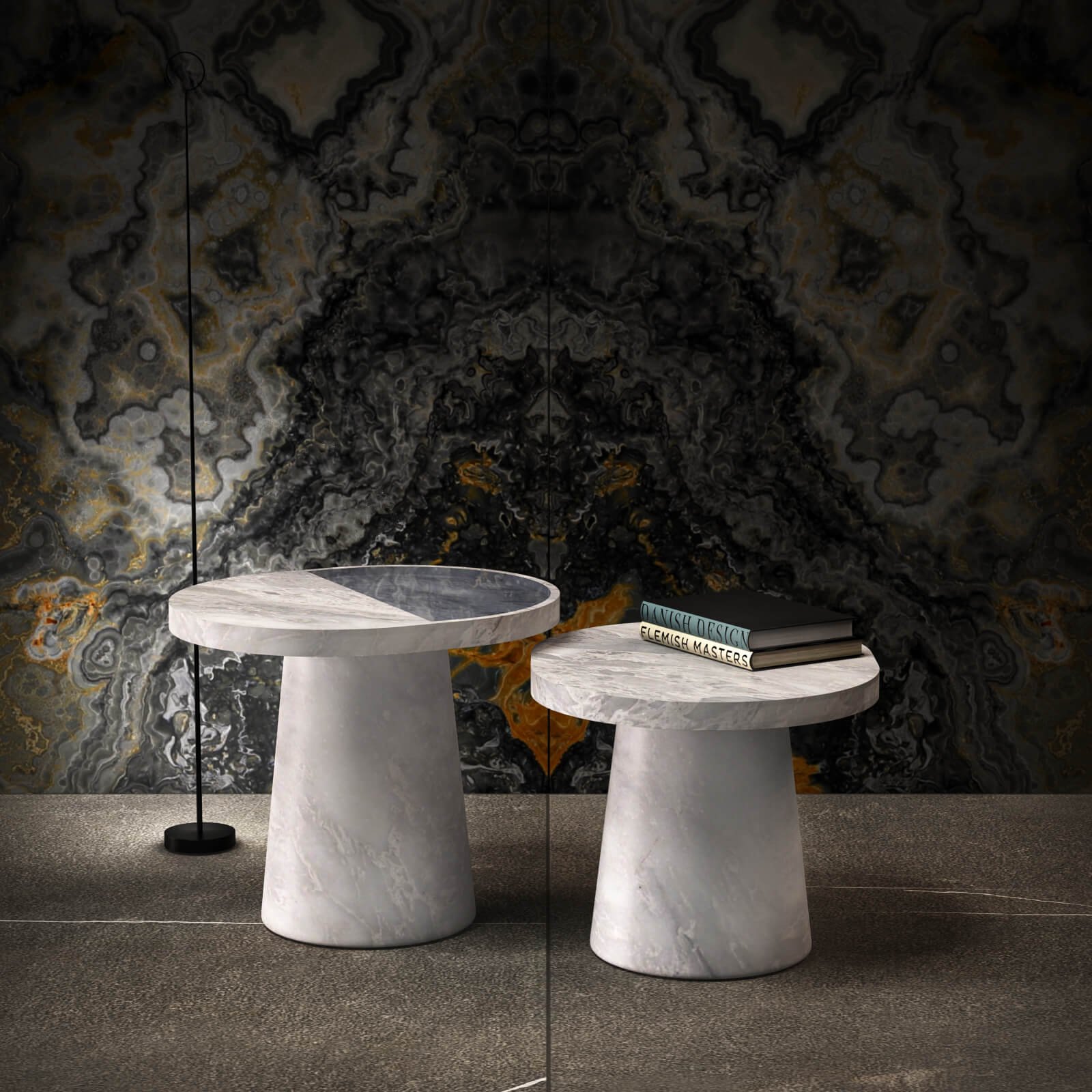
From Nero Marquina to Portoro, from the uniform blacks of the North to those crossed by veins of light: where black marble comes from, what sets each variety apart, and why it makes every space more intense.
If white marble holds the light, black marble swallows it and then gives it back in small flashes — along a vein, on the edge of a polished surface. It is a stone that does not whisper: it declares. It enters a room and shifts its centre of gravity, makes everything around it look precious, turns a countertop or a wall into something closer to a jewel than to a building material.
And yet, as with the whites, there is a whole world hidden behind the words “black marble”. There is the absolute, compact black that seems to absorb everything; and there is the black streaked with white lightning or threads of gold, telling a different story depending on how the light strikes it. It is worth looking at them closely.
Where the black begins
Black marble, too, starts from limestone, the same marine sediment that gives rise to the whites. The difference is made by what stays trapped in the stone as it forms. On the seabed, alongside the remains of organisms, organic substances settle as well: hydrocarbons, traces of carbon, bitumen. When the marble forms through metamorphism, those carbonaceous impurities remain inside the rock and tint it dark.
It is a fascinating paradox: white is born from purity, black from what the stone gathered and kept over time. Nero Marquina, for instance, is classed as a bituminous limestone precisely because it owes its colour to the bitumen and carbon laid down in the sediment. Its intensity is the memory of an ancient sea.
Why marble is black
The colour depends on the type and amount of impurities. Where carbonaceous substances are present — graphite, coal, bitumen — the background shifts toward grey, bluish, all the way to full black. Curiously, some black marbles are chemically very pure: Belgian black, for example, is made almost entirely of calcium carbonate, and owes its deep colour to an ancient impregnation of fossil hydrocarbons.
The white or golden veins, when they appear, are the counterpoint: crystallised calcite drawing bright flashes, or oxidations that light up threads of gold and silver. It is the dialogue between the dark background and these marks of light that turns every slab of black marble into a small spectacle, always different.
The great families of black marble
Blacks are not all alike. The origin changes, the drawing of the veins changes, the way they catch the light changes.
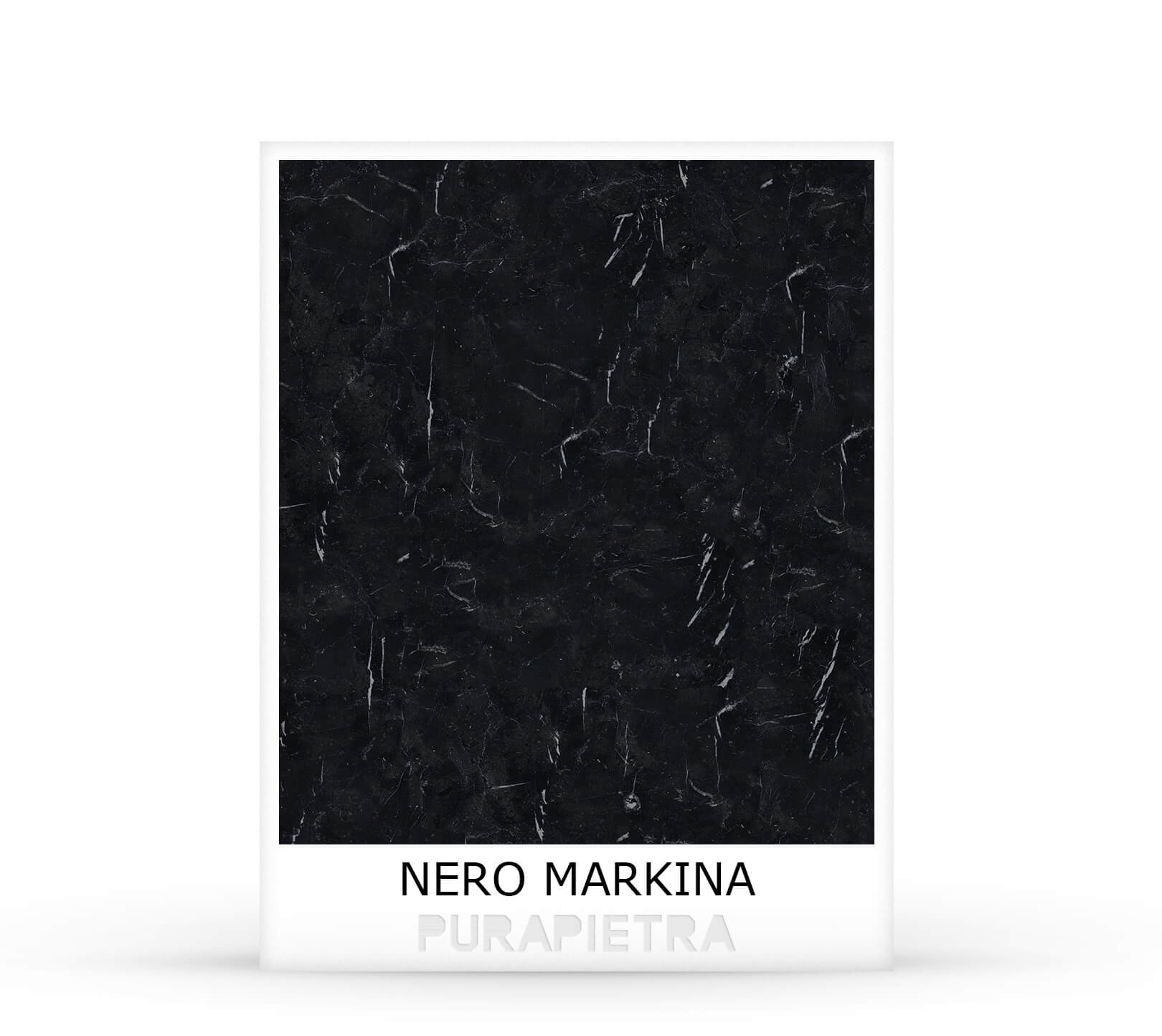
Nero Marquina
It is the best known black marble. It comes from northern Spain, from the area of Markina, near Bilbao. It has an intense, fine-grained black background, crossed by white or pale grey veins with an irregular pattern, often dotted with fossil inclusions. Polishing heightens the contrast, but its dense grain suits many different finishes. If you want to see how dark stone enters everyday objects, the Purapietra Nero collection starts right here.
Nero Portoro
If there is a king among black marbles, it is Portoro. Quarried in the area of Portovenere, in Liguria, it has a deep black background traced by golden and silvery veins, born from the oxidation of the organic substances that coloured the stone. For centuries it has adorned churches, villas and prestigious homes: it is the black that dresses in gold, and that is why it remains one of the most sought-after marbles of all.

The deep blacks: Belgium and France
Then there is the family of uniform blacks, the ones almost without veining, where the colour is everything. Belgian black and Nero di Francia belong to this group: a compact, very dark background, a surface that polished looks like a dark mirror and honed turns velvety and absorbing. They are the blacks of restraint, chosen when you want a strong but quiet presence.
The theatre of the veins
When black meets white, the spectacle changes completely. The veins are no longer a detail but become the subject, like lightning frozen in stone.
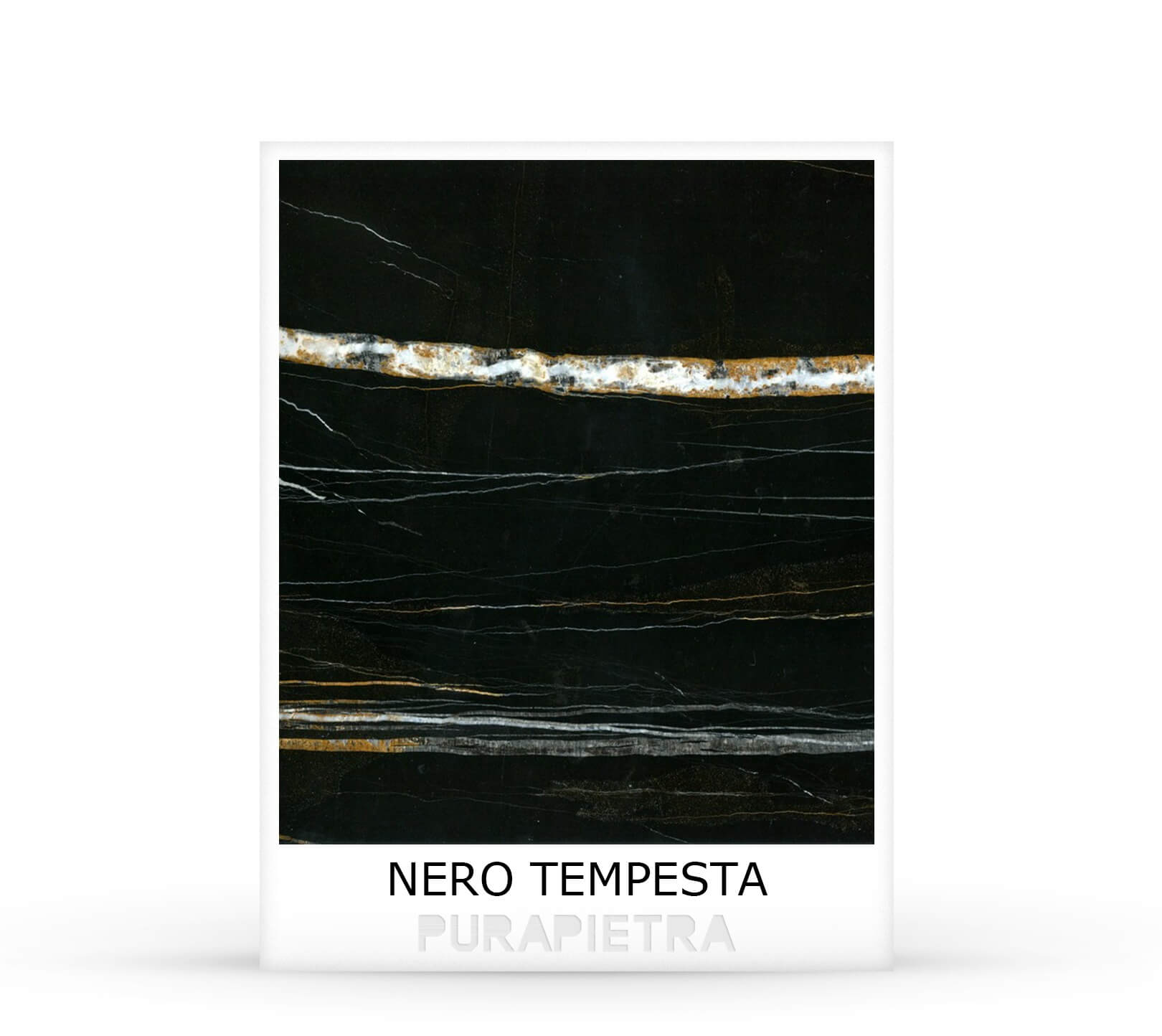
Marbles like Nero Tempesta play everything on contrast: the white bursts across the black in a broad, dramatic movement, and every slab becomes a unique drawing. It is a black that does not hide, perfect for the large surfaces where the veins have room to tell their story. At the opposite extreme are the blacks with golden veins, such as Portoro or the Tunisian Sahara Noir, where the warm light of gold runs in place of the white.
The character of the stone
Black marble has a precise personality, made of great presence and a little extra care.

Porosity. Even though it looks compact and impenetrable, marble is porous. Without a good protective treatment it can grow dull and lose its shine, and on black the loss of brilliance shows more than elsewhere.
Sensitivity to acids. Like every marble it is calcium carbonate, so it reacts to acidic substances. A drop of lemon or vinegar can leave a dull mark, especially visible on a dark background.
Light matters. The same slab changes face with the finish: polished, it becomes deep and reflective; honed, soft and quiet. On black, marks and fingerprints show more — the small price of its intensity.
When stone becomes an object
Black marble has always dressed the most important spaces: floors, fireplaces, inlays, architectural details that called for a touch of solemnity. Today it also enters everyday life in more intimate forms. It becomes a top that acts as a stage for light, as in Linear, where the dark stone turns into a single essential gesture.
It becomes vases with a bold character, or trays worked in thin sections, where black plays with reflections. In these objects marble stops being mere material and becomes presence, able to give depth to any space.
Living with black marble
Black asks for a little more care than white, mostly because it shows more. But the rule stays simple: protect it from acids and clean it gently.
Every day. A microfibre cloth and a neutral cleaner made for marble. Never harsh detergents, bleach or abrasive powders: they would ruin the shine.
What to avoid. Vinegar, lemon and acidic products in general. On kitchen surfaces it is best to wipe away every splash right away, before it leaves a mark.
Protection. A sealing treatment applied from time to time reduces porosity and keeps the black full and deep. And if the surface loses its brilliance over the years, re-polishing brings it back as good as new.
Questions that come up often
Which black marble is the most prized?
Nero Portoro is considered the most precious, thanks to its golden veins and its decorative history. Nero Marquina is the most widespread and recognisable, with its white veining.
Why is marble black?
Because of carbonaceous substances — carbon, bitumen, fossil hydrocarbons — trapped in the stone as it formed. The more there are, the darker the background.
Does black marble stain or dull easily?
It is porous and sensitive to acids, and on a dark background any dullness shows more. With good sealing and careful cleaning, though, it stays beautiful for a long time.
Is black marble suitable for a kitchen countertop?
Yes, and it is striking, provided you accept its nature: it needs to be protected, wiped clean of acids and treated with care. In return it offers a presence few materials can match.
A stone that holds the gaze
“Black marble” is a single phrase for many souls: the uniform intensity of the Belgian blacks, the white lightning of Marquina and Tempesta, the gold of Portoro. Understanding where its colour comes from and how it behaves over time helps you choose it well and care for it. It is an ancient, dramatic stone, able to give depth to every space it enters. If you would like to keep reading, you will find more stories of material and craftsmanship in the Purapietra magazine.
Black is one register in a much wider language. Read how the whites behave in white marble and Carrara vs Statuario, how the middle tones sit in grey marble and beige marble, and why blue marble is the hardest colour to find. For the full overview, start from types of marble.