
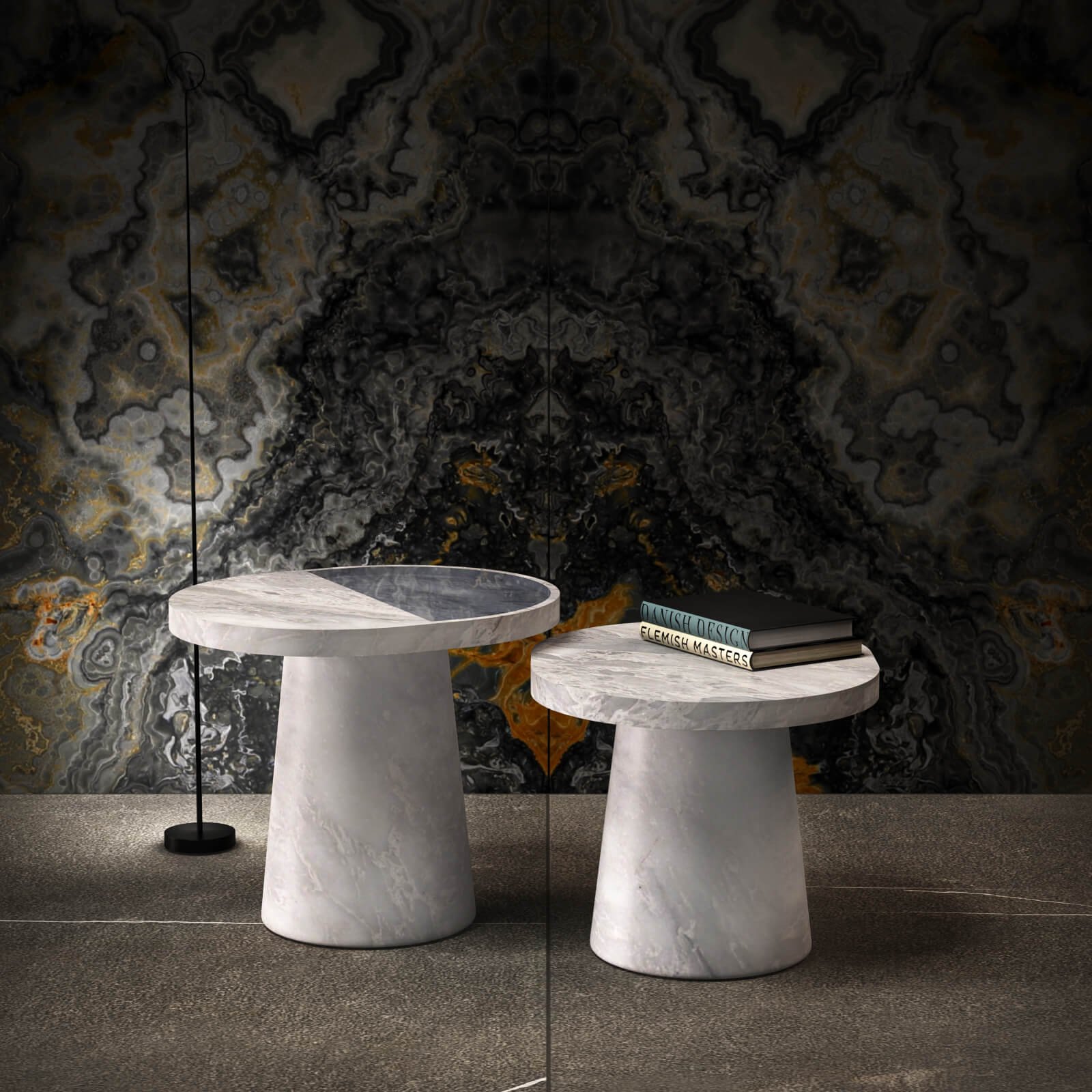
Breccia Cenere is often filed under “white marble” and left there, which undersells it. It isn’t built like the other whites in the Purapietra range: instead of veins drifting through a single block, it is made of broken pieces of stone cemented back together, which gives it a pattern with no direction and no repeat. This guide covers what a breccia actually is, how Breccia Cenere differs from the Carrara-type whites next to it in the catalogue, the finishes that suit it, and where it earns its place in a home.
What a breccia actually is
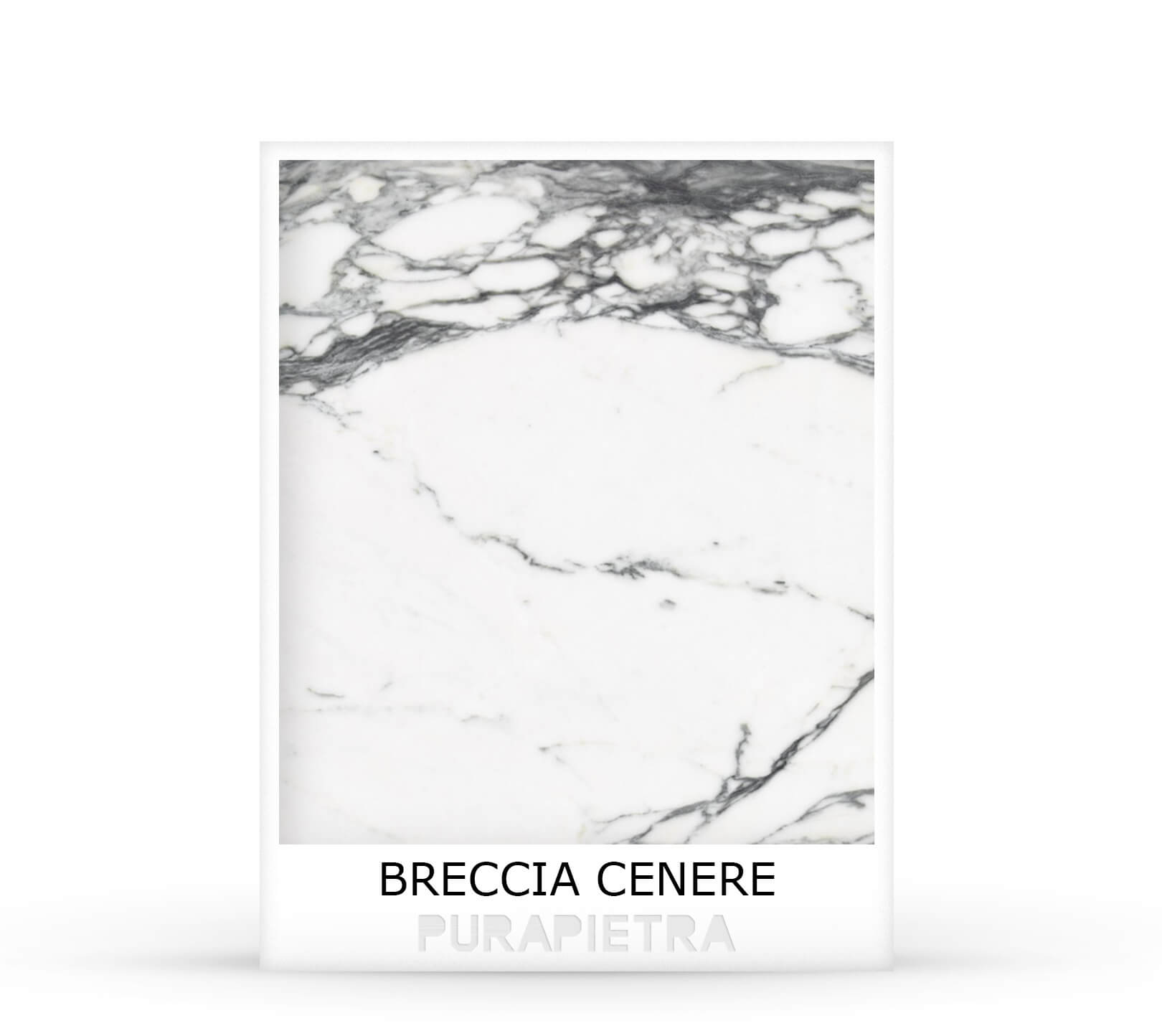
Most of the stones we write about here are marbles in the strict sense: limestone that got buried, heated and squeezed until it recrystallised into a dense, continuous block, with veining left behind by the mineral impurities that travelled through it while it cooked. A breccia is a different kind of rock entirely. The word comes from the Italian for “gap” or “breach”, and it describes a stone made of broken fragments of older rock, re-cemented by mineral-rich fluid into a new, solid mass.
That difference in formation is the whole reason Breccia Cenere looks the way it does. There is no directional flow to the pattern, because there was never a single molten or plastic mass moving through the block. Instead you get angular, irregular pieces, sometimes a few millimetres across, sometimes the size of a hand, locked into a paler binding matrix like fragments of a broken plate glued back together and then polished flat. Every panel is genuinely different from the next, in a way a veined marble rarely is.
Brecciated stones have been prized for exactly this unpredictability since antiquity. Roman builders used them for columns and floors precisely because the fragmented pattern reads as rich and complex from any angle, and the tradition never really stopped. For the wider context on how this fits within the marble family, our guide to white marble places Breccia Cenere alongside the other varieties in the Purapietra range, and Wikipedia’s entry on breccia covers the geology in more depth.
Breccia Cenere: colour, pattern and character
The name gives away the palette. “Cenere” is Italian for ash, and that is the tone running through the fragments: cool greys, from pale smoke to a deeper charcoal, set against a lighter, often near-white ground. The effect at a distance is closer to a soft marble than a bold one, because the fragments are small and evenly distributed enough that the eye blends them into a general grey-white texture. Get closer and the structure resolves into distinct pieces, each with its own edge, its own shade, its own internal texture.
This is the detail that makes Breccia Cenere useful in a way a single strong-veined marble is not: it works at two scales at once. From across a room it behaves like a quiet neutral stone. Up close, at a basin or a tabletop where people actually look at it, it rewards attention with real complexity. Few materials do both jobs.
What to check on the actual slab, not a sample chip. Fragment size and density vary meaningfully from block to block: some cuts run finer and more uniform, others carry larger, more graphic pieces with real colour contrast between them. Both are legitimate versions of the stone, but they behave very differently on a large surface, and a 10 cm sample will not show you which one you are getting.
Breccia Cenere against the other Purapietra whites
It helps to place it next to stones people already know. Against Acqua di Carrara, which is calm, directional and almost monochrome, Breccia Cenere is busier and more textural, though never as loud as a heavily figured Calacatta. Against Bianco Statuario, the difference is structural rather than just visual: Statuario is one continuous, dramatic vein through a single block, while Breccia Cenere is many small, separate pieces with no flow between them at all. Against Bianco delle Alpi, the palest and purest of the group, Breccia Cenere reads noticeably more textured and more grey.
None of this makes one better than the others. It means Breccia Cenere is the choice when a room wants a white-family stone with genuine visual movement but not the graphic drama of a big vein, and when the idea of a pattern with no obvious repeat is itself the appeal.
Finishes: how the surface changes a fragmented stone
Honed
A smooth matt surface with no reflection. On Breccia Cenere this is often the finish we recommend first, because it softens the contrast between the ash fragments and the lighter matrix, letting the pattern read as texture rather than as a collection of separate shapes. It also hides the small surface marks of daily use far better than a polish.
Polished
A high-gloss buff that deepens the greys and sharpens the edges of every fragment, so the brecciated structure reads clearly even from across a room. This is the finish to choose if the point of the material is that visual complexity and you want it on full display. It closes the surface more, which helps with staining, but it shows every fingerprint and water mark.
Brushed
Worked with abrasive brushes to a low, satin lustre with a faint texture underfoot or underhand. A practical middle ground for a surface that gets used daily, such as a kitchen island top or a hallway floor, where a small scratch or watermark needs to disappear into the material rather than stand out against a mirror finish.
The best ways to use Breccia Cenere in interiors
Bathrooms
This is where a brecciated white stone does its best work. Run it across the floor and up a shower wall and the pattern gives the room enough visual interest to need very little else: simple fittings, a plain mirror, and the stone carries the design. A basin carved from the same block turns the material from a surface into an object, which is the idea behind pieces like our Linear wall-mounted basin and the Unit freestanding basin.
Kitchens
Like every calcium-carbonate stone in this family, Breccia Cenere will etch where an acid touches it, so treat it the way you would any marble in a kitchen: as a splashback or an island front where you want the material visible, or accept that a worktop will develop a patina over time. The fragmented pattern is, in fact, more forgiving here than a clean marble, because small marks and etches tend to disappear into the existing texture instead of standing out against it.
Walls, floors and objects
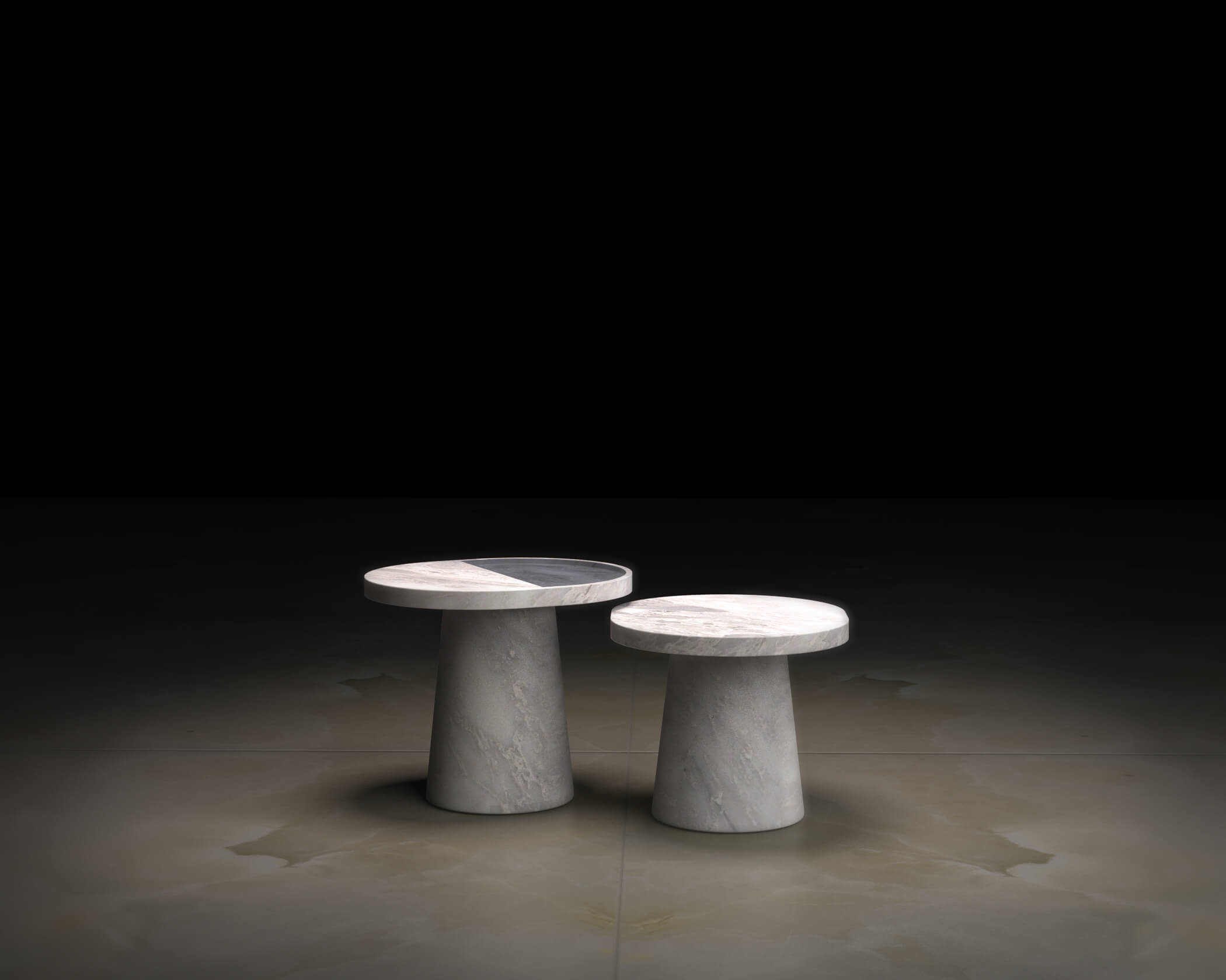
On walls and floors, larger formats read best, since bigger panels give the fragmented pattern room to sit without feeling chopped up by joints. At object scale, a round table or a set of trays or vases makes the most of the material’s close-up detail: you see the whole piece at once, fragments and all, which is exactly the distance at which Breccia Cenere is most persuasive.
Pairings that work
Because the stone already carries visual complexity, the materials around it are usually better kept quiet. Pale oak, unlacquered brass and matt black metal all let the breccia pattern do the work without competing for attention. A monochrome scheme of white walls and neutral fabrics is the classic setting, and it is classic for a reason: it lets the fragments read as the room’s one deliberate flourish. Where Breccia Cenere pairs less well is next to another highly patterned material in the same field of view, such as a busy encaustic tile or a strongly figured wood grain; two competing patterns rarely settle into the same room comfortably.
Formats, thickness and supply
Slabs are supplied in the standard large formats used across the Purapietra range, in 2 cm for cladding and lighter horizontal surfaces and 3 cm where a worktop or a threshold needs a more substantial edge. Because every panel of a breccia is genuinely unique, book-matching in the strict sense, mirroring the exact same pattern across a joint, is not really the point the way it is with a veined marble. What matters more is consistency of fragment size and tone across the panels used in one space, which is a conversation worth having with your fabricator before slabs are cut.
Maintenance and sealing
Breccia Cenere asks for the same routine as any natural stone in the marble family. Seal it on installation with a good impregnating sealer, and reseal every one to two years on surfaces that see water or heavy use. Clean with a pH-neutral stone cleaner only, never vinegar, lemon, or a generic bathroom spray, all of which will etch the surface over time. Wipe up spills, particularly anything acidic, as soon as they happen rather than later.
Etching shows up as a dull patch rather than a stain, and on a honed finish it is usually close to invisible given the stone’s existing texture. On a polished surface it is more noticeable and can often be restored with a marble polishing compound. As with any porous stone, mats at exterior doorways make a real difference over years of foot traffic.
Choosing a slab
Always look at the actual slab rather than a small sample, because fragment size, density and the contrast between the grey pieces and the lighter matrix genuinely vary between blocks. Decide early whether you want a finer, more uniform cut or a bolder one with larger, more graphic fragments, since both exist within the name Breccia Cenere and they behave differently at scale. Our guide to how to identify quality marble covers what to look for in any slab, brecciated or veined.
If you are considering Breccia Cenere for a specific room or a single carved piece, we are happy to talk it through before anything is committed. Write to info@purapietra.it, or browse the full range on our materials page.
Frequently asked questions about Breccia Cenere
What is Breccia Cenere?
Breccia Cenere is a natural stone from the white marble family, made of angular ash-grey fragments cemented into a paler matrix. Unlike a veined marble, it forms from broken pieces of older rock rather than a single continuous mass, which gives it a pattern with no direction or repeat.
What is the difference between a breccia and a marble?
A marble forms when limestone recrystallises under heat and pressure into a dense, continuous block, with veining left by mineral impurities. A breccia forms when existing rock is fractured and the fragments are re-cemented by mineral-rich fluid, producing a stone made of distinct angular pieces rather than a single flowing pattern.
Is Breccia Cenere suitable for a bathroom?
Yes, and it is one of its strongest uses. Choose a honed finish for grip and to keep the fragmented pattern reading as texture rather than sharp contrast, seal on installation, and clean only with pH-neutral products.
Can Breccia Cenere be used on a kitchen worktop?
It can, with the same caveats as any calcium-carbonate stone: it will etch where acids touch it. Its fragmented pattern tends to hide small marks better than a clean marble, but if you want a surface that never changes, use it as a splashback or island front and choose a harder material for the working top.
Does every slab of Breccia Cenere look the same?
No, and that is part of the appeal. Fragment size, density and colour contrast vary from block to block, so always view the actual slab rather than a small sample before committing to a project.
How does Breccia Cenere compare to Bianco Statuario or Acqua di Carrara?
Both of those are veined marbles with a directional pattern flowing through a single block. Breccia Cenere is structurally different: a fragmented stone with no flow, offering more close-up texture and less large-scale drama than Statuario, and more visual movement than the calmer Acqua di Carrara.
Keep exploring the Purapietra magazine. See also our guides to white marble and Acqua di Carrara, or browse the full materials collection.